radtel_rt950pro (v0.1.8)
CHIRP driver for the Radtel RT-950 Pro.
This single-file driver lets CHIRP read and write the Radtel RT-950 Pro handheld over its USB programming cable. It targets firmware with 990 channels in 10 zones of 99 channels (vendor CPS v1.2.1 and later, firmware 0.24 and later).
Memory layout (confirmed on hardware):
0x0000-0x7BBF  990 channels x 32 bytes = 10 zones x 99 channels
0x7BC0-0x7FFF  unused; kept verbatim in the image, never written to the radio
0x8000         VFO A/B/C            (0x100 bytes, 96 used)
0x9000         function settings    (0x100 bytes, 96 used)
0xA000         DTMF settings        (0x200 bytes, 384 used)
0xB000         modulation params    (0x200 bytes, 256 used)
0xC000-0xC09F  10 zone names x 16 bytes (read as 0xC000-0xC0FF)
0xD000         modulation names     (0x300 bytes)
APRS           separate space: read command 0x54, write command 0x58
Zone z, channel k (both 1-based) is 1-based slot (z - 1) * 99 + k,
i.e. RadioImage.channels[(z - 1) * 99 + k - 1] at byte address
((z - 1) * 99 + k - 1) * 32.
The vendor CPS setting Channel Divide (function byte 0x9026, measured on hardware: 0 = Zone CH Mode, 1 = All CH Mode) only changes how the radio presents these slots: in Zone CH Mode as 10 zones of 99 channels, in All CH Mode as one list of channels 1-990 in which channel n is slot n (the zones placed one after the other; empty channels stay empty and are not moved up). The channel memory is the same in both modes. The driver follows the setting: CHIRP shows ten zone tabs in Zone CH Mode and a single memory list 1-990 in All CH Mode.
The module is organised in layers, from raw bytes up to CHIRP:
- Channel records:
ToneSetting,ChannelRecordand the BCD/GB2312 codecs for the 32-byte channel structure. - Settings sections: dataclasses plus
parse_*/encode_*functions for the VFO, function, DTMF, modulation and APRS blocks. - Settings API: validated getters and setters (
get_*/set_*). - Image:
RadioImage, the parsed form of a complete clone image. - Transport:
CloneSerialTransport, the serial clone protocol (PROGRAMBT9000Uhandshake and XOR-obfuscated 0x80-byte blocks). - CHIRP integration:
RT950ProRadioand oneRT950ProZoneRadiosub-device per zone.
Unedited channel records, VFO entries and settings blocks are written back
byte-identical. Settings encoders work read-modify-write on the stored
bytes and only rewrite a field whose value was edited; a field byte holding
0xFF is treated as 0 before an edited field is merged into it. Settings
applied in CHIRP only touch the settings that were changed. An edited
channel record is rebuilt from its fields, keeping the unknown high nibbles
of bytes 12-13 (see ChannelRecord.to_bytes()).
The module needs CHIRP to work with a radio. Without CHIRP it still
imports (stand-ins for the CHIRP names, for documentation builds), but
HAVE_CHIRP is False; get_features, get_settings,
get_memory and set_memory then raise RadioError, other methods
may fail with AttributeError.
See docs/memory-map.md and docs/protocol.md in the repository for
the byte-level reference.
Warning:
Experimental. Always download from the radio and keep the
.imgas a backup before uploading.
1# Radtel RT-950 Pro driver for CHIRP 2# 3# Copyright (c) 2025 Nathan G. Barguss - 2E0NBS (original driver) 4# Copyright (c) 2026 PE1HVH (zones, zone names, 990 5# channels, APRS write, fixes) 6# 7# Version 0.1.8 (see CHANGELOG.md) 8# 9# Licensed under the MIT License; see the LICENSE file for the full text. 10# 11# EXPERIMENTAL. Use at your own risk: a driver bug can mis-program your radio. 12# Always keep a backup of your radio (CPS .dat and a CHIRP .img) before 13# writing. Tested on hardware: see README.md. 14 15"""CHIRP driver for the Radtel RT-950 Pro. 16 17This single-file driver lets CHIRP read and write the Radtel RT-950 Pro 18handheld over its USB programming cable. It targets firmware with 19990 channels in 10 zones of 99 channels (vendor CPS v1.2.1 and later, 20firmware 0.24 and later). 21 22Memory layout (confirmed on hardware): 23 24 0x0000-0x7BBF 990 channels x 32 bytes = 10 zones x 99 channels 25 0x7BC0-0x7FFF unused; kept verbatim in the image, never written to the radio 26 0x8000 VFO A/B/C (0x100 bytes, 96 used) 27 0x9000 function settings (0x100 bytes, 96 used) 28 0xA000 DTMF settings (0x200 bytes, 384 used) 29 0xB000 modulation params (0x200 bytes, 256 used) 30 0xC000-0xC09F 10 zone names x 16 bytes (read as 0xC000-0xC0FF) 31 0xD000 modulation names (0x300 bytes) 32 APRS separate space: read command 0x54, write command 0x58 33 34Zone *z*, channel *k* (both 1-based) is 1-based slot ``(z - 1) * 99 + k``, 35i.e. ``RadioImage.channels[(z - 1) * 99 + k - 1]`` at byte address 36``((z - 1) * 99 + k - 1) * 32``. 37 38The vendor CPS setting *Channel Divide* (function byte 0x9026, measured on 39hardware: 0 = *Zone CH Mode*, 1 = *All CH Mode*) only changes how the 40radio presents these slots: in Zone CH Mode as 10 zones of 99 channels, 41in All CH Mode as one list of channels 1-990 in which channel *n* is slot 42*n* (the zones placed one after the other; empty channels stay empty and 43are not moved up). The channel memory is the same in both modes. The 44driver follows the setting: CHIRP shows ten zone tabs in Zone CH Mode 45and a single memory list 1-990 in All CH Mode. 46 47The module is organised in layers, from raw bytes up to CHIRP: 48 491. Channel records: :class:`ToneSetting`, :class:`ChannelRecord` and the 50 BCD/GB2312 codecs for the 32-byte channel structure. 512. Settings sections: dataclasses plus ``parse_*``/``encode_*`` functions 52 for the VFO, function, DTMF, modulation and APRS blocks. 533. Settings API: validated getters and setters (``get_*``/``set_*``). 544. Image: :class:`RadioImage`, the parsed form of a complete clone image. 555. Transport: :class:`CloneSerialTransport`, the serial clone protocol 56 (``PROGRAMBT9000U`` handshake and XOR-obfuscated 0x80-byte blocks). 576. CHIRP integration: :class:`RT950ProRadio` and one 58 :class:`RT950ProZoneRadio` sub-device per zone. 59 60Unedited channel records, VFO entries and settings blocks are written back 61byte-identical. Settings encoders work read-modify-write on the stored 62bytes and only rewrite a field whose value was edited; a field byte holding 630xFF is treated as 0 before an edited field is merged into it. Settings 64applied in CHIRP only touch the settings that were changed. An edited 65channel record is rebuilt from its fields, keeping the unknown high nibbles 66of bytes 12-13 (see :meth:`ChannelRecord.to_bytes`). 67 68The module needs CHIRP to work with a radio. Without CHIRP it still 69imports (stand-ins for the CHIRP names, for documentation builds), but 70:data:`HAVE_CHIRP` is ``False``; ``get_features``, ``get_settings``, 71``get_memory`` and ``set_memory`` then raise ``RadioError``, other methods 72may fail with ``AttributeError``. 73 74See ``docs/memory-map.md`` and ``docs/protocol.md`` in the repository for 75the byte-level reference. 76 77Warning: 78 Experimental. Always download from the radio and keep the ``.img`` 79 as a backup before uploading. 80""" 81 82# Design-size checks are disabled module-wide on purpose: the dataclasses 83# mirror fixed radio structures field by field, and the settings builders 84# mirror the vendor CPS screens. Splitting them would hide the 1:1 mapping 85# with the memory map. The dataclasses in this module share their private 86# change-tracking state (_raw_bytes, _original_state, _state_tuple) by design. 87# pylint: disable=too-many-lines,too-many-instance-attributes 88# pylint: disable=too-few-public-methods,too-many-arguments 89# pylint: disable=too-many-positional-arguments,too-many-locals 90# pylint: disable=too-many-statements,too-many-branches,protected-access 91 92from __future__ import annotations 93 94import logging 95import random 96import time 97import unicodedata 98from dataclasses import dataclass, field 99from enum import Enum 100from pathlib import Path 101from typing import Callable, Dict, Iterable, List, Optional, Sequence, Tuple 102 103try: 104 import serial 105except ImportError: # pragma: no cover - pydoc/doc builds without pyserial 106 serial = None # pylint: disable=invalid-name 107 108__version__ = "0.1.8" 109"""Driver version (semantic versioning); equal to the latest entry in 110``CHANGELOG.md`` and to the release tag ``v<version>`` on GitHub. 111 112Shown after the module name in the heading of the documentation page 113(``docs/build.py``).""" 114 115__all__ = [ 116 # Channel records 117 "ToneMode", 118 "ToneSetting", 119 "PowerLevel", 120 "Bandwidth", 121 "Modulation", 122 "ChannelRecord", 123 # Settings sections 124 "VFOSettings", 125 "FunctionSettings", 126 "DTMFSettings", 127 "ModulationChannelEntry", 128 "ModulationSettings", 129 "APRSSettings", 130 "parse_vfo_section", 131 "parse_function_section", 132 "parse_dtmf_section", 133 "parse_modulation_sections", 134 "parse_aprs_section", 135 "encode_vfo_section", 136 "encode_function_section", 137 "encode_dtmf_section", 138 "encode_modulation_sections", 139 "encode_aprs_section", 140 # Settings API 141 "SettingsError", 142 "SettingSpec", 143 "CHANNEL_DIVIDE_ZONE", 144 "CHANNEL_DIVIDE_ALL", 145 "function_keys", 146 "get_function_value", 147 "set_function_value", 148 "aprs_keys", 149 "get_aprs_value", 150 "set_aprs_value", 151 "get_dtmf_current_id", 152 "set_dtmf_current_id", 153 "get_dtmf_ptt_mode", 154 "set_dtmf_ptt_mode", 155 "get_dtmf_code_group", 156 "set_dtmf_code_group", 157 # Image 158 "ZONE_COUNT", 159 "ZONE_SIZE", 160 "CHANNEL_COUNT", 161 "CHANNEL_SIZE", 162 "CHANNEL_SECTION_BYTES", 163 "parse_zone_names", 164 "encode_zone_names", 165 "RadioImage", 166 # Transport 167 "CloneSegment", 168 "CloneTransportError", 169 "CloneSerialConfig", 170 "CloneSerialTransport", 171 "DEFAULT_SEGMENTS", 172 # CHIRP integration 173 "MEM_FORMAT", 174 "HAVE_CHIRP", 175 "VALID_BANDS", 176 "RT950ProRadio", 177 "RT950ProZoneRadio", 178 "RT950ProDriver", 179] 180 181# =========================================================================== 182# 1. Channel records 183# =========================================================================== 184 185LOG = logging.getLogger(__name__ + ".channel") 186"""Module logger. 187 188Note: ``LOG`` is rebound to ``logging.getLogger(__name__)`` in section 6. 189Functions look ``LOG`` up at call time, so code that uses ``LOG`` directly 190logs through that final driver logger. Code that takes a ``logger`` 191argument uses the logger passed in (``RadioImage`` defaults to 192``CHANNEL_LOG``, the transport to ``__name__ + ".transport"``). 193""" 194 195_DCS_CODES = [ 196 "D023N", 197 "D025N", 198 "D026N", 199 "D031N", 200 "D032N", 201 "D036N", 202 "D043N", 203 "D047N", 204 "D051N", 205 "D053N", 206 "D054N", 207 "D065N", 208 "D071N", 209 "D072N", 210 "D073N", 211 "D074N", 212 "D114N", 213 "D115N", 214 "D116N", 215 "D122N", 216 "D125N", 217 "D131N", 218 "D132N", 219 "D134N", 220 "D143N", 221 "D145N", 222 "D152N", 223 "D155N", 224 "D156N", 225 "D162N", 226 "D165N", 227 "D172N", 228 "D174N", 229 "D205N", 230 "D212N", 231 "D223N", 232 "D225N", 233 "D226N", 234 "D243N", 235 "D244N", 236 "D245N", 237 "D246N", 238 "D251N", 239 "D252N", 240 "D255N", 241 "D261N", 242 "D263N", 243 "D265N", 244 "D266N", 245 "D271N", 246 "D274N", 247 "D306N", 248 "D311N", 249 "D315N", 250 "D325N", 251 "D331N", 252 "D332N", 253 "D343N", 254 "D346N", 255 "D351N", 256 "D356N", 257 "D364N", 258 "D365N", 259 "D371N", 260 "D411N", 261 "D412N", 262 "D413N", 263 "D423N", 264 "D431N", 265 "D432N", 266 "D445N", 267 "D446N", 268 "D452N", 269 "D454N", 270 "D455N", 271 "D462N", 272 "D464N", 273 "D465N", 274 "D466N", 275 "D503N", 276 "D506N", 277 "D516N", 278 "D523N", 279 "D526N", 280 "D532N", 281 "D546N", 282 "D565N", 283 "D606N", 284 "D612N", 285 "D624N", 286 "D627N", 287 "D631N", 288 "D632N", 289 "D645N", 290 "D654N", 291 "D662N", 292 "D664N", 293 "D703N", 294 "D712N", 295 "D723N", 296 "D731N", 297 "D732N", 298 "D734N", 299 "D743N", 300 "D754N", 301 "D023I", 302 "D025I", 303 "D026I", 304 "D031I", 305 "D032I", 306 "D036I", 307 "D043I", 308 "D047I", 309 "D051I", 310 "D053I", 311 "D054I", 312 "D065I", 313 "D071I", 314 "D072I", 315 "D073I", 316 "D074I", 317 "D114I", 318 "D115I", 319 "D116I", 320 "D122I", 321 "D125I", 322 "D131I", 323 "D132I", 324 "D134I", 325 "D143I", 326 "D145I", 327 "D152I", 328 "D155I", 329 "D156I", 330 "D162I", 331 "D165I", 332 "D172I", 333 "D174I", 334 "D205I", 335 "D212I", 336 "D223I", 337 "D225I", 338 "D226I", 339 "D243I", 340 "D244I", 341 "D245I", 342 "D246I", 343 "D251I", 344 "D252I", 345 "D255I", 346 "D261I", 347 "D263I", 348 "D265I", 349 "D266I", 350 "D271I", 351 "D274I", 352 "D306I", 353 "D311I", 354 "D315I", 355 "D325I", 356 "D331I", 357 "D332I", 358 "D343I", 359 "D346I", 360 "D351I", 361 "D356I", 362 "D364I", 363 "D365I", 364 "D371I", 365 "D411I", 366 "D412I", 367 "D413I", 368 "D423I", 369 "D431I", 370 "D432I", 371 "D445I", 372 "D446I", 373 "D452I", 374 "D454I", 375 "D455I", 376 "D462I", 377 "D464I", 378 "D465I", 379 "D466I", 380 "D503I", 381 "D506I", 382 "D516I", 383 "D523I", 384 "D526I", 385 "D532I", 386 "D546I", 387 "D565I", 388 "D606I", 389 "D612I", 390 "D624I", 391 "D627I", 392 "D631I", 393 "D632I", 394 "D645I", 395 "D654I", 396 "D662I", 397 "D664I", 398 "D703I", 399 "D712I", 400 "D723I", 401 "D731I", 402 "D732I", 403 "D734I", 404 "D743I", 405 "D754I", 406] 407"""DCS codes in radio order. 408 409A tone field with second byte 0x00 stores a DCS code as a 1-based index 410into this list: indexes 1-105 are normal polarity (``N``) and 106-210 are 411inverted (``I``). 412""" 413 414 415class ToneMode(Enum): 416 """Kind of sub-audio tone used by a channel for transmit or receive.""" 417 418 OFF = "off" 419 """No tone; carrier squelch.""" 420 CTCSS = "ctcss" 421 """Analog sub-audio tone (``ctcss_hz``).""" 422 DCS = "dcs" 423 """Digital coded squelch (``dcs_code`` and ``dcs_polarity``).""" 424 425 426@dataclass(slots=True) 427class ToneSetting: 428 """Transmit or receive tone of one channel or VFO. 429 430 The radio stores a tone in two bytes: 431 432 * ``00 00`` (or ``FF FF``): no tone. 433 * ``nn 00``: DCS, ``nn`` is a 1-based index into ``_DCS_CODES``. 434 * otherwise: CTCSS in tenths of a hertz, little-endian. 435 436 An instance remembers the bytes it was decoded from. As long as the 437 tone is not changed, :meth:`to_bytes` returns those original bytes, so 438 unknown encodings survive a read/write cycle unchanged. 439 """ 440 441 mode: ToneMode 442 """Tone kind.""" 443 ctcss_hz: Optional[float] = None 444 """CTCSS frequency in Hz when ``mode`` is CTCSS.""" 445 dcs_code: Optional[int] = None 446 """DCS code as an octal-looking integer (e.g. ``23`` for D023) when 447 ``mode`` is DCS. 448 """ 449 dcs_polarity: Optional[str] = None 450 """``"N"`` (normal) or ``"I"`` (inverted) for DCS.""" 451 _raw_bytes: bytes = field(default=b"", repr=False, compare=False) 452 """The two bytes this tone was decoded from (empty for a new tone). 453 Returned unchanged by :meth:`to_bytes` while the tone is not edited. 454 """ 455 _original_state: Optional[tuple] = field( 456 default=None, repr=False, compare=False) 457 """``(mode, ctcss_hz, dcs_code, dcs_polarity)`` when the tone was 458 created or last encoded; compared with the current state to detect an 459 edit. 460 """ 461 462 def __post_init__(self) -> None: 463 """Snapshot the initial state for change tracking.""" 464 if self._original_state is None: 465 object.__setattr__(self, "_original_state", self._state_tuple()) 466 467 def _state_tuple(self) -> tuple: 468 """Return the user-visible fields as a tuple for change detection. 469 470 Returns: 471 tuple: ``(mode, ctcss_hz, dcs_code, dcs_polarity)``. 472 """ 473 return ( 474 self.mode, 475 self.ctcss_hz, 476 self.dcs_code, 477 self.dcs_polarity, 478 ) 479 480 @property 481 def is_off(self) -> bool: 482 """Whether no tone is set (``mode`` is OFF).""" 483 return self.mode is ToneMode.OFF 484 485 @classmethod 486 def off(cls) -> "ToneSetting": 487 """Create a tone setting without a tone. 488 489 Returns: 490 ToneSetting: A setting with ``mode`` OFF. 491 """ 492 return cls(ToneMode.OFF) 493 494 @classmethod 495 def ctcss(cls, hz: float) -> "ToneSetting": 496 """Create a CTCSS tone setting. 497 498 Args: 499 hz: CTCSS frequency in hertz, e.g. ``88.5``. 500 501 Returns: 502 ToneSetting: A setting with ``mode`` CTCSS. 503 """ 504 return cls(ToneMode.CTCSS, ctcss_hz=hz) 505 506 @classmethod 507 def dcs(cls, code: int, polarity: str) -> "ToneSetting": 508 """Create a DCS tone setting. 509 510 Args: 511 code: DCS code as written, e.g. ``23`` for D023. 512 polarity: ``"N"`` or ``"I"`` (case-insensitive). 513 514 Returns: 515 ToneSetting: A setting with ``mode`` DCS. 516 """ 517 return cls(ToneMode.DCS, dcs_code=code, dcs_polarity=polarity.upper()) 518 519 def to_display(self) -> str: 520 """Format the tone the way the CPS shows it. 521 522 Returns: 523 str: ``"OFF"``, a CTCSS value such as ``"88.5"`` or a DCS code 524 such as ``"D023N"``. 525 """ 526 if self.mode is ToneMode.OFF: 527 return "OFF" 528 if self.mode is ToneMode.CTCSS and self.ctcss_hz is not None: 529 return f"{self.ctcss_hz:.1f}" 530 if (self.mode is ToneMode.DCS and self.dcs_code is not None 531 and self.dcs_polarity): 532 return f"D{self.dcs_code:03}{self.dcs_polarity.upper()}" 533 return "OFF" 534 535 def to_bytes(self) -> bytes: 536 """Encode the tone into the radio's two-byte format. 537 538 Unchanged tones return the bytes they were decoded from. A DCS or 539 CTCSS tone without a code, polarity or frequency encodes as ``00 00`` 540 (no tone). After encoding, the new bytes become the reference for 541 the next change check. 542 543 Returns: 544 bytes: Two bytes as stored in a channel or VFO record. 545 546 Raises: 547 ValueError: If the DCS code is not in ``_DCS_CODES`` or the 548 CTCSS value is not within 0.1-6553.5 Hz. 549 """ 550 current_state = self._state_tuple() 551 if ( 552 self._original_state is not None 553 and current_state == self._original_state 554 and self._raw_bytes 555 ): 556 return self._raw_bytes 557 558 if self.mode is ToneMode.OFF: 559 result = b"\x00\x00" 560 elif self.mode is ToneMode.DCS and self.dcs_code is not None and self.dcs_polarity: 561 token = f"D{self.dcs_code:03}{self.dcs_polarity.upper()}" 562 try: 563 index = _DCS_CODES.index(token) 564 except ValueError as exc: 565 raise ValueError(f"Unsupported DCS code {token}") from exc 566 result = bytes((index + 1, 0x00)) 567 elif self.mode is ToneMode.CTCSS and self.ctcss_hz is not None: 568 value = int(round(self.ctcss_hz * 10)) 569 if value <= 0 or value > 0xFFFF: 570 raise ValueError(f"CTCSS value out of range: {self.ctcss_hz}") 571 result = bytes((value & 0xFF, (value >> 8) & 0xFF)) 572 else: 573 result = b"\x00\x00" 574 575 object.__setattr__(self, "_raw_bytes", result) 576 object.__setattr__(self, "_original_state", current_state) 577 return result 578 579 @staticmethod 580 def from_bytes(raw: bytes) -> "ToneSetting": 581 """Decode a two-byte tone field. 582 583 Unknown DCS indexes are logged and decoded as OFF; the original bytes 584 are kept, so they are written back unchanged unless the tone is edited. 585 586 Args: 587 raw: The two tone bytes from a channel or VFO record. 588 589 Returns: 590 ToneSetting: The decoded tone, remembering ``raw``. 591 592 Raises: 593 ValueError: If ``raw`` is not exactly two bytes long. 594 """ 595 if len(raw) != 2: 596 raise ValueError("Tone bytes must be length 2") 597 first, second = raw 598 if first == 0 and second == 0: 599 setting = ToneSetting.off() 600 elif second == 0: 601 index = first 602 if 1 <= index <= len(_DCS_CODES): 603 token = _DCS_CODES[index - 1] 604 code = int(token[1:4]) 605 polarity = token[4] 606 setting = ToneSetting.dcs(code, polarity) 607 else: 608 LOG.warning("Unknown DCS index %s", index) 609 setting = ToneSetting.off() 610 else: 611 value = (second << 8) | first 612 if value == 0xFFFF: 613 setting = ToneSetting.off() 614 else: 615 hz = value / 10.0 616 setting = ToneSetting.ctcss(hz) 617 618 object.__setattr__(setting, "_raw_bytes", bytes(raw)) 619 object.__setattr__(setting, "_original_state", setting._state_tuple()) 620 return setting 621 622class PowerLevel(Enum): 623 """Transmit power as stored in the low nibble of channel byte 14.""" 624 625 HIGH = 0 626 """High power (stored value 0).""" 627 MEDIUM = 1 628 """Medium power (stored value 1).""" 629 LOW = 2 630 """Low power (stored value 2).""" 631 632class Bandwidth(Enum): 633 """FM channel bandwidth (bit 6 of the channel flags byte). 634 635 Note: 636 The enum values do not equal the stored bit; the codecs translate. 637 """ 638 639 NARROW = 0 640 """Narrow FM, 12.5 kHz; stored as bit 6 = 1.""" 641 WIDE = 1 642 """Wide FM, 25 kHz; stored as bit 6 = 0.""" 643 644class Modulation(Enum): 645 """Receive modulation (bit 0 of the channel flags byte).""" 646 647 FM = 0 648 """Frequency modulation; stored as bit 0 = 0.""" 649 AM = 1 650 """Amplitude modulation, e.g. airband; stored as bit 0 = 1.""" 651 652@dataclass(slots=True) 653class ChannelRecord: 654 """One 32-byte memory channel. 655 656 Byte layout: 657 658 0-3 RX frequency, packed BCD, 10 Hz units, little-endian 659 4-7 TX frequency, same format 660 8-9 RX tone (see ToneSetting) 661 10-11 TX tone 662 12 signalling group (low nibble); high nibble unknown, kept 663 13 PTT ID (low nibble); high nibble unknown, kept 664 14 scrambler (high nibble) | power (low nibble) 665 15 flags: b7 learn FHSS, b6 narrow, b5-4 encryption, 666 b3 busy lockout, b2 scan add, b1 TX enabled, b0 AM 667 16-19 FHSS code (byte 3 == 0xA0 when set) 668 20-31 name, GB2312, padded with 0xFF 669 670 An unchanged record serialises to exactly the bytes it was read from. 671 """ 672 673 rx_hz: Optional[int] 674 """Receive frequency in Hz, or ``None`` for an empty slot.""" 675 tx_hz: Optional[int] 676 """Transmit frequency in Hz, or ``None``.""" 677 rx_tone: ToneSetting 678 """Receive (decode) tone.""" 679 tx_tone: ToneSetting 680 """Transmit (encode) tone.""" 681 signalling_group: int 682 """DTMF signalling group, 0-15.""" 683 ptt_id: int 684 """PTT ID mode, 0-15.""" 685 power: PowerLevel 686 """Transmit power.""" 687 scrambler: int 688 """Scrambler code, 0-15 (0 = off).""" 689 learn_fhss: bool 690 """Learn-FHSS flag.""" 691 bandwidth: Bandwidth 692 """FM bandwidth.""" 693 encryption: int 694 """Encryption mode, 0-3 (0 = off).""" 695 busy_lockout: bool 696 """Busy-channel lockout.""" 697 scan_add: bool 698 """``True`` if the channel is included in scanning.""" 699 tx_enabled: bool 700 """TX-enable flag as stored by the radio.""" 701 rx_modulation: Modulation 702 """Receive modulation.""" 703 fhss_code: Optional[str] 704 """Six hex digits, or ``None``.""" 705 name: str 706 """Channel name, up to 12 bytes in GB2312.""" 707 _raw_bytes: bytes = field(default=b"", repr=False, compare=False) 708 """The 32 bytes this record was decoded from (empty for a new record). 709 Returned unchanged by :meth:`to_bytes` while the record is not edited, 710 so unknown bits survive a read/write cycle. 711 """ 712 _original_state: Optional[tuple] = field(default=None, repr=False, compare=False) 713 """Result of ``_state_tuple()`` when the record was decoded or last 714 encoded, or ``None`` for a new record; used to detect an edit. 715 """ 716 717 @classmethod 718 def from_bytes(cls, data: bytes, *, logger: Optional[logging.Logger] = None) -> "ChannelRecord": 719 """Parse a raw 32-byte channel record. 720 721 A power nibble above 2 is decoded as LOW; the raw bytes are kept, so 722 they are written back unchanged unless the record is edited. 723 724 Args: 725 data: Exactly 32 bytes from the channel area. 726 logger: Logger for name-decoding warnings; defaults to ``LOG``. 727 728 Returns: 729 ChannelRecord: The decoded record, remembering ``data``. 730 731 Raises: 732 ValueError: If ``data`` is not 32 bytes or holds invalid BCD. 733 """ 734 if len(data) != 32: 735 raise ValueError("Channel record must be exactly 32 bytes") 736 logger = logger or LOG 737 rx_hz = _decode_frequency(data[0:4]) 738 tx_hz = _decode_frequency(data[4:8]) 739 rx_tone = ToneSetting.from_bytes(data[8:10]) 740 tx_tone = ToneSetting.from_bytes(data[10:12]) 741 signalling_group = data[12] & 0x0F 742 ptt_id = data[13] & 0x0F 743 power = PowerLevel(min(data[14] & 0x0F, 2)) 744 scrambler = (data[14] >> 4) & 0x0F 745 flags = data[15] 746 learn_fhss = bool(flags & 0x80) 747 # Radio uses bit6: 1 = NARROW, 0 = WIDE 748 bandwidth = Bandwidth.NARROW if ((flags >> 6) & 0x01) else Bandwidth.WIDE 749 encryption = (flags >> 4) & 0x03 750 busy_lockout = bool(flags & 0x08) 751 scan_add = bool(flags & 0x04) 752 tx_enabled = bool(flags & 0x02) 753 rx_modulation = Modulation(flags & 0x01) 754 fhss_code = _decode_fhss_code(data[16:20]) 755 name = _decode_name(data[20:32], logger) 756 record = cls( 757 rx_hz=rx_hz, 758 tx_hz=tx_hz, 759 rx_tone=rx_tone, 760 tx_tone=tx_tone, 761 signalling_group=signalling_group, 762 ptt_id=ptt_id, 763 power=power, 764 scrambler=scrambler, 765 learn_fhss=learn_fhss, 766 bandwidth=bandwidth, 767 encryption=encryption, 768 busy_lockout=busy_lockout, 769 scan_add=scan_add, 770 tx_enabled=tx_enabled, 771 rx_modulation=rx_modulation, 772 fhss_code=fhss_code, 773 name=name, 774 ) 775 record._raw_bytes = bytes(data) 776 record._original_state = record._state_tuple() 777 return record 778 779 def to_bytes(self, *, logger: Optional[logging.Logger] = None) -> bytes: 780 """Serialise the record into the radio's 32-byte format. 781 782 An unchanged record returns its original bytes. A changed record is 783 rebuilt from scratch; the new bytes then become the reference for the 784 next change check. Rebuilding writes the known fields; the high 785 nibbles of bytes 12 and 13 (meaning unknown) are taken from the 786 original bytes (0 if that byte was 0xFF), the FHSS field becomes 787 0xFF x 4 when no code is set, and the name is padded with 0xFF. 788 789 Args: 790 logger: Logger for name-encoding warnings; defaults to ``LOG``. 791 792 Returns: 793 bytes: 32 bytes ready to be written to the channel area. 794 795 Raises: 796 ValueError: If a frequency, tone or FHSS code cannot be encoded. 797 """ 798 logger = logger or LOG 799 800 current_state = self._state_tuple() 801 if self._original_state is not None and current_state == self._original_state: 802 if self._raw_bytes: 803 return self._raw_bytes 804 805 buf = bytearray(b"\xFF" * 32) 806 buf[0:4] = _encode_frequency(self.rx_hz) 807 buf[4:8] = _encode_frequency(self.tx_hz) 808 buf[8:10] = self.rx_tone.to_bytes() 809 buf[10:12] = self.tx_tone.to_bytes() 810 # Keep the high nibbles of bytes 12-13 (meaning unknown) from the 811 # bytes this record was decoded from; 0xFF counts as 0. 812 old = self._raw_bytes if len(self._raw_bytes) == 32 else b"" 813 high12 = old[12] & 0xF0 if old and old[12] != 0xFF else 0 814 high13 = old[13] & 0xF0 if old and old[13] != 0xFF else 0 815 buf[12] = high12 | (self.signalling_group & 0x0F) 816 buf[13] = high13 | (self.ptt_id & 0x0F) 817 scram = self.scrambler & 0x0F 818 power_value = self.power.value & 0x0F 819 buf[14] = (scram << 4) | power_value 820 flags = 0 821 if self.learn_fhss: 822 flags |= 0x80 823 # Radio uses bit6: 1 = NARROW, 0 = WIDE 824 if self.bandwidth is Bandwidth.NARROW: 825 flags |= 0x40 826 flags |= (self.encryption & 0x03) << 4 827 if self.busy_lockout: 828 flags |= 0x08 829 if self.scan_add: 830 flags |= 0x04 831 if self.tx_enabled: 832 flags |= 0x02 833 if self.rx_modulation is Modulation.AM: 834 flags |= 0x01 835 buf[15] = flags 836 buf[16:20] = _encode_fhss_code(self.fhss_code) 837 buf[20:32] = _encode_name(self.name, logger) 838 result = bytes(buf) 839 self._raw_bytes = result 840 self._original_state = current_state 841 return result 842 843 def _state_tuple(self) -> tuple: 844 """Return all user-visible fields as a tuple for change detection. 845 846 Returns: 847 tuple: The field values, with tones reduced to their own state 848 tuples. 849 """ 850 return ( 851 self.rx_hz, 852 self.tx_hz, 853 self.rx_tone._state_tuple(), 854 self.tx_tone._state_tuple(), 855 self.signalling_group, 856 self.ptt_id, 857 self.power, 858 self.scrambler, 859 self.learn_fhss, 860 self.bandwidth, 861 self.encryption, 862 self.busy_lockout, 863 self.scan_add, 864 self.tx_enabled, 865 self.rx_modulation, 866 self.fhss_code, 867 self.name, 868 ) 869 870def _decode_frequency(raw: bytes) -> Optional[int]: 871 """Decode a channel frequency field. 872 873 The four bytes are packed BCD, least significant byte first, in units 874 of 10 Hz (``50 12 52 14`` is 145.21250 MHz). 875 876 Args: 877 raw: Four frequency bytes. 878 879 Returns: 880 int | None: Frequency in Hz, or ``None`` if all bytes are 0x00/0xFF. 881 882 Raises: 883 ValueError: If ``raw`` is not four bytes or contains a non-BCD nibble. 884 """ 885 if len(raw) != 4: 886 raise ValueError("Frequency field must be 4 bytes") 887 if all(b in (0x00, 0xFF) for b in raw): 888 return None 889 digits = [] 890 for byte in raw: 891 high = (byte >> 4) & 0x0F 892 low = byte & 0x0F 893 if high > 9 or low > 9: 894 raise ValueError(f"Invalid BCD digit in frequency byte {byte:02X}") 895 digits.append(high * 10 + low) 896 value = 0 897 for chunk in reversed(digits): 898 value = value * 100 + chunk 899 return value * 10 900 901def _encode_frequency(hz: Optional[int]) -> bytes: 902 """Encode a frequency into the four-byte channel format. 903 904 Args: 905 hz: Frequency in Hz; ``None`` or 0 gives an empty field (0xFF x 4). 906 907 Returns: 908 bytes: Four bytes, packed BCD, 10 Hz units, least significant first. 909 910 Raises: 911 ValueError: If ``hz`` is not a multiple of 10 or exceeds 8 digits. 912 """ 913 if hz is None or hz == 0: 914 return b"\xFF" * 4 915 if hz % 10 != 0: 916 raise ValueError("Frequency must align to 10 Hz steps") 917 value = hz // 10 918 digits = [] 919 for _ in range(4): 920 digits.append(value % 100) 921 value //= 100 922 if value: 923 raise ValueError("Frequency value exceeds 32-bit packed BCD range") 924 out = bytearray() 925 for chunk in digits: 926 high = chunk // 10 927 low = chunk % 10 928 out.append((high << 4) | low) 929 return bytes(out) 930 931def _decode_fhss_code(raw: bytes) -> Optional[str]: 932 """Decode the FHSS code field. 933 934 Byte 3 is 0xA0 when a code is set; bytes 2, 1, 0 hold its six hex 935 digits from most to least significant. 936 937 Args: 938 raw: Four FHSS bytes. 939 940 Returns: 941 str | None: Six upper-case hex digits, or ``None`` if not set. 942 943 Raises: 944 ValueError: If ``raw`` is not four bytes. 945 """ 946 if len(raw) != 4: 947 raise ValueError("FHSS field must be 4 bytes") 948 if raw[3] != 0xA0: 949 return None 950 digits = "0123456789ABCDEF" 951 parts = [] 952 for byte in reversed(raw[:3]): 953 parts.append(digits[(byte >> 4) & 0x0F]) 954 parts.append(digits[byte & 0x0F]) 955 return "".join(parts) 956 957def _encode_fhss_code(code: Optional[str]) -> bytes: 958 """Encode an FHSS code into its four-byte field. 959 960 Args: 961 code: Six hex digits, or empty/``None`` for no code. 962 963 Returns: 964 bytes: Four bytes; 0xFF x 4 when no code is given. 965 966 Raises: 967 ValueError: If ``code`` is not six hex characters. 968 """ 969 buf = bytearray(b"\xFF\xFF\xFF\xFF") 970 if not code: 971 return bytes(buf) 972 token = code.strip().upper() 973 if len(token) != 6 or any(c not in "0123456789ABCDEF" for c in token): 974 raise ValueError(f"FHSS code must be 6 hex characters: {code}") 975 buf[3] = 0xA0 976 digits = "0123456789ABCDEF" 977 buf[2] = (digits.index(token[0]) << 4) | digits.index(token[1]) 978 buf[1] = (digits.index(token[2]) << 4) | digits.index(token[3]) 979 buf[0] = (digits.index(token[4]) << 4) | digits.index(token[5]) 980 return bytes(buf) 981 982def _decode_name(raw: bytes, logger: logging.Logger) -> str: 983 """Decode a channel name. 984 985 Decoding stops at the first 0x00 or 0xFF byte. Invalid GB2312 bytes 986 are replaced and logged. 987 988 Args: 989 raw: The 12-byte name field. 990 logger: Logger for decoding warnings. 991 992 Returns: 993 str: The name, or ``""`` if empty. 994 """ 995 data = bytearray() 996 for byte in raw: 997 if byte in (0xFF, 0x00): 998 break 999 data.append(byte) 1000 if not data: 1001 return "" 1002 try: 1003 return data.decode("gb2312") 1004 except UnicodeDecodeError: 1005 name = data.decode("gb2312", errors="replace") 1006 logger.warning("Channel name contained invalid GB2312 bytes: %s", data.hex()) 1007 return name 1008 1009def _encode_name(name: str, logger: logging.Logger) -> bytes: 1010 """Encode a channel name into the 12-byte GB2312 field. 1011 1012 If the name cannot be encoded as GB2312, the whole name is 1013 NFKD-normalised and reduced to its ASCII characters (all non-ASCII 1014 characters, including valid GB2312 ones, are dropped); if nothing ASCII 1015 remains, the GB2312-encodable characters are kept instead. Characters 1016 that still cannot be encoded are dropped, and the result is truncated to 1017 12 bytes without splitting a character. Every change is logged. 1018 1019 Args: 1020 name: Channel name. 1021 logger: Logger for warnings about altered names. 1022 1023 Returns: 1024 bytes: 12 bytes, padded with 0xFF. 1025 """ 1026 if not name: 1027 return b"\xFF" * 12 1028 working = name 1029 try: 1030 working.encode("gb2312") 1031 except UnicodeEncodeError: 1032 normalised = unicodedata.normalize("NFKD", working) 1033 ascii_only = normalised.encode("ascii", errors="ignore").decode("ascii") 1034 if not ascii_only: 1035 ascii_only = normalised.encode("gb2312", errors="ignore").decode( 1036 "gb2312", errors="ignore" 1037 ) 1038 logger.warning( 1039 "Channel name '%s' contains non-GB2312 characters; stored as '%s'", 1040 name, 1041 ascii_only, 1042 ) 1043 working = ascii_only 1044 encoded = bytearray() 1045 for char in working: 1046 try: 1047 char_bytes = char.encode("gb2312") 1048 except UnicodeEncodeError: 1049 logger.warning( 1050 "Dropping character '%s' from channel name '%s' during encoding", 1051 char, 1052 name, 1053 ) 1054 continue 1055 if len(encoded) + len(char_bytes) > 12: 1056 logger.warning("Channel name '%s' truncated to 12 bytes", name) 1057 break 1058 encoded.extend(char_bytes) 1059 while len(encoded) < 12: 1060 encoded.append(0xFF) 1061 return bytes(encoded[:12]) 1062 1063 1064# =========================================================================== 1065# 2. Settings sections: data structures and codecs 1066# =========================================================================== 1067 1068_DTMF_DIGITS = "0123456789ABCD*#" 1069"""DTMF symbols in radio order; a stored byte is an index into this string. 1070 10710xFF terminates a sequence. 1072""" 1073 1074@dataclass(slots=True) 1075class VFOSettings: 1076 """One 32-byte VFO entry (VFO A, B or C) from the block at 0x8000. 1077 1078 Byte layout: 1079 1080 0-7 RX frequency, one decimal digit per byte, 10 Hz units 1081 8-9 RX tone 1082 10-11 TX tone 1083 13 b0 busy lockout 1084 14 b5-4 offset direction | b3-0 signalling group 1085 16 scrambler (high nibble) | power (low nibble) 1086 17 b7 learn FHSS, b6 narrow, b5-4 encryption, b0 AM 1087 18 frequency band (low nibble) 1088 19 step index (low nibble) 1089 20-26 offset, one decimal digit per byte, 100 Hz units 1090 1091 Bits and bytes not listed are preserved when encoding, except that a 1092 listed byte holding 0xFF is treated as 0 before its fields are written. 1093 """ 1094 1095 rx_hz: Optional[int] 1096 """Receive frequency in Hz, or ``None``.""" 1097 offset_hz: Optional[int] 1098 """Repeater offset in Hz, or ``None``.""" 1099 rx_tone: ToneSetting 1100 """Receive tone.""" 1101 tx_tone: ToneSetting 1102 """Transmit tone.""" 1103 busy_lockout: bool 1104 """Busy-channel lockout.""" 1105 offset_direction: int 1106 """0 none, 1 plus, 2 minus (CPS *Offset Dir*). 3 (split) is not offered 1107 by the CPS or in CHIRP; a stored 3 is kept.""" 1108 signalling_group: int 1109 """DTMF signalling group as stored, 0-14; the CPS shows it plus one 1110 (1-15).""" 1111 tx_power: PowerLevel 1112 """Transmit power: stored 0 High, 1 Middle (``MEDIUM``), 2 Low.""" 1113 scrambler: int 1114 """Scrambler code, 0 (off) to 8; the nibble can hold up to 15.""" 1115 learn_fhss: bool 1116 """Learn-FHSS flag; not shown in the CPS *VFO Mode* screen or in CHIRP, 1117 kept as stored.""" 1118 bandwidth: Bandwidth 1119 """FM bandwidth.""" 1120 encryption: int 1121 """Encryption mode, 0-3.""" 1122 rx_modulation: Modulation 1123 """Receive modulation.""" 1124 freq_band: int 1125 """Frequency band, 0 VHF or 1 UHF (see ``_VFO_BAND_CHOICES``).""" 1126 step_freq_index: int 1127 """Step index 0-9, 2.5 kHz to 100 kHz (see ``_VFO_STEP_CHOICES``).""" 1128 _raw_bytes: bytes = field(default=b"", repr=False, compare=False) 1129 """The 32-byte VFO entry this object was decoded from (empty when new). 1130 Written back unchanged by :func:`encode_vfo_section` while the entry 1131 is not edited. 1132 """ 1133 _original_state: Optional[tuple] = field(default=None, repr=False, compare=False) 1134 """Result of ``_state_tuple()`` when the entry was decoded or last 1135 encoded, or ``None`` when new; used to detect an edit. 1136 """ 1137 1138 def _state_tuple(self) -> tuple: 1139 """Return all user-visible fields as a tuple for change detection. 1140 1141 Returns: 1142 tuple: The field values, with tones reduced to their own state 1143 tuples. 1144 """ 1145 return ( 1146 self.rx_hz, 1147 self.offset_hz, 1148 self.rx_tone._state_tuple(), 1149 self.tx_tone._state_tuple(), 1150 self.busy_lockout, 1151 self.offset_direction, 1152 self.signalling_group, 1153 self.tx_power, 1154 self.scrambler, 1155 self.learn_fhss, 1156 self.bandwidth, 1157 self.encryption, 1158 self.rx_modulation, 1159 self.freq_band, 1160 self.step_freq_index, 1161 ) 1162 1163@dataclass(slots=True) 1164class FunctionSettings: 1165 """Function settings from the 96-byte block at 0x9000. 1166 1167 Values are kept in a flat dictionary keyed by the names used in 1168 ``_FUNCTION_SPECS`` (e.g. ``"sql"``, ``"tot"``, ``"key1_long"``). 1169 """ 1170 1171 values: Dict[str, Optional[int]] = field(default_factory=dict) 1172 """Setting name to raw integer value; ``None`` means the byte was 0xFF (not 1173 set). 1174 """ 1175 1176@dataclass(slots=True) 1177class DTMFSettings: 1178 """DTMF settings from the 384-byte block at 0xA000. 1179 1180 Layout: a 32-byte info part followed by 22 code groups of 16 bytes. 1181 """ 1182 1183 current_id: str 1184 """Own DTMF ID, up to 5 symbols.""" 1185 ptt_id_mode: Optional[int] 1186 """PTT ID mode 0-3 (off, BOT, EOT, both), or ``None``.""" 1187 last_time_send: Optional[int] 1188 """Raw "last time send" value, or ``None``.""" 1189 last_time_stop: Optional[int] 1190 """Raw "last time stop" value, or ``None``.""" 1191 code_groups: List[str] 1192 """The 22 code groups, up to 6 symbols each.""" 1193 1194@dataclass(slots=True) 1195class ModulationChannelEntry: 1196 """One of the 16 broadcast/SSB memory entries of the modulation screen. 1197 1198 Each entry holds an FM, an AM and an SSB memory side by side. 1199 """ 1200 1201 fm_frequency: Optional[int] 1202 """FM broadcast frequency in Hz (stored in 10 kHz units), or ``None``.""" 1203 fm_name: str 1204 """FM memory name.""" 1205 am_frequency: Optional[int] 1206 """AM broadcast frequency in Hz (stored in 10 kHz units), or ``None``.""" 1207 am_name: str 1208 """AM memory name.""" 1209 ssb_frequency: Optional[int] 1210 """SSB frequency in Hz (stored in 10 kHz units), or ``None``.""" 1211 ssb_bandwidth: Optional[int] 1212 """Raw SSB bandwidth index, or ``None``.""" 1213 ssb_beat_offset: Optional[int] 1214 """SSB BFO offset (signed), or ``None``.""" 1215 ssb_name: str 1216 """SSB memory name.""" 1217 1218@dataclass(slots=True) 1219class ModulationSettings: 1220 """Contents of the modulation blocks (parameters at 0xB000, names at 0xD000).""" 1221 1222 fm_current_channel: Optional[int] 1223 """Selected FM memory, 0-14, or ``None``.""" 1224 am_current_channel: Optional[int] 1225 """Selected AM memory, 0-14, or ``None``.""" 1226 ssb_current_channel: Optional[int] 1227 """Selected SSB memory, 0-14, or ``None``.""" 1228 work_mode: Optional[int] 1229 """Work mode, 0-1, or ``None``.""" 1230 modulation_mode: Optional[int] 1231 """Modulation mode, 0-4, or ``None``.""" 1232 am_step_index: Optional[int] 1233 """AM step index, 0-3, or ``None``.""" 1234 am_rx_gain: Optional[int] 1235 """AM RX gain, 0-36, or ``None``.""" 1236 ssb_step_index: Optional[int] 1237 """SSB step index, 0-5, or ``None``.""" 1238 ssb_rx_gain: Optional[int] 1239 """SSB RX gain, 0-36, or ``None``.""" 1240 channels: List[ModulationChannelEntry] 1241 """The 16 :class:`ModulationChannelEntry` items.""" 1242 1243@dataclass(slots=True) 1244class APRSSettings: 1245 """APRS settings from the separate 128-byte APRS space. 1246 1247 Values are kept in a flat dictionary keyed by the names used in 1248 ``_APRS_SPECS`` (e.g. ``"call_sign"``, ``"ssid"``, ``"altitude"``). 1249 """ 1250 1251 fields: Dict[str, Optional[object]] = field(default_factory=dict) 1252 """Setting name to value (int or str); ``None`` means not set.""" 1253 1254def parse_vfo_section(section: bytes) -> List[VFOSettings]: 1255 """Decode the VFO block into VFO entries. 1256 1257 Args: 1258 section: The used part of the VFO block (normally 96 bytes, three 1259 32-byte entries). 1260 1261 Returns: 1262 list[VFOSettings]: One entry per 32 bytes, in order A, B, C. Each 1263 entry remembers its raw bytes. 1264 1265 Raises: 1266 ValueError: If the length is not a multiple of 32. 1267 1268 Note: 1269 The power nibble (byte 16) holds 0 High, 1 Middle, 2 Low; a higher 1270 value is decoded as Low, as for channels, and written back as 2 only 1271 if that VFO entry is re-encoded because another field changed. 1272 """ 1273 if len(section) % 32 != 0: 1274 raise ValueError("VFO section must be a multiple of 32 bytes") 1275 entries: List[VFOSettings] = [] 1276 for offset in range(0, len(section), 32): 1277 chunk = section[offset : offset + 32] 1278 rx_hz = _decode_vfo_frequency(chunk[0:8]) 1279 rx_tone = ToneSetting.from_bytes(bytes(chunk[8:10])) 1280 tx_tone = ToneSetting.from_bytes(bytes(chunk[10:12])) 1281 busy_lockout = bool(chunk[13] & 0x01) 1282 offset_dir = (chunk[14] >> 4) & 0x03 1283 signalling_group = chunk[14] & 0x0F 1284 tx_power_raw = chunk[16] & 0x0F 1285 tx_power = PowerLevel(min(tx_power_raw, PowerLevel.LOW.value)) 1286 scrambler = (chunk[16] >> 4) & 0x0F 1287 learn_fhss = bool((chunk[17] >> 7) & 0x01) 1288 # Radio uses bit6: 1 = NARROW, 0 = WIDE 1289 bandwidth = Bandwidth.NARROW if ((chunk[17] >> 6) & 0x01) else Bandwidth.WIDE 1290 encryption = (chunk[17] >> 4) & 0x03 1291 rx_modulation = Modulation.AM if (chunk[17] & 0x01) else Modulation.FM 1292 freq_band = chunk[18] & 0x0F 1293 step_freq = chunk[19] & 0x0F 1294 offset_hz = _decode_offset_frequency(chunk[20:27]) 1295 entry = VFOSettings( 1296 rx_hz=rx_hz, 1297 offset_hz=offset_hz, 1298 rx_tone=rx_tone, 1299 tx_tone=tx_tone, 1300 busy_lockout=busy_lockout, 1301 offset_direction=offset_dir, 1302 signalling_group=signalling_group, 1303 tx_power=tx_power, 1304 scrambler=scrambler, 1305 learn_fhss=learn_fhss, 1306 bandwidth=bandwidth, 1307 encryption=encryption, 1308 rx_modulation=rx_modulation, 1309 freq_band=freq_band, 1310 step_freq_index=step_freq, 1311 ) 1312 entry._raw_bytes = bytes(chunk) 1313 entry._original_state = entry._state_tuple() 1314 entries.append(entry) 1315 return entries 1316 1317def parse_function_section(section: bytes) -> FunctionSettings: 1318 """Decode the 96-byte function block. 1319 1320 The block is read as three 32-byte parts; each known byte is mapped to 1321 a named setting (see the ``_set`` calls for the offsets). Each value is 1322 the low nibble of its byte (5 bits for ``key*_long``); byte 26 holds 1323 ``work_mode_a/b/c`` in bits 1-0, 3-2 and 5-4. 1324 1325 Args: 1326 section: Exactly 96 bytes. 1327 1328 Returns: 1329 FunctionSettings: All known settings; 0xFF bytes become ``None``. 1330 1331 Raises: 1332 ValueError: If ``section`` is not 96 bytes. 1333 """ 1334 if len(section) != 96: 1335 raise ValueError("Function config section must be 96 bytes") 1336 part1 = section[0:32] 1337 part2 = section[32:64] 1338 part3 = section[64:96] 1339 values: Dict[str, Optional[int]] = {} 1340 1341 def _masked(byte: int, mask: int = 0x0F, shift: int = 0) -> Optional[int]: 1342 """Extract a bit field from one byte; 0xFF (not set) gives ``None``. 1343 1344 Args: 1345 byte: Raw byte value from the function block. 1346 mask: Bit mask applied after shifting (default ``0x0F``). 1347 shift: Number of bits to shift right before masking. 1348 1349 Returns: 1350 Optional[int]: ``(byte >> shift) & mask``, or ``None`` if ``byte`` is 0xFF. 1351 """ 1352 if byte == 0xFF: 1353 return None 1354 return (byte >> shift) & mask 1355 1356 def _set(name: str, byte: int, mask: int = 0x0F, shift: int = 0) -> None: 1357 """Store the masked value of ``byte`` under ``name``. 1358 1359 Args: 1360 name: Setting key in the ``values`` dictionary. 1361 byte: Raw byte value from the function block. 1362 mask: Bit mask passed to ``_masked`` (default ``0x0F``). 1363 shift: Right shift passed to ``_masked``. 1364 """ 1365 values[name] = _masked(byte, mask, shift) 1366 1367 _set("sql", part1[0]) 1368 _set("save_mode", part1[1]) 1369 _set("vox", part1[2]) 1370 _set("auto_backlight", part1[3]) 1371 _set("tdr", part1[4]) 1372 _set("tot", part1[5]) 1373 _set("beep_prompt", part1[6]) 1374 _set("voice_prompt", part1[7]) 1375 _set("language", part1[8]) 1376 _set("dtmf_mode", part1[9]) 1377 _set("scan_mode", part1[10]) 1378 _set("ptt_id", part1[11]) 1379 _set("send_id_delay", part1[12]) 1380 _set("display_mode_a", part1[13]) 1381 _set("display_mode_b", part1[14]) 1382 _set("display_mode_c", part1[15]) 1383 _set("auto_key_lock", part1[16]) 1384 _set("alarm_mode", part1[17]) 1385 _set("alarm_sound", part1[18]) 1386 _set("tail_noise_clear", part1[20]) 1387 _set("pass_repeater_noise_clear", part1[21]) 1388 _set("pass_repeater_noise_detect", part1[22]) 1389 _set("sound_tx_end", part1[23]) 1390 _set("current_work_mode", part1[24]) 1391 _set("fm_radio", part1[25]) 1392 if part1[26] == 0xFF: 1393 values["work_mode_a"] = None 1394 values["work_mode_b"] = None 1395 values["work_mode_c"] = None 1396 else: 1397 values["work_mode_a"] = part1[26] & 0x03 1398 values["work_mode_b"] = (part1[26] >> 2) & 0x03 1399 values["work_mode_c"] = (part1[26] >> 4) & 0x03 1400 _set("lock_keyboard", part1[27]) 1401 _set("power_on_message", part1[28]) 1402 _set("bt_write_switch", part1[29]) 1403 _set("rtone", part1[30]) 1404 1405 _set("vox_delay", part2[0]) 1406 _set("timer_menu_quit", part2[1]) 1407 _set("weather_channel", part2[5]) 1408 _set("divide_channel", part2[6]) 1409 _set("subaudio_scan_save", part2[7]) 1410 _set("vox_switch", part2[8]) 1411 _set("key_side1_short", part2[9]) 1412 _set("key_side1_long", part2[10]) 1413 _set("key_side2_short", part2[11]) 1414 _set("key_side2_long", part2[12]) 1415 _set("current_work_area_a", part2[13]) 1416 _set("current_work_area_b", part2[14]) 1417 _set("current_work_area_c", part2[15]) 1418 _set("ab_uv_transfer", part2[25]) 1419 _set("sound_transfer", part2[26]) 1420 _set("key0_long", part2[27], mask=0x1F) 1421 _set("key1_long", part2[28], mask=0x1F) 1422 _set("key2_long", part2[29], mask=0x1F) 1423 _set("key3_long", part2[30], mask=0x1F) 1424 _set("key4_long", part2[31], mask=0x1F) 1425 1426 _set("key5_long", part3[0], mask=0x1F) 1427 _set("key6_long", part3[1], mask=0x1F) 1428 _set("key7_long", part3[2], mask=0x1F) 1429 _set("key8_long", part3[3], mask=0x1F) 1430 _set("key9_long", part3[4], mask=0x1F) 1431 1432 return FunctionSettings(values=values) 1433 1434def parse_dtmf_section(section: bytes) -> DTMFSettings: 1435 """Decode the 384-byte DTMF block. 1436 1437 Args: 1438 section: Exactly 384 bytes: 32 info bytes plus 22 code groups of 1439 16 bytes. 1440 1441 Returns: 1442 DTMFSettings: Own ID, PTT ID mode, timing values and code groups. 1443 1444 Raises: 1445 ValueError: If ``section`` is not 384 bytes. 1446 """ 1447 if len(section) != 384: 1448 raise ValueError("DTMF section must be 384 bytes") 1449 info = section[0:32] 1450 groups = section[32:] 1451 current_id = _decode_dtmf_sequence(info[0:5]) 1452 ptt_id = info[6] & 0x0F if info[6] != 0xFF else None 1453 last_send = info[7] & 0x0F if info[7] != 0xFF else None 1454 last_stop = info[8] & 0x0F if info[8] != 0xFF else None 1455 code_groups: List[str] = [] 1456 for offset in range(0, len(groups), 16): 1457 code_groups.append(_decode_dtmf_sequence(groups[offset : offset + 16], max_len=6)) 1458 return DTMFSettings( 1459 current_id=current_id, 1460 ptt_id_mode=ptt_id, 1461 last_time_send=last_send, 1462 last_time_stop=last_stop, 1463 code_groups=code_groups, 1464 ) 1465 1466def parse_modulation_sections(mod_block: bytes, name_block: bytes) -> ModulationSettings: 1467 """Decode the modulation parameter and name blocks. 1468 1469 Parameter block layout (offsets in bytes): 1470 1471 0-31 16 FM frequencies, LE uint16, 10 kHz units 1472 32 FM current channel 33 work mode 1473 34-65 16 AM frequencies, LE uint16, 10 kHz units 1474 66 AM current channel 67 modulation mode 68 AM RX gain 1475 69-148 16 SSB entries of 5 bytes: freq (LE uint16, 10 kHz units), 1476 bandwidth (u8), beat offset (LE int16) 1477 149 SSB current channel 150 SSB step 151 AM step 1478 152 SSB RX gain 1479 1480 Name block: three tables (FM, AM, SSB) of 16 names x 16 bytes, GB2312. 1481 1482 Args: 1483 mod_block: Exactly 256 parameter bytes. 1484 name_block: Exactly 768 name bytes. 1485 1486 Returns: 1487 ModulationSettings: Decoded parameters and the 16 entries. 1488 1489 Raises: 1490 ValueError: If a block has the wrong length. 1491 """ 1492 if len(mod_block) != 256: 1493 raise ValueError("Modulation parameter block must be 256 bytes") 1494 if len(name_block) != 768: 1495 raise ValueError("Modulation name block must be 768 bytes") 1496 1497 channels: List[ModulationChannelEntry] = [] 1498 1499 def _optional(value: int, modulus: int) -> Optional[int]: 1500 """Return ``value % modulus``, or ``None`` for 0xFF (not set). 1501 1502 Args: 1503 value: Raw byte value from the modulation parameter block. 1504 modulus: Number of valid values; the result is wrapped into ``0..modulus-1``. 1505 1506 Returns: 1507 Optional[int]: ``value % modulus``, or ``None`` if ``value`` is 0xFF. 1508 """ 1509 if value == 0xFF: 1510 return None 1511 return value % modulus 1512 1513 fm_freqs = [_decode_le_uint16(mod_block, idx * 2) for idx in range(16)] 1514 fm_current = _optional(mod_block[32], 15) 1515 work_mode = _optional(mod_block[33], 2) 1516 am_freqs = [_decode_le_uint16(mod_block, 34 + idx * 2) for idx in range(16)] 1517 am_current = _optional(mod_block[66], 15) 1518 modulation_mode = _optional(mod_block[67], 5) 1519 am_rx_gain = _optional(mod_block[68], 37) 1520 ssb_freqs = [] 1521 ssb_bandwidths = [] 1522 ssb_offsets = [] 1523 for idx in range(16): 1524 base = 69 + idx * 5 1525 ssb_freqs.append(_decode_le_uint16(mod_block, base)) 1526 ssb_bandwidths.append(mod_block[base + 2]) 1527 ssb_offsets.append(_decode_le_int16(mod_block, base + 3)) 1528 ssb_current = _optional(mod_block[149], 15) 1529 ssb_step = _optional(mod_block[150], 6) 1530 am_step = _optional(mod_block[151], 4) 1531 ssb_rx_gain = _optional(mod_block[152], 37) 1532 1533 fm_names = [_decode_gb2312(name_block, idx * 16) for idx in range(16)] 1534 am_names = [_decode_gb2312(name_block, 256 + idx * 16) for idx in range(16)] 1535 ssb_names = [_decode_gb2312(name_block, 512 + idx * 16) for idx in range(16)] 1536 1537 def _scale_freq(value: int) -> Optional[int]: 1538 """Convert a stored 10 kHz-unit value to Hz; 0 and 0xFFFF mean empty. 1539 1540 Args: 1541 value: Stored LE uint16 frequency in 10 kHz units. 1542 1543 Returns: 1544 Optional[int]: Frequency in Hz, or ``None`` for 0 or 0xFFFF. 1545 """ 1546 if value in (0, 0xFFFF): 1547 return None 1548 return value * 10_000 1549 1550 for idx in range(16): 1551 fm_freq = _scale_freq(fm_freqs[idx]) 1552 am_freq = _scale_freq(am_freqs[idx]) 1553 ssb_freq = _scale_freq(ssb_freqs[idx]) 1554 channels.append( 1555 ModulationChannelEntry( 1556 fm_frequency=fm_freq, 1557 fm_name=fm_names[idx], 1558 am_frequency=am_freq, 1559 am_name=am_names[idx], 1560 ssb_frequency=ssb_freq, 1561 ssb_bandwidth=( 1562 None if ssb_bandwidths[idx] in (0, 0xFF) else int(ssb_bandwidths[idx]) 1563 ), 1564 ssb_beat_offset=ssb_offsets[idx] if ssb_freq is not None else None, 1565 ssb_name=ssb_names[idx], 1566 ) 1567 ) 1568 1569 return ModulationSettings( 1570 fm_current_channel=fm_current, 1571 am_current_channel=am_current, 1572 ssb_current_channel=ssb_current, 1573 work_mode=work_mode, 1574 modulation_mode=modulation_mode, 1575 am_step_index=am_step, 1576 am_rx_gain=am_rx_gain, 1577 ssb_step_index=ssb_step, 1578 ssb_rx_gain=ssb_rx_gain, 1579 channels=channels, 1580 ) 1581 1582def parse_aprs_section(section: bytes) -> APRSSettings: 1583 """Decode the 128-byte APRS block. 1584 1585 Latitude is stored at bytes 7-10 (N/S letter, minute, degree, second) 1586 and longitude at bytes 11-14 (W/E letter, minute, degree, second). 1587 ``north_south``/``east_west`` decode ``N``/``W`` as 0 and any other byte 1588 as 1. Minutes and seconds are clamped to 59, degrees to 90/180. 1589 Altitude (bytes 15-16) is a little-endian signed 16-bit value clamped to 1590 +/-10000. Single-byte settings keep their low nibble (byte 6: 5 bits, 1591 byte 27: 7 bits). Text fields are ASCII (call sign, routes) or GB2312 1592 (custom message). 1593 1594 Args: 1595 section: Exactly 128 bytes. 1596 1597 Returns: 1598 APRSSettings: All known fields; 0xFF bytes become ``None``. 1599 1600 Raises: 1601 ValueError: If ``section`` is not 128 bytes. 1602 """ 1603 if len(section) != 128: 1604 raise ValueError("APRS section must be 128 bytes") 1605 data = section 1606 fields: Dict[str, Optional[object]] = {} 1607 1608 def _set(name: str, idx: int, mask: int = 0x0F) -> None: 1609 """Store the masked byte at ``idx`` under ``name``; 0xFF gives ``None``. 1610 1611 Args: 1612 name: Field key in the ``fields`` dictionary. 1613 idx: Byte offset within the 128-byte APRS block. 1614 mask: Bit mask applied to the byte (default ``0x0F``). 1615 """ 1616 byte = data[idx] 1617 if byte == 0xFF: 1618 fields[name] = None 1619 else: 1620 fields[name] = byte & mask 1621 1622 _set("aprs_switch", 0) 1623 _set("gps_switch", 1) 1624 _set("latlon_unit", 2) 1625 _set("speed_unit", 3) 1626 _set("distance_unit", 4) 1627 _set("altitude_unit", 5) 1628 _set("time_zone", 6, mask=0x1F) 1629 north_byte = data[7] 1630 if north_byte == 0xFF: 1631 fields["north_south"] = None 1632 else: 1633 fields["north_south"] = 0 if north_byte == 0x4E else 1 1634 fields["latitude_minute"] = None if data[8] == 0xFF else min(59, data[8]) 1635 fields["latitude_degree"] = None if data[9] == 0xFF else min(90, data[9]) 1636 fields["latitude_second"] = None if data[10] == 0xFF else min(59, data[10]) 1637 east_byte = data[11] 1638 if east_byte == 0xFF: 1639 fields["east_west"] = None 1640 else: 1641 fields["east_west"] = 0 if east_byte == 0x57 else 1 1642 fields["longitude_minute"] = None if data[12] == 0xFF else min(59, data[12]) 1643 fields["longitude_degree"] = None if data[13] == 0xFF else min(180, data[13]) 1644 fields["longitude_second"] = None if data[14] == 0xFF else min(59, data[14]) 1645 alt_bytes = data[15:17] 1646 if all(b == 0xFF for b in alt_bytes): 1647 fields["altitude"] = None 1648 else: 1649 altitude = int.from_bytes(bytes(alt_bytes), "little", signed=True) 1650 fields["altitude"] = max(-10000, min(10000, altitude)) 1651 1652 fields["call_sign"] = _decode_ascii(data, 17, 6) 1653 _set("ssid", 23) 1654 _set("routing_select", 24) 1655 _set("my_position", 25) 1656 _set("radio_symbol", 26) 1657 if data[27] == 0xFF: 1658 fields["user_defined_icon"] = None 1659 else: 1660 fields["user_defined_icon"] = data[27] & 0x7F 1661 _set("aprs_priority", 29) 1662 _set("data_tx_delay", 30) 1663 _set("aprs_decode_prompt_tone", 32) 1664 _set("aprs_rx_auto_popup", 33) 1665 _set("beacon_tx_type", 34) 1666 _set("timed_beacon_time", 36) 1667 _set("mice_type", 38) 1668 _set("tnc_data_type", 39) 1669 _set("aprs_forward_channel", 40) 1670 _set("aprs_forward_routing", 41) 1671 _set("aprs_wait_forward", 42) 1672 fields["custom_routing_one"] = _decode_ascii(data, 43, 6) 1673 _set("custom_routing_one_ssid", 49) 1674 fields["custom_routing_two"] = _decode_ascii(data, 50, 6) 1675 _set("custom_routing_two_ssid", 56) 1676 _set("send_custom_messages", 78) 1677 fields["custom_messages"] = _decode_gb2312(data, 79, max_len=40) 1678 1679 return APRSSettings(fields=fields) 1680 1681# --------------------------------------------------------------------------- 1682# Encoding helpers 1683# --------------------------------------------------------------------------- 1684 1685def encode_vfo_section(vfos: Optional[List[VFOSettings]], raw: Optional[bytes]) -> bytes: 1686 """Encode VFO entries into the 96-byte VFO block. 1687 1688 Unchanged entries are copied back verbatim. Changed entries are written 1689 over their previous bytes, so bits the driver does not know survive, 1690 except that a field byte holding 0xFF is treated as 0 first. 1691 ``rx_hz`` or ``offset_hz`` of ``None`` keeps the stored digits. Entries 1692 beyond the third are ignored. Each re-encoded entry's change-tracking 1693 snapshot is updated to the new bytes. 1694 1695 Args: 1696 vfos: Up to three entries; ``None`` or empty leaves ``raw`` as is. 1697 raw: The original 96 bytes; anything else starts from 0xFF. 1698 1699 Returns: 1700 bytes: The 96-byte VFO block. 1701 """ 1702 if raw and len(raw) == 96: 1703 buffer = bytearray(raw) 1704 else: 1705 buffer = bytearray(b"\xFF" * 96) 1706 if not vfos: 1707 return bytes(buffer) 1708 mv = memoryview(buffer) 1709 for idx, entry in enumerate(vfos[:3]): 1710 start = idx * 32 1711 current_state = entry._state_tuple() 1712 if ( 1713 entry._original_state is not None 1714 and current_state == entry._original_state 1715 and entry._raw_bytes 1716 ): 1717 mv[start : start + 32] = entry._raw_bytes 1718 continue 1719 source = ( 1720 entry._raw_bytes if len(entry._raw_bytes) == 32 else bytes(mv[start : start + 32]) 1721 ) 1722 chunk = bytearray(source) 1723 if entry.rx_hz is not None: 1724 chunk[0:8] = _encode_vfo_frequency(entry.rx_hz) 1725 chunk[8:10] = entry.rx_tone.to_bytes() 1726 chunk[10:12] = entry.tx_tone.to_bytes() 1727 base13 = 0 if chunk[13] == 0xFF else chunk[13] & ~0x01 1728 chunk[13] = base13 | (0x01 if entry.busy_lockout else 0x00) 1729 preserved14 = 0 if chunk[14] == 0xFF else chunk[14] & 0xC0 1730 chunk[14] = ( 1731 preserved14 1732 | ((entry.offset_direction & 0x03) << 4) 1733 | (entry.signalling_group & 0x0F) 1734 ) 1735 chunk[16] = ((entry.scrambler & 0x0F) << 4) | (entry.tx_power.value & 0x0F) 1736 flags = 0 if chunk[17] == 0xFF else chunk[17] & ~(0x80 | 0x40 | 0x30 | 0x01) 1737 if entry.learn_fhss: 1738 flags |= 0x80 1739 # Radio uses bit6: 1 = NARROW, 0 = WIDE 1740 if entry.bandwidth is Bandwidth.NARROW: 1741 flags |= 0x40 1742 flags |= (entry.encryption & 0x03) << 4 1743 if entry.rx_modulation is Modulation.AM: 1744 flags |= 0x01 1745 chunk[17] = flags 1746 preserved18 = 0 if chunk[18] == 0xFF else chunk[18] & 0xF0 1747 chunk[18] = preserved18 | (entry.freq_band & 0x0F) 1748 preserved19 = 0 if chunk[19] == 0xFF else chunk[19] & 0xF0 1749 chunk[19] = preserved19 | (entry.step_freq_index & 0x0F) 1750 if entry.offset_hz is not None: 1751 chunk[20:27] = _encode_offset_frequency(entry.offset_hz) 1752 encoded = bytes(chunk) 1753 mv[start : start + 32] = encoded 1754 entry._raw_bytes = encoded 1755 entry._original_state = entry._state_tuple() 1756 return bytes(buffer) 1757 1758def encode_function_section(settings: Optional[FunctionSettings], raw: Optional[bytes]) -> bytes: 1759 """Encode function settings into the 96-byte function block. 1760 1761 Only the bits of each field are replaced; other bits in the same byte 1762 are preserved, but a byte holding 0xFF is treated as 0 when merging 1763 bits. A value of ``None``, or a key missing from ``settings.values``, 1764 writes 0xFF over the whole byte. Byte 26 packs ``work_mode_a/b/c`` 1765 (bits 1-0, 3-2, 5-4); it becomes 0xFF if any of the three is ``None``. 1766 1767 Args: 1768 settings: Settings to write; ``None`` leaves ``raw`` as is. 1769 raw: The original 96 bytes; anything else starts from 0xFF. 1770 1771 Returns: 1772 bytes: The 96-byte function block. 1773 """ 1774 if raw and len(raw) == 96: 1775 buffer = bytearray(raw) 1776 else: 1777 buffer = bytearray(b"\xFF" * 96) 1778 if settings is None: 1779 return bytes(buffer) 1780 part1 = memoryview(buffer)[0:32] 1781 part2 = memoryview(buffer)[32:64] 1782 part3 = memoryview(buffer)[64:96] 1783 values = settings.values 1784 1785 def _set(part: memoryview, index: int, key: str, mask: int = 0x0F, shift: int = 0) -> None: 1786 """Write ``values[key]`` into ``part[index]`` under ``mask``/``shift``. 1787 1788 ``None`` writes 0xFF; otherwise bits outside ``mask << shift`` are kept, 1789 except that a 0xFF byte is treated as 0. 1790 1791 Args: 1792 part: 32-byte view of one third of the function block. 1793 index: Byte offset within ``part`` (0-31). 1794 key: Setting key in ``settings.values``. 1795 mask: Bit mask of the field before shifting (default ``0x0F``). 1796 shift: Bit position of the field within the byte. 1797 """ 1798 value = values.get(key) 1799 if value is None: 1800 part[index] = 0xFF 1801 return 1802 encoded = (int(value) & mask) << shift 1803 current = part[index] 1804 if current == 0xFF: 1805 base = 0 1806 else: 1807 base = current & ~(mask << shift) 1808 part[index] = base | encoded 1809 1810 _set(part1, 0, "sql") 1811 _set(part1, 1, "save_mode") 1812 _set(part1, 2, "vox") 1813 _set(part1, 3, "auto_backlight") 1814 _set(part1, 4, "tdr") 1815 _set(part1, 5, "tot") 1816 _set(part1, 6, "beep_prompt") 1817 _set(part1, 7, "voice_prompt") 1818 _set(part1, 8, "language") 1819 _set(part1, 9, "dtmf_mode") 1820 _set(part1, 10, "scan_mode") 1821 _set(part1, 11, "ptt_id") 1822 _set(part1, 12, "send_id_delay") 1823 _set(part1, 13, "display_mode_a") 1824 _set(part1, 14, "display_mode_b") 1825 _set(part1, 15, "display_mode_c") 1826 _set(part1, 16, "auto_key_lock") 1827 _set(part1, 17, "alarm_mode") 1828 _set(part1, 18, "alarm_sound") 1829 _set(part1, 20, "tail_noise_clear") 1830 _set(part1, 21, "pass_repeater_noise_clear") 1831 _set(part1, 22, "pass_repeater_noise_detect") 1832 _set(part1, 23, "sound_tx_end") 1833 _set(part1, 24, "current_work_mode") 1834 _set(part1, 25, "fm_radio") 1835 a = values.get("work_mode_a") 1836 b = values.get("work_mode_b") 1837 c = values.get("work_mode_c") 1838 if any(v is None for v in (a, b, c)): 1839 part1[26] = 0xFF 1840 else: 1841 preserved = 0 if part1[26] == 0xFF else part1[26] & 0xC0 1842 part1[26] = preserved | ((int(c) & 0x03) << 4) | ((int(b) & 0x03) << 2) | (int(a) & 0x03) 1843 _set(part1, 27, "lock_keyboard") 1844 _set(part1, 28, "power_on_message") 1845 _set(part1, 29, "bt_write_switch") 1846 _set(part1, 30, "rtone") 1847 1848 _set(part2, 0, "vox_delay") 1849 _set(part2, 1, "timer_menu_quit") 1850 _set(part2, 5, "weather_channel") 1851 _set(part2, 6, "divide_channel") 1852 _set(part2, 7, "subaudio_scan_save") 1853 _set(part2, 8, "vox_switch") 1854 _set(part2, 9, "key_side1_short") 1855 _set(part2, 10, "key_side1_long") 1856 _set(part2, 11, "key_side2_short") 1857 _set(part2, 12, "key_side2_long") 1858 _set(part2, 13, "current_work_area_a") 1859 _set(part2, 14, "current_work_area_b") 1860 _set(part2, 15, "current_work_area_c") 1861 _set(part2, 25, "ab_uv_transfer") 1862 _set(part2, 26, "sound_transfer") 1863 _set(part2, 27, "key0_long", mask=0x1F) 1864 _set(part2, 28, "key1_long", mask=0x1F) 1865 _set(part2, 29, "key2_long", mask=0x1F) 1866 _set(part2, 30, "key3_long", mask=0x1F) 1867 _set(part2, 31, "key4_long", mask=0x1F) 1868 1869 _set(part3, 0, "key5_long", mask=0x1F) 1870 _set(part3, 1, "key6_long", mask=0x1F) 1871 _set(part3, 2, "key7_long", mask=0x1F) 1872 _set(part3, 3, "key8_long", mask=0x1F) 1873 _set(part3, 4, "key9_long", mask=0x1F) 1874 1875 return bytes(buffer) 1876 1877def encode_dtmf_section(settings: Optional[DTMFSettings], raw: Optional[bytes]) -> bytes: 1878 """Encode DTMF settings into the 384-byte DTMF block. 1879 1880 The own ID and code groups are rewritten only when their text changed, 1881 so the radio's original padding bytes survive otherwise. A rewritten 1882 code group has bytes 6-15 set to 0xFF; groups missing from 1883 ``settings.code_groups`` are encoded as empty. Info bytes 6-8 (PTT ID 1884 mode, last-time send/stop) are always written to the low nibble. 1885 1886 Args: 1887 settings: Settings to write; ``None`` leaves ``raw`` as is. 1888 raw: The original 384 bytes; anything else starts from 0xFF. 1889 1890 Returns: 1891 bytes: The 384-byte DTMF block. 1892 """ 1893 if raw and len(raw) == 384: 1894 buffer = bytearray(raw) 1895 else: 1896 buffer = bytearray(b"\xFF" * 384) 1897 if settings is None: 1898 return bytes(buffer) 1899 info = memoryview(buffer)[0:32] 1900 groups = memoryview(buffer)[32:384] 1901 1902 current_raw_id = _decode_dtmf_sequence(bytes(info[0:5])) 1903 if settings.current_id != current_raw_id: 1904 info[0:5] = _encode_dtmf_sequence(settings.current_id, 5) 1905 1906 def _write_mode(index: int, value: Optional[int]) -> None: 1907 """Write a nibble value at info byte ``index``; ``None`` writes 0xFF. 1908 1909 Args: 1910 index: Byte offset within the 32-byte DTMF info area (6, 7 or 8). 1911 value: Value for the low nibble; the high nibble is kept unless 0xFF. 1912 """ 1913 if value is None: 1914 info[index] = 0xFF 1915 else: 1916 current = info[index] 1917 base = 0 if current == 0xFF else current & 0xF0 1918 info[index] = base | (int(value) & 0x0F) 1919 1920 _write_mode(6, settings.ptt_id_mode) 1921 _write_mode(7, settings.last_time_send) 1922 _write_mode(8, settings.last_time_stop) 1923 1924 for idx in range(22): 1925 start = idx * 16 1926 seq = settings.code_groups[idx] if idx < len(settings.code_groups) else "" 1927 encoded = _encode_dtmf_sequence(seq, 6) 1928 chunk = bytearray(groups[start : start + 16]) 1929 raw_sequence = _decode_dtmf_sequence(bytes(chunk[:16]), max_len=6) 1930 if seq == raw_sequence: 1931 continue 1932 chunk[0:6] = encoded 1933 chunk[6:16] = b"\xFF" * 10 1934 groups[start : start + 16] = chunk 1935 1936 return bytes(buffer) 1937 1938def encode_modulation_sections( 1939 settings: Optional[ModulationSettings], 1940 params_raw: Optional[bytes], 1941 names_raw: Optional[bytes], 1942) -> tuple[bytes, bytes]: 1943 """Encode modulation settings into the parameter and name blocks. 1944 1945 Every field is only rewritten when its value differs from what 1946 :func:`parse_modulation_sections` decodes from the original blocks, so 1947 unedited blocks, including unset (0xFF) fields, are written back 1948 byte-identical. A rewritten frequency of ``None`` is stored as 0x0000, 1949 a bandwidth or beat offset of ``None`` as 0. Entries beyond 1950 ``len(settings.channels)`` (up to 16) are cleared to 0xFF. Parameter 1951 bytes 32, 33, 66-68 and 149-152 are written when their value differs 1952 (``None`` never overwrites). 1953 1954 Args: 1955 settings: Settings to write; ``None`` leaves both blocks as is. 1956 params_raw: The original 256 parameter bytes. 1957 names_raw: The original 768 name bytes. 1958 1959 Returns: 1960 tuple[bytes, bytes]: The 256-byte parameter block and the 768-byte 1961 name block. 1962 """ 1963 params = ( 1964 bytearray(params_raw) if params_raw and len(params_raw) == 256 else bytearray(b"\xff" * 256) 1965 ) 1966 names = ( 1967 bytearray(names_raw) if names_raw and len(names_raw) == 768 else bytearray(b"\xff" * 768) 1968 ) 1969 if settings is None: 1970 return bytes(params), bytes(names) 1971 1972 stored = parse_modulation_sections(bytes(params), bytes(names)) 1973 channels = settings.channels[:16] 1974 1975 def _encode_freq(value: Optional[int]) -> bytes: 1976 """Convert Hz to a LE uint16 in 10 kHz units; ``None``/<=0 gives 0. 1977 1978 Args: 1979 value: Frequency in Hz, or ``None``. 1980 1981 Returns: 1982 bytes: Two bytes, LE uint16 of ``value / 10000`` rounded and clamped 1983 to 0-0xFFFF. 1984 """ 1985 if value is None or value <= 0: 1986 return b'\x00\x00' 1987 scaled = max(0, min(0xFFFF, int(round(value / 10_000)))) 1988 return _encode_le_uint16(scaled) 1989 1990 for idx, channel in enumerate(channels): 1991 old = stored.channels[idx] 1992 if channel.fm_frequency != old.fm_frequency: 1993 params[idx * 2 : idx * 2 + 2] = _encode_freq(channel.fm_frequency) 1994 if channel.am_frequency != old.am_frequency: 1995 params[34 + idx * 2 : 36 + idx * 2] = _encode_freq(channel.am_frequency) 1996 base = 69 + idx * 5 1997 if channel.ssb_frequency != old.ssb_frequency: 1998 params[base : base + 2] = _encode_freq(channel.ssb_frequency) 1999 if channel.ssb_bandwidth != old.ssb_bandwidth: 2000 params[base + 2] = 0 if channel.ssb_bandwidth is None else channel.ssb_bandwidth & 0xFF 2001 if channel.ssb_beat_offset != old.ssb_beat_offset: 2002 beat_value = ( 2003 0 2004 if channel.ssb_beat_offset is None 2005 else max(-32768, min(32767, int(channel.ssb_beat_offset))) 2006 ) 2007 params[base + 3 : base + 5] = _encode_le_int16(beat_value) 2008 2009 for table, new_name, old_name in ((0, channel.fm_name, old.fm_name), 2010 (256, channel.am_name, old.am_name), 2011 (512, channel.ssb_name, old.ssb_name)): 2012 if new_name.rstrip('\x00') != old_name.rstrip('\x00'): 2013 offset = table + idx * 16 2014 names[offset : offset + 16] = _encode_gb2312(new_name, 16) 2015 2016 for idx in range(len(channels), 16): 2017 params[idx * 2 : idx * 2 + 2] = b"\xFF\xFF" 2018 params[34 + idx * 2 : 34 + idx * 2 + 2] = b"\xFF\xFF" 2019 base = 69 + idx * 5 2020 params[base : base + 5] = b"\xFF" * 5 2021 names[idx * 16 : idx * 16 + 16] = b"\xFF" * 16 2022 names[256 + idx * 16 : 256 + idx * 16 + 16] = b"\xFF" * 16 2023 names[512 + idx * 16 : 512 + idx * 16 + 16] = b"\xFF" * 16 2024 2025 for index, attr in ((32, 'fm_current_channel'), (33, 'work_mode'), 2026 (66, 'am_current_channel'), (67, 'modulation_mode'), 2027 (68, 'am_rx_gain'), (149, 'ssb_current_channel'), 2028 (150, 'ssb_step_index'), (151, 'am_step_index'), 2029 (152, 'ssb_rx_gain')): 2030 value = getattr(settings, attr) 2031 if value is not None and value != getattr(stored, attr): 2032 params[index] = value & 0xFF 2033 2034 return bytes(params), bytes(names) 2035 2036def encode_aprs_section(settings: Optional[APRSSettings], raw: Optional[bytes]) -> bytes: 2037 """Encode APRS settings into the 128-byte APRS block. 2038 2039 Every field is only changed when its value differs from what 2040 :func:`parse_aprs_section` decodes from ``raw``, so an unedited block is 2041 written back byte-identical, including stored values outside the normal 2042 ranges (an N/S or W/E byte other than the letters, minutes above 59, bit 2043 7 of byte 27). A changed field is written normalised. A key missing from 2044 ``settings.fields`` writes 0xFF. 2045 2046 Args: 2047 settings: Settings to write; ``None`` leaves ``raw`` as is. 2048 raw: The original 128 bytes; anything else starts from 0xFF. 2049 2050 Returns: 2051 bytes: The 128-byte APRS block. 2052 """ 2053 if raw and len(raw) == 128: 2054 data = bytearray(raw) 2055 else: 2056 data = bytearray(b"\xFF" * 128) 2057 if settings is None: 2058 return bytes(data) 2059 2060 fields = settings.fields 2061 stored = parse_aprs_section(bytes(data)).fields 2062 2063 def _edited(key: str) -> bool: 2064 """Return whether ``fields[key]`` differs from the value decoded from ``raw``. 2065 2066 Args: 2067 key: Field key in ``settings.fields``. 2068 2069 Returns: 2070 bool: ``True`` if the field must be written. 2071 """ 2072 return fields.get(key) != stored.get(key) 2073 2074 def _set(idx: int, key: str, mask: int = 0x0F) -> None: 2075 """Write ``fields[key]`` at ``idx`` under ``mask``; ``None`` writes 0xFF. 2076 2077 Args: 2078 idx: Byte offset within the 128-byte APRS block. 2079 key: Field key in ``settings.fields``. 2080 mask: Bit mask of the field (default ``0x0F``). 2081 """ 2082 value = fields.get(key) 2083 current = data[idx] 2084 if value is None: 2085 if current != 0xFF: 2086 data[idx] = 0xFF 2087 return 2088 encoded = int(value) & mask 2089 base = 0 if current == 0xFF else current & ~mask 2090 new_value = base | encoded 2091 if new_value != current: 2092 data[idx] = new_value 2093 2094 _set(0, "aprs_switch") 2095 _set(1, "gps_switch") 2096 _set(2, "latlon_unit") 2097 _set(3, "speed_unit") 2098 _set(4, "distance_unit") 2099 _set(5, "altitude_unit") 2100 _set(6, "time_zone", mask=0x1F) 2101 2102 if _edited("north_south"): 2103 north = fields.get("north_south") 2104 data[7] = 0xFF if north is None else (0x4E if int(north) == 0 else 0x53) 2105 for idx, key, limit in ((8, "latitude_minute", 59), (9, "latitude_degree", 90), 2106 (10, "latitude_second", 59), (12, "longitude_minute", 59), 2107 (13, "longitude_degree", 180), (14, "longitude_second", 59)): 2108 if _edited(key): 2109 data[idx] = _encode_optional_bounded(fields.get(key), limit) 2110 if _edited("east_west"): 2111 east = fields.get("east_west") 2112 data[11] = 0xFF if east is None else (0x57 if int(east) == 0 else 0x45) 2113 2114 if _edited("altitude"): 2115 altitude = fields.get("altitude") 2116 if altitude is None: 2117 data[15:17] = b"\xFF\xFF" 2118 else: 2119 alt = max(-10000, min(10000, int(altitude))) 2120 data[15:17] = alt.to_bytes(2, "little", signed=True) 2121 2122 call_sign_value = fields.get("call_sign") 2123 raw_call_sign_bytes = data[17:23] 2124 raw_call_sign = _decode_ascii(data, 17, 6) 2125 if call_sign_value is None: 2126 if any(b != 0xFF for b in raw_call_sign_bytes): 2127 data[17:23] = _encode_ascii(None, 6) 2128 elif call_sign_value != raw_call_sign: 2129 data[17:23] = _encode_ascii(call_sign_value, 6) 2130 _set(23, "ssid") 2131 _set(24, "routing_select") 2132 _set(25, "my_position") 2133 _set(26, "radio_symbol") 2134 if _edited("user_defined_icon"): 2135 icon = fields.get("user_defined_icon") 2136 data[27] = 0xFF if icon is None else int(icon) & 0x7F 2137 _set(29, "aprs_priority") 2138 _set(30, "data_tx_delay") 2139 _set(32, "aprs_decode_prompt_tone") 2140 _set(33, "aprs_rx_auto_popup") 2141 _set(34, "beacon_tx_type") 2142 _set(36, "timed_beacon_time") 2143 _set(38, "mice_type") 2144 _set(39, "tnc_data_type") 2145 _set(40, "aprs_forward_channel") 2146 _set(41, "aprs_forward_routing") 2147 _set(42, "aprs_wait_forward") 2148 custom_one = fields.get("custom_routing_one") 2149 raw_custom_one_bytes = data[43:49] 2150 raw_custom_one = _decode_ascii(data, 43, 6) 2151 if custom_one is None: 2152 if any(b != 0xFF for b in raw_custom_one_bytes): 2153 data[43:49] = _encode_ascii(None, 6) 2154 elif custom_one != raw_custom_one: 2155 data[43:49] = _encode_ascii(custom_one, 6) 2156 _set(49, "custom_routing_one_ssid") 2157 custom_two = fields.get("custom_routing_two") 2158 raw_custom_two_bytes = data[50:56] 2159 raw_custom_two = _decode_ascii(data, 50, 6) 2160 if custom_two is None: 2161 if any(b != 0xFF for b in raw_custom_two_bytes): 2162 data[50:56] = _encode_ascii(None, 6) 2163 elif custom_two != raw_custom_two: 2164 data[50:56] = _encode_ascii(custom_two, 6) 2165 _set(56, "custom_routing_two_ssid") 2166 _set(78, "send_custom_messages") 2167 custom_messages = fields.get("custom_messages") 2168 raw_custom_messages_bytes = data[79:119] 2169 raw_custom_messages = _decode_gb2312(data, 79, max_len=40) 2170 if custom_messages is None: 2171 if any(b != 0xFF for b in raw_custom_messages_bytes): 2172 data[79:119] = b"\xFF" * 40 2173 elif custom_messages != raw_custom_messages: 2174 data[79:119] = _encode_gb2312(custom_messages, 40) 2175 2176 return bytes(data) 2177 2178# --------------------------------------------------------------------------- 2179# Decode helpers 2180# --------------------------------------------------------------------------- 2181 2182def _decode_vfo_frequency(digits: bytes) -> Optional[int]: 2183 """Decode an 8-byte VFO frequency (one decimal digit per byte). 2184 2185 The digits read as MHz with five decimals: ``1 4 5 5 0 0 0 0`` is 2186 145.50000 MHz. 2187 2188 Args: 2189 digits: Eight bytes, each 0-9. Bytes outside 0-9 are not validated 2190 and produce a wrong value. 2191 2192 Returns: 2193 int | None: Frequency in Hz, or ``None`` if all bytes are 0x00/0xFF. 2194 """ 2195 if all(b in (0x00, 0xFF) for b in digits): 2196 return None 2197 value = int("".join(str(b) for b in digits)) 2198 mhz = value / 100000.0 2199 return int(round(mhz * 1_000_000)) 2200 2201def _decode_offset_frequency(digits: bytes) -> Optional[int]: 2202 """Decode a 7-byte VFO offset (one decimal digit per byte). 2203 2204 The digits read as MHz with four decimals: ``0 0 0 6 0 0 0`` is 2205 0.6000 MHz. 2206 2207 Args: 2208 digits: Seven bytes, each 0-9. 2209 2210 Returns: 2211 int | None: Offset in Hz, or ``None`` if all bytes are 0x00/0xFF. 2212 """ 2213 if all(b in (0x00, 0xFF) for b in digits): 2214 return None 2215 value = int("".join(str(b) for b in digits)) 2216 mhz = value / 10000.0 2217 return int(round(mhz * 1_000_000)) 2218 2219def _decode_dtmf_sequence(data: bytes, *, max_len: int = 5) -> str: 2220 """Decode a DTMF sequence stored as indexes into ``_DTMF_DIGITS``. 2221 2222 Args: 2223 data: The stored bytes. 2224 max_len: Maximum number of symbols to read. 2225 2226 Returns: 2227 str: The symbols up to the first 0xFF or ``max_len`` bytes; bytes 2228 that are not valid symbol indexes are skipped. 2229 """ 2230 sequence = [] 2231 for byte in data[:max_len]: 2232 if byte == 0xFF: 2233 break 2234 if 0 <= byte < len(_DTMF_DIGITS): 2235 sequence.append(_DTMF_DIGITS[byte]) 2236 return "".join(sequence) 2237 2238def _decode_le_uint16(buffer: bytes, offset: int) -> int: 2239 """Read an unsigned little-endian 16-bit value at ``offset``. 2240 2241 Args: 2242 buffer: Source bytes. 2243 offset: Byte offset of the low byte. 2244 2245 Returns: 2246 int: The value, 0-65535. 2247 """ 2248 return int.from_bytes(buffer[offset : offset + 2], "little") 2249 2250def _decode_le_int16(buffer: bytes, offset: int) -> int: 2251 """Read a signed little-endian 16-bit value at ``offset``. 2252 2253 Args: 2254 buffer: Source bytes. 2255 offset: Byte offset of the low byte. 2256 2257 Returns: 2258 int: The value, -32768 to 32767. 2259 """ 2260 return int.from_bytes(buffer[offset : offset + 2], "little", signed=True) 2261 2262def _decode_gb2312(buffer: bytes, offset: int, max_len: int = 12) -> str: 2263 """Decode a GB2312 string of at most ``max_len`` bytes. 2264 2265 Bytes >= 0xA1 start a two-byte character. Decoding stops at 0x00 or 2266 0xFF; invalid sequences are replaced. 2267 2268 Args: 2269 buffer: Source bytes. 2270 offset: Start of the string. 2271 max_len: Maximum number of bytes to consume. 2272 2273 Returns: 2274 str: The decoded, stripped text. 2275 """ 2276 data = bytearray() 2277 consumed = 0 2278 buf_len = len(buffer) 2279 while consumed < max_len and (offset + consumed) < buf_len: 2280 byte = buffer[offset + consumed] 2281 if byte in (0xFF, 0x00): 2282 break 2283 if ( 2284 byte >= 0xA1 2285 and consumed + 1 < max_len 2286 and (offset + consumed + 1) < buf_len 2287 ): 2288 data.extend(buffer[offset + consumed : offset + consumed + 2]) 2289 consumed += 2 2290 else: 2291 data.append(byte) 2292 consumed += 1 2293 if not data: 2294 return "" 2295 return bytes(data).decode("gb2312", errors="replace").strip() 2296 2297def _decode_ascii(buffer: bytes, offset: int, max_len: int) -> str: 2298 """Decode an ASCII string of at most ``max_len`` bytes. 2299 2300 Args: 2301 buffer: Source bytes. 2302 offset: Start of the string. 2303 max_len: Maximum length; 0x00 or 0xFF ends the string earlier. 2304 2305 Returns: 2306 str: The decoded, stripped text; non-ASCII bytes are dropped. 2307 """ 2308 length = 0 2309 buf_len = len(buffer) 2310 for idx in range(max_len): 2311 if (offset + idx) >= buf_len: 2312 break 2313 if buffer[offset + idx] in (0xFF, 0x00): 2314 break 2315 length += 1 2316 if length == 0: 2317 return "" 2318 return buffer[offset : offset + length].decode("ascii", errors="ignore").strip() 2319 2320# --------------------------------------------------------------------------- 2321# Encode helper utilities 2322# --------------------------------------------------------------------------- 2323 2324def _encode_vfo_frequency(hz: Optional[int]) -> bytes: 2325 """Encode a frequency into 8 VFO digit bytes (MHz with five decimals). 2326 2327 Args: 2328 hz: Frequency in Hz, or ``None`` for 0xFF x 8. 2329 2330 Returns: 2331 bytes: Eight bytes, one decimal digit each. 2332 """ 2333 if hz is None: 2334 return b"\xFF" * 8 2335 mhz = hz / 1_000_000.0 2336 digits = f"{mhz:0.5f}".replace(".", "") 2337 digits = digits[:8].rjust(8, "0") 2338 return bytes(int(ch) for ch in digits) 2339 2340def _encode_offset_frequency(hz: Optional[int]) -> bytes: 2341 """Encode an offset into 7 VFO digit bytes (MHz with four decimals). 2342 2343 Args: 2344 hz: Offset in Hz, or ``None`` for 0xFF x 7. 2345 2346 Returns: 2347 bytes: Seven bytes, one decimal digit each. 2348 """ 2349 if hz is None: 2350 return b"\xFF" * 7 2351 value = int(round((hz / 1_000_000.0) * 10000)) 2352 digits = f"{value:07d}" 2353 return bytes(int(ch) for ch in digits) 2354 2355def _encode_dtmf_sequence(seq: str, max_len: int) -> bytes: 2356 """Encode DTMF symbols as indexes into ``_DTMF_DIGITS``. 2357 2358 Unknown symbols are skipped (their position stays 0xFF). 2359 2360 Args: 2361 seq: DTMF symbols, e.g. ``"123A#"``. 2362 max_len: Field length in bytes. 2363 2364 Returns: 2365 bytes: ``max_len`` bytes padded with 0xFF. 2366 """ 2367 out = bytearray(b"\xFF" * max_len) 2368 if not seq: 2369 return bytes(out) 2370 for idx, char in enumerate(seq[:max_len]): 2371 pos = _DTMF_DIGITS.find(char) 2372 if pos == -1: 2373 pos = _DTMF_DIGITS.find(char.upper()) 2374 if pos == -1: 2375 continue 2376 out[idx] = pos 2377 return bytes(out) 2378 2379def _encode_le_uint16(value: int) -> bytes: 2380 """Encode a value as unsigned little-endian 16-bit; negatives become 0. 2381 2382 Args: 2383 value: Value to encode; must not exceed 0xFFFF. 2384 2385 Returns: 2386 bytes: Two bytes, low byte first. 2387 """ 2388 return int(max(0, value)).to_bytes(2, "little", signed=False) 2389 2390def _encode_le_int16(value: int) -> bytes: 2391 """Encode a value as signed little-endian 16-bit. 2392 2393 Args: 2394 value: Value to encode, -32768 to 32767. 2395 2396 Returns: 2397 bytes: Two bytes, low byte first (two's complement). 2398 """ 2399 return int(value).to_bytes(2, "little", signed=True) 2400 2401def _encode_gb2312(text: Optional[str], max_len: int) -> bytes: 2402 """Encode text as GB2312 into a fixed-length field. 2403 2404 Text longer than ``max_len`` bytes is cut before the first character 2405 that does not fit completely, so a two-byte character is never halved. 2406 2407 Args: 2408 text: Text to encode; unencodable characters are dropped. 2409 max_len: Field length in bytes. 2410 2411 Returns: 2412 bytes: ``max_len`` bytes padded with 0xFF. 2413 """ 2414 if not text: 2415 return b"\xFF" * max_len 2416 encoded = bytearray() 2417 for char in text: 2418 char_bytes = char.encode("gb2312", errors="ignore") 2419 if len(encoded) + len(char_bytes) > max_len: 2420 break 2421 encoded += char_bytes 2422 return bytes(encoded) + b"\xFF" * (max_len - len(encoded)) 2423 2424def _encode_ascii(text: Optional[str], length: int) -> bytes: 2425 """Encode text as ASCII into a fixed-length field. 2426 2427 Args: 2428 text: Text to encode; non-ASCII characters are dropped. 2429 length: Field length in bytes. 2430 2431 Returns: 2432 bytes: ``length`` bytes padded with 0xFF. 2433 """ 2434 if not text: 2435 return b"\xFF" * length 2436 encoded = text.encode("ascii", errors="ignore")[:length] 2437 return encoded + b"\xFF" * (length - len(encoded)) 2438 2439def _encode_optional_bounded(value: Optional[object], maximum: int) -> int: 2440 """Encode an optional value as one byte, capped at ``maximum``. 2441 2442 Args: 2443 value: Value to encode, or ``None``. 2444 maximum: Upper bound. 2445 2446 Returns: 2447 int: 0xFF for ``None``, otherwise ``min(maximum, value)``. 2448 """ 2449 if value is None: 2450 return 0xFF 2451 return min(maximum, int(value)) & 0xFF 2452 2453 2454# =========================================================================== 2455# 3. Settings API: validated access to the settings sections 2456# =========================================================================== 2457 2458class SettingsError(ValueError): 2459 """Raised when a setting is given a value outside its allowed range.""" 2460 2461@dataclass(frozen=True) 2462class SettingSpec: 2463 """Validation rule for one setting.""" 2464 2465 kind: str # "bool", "int", "enum", "string" 2466 """``"bool"``, ``"int"``, ``"enum"`` or ``"string"``.""" 2467 min_value: Optional[int] = None 2468 """Lowest allowed value for ``"int"``.""" 2469 max_value: Optional[int] = None 2470 """Highest allowed value for ``"int"``.""" 2471 choices: Optional[Iterable[int]] = None 2472 """Allowed values for ``"enum"``.""" 2473 max_length: Optional[int] = None 2474 """Maximum length for ``"string"``.""" 2475 2476# --------------------------------------------------------------------------- 2477# Function block helpers ---------------------------------------------------- 2478# --------------------------------------------------------------------------- 2479 2480CHANNEL_DIVIDE_ZONE = 0 2481"""Value of the function setting ``divide_channel`` (byte 0x9026) for the 2482CPS choice *Zone CH Mode*: the radio shows 10 zones of 99 channels. 2483Measured on hardware (firmware 0.29, CPS v1.3.3).""" 2484 2485CHANNEL_DIVIDE_ALL = 1 2486"""Value of the function setting ``divide_channel`` (byte 0x9026) for the 2487CPS choice *All CH Mode*: the radio shows one list of channels 1-990, the 2488zones placed one after the other; empty channels stay empty. Measured on 2489hardware (firmware 0.29, CPS v1.3.3); switching the mode changed no other 2490byte of the clone image.""" 2491 2492_FUNCTION_SPECS: Dict[str, SettingSpec] = { 2493 "sql": SettingSpec("int", 0, 9), 2494 "save_mode": SettingSpec("int", 0, 3), 2495 "vox": SettingSpec("int", 0, 9), 2496 "auto_backlight": SettingSpec("int", 0, 9), 2497 "tdr": SettingSpec("bool"), 2498 "tot": SettingSpec("int", 0, 9), 2499 "beep_prompt": SettingSpec("bool"), 2500 "voice_prompt": SettingSpec("enum", choices=tuple(range(0, 3))), 2501 "language": SettingSpec("enum", choices=tuple(range(0, 3))), 2502 "dtmf_mode": SettingSpec("enum", choices=tuple(range(0, 4))), 2503 "scan_mode": SettingSpec("enum", choices=tuple(range(0, 3))), 2504 "ptt_id": SettingSpec("enum", choices=tuple(range(0, 4))), 2505 "send_id_delay": SettingSpec("int", 0, 9), 2506 "display_mode_a": SettingSpec("enum", choices=(0, 1, 2)), 2507 "display_mode_b": SettingSpec("enum", choices=(0, 1, 2)), 2508 "display_mode_c": SettingSpec("enum", choices=(0, 1, 2)), 2509 "auto_key_lock": SettingSpec("bool"), 2510 "alarm_mode": SettingSpec("enum", choices=tuple(range(0, 3))), 2511 "alarm_sound": SettingSpec("enum", choices=tuple(range(0, 3))), 2512 "tail_noise_clear": SettingSpec("bool"), 2513 "pass_repeater_noise_clear": SettingSpec("bool"), 2514 "pass_repeater_noise_detect": SettingSpec("bool"), 2515 "sound_tx_end": SettingSpec("bool"), 2516 "current_work_mode": SettingSpec("enum", choices=(0, 1, 2)), 2517 "fm_radio": SettingSpec("bool"), 2518 "work_mode_a": SettingSpec("enum", choices=(0, 1, 2, 3)), 2519 "work_mode_b": SettingSpec("enum", choices=(0, 1, 2, 3)), 2520 "work_mode_c": SettingSpec("enum", choices=(0, 1, 2, 3)), 2521 "lock_keyboard": SettingSpec("bool"), 2522 "power_on_message": SettingSpec("enum", choices=tuple(range(0, 3))), 2523 "bt_write_switch": SettingSpec("bool"), 2524 "rtone": SettingSpec("enum", choices=tuple(range(0, 3))), 2525 "vox_delay": SettingSpec("int", 0, 9), 2526 "timer_menu_quit": SettingSpec("int", 0, 9), 2527 "weather_channel": SettingSpec("enum", choices=tuple(range(0, 10))), 2528 "divide_channel": SettingSpec( 2529 "enum", choices=(CHANNEL_DIVIDE_ZONE, CHANNEL_DIVIDE_ALL)), 2530 "subaudio_scan_save": SettingSpec("bool"), 2531 "vox_switch": SettingSpec("bool"), 2532 "key_side1_short": SettingSpec("enum", choices=tuple(range(0, 8))), 2533 "key_side1_long": SettingSpec("enum", choices=tuple(range(0, 8))), 2534 "key_side2_short": SettingSpec("enum", choices=tuple(range(0, 7))), 2535 "key_side2_long": SettingSpec("enum", choices=tuple(range(0, 7))), 2536 "current_work_area_a": SettingSpec("enum", choices=tuple(range(0, 16))), 2537 "current_work_area_b": SettingSpec("enum", choices=tuple(range(0, 16))), 2538 "current_work_area_c": SettingSpec("enum", choices=tuple(range(0, 16))), 2539 "ab_uv_transfer": SettingSpec("bool"), 2540 "sound_transfer": SettingSpec("bool"), 2541 "key0_long": SettingSpec("enum", choices=tuple(range(0, 32))), 2542 "key1_long": SettingSpec("enum", choices=tuple(range(0, 32))), 2543 "key2_long": SettingSpec("enum", choices=tuple(range(0, 32))), 2544 "key3_long": SettingSpec("enum", choices=tuple(range(0, 32))), 2545 "key4_long": SettingSpec("enum", choices=tuple(range(0, 32))), 2546 "key5_long": SettingSpec("enum", choices=tuple(range(0, 32))), 2547 "key6_long": SettingSpec("enum", choices=tuple(range(0, 32))), 2548 "key7_long": SettingSpec("enum", choices=tuple(range(0, 32))), 2549 "key8_long": SettingSpec("enum", choices=tuple(range(0, 32))), 2550 "key9_long": SettingSpec("enum", choices=tuple(range(0, 32))), 2551} 2552"""Validation rule per function setting, keyed by the names in 2553:class:`FunctionSettings`. 2554 2555``key_side1_short/long`` are PF1 Short/Long in the CPS (8 functions: Radio, 2556Moni, Scan, Search, SOS, Spectrum, BeaconTx, PTTC = 0-7); ``key_side2_*`` 2557are PF2 (the same without PTTC, 0-6). Confirmed on a radio. 2558""" 2559 2560def function_keys() -> Iterable[str]: 2561 """List the names of all function settings. 2562 2563 Returns: 2564 Iterable[str]: Keys accepted by :func:`get_function_value` and 2565 :func:`set_function_value`. 2566 """ 2567 return _FUNCTION_SPECS.keys() 2568 2569def _coerce_bool(value) -> int: 2570 """Convert ``True``/``False``/0/1 to 0 or 1. 2571 2572 Args: 2573 value: Proposed value for a boolean setting. 2574 2575 Returns: 2576 int: 1 for ``True``/1, 0 for ``False``/0. 2577 2578 Raises: 2579 SettingsError: For any other value. 2580 """ 2581 if isinstance(value, bool): 2582 return 1 if value else 0 2583 if value in (0, 1): 2584 return int(value) 2585 raise SettingsError("Boolean setting expects True/False or 0/1") 2586 2587def _validate(spec: SettingSpec, value) -> int: 2588 """Check ``value`` against ``spec`` and return the value to store. 2589 2590 Args: 2591 spec: Validation rule. 2592 value: Proposed value. 2593 2594 Returns: 2595 int: The value to store (0/1 for booleans). 2596 2597 Raises: 2598 SettingsError: If the value is of the wrong type or out of range, or 2599 if ``spec.kind`` is not ``bool``/``int``/``enum`` (strings are 2600 validated by :func:`set_aprs_value`). 2601 """ 2602 if spec.kind == "bool": 2603 return _coerce_bool(value) 2604 if not isinstance(value, int): 2605 raise SettingsError("Setting expects integer value") 2606 if spec.kind == "int": 2607 if spec.min_value is not None and value < spec.min_value: 2608 raise SettingsError(f"Value {value} below minimum {spec.min_value}") 2609 if spec.max_value is not None and value > spec.max_value: 2610 raise SettingsError(f"Value {value} above maximum {spec.max_value}") 2611 return value 2612 if spec.kind == "enum": 2613 if spec.choices is not None and value not in spec.choices: 2614 raise SettingsError(f"Value {value} not in allowed choices {tuple(spec.choices)}") 2615 return value 2616 raise SettingsError(f"Unsupported setting kind {spec.kind}") 2617 2618def get_function_value(settings: FunctionSettings, key: str): 2619 """Read one function setting. 2620 2621 Args: 2622 settings: Function settings. 2623 key: Setting name (see :func:`function_keys`). 2624 2625 Returns: 2626 bool | int | None: A ``bool`` for boolean settings, otherwise the 2627 stored integer; ``None`` if not set. 2628 2629 Raises: 2630 KeyError: If ``key`` is unknown. 2631 """ 2632 if key not in _FUNCTION_SPECS: 2633 raise KeyError(key) 2634 value = settings.values.get(key) 2635 if value is None: 2636 return None 2637 spec = _FUNCTION_SPECS[key] 2638 if spec.kind == "bool": 2639 return bool(value) 2640 return value 2641 2642def set_function_value(settings: FunctionSettings, key: str, value) -> None: 2643 """Validate and store one function setting. 2644 2645 Args: 2646 settings: Function settings to update. 2647 key: Setting name (see :func:`function_keys`). 2648 value: New value, or ``None`` to mark it as not set. 2649 2650 Raises: 2651 KeyError: If ``key`` is unknown. 2652 SettingsError: If ``value`` is not allowed. 2653 """ 2654 if key not in _FUNCTION_SPECS: 2655 raise KeyError(key) 2656 if value is None: 2657 settings.values[key] = None 2658 return 2659 spec = _FUNCTION_SPECS[key] 2660 encoded = _validate(spec, value) 2661 settings.values[key] = encoded 2662 2663# --------------------------------------------------------------------------- 2664# APRS helpers -------------------------------------------------------------- 2665# --------------------------------------------------------------------------- 2666 2667_APRS_SPECS: Dict[str, SettingSpec] = { 2668 "aprs_switch": SettingSpec("bool"), 2669 "gps_switch": SettingSpec("bool"), 2670 "latlon_unit": SettingSpec("enum", choices=(0, 1)), 2671 "speed_unit": SettingSpec("enum", choices=(0, 1)), 2672 "distance_unit": SettingSpec("enum", choices=(0, 1)), 2673 "altitude_unit": SettingSpec("enum", choices=(0, 1)), 2674 "time_zone": SettingSpec("int", 0, 23), 2675 "north_south": SettingSpec("enum", choices=(0, 1)), 2676 "latitude_minute": SettingSpec("int", 0, 59), 2677 "latitude_degree": SettingSpec("int", 0, 90), 2678 "latitude_second": SettingSpec("int", 0, 59), 2679 "east_west": SettingSpec("enum", choices=(0, 1)), 2680 "longitude_minute": SettingSpec("int", 0, 59), 2681 "longitude_degree": SettingSpec("int", 0, 180), 2682 "longitude_second": SettingSpec("int", 0, 59), 2683 "altitude": SettingSpec("int", -10000, 10000), 2684 "call_sign": SettingSpec("string", max_length=6), 2685 "ssid": SettingSpec("enum", choices=tuple(range(0, 16))), 2686 "routing_select": SettingSpec("enum", choices=tuple(range(0, 6))), 2687 "my_position": SettingSpec("enum", choices=tuple(range(0, 6))), 2688 "radio_symbol": SettingSpec("enum", choices=tuple(range(0, 5))), 2689 "user_defined_icon": SettingSpec("enum", choices=tuple(range(0, 128))), 2690 "aprs_priority": SettingSpec("enum", choices=tuple(range(0, 3))), 2691 "data_tx_delay": SettingSpec("int", 0, 9), 2692 "aprs_decode_prompt_tone": SettingSpec("bool"), 2693 "aprs_rx_auto_popup": SettingSpec("bool"), 2694 "beacon_tx_type": SettingSpec("enum", choices=tuple(range(0, 3))), 2695 "timed_beacon_time": SettingSpec("enum", choices=tuple(range(0, 10))), 2696 "mice_type": SettingSpec("enum", choices=tuple(range(0, 4))), 2697 "tnc_data_type": SettingSpec("enum", choices=tuple(range(0, 4))), 2698 "aprs_forward_channel": SettingSpec("enum", choices=tuple(range(0, 16))), 2699 "aprs_forward_routing": SettingSpec("enum", choices=tuple(range(0, 6))), 2700 "aprs_wait_forward": SettingSpec("int", 0, 9), 2701 "custom_routing_one": SettingSpec("string", max_length=6), 2702 "custom_routing_one_ssid": SettingSpec("enum", choices=tuple(range(0, 16))), 2703 "custom_routing_two": SettingSpec("string", max_length=6), 2704 "custom_routing_two_ssid": SettingSpec("enum", choices=tuple(range(0, 16))), 2705 "send_custom_messages": SettingSpec("bool"), 2706 "custom_messages": SettingSpec("string", max_length=40), 2707} 2708"""Validation rule per APRS setting, keyed by the names in 2709:class:`APRSSettings`. 2710 2711``timed_beacon_time`` is the index of CPS *Timed Beacon Time* (30 sec, 1, 2, 27123, 5, 10, 15, 20, 30, 60 min = 0-9; 30 sec = 0 confirmed on a radio, the 2713rest follows the CPS list order). ``radio_symbol`` is the index of CPS 2714*Radio Symbol* (Pedestrians, Bicycles, Cars, RecreationalVehicles, 2715UserDefined = 0-4; 0 and 4 confirmed on a radio). 2716""" 2717 2718def aprs_keys() -> Iterable[str]: 2719 """List the names of all APRS settings. 2720 2721 Returns: 2722 Iterable[str]: Keys accepted by :func:`get_aprs_value` and 2723 :func:`set_aprs_value`. 2724 """ 2725 return _APRS_SPECS.keys() 2726 2727def get_aprs_value(settings: APRSSettings, key: str): 2728 """Read one APRS setting. 2729 2730 Args: 2731 settings: APRS settings. 2732 key: Setting name (see :func:`aprs_keys`). 2733 2734 Returns: 2735 bool | int | str | None: A ``bool`` for boolean settings, otherwise 2736 the stored value; ``None`` if not set. 2737 2738 Raises: 2739 KeyError: If ``key`` is unknown. 2740 """ 2741 if key not in _APRS_SPECS: 2742 raise KeyError(key) 2743 value = settings.fields.get(key) 2744 spec = _APRS_SPECS[key] 2745 if value is None: 2746 return None 2747 if spec.kind == "bool": 2748 return bool(value) 2749 return value 2750 2751def set_aprs_value(settings: APRSSettings, key: str, value) -> None: 2752 """Validate and store one APRS setting. 2753 2754 Args: 2755 settings: APRS settings to update. 2756 key: Setting name (see :func:`aprs_keys`). 2757 value: New value, or ``None`` to mark it as not set. 2758 2759 Raises: 2760 KeyError: If ``key`` is unknown. 2761 SettingsError: If ``value`` is not allowed. 2762 """ 2763 if key not in _APRS_SPECS: 2764 raise KeyError(key) 2765 if value is None: 2766 settings.fields[key] = None 2767 return 2768 spec = _APRS_SPECS[key] 2769 if spec.kind == "string": 2770 if not isinstance(value, str): 2771 raise SettingsError("String setting expects str value") 2772 if spec.max_length is not None and len(value) > spec.max_length: 2773 raise SettingsError( 2774 f"String '{value}' longer than allowed {spec.max_length} characters" 2775 ) 2776 settings.fields[key] = value 2777 return 2778 encoded = _validate(spec, value) 2779 settings.fields[key] = encoded 2780 2781# --------------------------------------------------------------------------- 2782# DTMF helpers -------------------------------------------------------------- 2783# --------------------------------------------------------------------------- 2784 2785_ALLOWED_DTMF = set("0123456789ABCD*#") 2786"""Characters accepted in DTMF IDs and code groups.""" 2787 2788def _validate_dtmf_string(value: str, max_len: int) -> str: 2789 """Check a DTMF string and return it stripped. 2790 2791 Args: 2792 value: DTMF symbols (``0-9``, ``A-D``, ``*``, ``#``). 2793 max_len: Maximum number of symbols. 2794 2795 Returns: 2796 str: The stripped value. 2797 2798 Raises: 2799 SettingsError: If the value is not a string, too long or contains 2800 other characters. 2801 """ 2802 if not isinstance(value, str): 2803 raise SettingsError("DTMF sequence must be a string") 2804 filtered = value.strip() 2805 if len(filtered) > max_len: 2806 raise SettingsError(f"DTMF value '{value}' exceeds {max_len} characters") 2807 if not all(ch in _ALLOWED_DTMF for ch in filtered): 2808 raise SettingsError("DTMF value contains invalid characters") 2809 return filtered 2810 2811def get_dtmf_current_id(settings: DTMFSettings) -> str: 2812 """Return the radio's own DTMF ID. 2813 2814 Args: 2815 settings: DTMF settings to read. 2816 2817 Returns: 2818 str: The own ID as DTMF symbols (up to 5). 2819 """ 2820 return settings.current_id 2821 2822def set_dtmf_current_id(settings: DTMFSettings, value: str) -> None: 2823 """Set the radio's own DTMF ID (up to 5 symbols). 2824 2825 Args: 2826 settings: DTMF settings to update. 2827 value: New ID; surrounding whitespace is stripped. 2828 2829 Raises: 2830 SettingsError: If the ID is invalid. 2831 """ 2832 settings.current_id = _validate_dtmf_string(value, 5) 2833 2834def get_dtmf_ptt_mode(settings: DTMFSettings) -> Optional[int]: 2835 """Return the PTT ID mode (0 off, 1 BOT, 2 EOT, 3 both), or ``None``. 2836 2837 Args: 2838 settings: DTMF settings to read. 2839 2840 Returns: 2841 Optional[int]: The mode, or ``None`` if not set. 2842 """ 2843 return settings.ptt_id_mode 2844 2845def set_dtmf_ptt_mode(settings: DTMFSettings, value: Optional[int]) -> None: 2846 """Set the PTT ID mode. 2847 2848 Args: 2849 settings: DTMF settings to update. 2850 value: 0 off, 1 BOT, 2 EOT, 3 both, or ``None`` for not set. 2851 2852 Raises: 2853 SettingsError: If ``value`` is not 0-3 or ``None``. 2854 """ 2855 if value is None: 2856 settings.ptt_id_mode = None 2857 return 2858 if value not in (0, 1, 2, 3): 2859 raise SettingsError("DTMF PTT mode must be 0-3") 2860 settings.ptt_id_mode = value 2861 2862def get_dtmf_code_group(settings: DTMFSettings, index: int) -> str: 2863 """Return DTMF code group ``index`` (0-based). 2864 2865 Args: 2866 settings: DTMF settings to read. 2867 index: Code group number, 0-based. 2868 2869 Returns: 2870 str: The code group as DTMF symbols (up to 6). 2871 2872 Raises: 2873 IndexError: If ``index`` is negative or not below the number of 2874 code groups. 2875 """ 2876 if not 0 <= index < len(settings.code_groups): 2877 raise IndexError(index) 2878 return settings.code_groups[index] 2879 2880def set_dtmf_code_group(settings: DTMFSettings, index: int, value: str) -> None: 2881 """Set DTMF code group ``index`` (0-based, up to 6 symbols). 2882 2883 Args: 2884 settings: DTMF settings to update. 2885 index: Code group number, 0-based. 2886 value: New code; surrounding whitespace is stripped. 2887 2888 Raises: 2889 IndexError: If ``index`` is out of range. 2890 SettingsError: If the code is invalid. 2891 """ 2892 if not 0 <= index < len(settings.code_groups): 2893 raise IndexError(index) 2894 settings.code_groups[index] = _validate_dtmf_string(value, 6) 2895 2896 2897# =========================================================================== 2898# 4. Image: the parsed form of a complete clone image 2899# =========================================================================== 2900 2901CHANNEL_LOG = logging.getLogger(__name__ + ".image") 2902"""Default logger for :class:`RadioImage` parsing and serialisation.""" 2903 2904ZONE_COUNT = 10 2905"""Number of zones in the radio (CPS: arrayZoneName[10]).""" 2906 2907ZONE_SIZE = 99 2908"""Channels per zone (CPS: channelList[990] = 10 x 99).""" 2909 2910CHANNEL_COUNT = ZONE_COUNT * ZONE_SIZE 2911"""Total number of memory channels supported by the radio (990).""" 2912 2913CHANNEL_SIZE = 32 2914"""Size in bytes of a single channel record.""" 2915 2916CHANNEL_DATA_BYTES = CHANNEL_COUNT * CHANNEL_SIZE 2917"""Bytes occupied by the 990 channel records (0x0000-0x7BBF).""" 2918 2919CHANNEL_SECTION_BYTES = 0x8000 2920"""Total byte length of the channel segment within the clone image. 2921 2922The segment runs up to the VFO block at 0x8000. Bytes after the last channel 2923record (0x7BC0-0x7FFF) are kept verbatim in the image; the driver never 2924writes past 0x7BFF.""" 2925 2926LEGACY_CHANNEL_SECTION_BYTES = 0x7800 2927"""Channel segment size used by older versions of this driver (960 slots).""" 2928 2929VFO_DATA_BYTES = 96 2930"""Used bytes of the VFO segment (three 32-byte entries).""" 2931VFO_SEGMENT_BYTES = 0x100 2932"""Size of the VFO segment read from 0x8000.""" 2933FUNCTION_DATA_BYTES = 96 2934"""Used bytes of the function segment.""" 2935FUNCTION_SEGMENT_BYTES = 0x100 2936"""Size of the function segment read from 0x9000.""" 2937DTMF_DATA_BYTES = 384 2938"""Used bytes of the DTMF segment (32 info + 22 x 16 code groups).""" 2939DTMF_SEGMENT_BYTES = 0x200 2940"""Size of the DTMF segment read from 0xA000.""" 2941MODULATION_PARAM_DATA_BYTES = 256 2942"""Used bytes of the modulation parameter segment.""" 2943MODULATION_PARAM_SEGMENT_BYTES = 0x200 2944"""Size of the modulation parameter segment read from 0xB000.""" 2945MODULATION_NAME_SEGMENT_BYTES = 0x300 2946"""Size of the modulation name segment read from 0xD000 2947(3 tables x 16 names x 16 bytes). 2948""" 2949APRS_SEGMENT_BYTES = 0x80 2950"""Size of the APRS block (separate address space, commands 0x54/0x58).""" 2951ZONE_NAME_SEGMENT_BYTES = 0x100 2952"""Zone names at radio address 0xC000: 10 x 16 bytes (confirmed on a real 2953RT-950 Pro: zone 1 at 0xC000, zone 2 at 0xC010 ... zone 10 at 0xC090). 2954Read as two 0x80 blocks (0xC000-0xC0FF).""" 2955ZONE_NAME_ADDRESS = 0xC000 2956"""Radio address of the first zone name.""" 2957ZONE_NAME_STRIDE = 16 2958"""Distance in bytes between consecutive zone-name slots.""" 2959ZONE_NAME_READ_LENGTH = 16 2960"""Decode up to the full 16-byte slot, stopping at 0x00/0xFF padding.""" 2961ZONE_NAME_LENGTH = 12 2962"""Maximum length of a zone name: the CPS (*Cur Zone Name*) cuts a name to 296312 characters, confirmed on a radio. The 16-byte slot is padded after it.""" 2964 2965KNOWN_SEGMENT_BYTES = ( 2966 VFO_SEGMENT_BYTES 2967 + FUNCTION_SEGMENT_BYTES 2968 + DTMF_SEGMENT_BYTES 2969 + MODULATION_PARAM_SEGMENT_BYTES 2970 + MODULATION_NAME_SEGMENT_BYTES 2971 + APRS_SEGMENT_BYTES 2972 + ZONE_NAME_SEGMENT_BYTES 2973) 2974"""Total size of all segments after the channel segment.""" 2975 2976def _decode_zone_name(raw: bytes) -> str: 2977 """Decode one 16-byte zone-name slot as ASCII up to the first 0x00/0xFF. 2978 2979 Args: 2980 raw: The slot bytes; only the first ``ZONE_NAME_READ_LENGTH`` are used. 2981 2982 Returns: 2983 str: The stripped name; invalid bytes are replaced, ``""`` if empty. 2984 """ 2985 text = bytearray() 2986 for byte in raw[:ZONE_NAME_READ_LENGTH]: 2987 if byte in (0x00, 0xFF): 2988 break 2989 text.append(byte) 2990 return text.decode("ascii", errors="replace").strip() 2991 2992 2993def parse_zone_names(segment: bytes) -> List[str]: 2994 """Decode the ten zone names from the zone-name segment. 2995 2996 Args: 2997 segment: The segment read from 0xC000 (at least 160 bytes). 2998 2999 Returns: 3000 list[str]: Ten names; ``""`` means no name is set. 3001 """ 3002 return [ 3003 _decode_zone_name(segment[i * ZONE_NAME_STRIDE : (i + 1) * ZONE_NAME_STRIDE]) 3004 for i in range(ZONE_COUNT) 3005 ] 3006 3007 3008def encode_zone_names(names: Optional[List[str]], raw: bytes) -> bytes: 3009 """Write changed zone names into the zone-name segment. 3010 3011 Unchanged names stay byte-identical. A changed name is cut to 3012 ``ZONE_NAME_LENGTH`` ASCII characters and padded with the padding byte 3013 (0x00 or 0xFF) the slot already used. 3014 3015 Args: 3016 names: Ten names, or ``None`` to leave the segment untouched. 3017 raw: The original segment; padded with 0xFF to 3018 ``ZONE_NAME_SEGMENT_BYTES``. 3019 3020 Returns: 3021 bytes: The segment, ``ZONE_NAME_SEGMENT_BYTES`` long. 3022 """ 3023 data = bytearray(raw.ljust(ZONE_NAME_SEGMENT_BYTES, b"\xFF")) 3024 if names is None: 3025 return bytes(data) 3026 for i, name in enumerate(names[:ZONE_COUNT]): 3027 start = i * ZONE_NAME_STRIDE 3028 if name == _decode_zone_name(data[start : start + ZONE_NAME_STRIDE]): 3029 continue 3030 encoded = name.encode("ascii", errors="ignore")[:ZONE_NAME_LENGTH] 3031 old = bytes(data[start : start + ZONE_NAME_STRIDE]) 3032 # keep the padding byte the radio already uses for this slot 3033 used = len(old.rstrip(b"\x00\xFF")) 3034 pad = 0x00 if used < len(old) and old[used] == 0x00 else 0xFF 3035 width = max(ZONE_NAME_LENGTH, used) 3036 data[start : start + width] = encoded.ljust(width, bytes([pad])) 3037 return bytes(data) 3038 3039 3040def _chunk(iterable: Sequence[int], size: int) -> Iterable[bytes]: 3041 """Yield consecutive ``size``-byte chunks; a short final chunk is dropped. 3042 3043 Args: 3044 iterable: Byte sequence to split (the channel segment). 3045 size: Chunk length in bytes (``CHANNEL_SIZE`` at the call site). 3046 3047 Yields: 3048 bytes: The next chunk of exactly ``size`` bytes. 3049 """ 3050 for i in range(0, len(iterable), size): 3051 chunk = iterable[i : i + size] 3052 if len(chunk) == size: 3053 yield bytes(chunk) 3054 3055@dataclass 3056class RadioImage: 3057 """Parsed contents of a complete clone image. 3058 3059 The image bytes are the concatenation of ``DEFAULT_SEGMENTS``: the 3060 0x8000-byte channel segment followed by the settings segments, the APRS 3061 block and the zone names. :meth:`from_bytes` and :meth:`to_bytes` 3062 convert between bytes and this structure. 3063 """ 3064 3065 channels: List[ChannelRecord] 3066 """The 990 channel records, slot 0 first.""" 3067 vfo: Optional[List[VFOSettings]] = None 3068 """VFO A/B/C, or ``None`` if the image is too short.""" 3069 function: Optional[FunctionSettings] = None 3070 """Function settings, or ``None``.""" 3071 dtmf: Optional[DTMFSettings] = None 3072 """DTMF settings, or ``None``.""" 3073 modulation: Optional[ModulationSettings] = None 3074 """Modulation settings, or ``None``.""" 3075 aprs: Optional[APRSSettings] = None 3076 """APRS settings, or ``None``.""" 3077 remainder: bytes = b"" 3078 """All bytes after the channel segment, as read. Used as the base when re- 3079 encoding, so unknown bytes survive. 3080 """ 3081 channel_extra: bytes = b"" 3082 """Bytes 0x7BC0-0x7FFF after the last channel, kept verbatim.""" 3083 zone_names: Optional[List[str]] = None 3084 """Ten zone names, or ``None`` if not present.""" 3085 3086 @classmethod 3087 def from_bytes( 3088 cls, 3089 blob: bytes, 3090 *, 3091 logger: Optional[logging.Logger] = None, 3092 ) -> "RadioImage": 3093 """Parse a raw clone image. 3094 3095 Sections beyond the end of ``blob`` are left as ``None``. 3096 3097 Args: 3098 blob: Image bytes in ``DEFAULT_SEGMENTS`` order; at least the 3099 0x8000-byte channel segment. 3100 logger: Logger for decoding warnings; defaults to ``CHANNEL_LOG``. 3101 3102 Returns: 3103 RadioImage: The parsed image. 3104 3105 Raises: 3106 ValueError: If ``blob`` is shorter than the channel segment or a 3107 channel cannot be decoded. 3108 """ 3109 logger = logger or CHANNEL_LOG 3110 if len(blob) < CHANNEL_SECTION_BYTES: 3111 raise ValueError( 3112 f"Clone image is too small ({len(blob)} bytes); " 3113 f"expected at least {CHANNEL_SECTION_BYTES}" 3114 ) 3115 3116 channel_bytes = memoryview(blob)[:CHANNEL_DATA_BYTES] 3117 channels: List[ChannelRecord] = [] 3118 for index, chunk in enumerate(_chunk(channel_bytes, CHANNEL_SIZE)): 3119 try: 3120 record = ChannelRecord.from_bytes(chunk, logger=logger) 3121 except ValueError as exc: 3122 raise ValueError(f"Failed to decode channel {index}: {exc}") from exc 3123 channels.append(record) 3124 3125 offset = CHANNEL_SECTION_BYTES 3126 vfo: Optional[List[VFOSettings]] = None 3127 function: Optional[FunctionSettings] = None 3128 dtmf: Optional[DTMFSettings] = None 3129 modulation: Optional[ModulationSettings] = None 3130 aprs: Optional[APRSSettings] = None 3131 3132 if len(blob) >= offset + VFO_SEGMENT_BYTES: 3133 vfo_segment = bytes(blob[offset : offset + VFO_SEGMENT_BYTES]) 3134 vfo = parse_vfo_section(vfo_segment[:VFO_DATA_BYTES]) 3135 offset += VFO_SEGMENT_BYTES 3136 3137 if len(blob) >= offset + FUNCTION_SEGMENT_BYTES: 3138 function_segment = bytes(blob[offset : offset + FUNCTION_SEGMENT_BYTES]) 3139 function = parse_function_section(function_segment[:FUNCTION_DATA_BYTES]) 3140 offset += FUNCTION_SEGMENT_BYTES 3141 3142 if len(blob) >= offset + DTMF_SEGMENT_BYTES: 3143 dtmf_segment = bytes(blob[offset : offset + DTMF_SEGMENT_BYTES]) 3144 dtmf = parse_dtmf_section(dtmf_segment[:DTMF_DATA_BYTES]) 3145 offset += DTMF_SEGMENT_BYTES 3146 3147 if len(blob) >= offset + MODULATION_PARAM_SEGMENT_BYTES + MODULATION_NAME_SEGMENT_BYTES: 3148 params_segment = bytes(blob[offset : offset + MODULATION_PARAM_SEGMENT_BYTES]) 3149 names_segment = bytes( 3150 blob[ 3151 offset 3152 + MODULATION_PARAM_SEGMENT_BYTES : offset 3153 + MODULATION_PARAM_SEGMENT_BYTES 3154 + MODULATION_NAME_SEGMENT_BYTES 3155 ] 3156 ) 3157 modulation = parse_modulation_sections( 3158 params_segment[:MODULATION_PARAM_DATA_BYTES], 3159 names_segment[:MODULATION_NAME_SEGMENT_BYTES], 3160 ) 3161 offset += MODULATION_PARAM_SEGMENT_BYTES + MODULATION_NAME_SEGMENT_BYTES 3162 3163 if len(blob) >= offset + APRS_SEGMENT_BYTES: 3164 aprs_data = bytes(blob[offset : offset + APRS_SEGMENT_BYTES]) 3165 aprs = parse_aprs_section(aprs_data[:APRS_SEGMENT_BYTES]) 3166 offset += APRS_SEGMENT_BYTES 3167 3168 zone_names: Optional[List[str]] = None 3169 if len(blob) >= offset + ZONE_NAME_SEGMENT_BYTES: 3170 zone_names = parse_zone_names(bytes(blob[offset : offset + ZONE_NAME_SEGMENT_BYTES])) 3171 3172 remainder = bytes(blob[CHANNEL_SECTION_BYTES:]) 3173 channel_extra = bytes(blob[CHANNEL_DATA_BYTES:CHANNEL_SECTION_BYTES]) 3174 return cls( 3175 channels=channels, 3176 vfo=vfo, 3177 function=function, 3178 dtmf=dtmf, 3179 modulation=modulation, 3180 aprs=aprs, 3181 remainder=remainder, 3182 channel_extra=channel_extra, 3183 zone_names=zone_names, 3184 ) 3185 3186 @classmethod 3187 def from_file( 3188 cls, 3189 path: Path, 3190 *, 3191 logger: Optional[logging.Logger] = None, 3192 ) -> "RadioImage": 3193 """Load and parse an image file. 3194 3195 Args: 3196 path: File containing a raw clone image. 3197 logger: Logger for decoding warnings. 3198 3199 Returns: 3200 RadioImage: The parsed image (see :meth:`from_bytes`). 3201 3202 Raises: 3203 ValueError: If the file cannot be read or parsed. 3204 """ 3205 try: 3206 data = path.read_bytes() 3207 except OSError as exc: 3208 raise ValueError(f"Unable to read image file {path}: {exc}") from exc 3209 return cls.from_bytes(data, logger=logger) 3210 3211 def to_bytes(self, *, logger: Optional[logging.Logger] = None) -> bytes: 3212 """Serialise the image back into clone-image bytes. 3213 3214 Each settings section is re-encoded on top of its original bytes from 3215 ``remainder``; channels use their own change tracking. Zone names are 3216 re-encoded the same way. A missing or short ``remainder`` is padded 3217 with 0xFF. Encoding updates the change-tracking snapshots of edited 3218 channels and VFO entries. 3219 3220 Args: 3221 logger: Logger for encoding warnings; defaults to ``CHANNEL_LOG``. 3222 3223 Returns: 3224 bytes: Image bytes in ``DEFAULT_SEGMENTS`` order. 3225 3226 Raises: 3227 ValueError: If the image does not hold exactly ``CHANNEL_COUNT`` 3228 channels or a channel cannot be encoded. 3229 """ 3230 logger = logger or CHANNEL_LOG 3231 if len(self.channels) != CHANNEL_COUNT: 3232 raise ValueError( 3233 f"Image must contain {CHANNEL_COUNT} channels; has {len(self.channels)}" 3234 ) 3235 3236 tail = bytearray(self.remainder) 3237 if len(tail) < KNOWN_SEGMENT_BYTES: 3238 tail.extend(b"\xFF" * (KNOWN_SEGMENT_BYTES - len(tail))) 3239 3240 offset = 0 3241 3242 vfo_segment = bytearray(tail[offset : offset + VFO_SEGMENT_BYTES]) 3243 vfo_encoded = encode_vfo_section(self.vfo, bytes(vfo_segment[:VFO_DATA_BYTES])) 3244 vfo_segment[:VFO_DATA_BYTES] = vfo_encoded 3245 tail[offset : offset + VFO_SEGMENT_BYTES] = vfo_segment 3246 offset += VFO_SEGMENT_BYTES 3247 3248 function_segment = bytearray(tail[offset : offset + FUNCTION_SEGMENT_BYTES]) 3249 function_encoded = encode_function_section( 3250 self.function, bytes(function_segment[:FUNCTION_DATA_BYTES]) 3251 ) 3252 function_segment[:FUNCTION_DATA_BYTES] = function_encoded 3253 tail[offset : offset + FUNCTION_SEGMENT_BYTES] = function_segment 3254 offset += FUNCTION_SEGMENT_BYTES 3255 3256 dtmf_segment = bytearray(tail[offset : offset + DTMF_SEGMENT_BYTES]) 3257 dtmf_encoded = encode_dtmf_section(self.dtmf, bytes(dtmf_segment[:DTMF_DATA_BYTES])) 3258 dtmf_segment[:DTMF_DATA_BYTES] = dtmf_encoded 3259 tail[offset : offset + DTMF_SEGMENT_BYTES] = dtmf_segment 3260 offset += DTMF_SEGMENT_BYTES 3261 3262 params_offset = offset 3263 names_offset = params_offset + MODULATION_PARAM_SEGMENT_BYTES 3264 3265 params_segment = bytearray( 3266 tail[params_offset : params_offset + MODULATION_PARAM_SEGMENT_BYTES] 3267 ) 3268 names_segment = bytearray(tail[names_offset : names_offset + MODULATION_NAME_SEGMENT_BYTES]) 3269 params_raw = bytes(params_segment[:MODULATION_PARAM_DATA_BYTES]) 3270 names_raw = bytes(names_segment[:MODULATION_NAME_SEGMENT_BYTES]) 3271 mod_params, mod_names = encode_modulation_sections( 3272 self.modulation, params_raw, names_raw 3273 ) 3274 params_segment[:MODULATION_PARAM_DATA_BYTES] = mod_params 3275 names_segment[:MODULATION_NAME_SEGMENT_BYTES] = mod_names 3276 tail[params_offset : params_offset + MODULATION_PARAM_SEGMENT_BYTES] = params_segment 3277 tail[names_offset : names_offset + MODULATION_NAME_SEGMENT_BYTES] = names_segment 3278 offset = names_offset + MODULATION_NAME_SEGMENT_BYTES 3279 3280 aprs_segment = bytearray(tail[offset : offset + APRS_SEGMENT_BYTES]) 3281 aprs_encoded = encode_aprs_section(self.aprs, bytes(aprs_segment)) 3282 tail[offset : offset + APRS_SEGMENT_BYTES] = aprs_encoded 3283 offset += APRS_SEGMENT_BYTES 3284 3285 zone_segment = bytes(tail[offset : offset + ZONE_NAME_SEGMENT_BYTES]) 3286 tail[offset : offset + ZONE_NAME_SEGMENT_BYTES] = encode_zone_names( 3287 self.zone_names, zone_segment 3288 ) 3289 3290 buffer = bytearray(CHANNEL_SECTION_BYTES + len(tail)) 3291 extra = bytes(self.channel_extra[: CHANNEL_SECTION_BYTES - CHANNEL_DATA_BYTES]) 3292 extra = extra.ljust(CHANNEL_SECTION_BYTES - CHANNEL_DATA_BYTES, b"\xFF") 3293 buffer[CHANNEL_DATA_BYTES:CHANNEL_SECTION_BYTES] = extra 3294 for index, channel in enumerate(self.channels): 3295 start = index * CHANNEL_SIZE 3296 buffer[start : start + CHANNEL_SIZE] = channel.to_bytes(logger=logger) 3297 3298 buffer[CHANNEL_SECTION_BYTES:] = tail 3299 return bytes(buffer) 3300 3301 def empty_slot_indexes(self) -> List[int]: 3302 """Return the 0-based slots that have no receive frequency. 3303 3304 Returns: 3305 list[int]: Indexes of empty channels. 3306 """ 3307 return [idx for idx, channel in enumerate(self.channels) if channel.rx_hz is None] 3308 3309 def iter_populated_channels(self) -> Iterable[tuple[int, ChannelRecord]]: 3310 """Iterate over channels that have a receive frequency. 3311 3312 Yields: 3313 tuple[int, ChannelRecord]: 0-based slot index and its record. 3314 """ 3315 for index, channel in enumerate(self.channels): 3316 if channel.rx_hz is not None: 3317 yield index, channel 3318 3319 def save(self, path: Path, *, logger: Optional[logging.Logger] = None) -> None: 3320 """Write the image to a file. 3321 3322 Args: 3323 path: Destination file. 3324 logger: Logger for encoding warnings. 3325 3326 Raises: 3327 ValueError: If the image cannot be encoded or written. 3328 """ 3329 data = self.to_bytes(logger=logger) 3330 try: 3331 path.write_bytes(data) 3332 except OSError as exc: 3333 raise ValueError(f"Unable to write image file {path}: {exc}") from exc 3334 3335 3336# =========================================================================== 3337# 5. Transport: serial clone protocol 3338# =========================================================================== 3339 3340HANDSHAKE_STRING = b"PROGRAMBT9000U" 3341"""Magic string that puts the radio into clone mode.""" 3342 3343ACK = b"\x06" 3344"""Single-byte acknowledgement sent by the radio.""" 3345 3346END_COMMAND = b"E" 3347"""Command that ends a clone session.""" 3348 3349READ_BLOCK = 0x80 3350"""Payload size in bytes of every read and write block.""" 3351 3352BLOCK_HEADER = 4 3353"""Size of the block header: command, address high, address low, length.""" 3354 3355ENCRYPT_STRINGS: Tuple[bytes, ...] = ( 3356 b"BHT ", 3357 b"CO 7", 3358 b"A ES", 3359 b" EIY", 3360 b"M PQ", 3361 b"XN Y", 3362 b"RVB ", 3363 b" HQP", 3364 b"W RC", 3365 b"MS N", 3366 b" SAT", 3367 b"K DH", 3368 b"ZO R", 3369 b"C SL", 3370 b"6RB ", 3371 b" JCG", 3372 b"PN V", 3373 b"J PK", 3374 b"EK L", 3375 b"I LZ", 3376) 3377"""Candidate 4-byte XOR keys; the handshake frame selects one of them.""" 3378 3379 3380@dataclass(slots=True) 3381class CloneSegment: 3382 """A contiguous memory region transferred in 0x80-byte blocks.""" 3383 3384 read_command: int 3385 """Command byte for reading (0x52, or 0x54 for APRS).""" 3386 write_command: int 3387 """Command byte for writing (0x57, or 0x58 for APRS).""" 3388 start: int 3389 """Start address in the radio.""" 3390 length: int 3391 """Length in bytes; a multiple of ``READ_BLOCK``.""" 3392 3393DEFAULT_SEGMENTS: Tuple[CloneSegment, ...] = ( 3394 CloneSegment(0x52, 0x57, 0x0000, 0x8000), 3395 CloneSegment(0x52, 0x57, 0x8000, 0x0100), 3396 CloneSegment(0x52, 0x57, 0x9000, 0x0100), 3397 CloneSegment(0x52, 0x57, 0xA000, 0x0200), 3398 CloneSegment(0x52, 0x57, 0xB000, 0x0200), 3399 CloneSegment(0x52, 0x57, 0xD000, 0x0300), 3400 # APRS: read 0x54, write 0x58. 0x55 (old notes) gets no ACK / an error 3401 # frame; 0x58 per NeonPlug (infamy/NeonPlug PR #197, radio-confirmed). 3402 CloneSegment(0x54, 0x58, 0x0000, 0x0080), 3403 CloneSegment(0x52, 0x57, ZONE_NAME_ADDRESS, 0x0100), 3404) 3405"""Clone image layout, in image order. 3406 3407Reading follows this order; the image (``.img``) is the concatenation of 3408these segments. Writing uses these segments in the order and lengths given 3409by ``_WRITE_PLAN`` / :func:`_build_write_plan`: the channel segment is cut to 34100x7800 or 0x7C00, and zone names and APRS are optional. 3411""" 3412 3413 3414class CloneTransportError(RuntimeError): 3415 """Raised when the serial clone protocol fails. 3416 3417 Causes include a timeout, a missing ACK, a short write or unexpected 3418 data. 3419 """ 3420 3421@dataclass(slots=True) 3422class CloneSerialConfig: 3423 """Settings for opening the programming cable's serial port.""" 3424 3425 port: str 3426 """Device name, e.g. ``"/dev/ttyUSB0"`` or ``"COM3"``.""" 3427 baudrate: int = 115200 3428 """Serial speed.""" 3429 timeout: float = 1.0 3430 """Read timeout in seconds (raised to at least 3 s).""" 3431 write_timeout: float = 1.0 3432 """Write timeout in seconds (raised to at least 3 s).""" 3433 3434class CloneSerialTransport: 3435 """The RT-950 Pro serial clone protocol. 3436 3437 Session outline: 3438 3439 1. Send ``PROGRAMBT9000U``; the radio answers ACK (0x06). 3440 2. ``F``: the radio returns a 16-byte blob (logged only). 3441 3. ``M``: the radio returns its 12-byte model string. 3442 4. Send a 25-byte ``SEND`` frame whose random contents select one of 3443 ``ENCRYPT_STRINGS`` as the 4-byte XOR key; the radio answers ACK. 3444 5. Transfer 0x80-byte blocks: header ``cmd, addr_hi, addr_lo, 0x80``; 3445 reads return header plus payload, writes are answered with ACK. 3446 6. Send ``E`` to end the session. 3447 3448 Payload bytes are XOR-ed with the key, except 0x00, 0xFF, the key byte 3449 itself and its complement, and positions where the key byte is a space. 3450 """ 3451 3452 def __init__( 3453 self, 3454 serial_port, 3455 *, 3456 logger=None, 3457 rng: Optional[random.Random] = None, 3458 ) -> None: 3459 """Wrap an already open port. 3460 3461 Read and write timeouts below 3 s are raised to 3 s. 3462 3463 Args: 3464 serial_port: Open serial port or CHIRP pipe. 3465 logger: Logger for protocol tracing; defaults to the module's 3466 transport logger. 3467 rng: Random source for the key-selection frame; inject a seeded 3468 one for reproducible tests. 3469 """ 3470 self.serial = serial_port 3471 """The open port or CHIRP pipe; its timeouts are raised to at least 3 s.""" 3472 self.logger = logger or logging.getLogger(__name__ + ".transport") 3473 """Logger for protocol tracing (debug level: commands, addresses).""" 3474 # Enforce sensible minimums to avoid premature timeouts during clone. 3475 # The port object may be any pipe-like object, so any failure while 3476 # inspecting it falls back to the minimum. 3477 try: 3478 to = getattr(self.serial, "timeout", None) 3479 if to is None or float(to) < 3.0: 3480 self.serial.timeout = 3.0 3481 except Exception: # pylint: disable=broad-exception-caught 3482 self.serial.timeout = 3.0 3483 try: 3484 wto = getattr(self.serial, "write_timeout", None) 3485 if wto is None or float(wto) < 3.0: 3486 self.serial.write_timeout = 3.0 3487 except Exception: # pylint: disable=broad-exception-caught 3488 self.serial.write_timeout = 3.0 3489 self._rng = rng or random.Random() 3490 """Random source for the 25-byte ``SEND`` frame that selects the key.""" 3491 self._xor_key: Optional[bytearray] = None 3492 """4-byte XOR key chosen during :meth:`handshake`; ``None`` before.""" 3493 self._model: Optional[str] = None 3494 """Model string reported by the radio (``M`` command); ``None`` before 3495 :meth:`handshake`.""" 3496 self.progress_cb: Optional[Callable[[int, int, str], None]] = None 3497 """Optional ``callback(done, total, phase)`` called after every block; 3498 ``phase`` is ``"read"`` or ``"write"``.""" 3499 3500 @classmethod 3501 def open( 3502 cls, 3503 config: CloneSerialConfig, 3504 *, 3505 logger=None, 3506 rng: Optional[random.Random] = None, 3507 serial_class=None, 3508 ) -> "CloneSerialTransport": 3509 """Open a real serial port and return a transport on it. 3510 3511 Args: 3512 config: Port name and timing. 3513 logger: Logger for protocol tracing; defaults to the module's 3514 transport logger. 3515 rng: Random source for the key-selection frame; inject a seeded 3516 one for reproducible tests. 3517 serial_class: Port class to instantiate; defaults to 3518 ``serial.Serial`` (pyserial). 3519 3520 Returns: 3521 CloneSerialTransport: Transport on the opened port. 3522 3523 Raises: 3524 CloneTransportError: If no ``serial_class`` is given and 3525 pyserial is not installed. Errors raised by ``serial_class`` 3526 (e.g. ``serial.SerialException``) propagate unchanged. 3527 """ 3528 if serial_class is None: 3529 if serial is None: 3530 raise CloneTransportError("pyserial is not installed") 3531 serial_class = serial.Serial 3532 port = serial_class( 3533 config.port, 3534 baudrate=config.baudrate, 3535 timeout=config.timeout, 3536 write_timeout=config.write_timeout, 3537 ) 3538 return cls(port, logger=logger, rng=rng) 3539 3540 def __enter__(self) -> "CloneSerialTransport": 3541 """Return the transport itself for use in a ``with`` statement. 3542 3543 Returns: 3544 CloneSerialTransport: This transport. 3545 """ 3546 return self 3547 3548 def __exit__(self, exc_type, exc, tb) -> None: # type: ignore[override] 3549 """Close the port when leaving a ``with`` block. 3550 3551 Exceptions are not suppressed. 3552 3553 Args: 3554 exc_type: Exception class raised in the block, or ``None``; unused. 3555 exc: Exception instance, or ``None``; unused. 3556 tb: Traceback, or ``None``; unused. 3557 """ 3558 self.close() 3559 3560 @property 3561 def model(self) -> Optional[str]: 3562 """Model string reported during the handshake, or ``None`` before it.""" 3563 return self._model 3564 3565 def close(self) -> None: 3566 """Close the underlying port, ignoring any error.""" 3567 try: 3568 self.serial.close() 3569 # Closing must never raise during cleanup. 3570 except Exception: # pragma: no cover # pylint: disable=broad-exception-caught 3571 pass 3572 3573 def handshake(self) -> str: 3574 """Enter clone mode and negotiate the XOR key. 3575 3576 Returns: 3577 str: The model string reported by the radio. 3578 3579 Raises: 3580 CloneTransportError: If an ACK is missing or wrong, the model 3581 string is empty, a read times out or a write is short. 3582 """ 3583 self.logger.debug("Starting clone handshake") 3584 if hasattr(self.serial, "reset_input_buffer"): 3585 self.serial.reset_input_buffer() 3586 if hasattr(self.serial, "reset_output_buffer"): 3587 self.serial.reset_output_buffer() 3588 3589 self._write(HANDSHAKE_STRING) 3590 if self._read_exact(1) != ACK: 3591 raise CloneTransportError("Handshake ACK not received") 3592 3593 self._write(b"F") 3594 blob = self._read_exact(16) 3595 self.logger.debug("Received handshake blob: %s", blob.hex()) 3596 3597 self._write(b"M") 3598 model_raw = self._read_exact(12) 3599 self._model = model_raw.decode("ascii", errors="ignore").strip("\x00 ") 3600 if not self._model: 3601 raise CloneTransportError("Radio did not return a model identifier") 3602 self.logger.debug("Radio model reported as %s", self._model) 3603 3604 frame, key = self._build_encryption_frame() 3605 self._write(frame) 3606 if self._read_exact(1) != ACK: 3607 raise CloneTransportError("Encryption ACK not received") 3608 self._xor_key = key 3609 self.logger.debug("Negotiated XOR key: %s", key.hex()) 3610 return self._model 3611 3612 def read_clone(self, *, segments: Sequence[CloneSegment] | None = None) -> bytes: 3613 """Read memory from the radio. 3614 3615 Performs the handshake first if needed and ends the session with 3616 ``E``. 3617 3618 Args: 3619 segments: Regions to read, in order; defaults to 3620 ``DEFAULT_SEGMENTS``. 3621 3622 Returns: 3623 bytes: The decrypted payloads concatenated in segment order. 3624 3625 Raises: 3626 CloneTransportError: On a timeout or protocol error. 3627 """ 3628 if segments is None: 3629 segments = DEFAULT_SEGMENTS 3630 if self._xor_key is None: 3631 self.handshake() 3632 3633 raw = bytearray() 3634 total_blocks = sum(seg.length for seg in segments) // READ_BLOCK 3635 done = 0 3636 for command, address in self._iter_read_commands(segments): 3637 header = bytes((command, (address >> 8) & 0xFF, address & 0xFF, READ_BLOCK)) 3638 self.logger.debug( 3639 "Requesting block: command=0x%02X address=0x%04X", command, address 3640 ) 3641 self._write(header) 3642 block = self._read_exact(BLOCK_HEADER + READ_BLOCK) 3643 payload = bytearray(block[BLOCK_HEADER:]) 3644 decrypted = self._apply_xor(payload) 3645 raw.extend(decrypted) 3646 done += 1 3647 if self.progress_cb: 3648 try: 3649 self.progress_cb(done, total_blocks, "read") 3650 # Progress reporting must never break the clone operation. 3651 except Exception: # pylint: disable=broad-exception-caught 3652 pass 3653 self._write(END_COMMAND) 3654 return bytes(raw) 3655 3656 def write_clone(self, data: bytes, *, segments: Sequence[CloneSegment] | None = None) -> None: 3657 """Write memory to the radio. 3658 3659 Each block must be acknowledged. Flash commits are slow, so the ACK 3660 timeout is 8 s for channel blocks, 10 s for settings blocks (address 3661 >= 0x8000) and 30 s for the APRS block (command 0x58). Performs the 3662 handshake first if needed and ends the session with ``E``. Pauses: 3663 0.05 s after blocks at >= 0x8000, 0.1 s + 0.5 s after the APRS block. 3664 3665 Args: 3666 data: Payloads concatenated in segment order; its length must equal 3667 the total segment length. 3668 segments: Regions to write, in order; defaults to 3669 ``DEFAULT_SEGMENTS``. 3670 3671 Raises: 3672 CloneTransportError: On a length mismatch, timeout, missing ACK 3673 or wrong ACK byte. 3674 """ 3675 if segments is None: 3676 segments = DEFAULT_SEGMENTS 3677 if self._xor_key is None: 3678 self.handshake() 3679 3680 expected = sum(segment.length for segment in segments) 3681 if len(data) != expected: 3682 raise CloneTransportError( 3683 f"Write buffer length {len(data)} does not match expected {expected}" 3684 ) 3685 3686 offset = 0 3687 total_blocks = sum(seg.length for seg in segments) // READ_BLOCK 3688 done = 0 3689 for command, address in self._iter_write_commands(segments): 3690 chunk = data[offset : offset + READ_BLOCK] 3691 if len(chunk) != READ_BLOCK: 3692 raise CloneTransportError("Write chunk size mismatch") 3693 payload = self._apply_xor(bytearray(chunk)) 3694 header = bytes((command, (address >> 8) & 0xFF, address & 0xFF, READ_BLOCK)) 3695 self.logger.debug("Writing block: command=0x%02X address=0x%04X", command, address) 3696 self._write(header + payload) 3697 # Flash commits can take seconds: settings blocks up to 10 s, 3698 # APRS up to 30 s (pacing as in NeonPlug's RT-950 Pro support). 3699 if command == 0x58: 3700 ack_timeout, pause = 30.0, 0.1 3701 elif address >= 0x8000: 3702 ack_timeout, pause = 10.0, 0.05 3703 else: 3704 ack_timeout, pause = 8.0, 0.0 3705 old_timeout = getattr(self.serial, "timeout", None) 3706 # Pipe-like objects may not support changing the timeout. 3707 try: 3708 self.serial.timeout = ack_timeout 3709 except Exception: # pylint: disable=broad-exception-caught 3710 pass 3711 try: 3712 ack = self._read_exact(1) 3713 except CloneTransportError as exc: 3714 raise CloneTransportError( 3715 f"No ACK for write cmd 0x{command:02X} address 0x{address:04X} ({exc})" 3716 ) from exc 3717 if ack != ACK: 3718 raise CloneTransportError( 3719 f"Write ACK mismatch at 0x{address:04X}: expected 0x06, got {ack.hex()}" 3720 ) 3721 self.logger.debug("Received ACK for 0x%04X", address) 3722 try: 3723 self.serial.timeout = old_timeout 3724 except Exception: # pylint: disable=broad-exception-caught 3725 pass 3726 if pause: 3727 time.sleep(pause) 3728 if command == 0x58: 3729 time.sleep(0.5) # let the APRS commit settle before 'E' 3730 offset += READ_BLOCK 3731 done += 1 3732 if self.progress_cb: 3733 try: 3734 self.progress_cb(done, total_blocks, "write") 3735 # Progress reporting must never break the clone operation. 3736 except Exception: # pylint: disable=broad-exception-caught 3737 pass 3738 3739 self._write(END_COMMAND) 3740 3741 # ------------------------------------------------------------------ 3742 # Internal helpers 3743 # ------------------------------------------------------------------ 3744 3745 def _write(self, data: bytes) -> None: 3746 """Send bytes to the radio. 3747 3748 Args: 3749 data: Raw bytes to write; empty data sends nothing. 3750 3751 Raises: 3752 CloneTransportError: If the port reports a short write. 3753 """ 3754 if not data: 3755 return 3756 written = self.serial.write(data) 3757 if written is None: 3758 return 3759 if written != len(data): 3760 raise CloneTransportError("Serial write truncated") 3761 3762 def _read_exact(self, size: int) -> bytes: 3763 """Read exactly ``size`` bytes. 3764 3765 Args: 3766 size: Number of bytes to read. 3767 3768 Returns: 3769 bytes: Exactly ``size`` bytes as received (not XOR-decoded). 3770 3771 Raises: 3772 CloneTransportError: If the port times out first. 3773 """ 3774 buf = bytearray() 3775 while len(buf) < size: 3776 chunk = self.serial.read(size - len(buf)) 3777 if not chunk: 3778 raise CloneTransportError("Serial read timed out") 3779 buf.extend(chunk) 3780 return bytes(buf) 3781 3782 def _build_encryption_frame(self) -> Tuple[bytes, bytearray]: 3783 """Build the 25-byte ``SEND`` frame and the key it selects. 3784 3785 Bytes 0-3 are ``SEND``. Byte 4 is a random code 0x10-0x14 or 3786 0x20-0x24. Bytes 5-23 are random indexes 0-19. Byte 24 is 0. Code 3787 0x1n selects ``frame[5 + 2n]``, code 0x2n selects ``frame[6 + 2n]``; 3788 that byte is the index into ``ENCRYPT_STRINGS`` of the key. 3789 3790 Returns: 3791 tuple[bytes, bytearray]: The frame to send and the 4-byte XOR key. 3792 """ 3793 frame = bytearray(25) 3794 frame[0:4] = b"SEND" 3795 frame[4] = (self._rng.randint(1, 2) << 4) | self._rng.randint(0, 4) 3796 for index in range(19): 3797 frame[5 + index] = self._rng.randint(0, 19) 3798 code = frame[4] 3799 if code & 0x20: 3800 idx = (code - 0x20) * 2 + 1 3801 else: 3802 idx = (code - 0x10) * 2 3803 idx += 1 3804 symbol_index = frame[4 + idx] 3805 key = bytearray(ENCRYPT_STRINGS[symbol_index]) 3806 return bytes(frame), key 3807 3808 def _apply_xor(self, payload: bytearray) -> bytearray: 3809 """XOR a payload in place with the session key and return it. 3810 3811 The operation is its own inverse, so it both encrypts and decrypts. 3812 3813 Bytes 0x00 and 0xFF, bytes equal to the key byte or its complement, and 3814 positions where the key byte is a space (0x20) are left unchanged. 3815 3816 Args: 3817 payload: Block payload; modified in place. 3818 3819 Returns: 3820 bytearray: The same ``payload`` object after XOR. 3821 """ 3822 assert self._xor_key is not None, "XOR key not initialised" 3823 key = self._xor_key 3824 key_idx = 0 3825 for i, value in enumerate(payload): 3826 k = key[key_idx] 3827 key_idx = (key_idx + 1) % len(key) 3828 if k != 0x20 and value not in (0x00, 0xFF) and value not in (k, k ^ 0xFF): 3829 payload[i] = value ^ k 3830 return payload 3831 3832 @staticmethod 3833 def _iter_read_commands(segments: Sequence[CloneSegment]) -> Iterable[Tuple[int, int]]: 3834 """Yield ``(read_command, address)`` for every block of ``segments``. 3835 3836 Args: 3837 segments: Regions to read, in order. 3838 3839 Yields: 3840 tuple[int, int]: The segment's read command and the start address of 3841 each ``READ_BLOCK``-byte block. 3842 """ 3843 for segment in segments: 3844 for offset in range(0, segment.length, READ_BLOCK): 3845 yield segment.read_command, segment.start + offset 3846 3847 @staticmethod 3848 def _iter_write_commands(segments: Sequence[CloneSegment]) -> Iterable[Tuple[int, int]]: 3849 """Yield ``(write_command, address)`` for every block of ``segments``. 3850 3851 Args: 3852 segments: Regions to write, in order. 3853 3854 Yields: 3855 tuple[int, int]: The segment's write command and the start address of 3856 each ``READ_BLOCK``-byte block. 3857 """ 3858 for segment in segments: 3859 for offset in range(0, segment.length, READ_BLOCK): 3860 yield segment.write_command, segment.start + offset 3861 3862 3863# =========================================================================== 3864# 6. CHIRP integration 3865# =========================================================================== 3866 3867LOG = logging.getLogger(__name__) 3868"""Driver logger; rebinds the section-1 ``LOG`` (see there).""" 3869 3870# --------------------------------------------------------------------------- 3871# CHIRP compatibility layer 3872# 3873# Inside CHIRP the real modules are imported. Without CHIRP (documentation 3874# builds) minimal stand-ins with the same names are defined so the module 3875# still imports; the radio cannot be used then (HAVE_CHIRP is False; 3876# get_features, get_settings, get_memory and set_memory raise RadioError). The stand-ins mimic CHIRP's module and 3877# class names, hence the naming-style exceptions below. 3878# --------------------------------------------------------------------------- 3879 3880try: # pragma: no cover - executed when real CHIRP is available 3881 from chirp import chirp_common, directory, errors, memmap # type: ignore 3882 from chirp import bitwise # type: ignore 3883 from chirp.settings import ( 3884 RadioSetting, 3885 RadioSettingGroup, 3886 RadioSettingValueBoolean, 3887 RadioSettingValueInteger, 3888 RadioSettingValueList, 3889 RadioSettingValueString, 3890 RadioSettings, 3891 ) 3892 3893 _CHIRP_IMPORT_ERROR: Optional[ImportError] = None 3894 """Why CHIRP could not be imported; ``None`` when it was.""" 3895 3896except ImportError as _chirp_import_error: # pragma: no cover - documentation builds 3897 _CHIRP_IMPORT_ERROR = _chirp_import_error 3898 # The stand-ins keep CHIRP's signatures, so some arguments are unused. 3899 # pylint: disable=unused-argument 3900 3901 class _Memory: 3902 """Stand-in for ``chirp_common.Memory``: plain attributes, not all the driver sets.""" 3903 3904 def __init__(self) -> None: 3905 """Create a memory with zero or blank fields. 3906 3907 These are not CHIRP's defaults; ``empty`` is ``False``. 3908 """ 3909 self.number = 0 3910 """Memory number.""" 3911 self.freq = 0 3912 """Receive frequency in Hz.""" 3913 self.offset = 0 3914 """Offset in Hz, or the TX frequency for ``split``.""" 3915 self.duplex = "" 3916 """``""``, ``"+"``, ``"-"`` or ``"split"``.""" 3917 self.tmode = "" 3918 """CHIRP tone mode, e.g. ``"Tone"``.""" 3919 self.rtone = 0.0 3920 """Tone-mode CTCSS tone in Hz.""" 3921 self.ctone = 0.0 3922 """TSQL CTCSS tone in Hz.""" 3923 self.dtcs = 0 3924 """DCS code.""" 3925 self.dtcs_pol = "N" 3926 """DCS polarity; CHIRP's attribute is ``dtcs_polarity`` (e.g. ``"NN"``).""" 3927 self.mode = "FM" 3928 """Modulation.""" 3929 self.power = "" 3930 """Power level.""" 3931 self.skip = "" 3932 """``""`` scanned or ``"S"`` skipped.""" 3933 self.name = "" 3934 """Channel name.""" 3935 self.empty = False 3936 """``True`` for an unused memory.""" 3937 self.extra = {} 3938 """Extra per-memory settings.""" 3939 3940 class _RadioFeatures: 3941 """Stand-in for ``chirp_common.RadioFeatures``: plain attributes.""" 3942 3943 def __init__(self) -> None: 3944 """Set the attributes the driver reads or overwrites.""" 3945 self.has_bank = False 3946 """Banks supported.""" 3947 self.has_bank_names = False 3948 """Bank names supported.""" 3949 self.has_name = True 3950 """Channel names supported.""" 3951 self.has_ctone = True 3952 """Separate TSQL tone supported.""" 3953 self.has_dtcs = True 3954 """DCS supported.""" 3955 self.has_dtcs_polarity = True 3956 """DCS polarity supported.""" 3957 self.has_mode = True 3958 """Modulation selectable.""" 3959 self.has_offset = True 3960 """Offset supported.""" 3961 self.has_tuning_step = False 3962 """Per-channel tuning step supported.""" 3963 self.can_delete = True 3964 """Memories can be erased.""" 3965 self.can_odd_split = True 3966 """``split`` (any TX frequency) supported.""" 3967 self.memory_bounds = (0, 0) 3968 """First and last memory number.""" 3969 self.valid_bands = [] 3970 """``(low, high)`` bands in Hz.""" 3971 self.valid_duplexes = ["", "+", "-", "split"] 3972 """Allowed duplex values.""" 3973 self.valid_tmodes = ["", "Tone", "TSQL", "DTCS", "Cross"] 3974 """Allowed tone modes.""" 3975 self.valid_modes = ["FM", "NFM", "AM"] 3976 """Allowed modulations.""" 3977 self.valid_power_levels = ["Low", "Medium", "High"] 3978 """Allowed power levels.""" 3979 self.valid_skips = ["", "S"] 3980 """Allowed skip values.""" 3981 self.valid_name_length = 12 3982 """Maximum name length in characters.""" 3983 3984 class _CloneModeRadio: 3985 """Stand-in for ``chirp_common.CloneModeRadio``.""" 3986 3987 VENDOR = "" 3988 """Vendor name; set by the driver class.""" 3989 MODEL = "" 3990 """Model name; set by the driver class.""" 3991 BAUD_RATE = 115200 3992 """Serial speed in baud.""" 3993 3994 def __init__(self, *args, **kwargs) -> None: 3995 """Store ``pipe`` if given as keyword. 3996 3997 Unlike CHIRP's base class, a positional port is ignored and 3998 nothing is loaded. 3999 4000 Args: 4001 *args: Positional arguments; ignored. 4002 **kwargs: Keyword arguments; only ``pipe`` is used and stored 4003 as ``self.pipe``. 4004 """ 4005 self.pipe = kwargs.get("pipe") 4006 """Serial port object, or ``None``.""" 4007 4008 class _Directory: 4009 """Stand-in for ``chirp.directory``.""" 4010 4011 @staticmethod 4012 def register(radio_class): 4013 """Return ``radio_class`` unchanged; nothing is registered. 4014 4015 Args: 4016 radio_class: The driver class being decorated. 4017 4018 Returns: 4019 type: ``radio_class`` itself. 4020 """ 4021 return radio_class 4022 4023 class _Errors: 4024 """Stand-in for ``chirp.errors``.""" 4025 4026 class RadioError(Exception): 4027 """Stand-in for ``chirp.errors.RadioError``.""" 4028 4029 class _MemoryMapBytes(bytearray): 4030 """Stand-in for ``chirp.memmap.MemoryMapBytes``: a mutable byte buffer.""" 4031 4032 def get_packed(self): 4033 """Return the buffer as bytes. 4034 4035 Returns: 4036 bytes: A copy of the buffer. 4037 """ 4038 return bytes(self) 4039 4040 class memmap: # type: ignore # pylint: disable=invalid-name 4041 """Stand-in for the ``chirp.memmap`` module.""" 4042 4043 MemoryMapBytes = _MemoryMapBytes 4044 """The stand-in memory map class.""" 4045 4046 class _PowerLevel(str): 4047 """Stand-in for ``chirp_common.PowerLevel``: a label with ``watts``.""" 4048 4049 def __new__(cls, label, watts=0.0): 4050 """Create the level as a string with a ``watts`` attribute. 4051 4052 Args: 4053 label: Display label, e.g. ``"High"``. 4054 watts: Nominal power in watts. 4055 4056 Returns: 4057 _PowerLevel: The new level. 4058 """ 4059 obj = str.__new__(cls, label) 4060 obj.watts = watts 4061 return obj 4062 4063 class _RadioSettingValue: 4064 """Stand-in base for ``chirp.settings.RadioSettingValue*``.""" 4065 4066 def __init__(self, value=None): 4067 """Store the initial value; the value starts editable. 4068 4069 Args: 4070 value: Initial current value. 4071 """ 4072 self._value = value 4073 """Current value.""" 4074 self._mutable = True 4075 """``False`` after ``set_mutable(False)``.""" 4076 4077 def initialize(self): 4078 """Do nothing. 4079 4080 In CHIRP it sets the value stashed by ``queue_current``; the 4081 stand-in stores that value at once. 4082 """ 4083 4084 def set_mutable(self, mutable): 4085 """Mark the value as editable or read-only, as CHIRP does. 4086 4087 Args: 4088 mutable: ``False`` for a read-only value. 4089 """ 4090 self._mutable = mutable 4091 4092 def get_mutable(self): 4093 """Return whether the value is editable. 4094 4095 Returns: 4096 bool: ``False`` after ``set_mutable(False)``. 4097 """ 4098 return self._mutable 4099 4100 def set_value(self, value): 4101 """Store ``value`` without checks. 4102 4103 Args: 4104 value: New value. 4105 """ 4106 self._value = value 4107 4108 def get_value(self): 4109 """Return the current value. 4110 4111 Returns: 4112 object: The stored value. 4113 """ 4114 return self._value 4115 4116 def queue_current(self, value): 4117 """Store ``value`` at once (CHIRP stashes it until ``initialize``). 4118 4119 Args: 4120 value: New value. 4121 """ 4122 self._value = value 4123 4124 def __int__(self): 4125 """Return the value as an integer. 4126 4127 Returns: 4128 int: ``int(value)``. 4129 """ 4130 return int(self._value) 4131 4132 def __bool__(self): 4133 """Return the value as a boolean. 4134 4135 Returns: 4136 bool: ``bool(value)``. 4137 """ 4138 return bool(self._value) 4139 4140 def __str__(self): 4141 """Return the value as text. 4142 4143 Returns: 4144 str: ``str(value)``. 4145 """ 4146 return str(self._value) 4147 4148 class RadioSettingValueBoolean(_RadioSettingValue): 4149 """Stand-in for ``chirp.settings.RadioSettingValueBoolean``.""" 4150 4151 def __init__(self, current, mem_vals=(0, 1)): 4152 """Store ``bool(current)``. 4153 4154 Args: 4155 current: Initial value; stored as ``bool(current)``. 4156 mem_vals: Ignored by the stand-in. 4157 """ 4158 super().__init__(bool(current)) 4159 4160 def set_value(self, value): 4161 """Store ``bool(value)``. 4162 4163 Args: 4164 value: New value. 4165 """ 4166 super().set_value(bool(value)) 4167 4168 class RadioSettingValueInteger(_RadioSettingValue): 4169 """Stand-in for ``chirp.settings.RadioSettingValueInteger``.""" 4170 4171 def __init__(self, minval, maxval, current, step=1): 4172 """Store the range and ``int(current)``. 4173 4174 Args: 4175 minval: Lowest value accepted by ``set_value``. 4176 maxval: Highest value accepted by ``set_value``. 4177 current: Initial value; stored as ``int(current)``. 4178 step: Ignored by the stand-in. 4179 """ 4180 self._min = minval 4181 """Lowest accepted value.""" 4182 self._max = maxval 4183 """Highest accepted value.""" 4184 super().__init__(int(current)) 4185 4186 def set_value(self, value): 4187 """Store ``int(value)`` if it lies within the range. 4188 4189 Args: 4190 value: New value. 4191 4192 Raises: 4193 ValueError: If ``int(value)`` fails or lies outside 4194 ``minval``-``maxval``. 4195 """ 4196 value = int(value) 4197 if value < self._min or value > self._max: 4198 raise ValueError 4199 super().set_value(value) 4200 4201 class RadioSettingValueList(_RadioSettingValue): 4202 """Stand-in for ``chirp.settings.RadioSettingValueList``.""" 4203 4204 def __init__(self, choices, current_index=0): 4205 """Store the choices and select ``choices[current_index]``. 4206 4207 Args: 4208 choices: Allowed values, in display order. 4209 current_index: Index into ``choices`` of the initial value. 4210 """ 4211 self.choices = list(choices) 4212 """Allowed values, in display order.""" 4213 index = int(current_index) if self.choices else 0 4214 super().__init__(self.choices[index] if self.choices else None) 4215 4216 def set_value(self, value): 4217 """Select a choice by index or by value. 4218 4219 Args: 4220 value: Index into ``choices`` (``int``) or one of the choices. 4221 4222 Raises: 4223 ValueError: If the index is out of range or the value is not 4224 one of the choices. 4225 """ 4226 if isinstance(value, int): 4227 if value < 0 or value >= len(self.choices): 4228 raise ValueError 4229 self._value = self.choices[value] 4230 else: 4231 if value not in self.choices: 4232 raise ValueError 4233 self._value = value 4234 4235 def __int__(self): 4236 """Return the index of the current value in ``choices``. 4237 4238 Returns: 4239 int: The index. 4240 4241 Raises: 4242 ValueError: If the current value is not one of the choices. 4243 """ 4244 if self._value in self.choices: 4245 return self.choices.index(self._value) 4246 raise ValueError 4247 4248 class RadioSettingValueString(_RadioSettingValue): 4249 """Stand-in for ``chirp.settings.RadioSettingValueString``.""" 4250 4251 def __init__(self, minlength, maxlength, current, autopad=True, 4252 charset=None, mem_pad_char=' '): 4253 """Store the limits and the initial text. 4254 4255 Args: 4256 minlength: Ignored by the stand-in. 4257 maxlength: Maximum length accepted by ``set_value``. 4258 current: Initial text; ``None`` or empty becomes ``""``. 4259 autopad: Stored as ``self.autopad``; not otherwise used. 4260 charset: Ignored by the stand-in. 4261 mem_pad_char: Stored as ``self.mem_pad_char``; not otherwise used. 4262 """ 4263 self.maxlength = maxlength 4264 """Maximum length accepted by ``set_value``.""" 4265 self.autopad = autopad 4266 """Stored only.""" 4267 self.mem_pad_char = mem_pad_char 4268 """Stored only.""" 4269 super().__init__(current or "") 4270 4271 def set_value(self, value): 4272 """Store ``str(value)`` if it is not too long. 4273 4274 Args: 4275 value: New text. 4276 4277 Raises: 4278 ValueError: If the text is longer than ``maxlength``. 4279 """ 4280 value = str(value) 4281 if len(value) > self.maxlength: 4282 raise ValueError 4283 super().set_value(value) 4284 4285 class RadioSettingGroup: 4286 """Stand-in for ``chirp.settings.RadioSettingGroup``.""" 4287 4288 def __init__(self, name, label, *elements): 4289 """Store name and label and append ``elements`` in order. 4290 4291 Args: 4292 name: Internal group name. 4293 label: Display label. 4294 *elements: Initial child settings or groups, appended in order. 4295 """ 4296 self.name = name 4297 """Internal group name.""" 4298 self.label = label 4299 """Display label.""" 4300 self._children = [] 4301 """Child settings and groups, in order.""" 4302 for element in elements: 4303 self.append(element) 4304 4305 def append(self, element): 4306 """Add a child setting or group at the end. 4307 4308 Args: 4309 element: A ``RadioSetting`` or ``RadioSettingGroup``. 4310 """ 4311 self._children.append(element) 4312 4313 def __iter__(self): 4314 """Iterate over the direct children. 4315 4316 Returns: 4317 Iterator: Over the children, in order. 4318 """ 4319 return iter(self._children) 4320 4321 def get(self, name, default=None): 4322 """Return the value of the direct child setting called ``name``. 4323 4324 Args: 4325 name: Setting name. 4326 default: Returned when no direct child has that name. 4327 4328 Returns: 4329 object: The setting's ``get_value()`` (or its value object 4330 if it has none), or ``default``. 4331 """ 4332 for child in self._children: 4333 if isinstance(child, RadioSetting) and child.name == name: 4334 value_obj = getattr(child, 'value', None) 4335 if hasattr(value_obj, 'get_value'): 4336 return value_obj.get_value() 4337 return value_obj 4338 return default 4339 4340 def __getitem__(self, name): 4341 """Return the value of the direct child setting called ``name``. 4342 4343 Args: 4344 name: Setting name. 4345 4346 Returns: 4347 object: As :meth:`get`. 4348 4349 Raises: 4350 KeyError: If no direct child has that name or its value is 4351 ``None``. 4352 """ 4353 result = self.get(name, None) 4354 if result is None: 4355 raise KeyError(name) 4356 return result 4357 4358 def walk(self) -> Iterable["RadioSetting"]: 4359 """Yield every setting in the tree, depth first. 4360 4361 Yields: 4362 RadioSetting: Each setting below this group, in order. 4363 """ 4364 for child in self._children: 4365 if isinstance(child, RadioSetting): 4366 yield child 4367 elif isinstance(child, RadioSettingGroup): 4368 yield from child.walk() 4369 4370 class RadioSetting(RadioSettingGroup): 4371 """Stand-in for ``chirp.settings.RadioSetting``.""" 4372 4373 def __init__(self, name, label, value): 4374 """Store the setting with ``value`` as its only child. 4375 4376 Args: 4377 name: Internal setting name. 4378 label: Display label. 4379 value: The ``RadioSettingValue*`` object holding the value. 4380 """ 4381 super().__init__(name, label, value) 4382 self._value = value 4383 """The ``RadioSettingValue*`` object.""" 4384 self._apply = None 4385 """Apply callback without arguments, or ``None``.""" 4386 4387 @property 4388 def value(self): 4389 """The ``RadioSettingValue*`` object holding the value.""" 4390 return self._value 4391 4392 def set_apply_callback(self, callback, *args): 4393 """Register ``callback(setting, *args)`` to run on apply. 4394 4395 Args: 4396 callback: Function called with this setting and ``args``. 4397 *args: Extra arguments passed to ``callback``. 4398 """ 4399 self._apply = lambda: callback(self, *args) 4400 4401 def has_apply_callback(self): 4402 """Return whether an apply callback is registered. 4403 4404 Returns: 4405 bool: ``True`` after :meth:`set_apply_callback`. 4406 """ 4407 return self._apply is not None 4408 4409 def run_apply_callback(self): 4410 """Run the apply callback, if any.""" 4411 if self._apply: 4412 self._apply() 4413 4414 def get_name(self): 4415 """Return the internal setting name. 4416 4417 Returns: 4418 str: ``self.name``. 4419 """ 4420 return self.name 4421 4422 class RadioSettings(RadioSettingGroup): 4423 """Stand-in for ``chirp.settings.RadioSettings``.""" 4424 4425 def __init__(self, *groups): 4426 """Create the root group ``root`` holding ``groups``. 4427 4428 Args: 4429 *groups: Top-level setting groups, appended in order. 4430 """ 4431 super().__init__('root', 'root', *groups) 4432 4433 class chirp_common: # type: ignore # pylint: disable=invalid-name 4434 """Stand-in for the ``chirp.chirp_common`` module. 4435 4436 Only enough to import the module and build the documentation. It 4437 lacks, among others, ``Status``, ``DTCS_CODES``, ``CHARSET_ASCII``, 4438 ``CROSS_MODES``, ``is_split`` and ``split_tone_decode``/``encode``. 4439 ``get_features``, ``get_settings``, ``get_memory`` and ``set_memory`` 4440 check :data:`HAVE_CHIRP` and raise a ``RadioError``; other methods may 4441 fail with ``AttributeError``. 4442 """ 4443 4444 Memory = _Memory 4445 """The stand-in memory class.""" 4446 RadioFeatures = _RadioFeatures 4447 """The stand-in features class.""" 4448 CloneModeRadio = _CloneModeRadio 4449 """The stand-in radio base class.""" 4450 PowerLevel = _PowerLevel 4451 """The stand-in power level class.""" 4452 4453 @staticmethod 4454 def format_freq(hz): 4455 """Format a frequency in Hz as MHz with six decimals. 4456 4457 Args: 4458 hz: Frequency in Hz; ``None`` or ``""`` counts as 0. 4459 4460 Returns: 4461 str: E.g. ``"145.500000"`` for 145500000. 4462 """ 4463 hz = 0 if hz in (None, "") else int(hz) 4464 return f"{hz / 1_000_000:.6f}" 4465 4466 @staticmethod 4467 def parse_freq(text): 4468 """Parse a frequency text into Hz. 4469 4470 Without a unit or with ``MHz`` the number is MHz, e.g. 4471 ``"145.5"``, unless it is at least 1000000, then it is Hz. 4472 ``kHz`` and ``Hz`` suffixes are accepted too; units are 4473 case-insensitive. 4474 4475 Args: 4476 text: The frequency text; empty gives 0. 4477 4478 Returns: 4479 int: The frequency in Hz, rounded. 4480 4481 Raises: 4482 ValueError: If the text is not a number or is negative. 4483 OverflowError: If the number is infinite (e.g. ``"inf"``). 4484 """ 4485 value = str(text).strip().lower() 4486 if not value: 4487 return 0 4488 multiplier = 1_000_000 4489 if value.endswith('mhz'): 4490 value = value[:-3].strip() 4491 multiplier = 1_000_000 4492 elif value.endswith('khz'): 4493 value = value[:-3].strip() 4494 multiplier = 1_000 4495 elif value.endswith('hz'): 4496 value = value[:-2].strip() 4497 multiplier = 1 4498 try: 4499 numeric = float(value) 4500 except ValueError as exc: 4501 raise ValueError(f"Invalid frequency '{text}'") from exc 4502 if numeric < 0: 4503 raise ValueError('Frequency must be non-negative') 4504 if multiplier == 1 and numeric >= 1_000_000: 4505 return int(round(numeric)) 4506 if multiplier == 1_000_000 and numeric >= 1_000_000: 4507 return int(round(numeric)) 4508 return int(round(numeric * multiplier)) 4509 4510 directory = _Directory() # type: ignore 4511 errors = _Errors() # type: ignore 4512 # pylint: enable=unused-argument 4513 4514HAVE_CHIRP: bool = _CHIRP_IMPORT_ERROR is None 4515"""``True`` when the real CHIRP modules were imported. 4516 4517``False`` means the stand-ins above are in use: the module imports (for 4518documentation builds) but :meth:`RT950ProRadio.get_features`, 4519:meth:`RT950ProRadio.get_settings`, :meth:`RT950ProRadio.get_memory` and 4520:meth:`RT950ProRadio.set_memory` (and the same methods of a zone) raise 4521``RadioError``.""" 4522 4523 4524def _require_chirp(what: str) -> None: 4525 """Raise a clear error when CHIRP is not available. 4526 4527 Args: 4528 what: Name of the method that needs CHIRP, used in the message. 4529 4530 Raises: 4531 RadioError: If :data:`HAVE_CHIRP` is ``False``; the message names 4532 ``what`` and the original import error. 4533 """ 4534 if not HAVE_CHIRP: 4535 raise errors.RadioError( 4536 f"{what} needs CHIRP, which could not be imported " 4537 f"({_CHIRP_IMPORT_ERROR}); without CHIRP the driver only loads " 4538 "for documentation builds" 4539 ) 4540 4541# --------------------------------------------------------------------------- 4542# Constants and lookup tables for the CHIRP layer 4543# --------------------------------------------------------------------------- 4544 4545_SEGMENT_LENGTH = sum(segment.length for segment in DEFAULT_SEGMENTS) 4546"""Size in bytes of a complete clone image (all ``DEFAULT_SEGMENTS``).""" 4547 4548_CHIRP_POWER_LEVELS = [ 4549 chirp_common.PowerLevel('Low', watts=1.0), 4550 chirp_common.PowerLevel('Medium', watts=5.0), 4551 chirp_common.PowerLevel('High', watts=10.0), 4552] 4553"""Power levels offered in CHIRP, lowest first. 4554 4555The wattages are nominal values for display; the radio stores only 4556the level. 4557""" 4558 4559_POWER_ENUM_TO_CHIRP = { 4560 PowerLevel.LOW: _CHIRP_POWER_LEVELS[0], 4561 PowerLevel.MEDIUM: _CHIRP_POWER_LEVELS[1], 4562 PowerLevel.HIGH: _CHIRP_POWER_LEVELS[2], 4563} 4564"""Maps :class:`PowerLevel` to the CHIRP power level.""" 4565 4566_POWER_LABEL_TO_ENUM = {str(level).upper(): enum for enum, level in _POWER_ENUM_TO_CHIRP.items()} 4567"""Maps an upper-case CHIRP power label (``"HIGH"``) to :class:`PowerLevel`.""" 4568 4569_CHANNEL_DIVIDE_CHOICES = [ 4570 ('Zone CH Mode', CHANNEL_DIVIDE_ZONE), 4571 ('All CH Mode', CHANNEL_DIVIDE_ALL), 4572] 4573"""Labels (as in the CPS list *Channel Divide*, in its order) and stored 4574values of the function setting ``divide_channel``.""" 4575 4576_FUNCTION_UI = { 4577 'sql': {'label': 'Squelch Level', 'type': 'int', 'min': 0, 'max': 9}, 4578 'save_mode': {'label': 'Battery Save', 'type': 'int', 'min': 0, 'max': 3}, 4579 'vox': {'label': 'VOX Gain', 'type': 'int', 'min': 0, 'max': 9}, 4580 'vox_delay': {'label': 'VOX Delay', 'type': 'int', 'min': 0, 'max': 9}, 4581 'auto_backlight': {'label': 'Auto Backlight', 'type': 'int', 'min': 0, 'max': 9}, 4582 'tot': {'label': 'Time-out Timer', 'type': 'int', 'min': 0, 'max': 9}, 4583 'beep_prompt': {'label': 'Key Beep', 'type': 'bool'}, 4584 'voice_prompt': { 4585 'label': 'Voice Prompt', 4586 'type': 'enum', 4587 'choices': [('Off', 0), ('English', 1), ('Chinese', 2)], 4588 }, 4589 'language': { 4590 'label': 'Menu Language', 4591 'type': 'enum', 4592 'choices': [('English', 0), ('Chinese', 1), ('Other', 2)], 4593 }, 4594 'dtmf_mode': { 4595 'label': 'DTMF Mode', 4596 'type': 'enum', 4597 'choices': [('Off', 0), ('DT-ST', 1), ('ANI-ID', 2), ('DTMF', 3)], 4598 }, 4599 'scan_mode': { 4600 'label': 'Scan Mode', 4601 'type': 'enum', 4602 'choices': [('Time', 0), ('Carrier', 1), ('Search', 2)], 4603 }, 4604 'ptt_id': { 4605 'label': 'PTT ID', 4606 'type': 'enum', 4607 'choices': [('Off', 0), ('BOT', 1), ('EOT', 2), ('Both', 3)], 4608 }, 4609 'display_mode_a': { 4610 'label': 'Display Mode A', 4611 'type': 'enum', 4612 'choices': [('Channel', 0), ('Frequency', 1), ('Name', 2)], 4613 }, 4614 'display_mode_b': { 4615 'label': 'Display Mode B', 4616 'type': 'enum', 4617 'choices': [('Channel', 0), ('Frequency', 1), ('Name', 2)], 4618 }, 4619 'display_mode_c': { 4620 'label': 'Display Mode C', 4621 'type': 'enum', 4622 'choices': [('Channel', 0), ('Frequency', 1), ('Name', 2)], 4623 }, 4624 'auto_key_lock': {'label': 'Auto Key Lock', 'type': 'bool'}, 4625 'alarm_mode': { 4626 'label': 'Alarm Mode', 4627 'type': 'enum', 4628 'choices': [('Local', 0), ('Remote', 1), ('Tone', 2)], 4629 }, 4630 'alarm_sound': { 4631 'label': 'Alarm Sound', 4632 'type': 'enum', 4633 'choices': [('Off', 0), ('Type 1', 1), ('Type 2', 2)], 4634 }, 4635 'tail_noise_clear': {'label': 'Tail Noise Clear', 'type': 'bool'}, 4636 'pass_repeater_noise_clear': {'label': 'Repeater Noise Clear', 'type': 'bool'}, 4637 'sound_tx_end': {'label': 'Roger Beep', 'type': 'bool'}, 4638 'fm_radio': {'label': 'FM Radio', 'type': 'bool'}, 4639 'lock_keyboard': {'label': 'Keypad Lock', 'type': 'bool'}, 4640 'power_on_message': { 4641 'label': 'Power-on Message', 4642 'type': 'enum', 4643 'choices': [('Full', 0), ('Message', 1), ('Voltage', 2)], 4644 }, 4645 'bt_write_switch': {'label': 'Bluetooth Enable', 'type': 'bool'}, 4646 'vox_switch': {'label': 'VOX Enable', 'type': 'bool'}, 4647 'divide_channel': { 4648 'label': 'Channel Divide', 4649 'type': 'enum', 4650 'choices': _CHANNEL_DIVIDE_CHOICES, 4651 'volatile': True, 4652 }, 4653} 4654"""Function settings shown in CHIRP: key to label, type and range or 4655choices. Keys not listed here are kept but not shown. 4656 4657An entry with ``'volatile': True`` is marked volatile in CHIRP (see 4658:func:`_create_function_setting`): changing it makes CHIRP rebuild the 4659editor, so the memory tabs follow the new value at once. 4660""" 4661 4662_APRS_UI = { 4663 'aprs_switch': {'label': 'APRS Enable', 'type': 'bool'}, 4664 'gps_switch': {'label': 'GPS Enable', 'type': 'bool'}, 4665 'call_sign': {'label': 'Callsign', 'type': 'string', 'length': 6}, 4666 'ssid': {'label': 'SSID', 'type': 'enum', 'choices': [(str(i), i) for i in range(16)]}, 4667 'aprs_priority': { 4668 'label': 'Priority', 4669 'type': 'enum', 4670 'choices': [('Low', 0), ('Normal', 1), ('High', 2)], 4671 }, 4672 'data_tx_delay': {'label': 'Data TX Delay', 'type': 'int', 'min': 0, 'max': 9}, 4673 'aprs_decode_prompt_tone': {'label': 'RX Prompt Tone', 'type': 'bool'}, 4674 'aprs_rx_auto_popup': {'label': 'RX Auto Popup', 'type': 'bool'}, 4675 'aprs_forward_channel': { 4676 'label': 'Forward Channel', 4677 'type': 'enum', 4678 'choices': [(str(i), i) for i in range(16)], 4679 }, 4680 'aprs_wait_forward': {'label': 'Forward Wait', 'type': 'int', 'min': 0, 'max': 9}, 4681 'custom_messages': {'label': 'Custom Message', 'type': 'string', 'length': 40}, 4682} 4683"""APRS settings shown in CHIRP: key to label, type and range or choices. 4684Keys not listed here are kept but not shown. 4685""" 4686 4687_DTMF_GROUP_LIMIT = 5 4688"""Number of DTMF code groups shown in CHIRP (the radio has 22).""" 4689 4690_DTMF_ID_MAXLEN = 5 4691"""Maximum length of the own DTMF ID.""" 4692 4693_DTMF_CODE_MAXLEN = 6 4694"""Maximum length of a DTMF code group.""" 4695 4696_DTMF_MODE_CHOICES = [('Off', 0), ('BOT', 1), ('EOT', 2), ('Both', 3)] 4697"""PTT ID mode labels and stored values.""" 4698 4699_VFO_LABELS = ['A', 'B', 'C'] 4700"""Letters of the three VFOs; the groups are named ``VFO-A`` to ``VFO-C`` as in the CPS.""" 4701_VFO_OFFSET_CHOICES = [('None', 0), ('Plus', 1), ('Minus', 2)] 4702"""Offset Dir labels of the CPS and the stored values (byte 14, bits 5-4). 4703Stored value 3 is not offered and is shown as unknown.""" 4704_VFO_BANDWIDTH_CHOICES = [('Wide', Bandwidth.WIDE), ('Narrow', Bandwidth.NARROW)] 4705"""Bandwidth labels of the CPS and :class:`Bandwidth` values.""" 4706_VFO_MODULATION_CHOICES = [('FM', Modulation.FM), ('AM', Modulation.AM)] 4707"""RxModulation labels of the CPS and :class:`Modulation` values.""" 4708_VFO_POWER_CHOICES = [ 4709 ('High', PowerLevel.HIGH), 4710 ('Middle', PowerLevel.MEDIUM), 4711 ('Low', PowerLevel.LOW), 4712] 4713"""Tx Power labels of the CPS and :class:`PowerLevel` values (stored 0, 1, 2).""" 4714_VFO_ENCRYPTION_CHOICES = [('OFF', 0), ('Encryption 1', 1), ('Encryption 2', 2), 4715 ('Encryption 3', 3)] 4716"""Encryption labels of the CPS and the stored values (byte 17, bits 5-4).""" 4717_VFO_BAND_CHOICES = [('VHF', 0), ('UHF', 1)] 4718"""Freq Band labels of the CPS and the stored values (byte 18, low nibble). 4719 4720Confirmed on a radio: 439.4 MHz stores 1 (UHF), 145.025 MHz and 27.025 MHz 4721store 0 (VHF). The CPS shows the field read-only and derives it from Rx 4722Freq; so does the driver (see ``_VFO_UHF_FROM_HZ``). 4723""" 4724_VFO_UHF_FROM_HZ = 300_000_000 4725"""Lowest Rx Freq the CPS shows as UHF: 299.99999 MHz is VHF, 300.00000 MHz 4726UHF (measured in the CPS VFO Mode screen).""" 4727_VFO_STEP_CHOICES = [ 4728 ('2.5KHz', 0), 4729 ('5.0KHz', 1), 4730 ('6.25KHz', 2), 4731 ('8.33KHz', 3), 4732 ('10.0KHz', 4), 4733 ('12.5KHz', 5), 4734 ('20.0KHz', 6), 4735 ('25.0KHz', 7), 4736 ('50.0KHz', 8), 4737 ('100.0KHz', 9), 4738] 4739"""Step Freq labels of the CPS and the stored index (byte 19, low nibble). 4740 4741Confirmed on a radio: 100.0KHz stores 9, 25.0KHz 7, 12.5KHz 5. 4742""" 4743_VFO_SCRAMBLE_CHOICES = [('OFF', 0)] + [(f'Scramble {n}', n) for n in range(1, 9)] 4744"""Scramble labels of the CPS and the stored values 0-8 (byte 16, high nibble).""" 4745_VFO_SIGNALLING_CHOICES = [(str(n + 1), n) for n in range(15)] 4746"""Signalling labels of the CPS (1-15) and the stored values 0-14. 4747 4748The CPS stores the shown number minus one (byte 14, low nibble); confirmed 4749on a radio: 15 stores 14, 1 stores 0. A stored 15 is not offered and shows 4750as ``Unknown (15)``, the stored value. 4751""" 4752_VFO_BUSY_LOCKOUT_CHOICES = [('OFF', False), ('ON', True)] 4753"""Busy Lockout labels of the CPS and the flag value (byte 13, bit 0).""" 4754_CTCSS_TONES = ( 4755 67.0, 69.3, 71.9, 74.4, 77.0, 79.7, 82.5, 85.4, 88.5, 91.5, 4756 94.8, 97.4, 100.0, 103.5, 107.2, 110.9, 114.8, 118.8, 123.0, 127.3, 4757 131.8, 136.5, 141.3, 146.2, 151.4, 156.7, 159.8, 162.2, 165.5, 167.9, 4758 171.3, 173.8, 177.3, 179.9, 183.5, 186.2, 189.9, 192.8, 196.6, 199.5, 4759 203.5, 206.5, 210.7, 218.1, 225.7, 229.1, 233.6, 241.8, 250.3, 254.1, 4760) 4761"""The 50 standard CTCSS tones in Hz, offered for the VFO QT/DQT fields. 4762 4763The CPS list starts with 67.0 and ends its CTCSS part with 254.1, like 4764this one; the tones in between were not compared one by one. 4765""" 4766_VFO_TONE_LABELS = (['OFF'] + [f'{hz:.1f}' for hz in _CTCSS_TONES] + list(_DCS_CODES)) 4767"""Rx/Tx QT/DQT choices as the CPS writes them: ``OFF``, the CTCSS tones 4768(e.g. ``88.5``), then the DCS codes of ``_DCS_CODES`` (``D023N`` ... 4769``D754I``).""" 4770 4771def _build_memory_extra(channel: ChannelRecord) -> RadioSettingGroup: 4772 """Build the per-channel *RT-950 Pro Extras* settings shown by CHIRP. 4773 4774 Args: 4775 channel: The channel record. 4776 4777 Returns: 4778 RadioSettingGroup: Scrambler code and encryption mode. 4779 """ 4780 group = RadioSettingGroup('rt950_extra', 'RT-950 Pro Extras') 4781 scrambler_value = RadioSettingValueInteger(0, 8, channel.scrambler or 0) 4782 scrambler = RadioSetting('scrambler', 'Scrambler Code', scrambler_value) 4783 group.append(scrambler) 4784 encryption_raw = channel.encryption if channel.encryption is not None else 0 4785 encryption_value = RadioSettingValueInteger(0, 3, encryption_raw) 4786 encryption = RadioSetting('encryption', 'Encryption Mode', encryption_value) 4787 group.append(encryption) 4788 return group 4789 4790def _extract_memory_extra(mem) -> Dict[str, int]: 4791 """Collect the extra settings from a CHIRP memory. 4792 4793 Accepts both a plain dict and a CHIRP settings group in ``mem.extra``. 4794 4795 Args: 4796 mem: A CHIRP ``Memory``. 4797 4798 Returns: 4799 dict[str, int]: Setting name to value. 4800 """ 4801 extras: Dict[str, int] = {} 4802 container = getattr(mem, 'extra', None) 4803 if isinstance(container, dict): 4804 for key in ('scrambler', 'encryption'): 4805 value = container.get(key) 4806 if value is not None: 4807 extras[key] = value 4808 return extras 4809 if container is None: 4810 return extras 4811 if hasattr(container, 'walk'): 4812 iterable = list(container.walk()) 4813 else: 4814 try: 4815 iterable = list(container) 4816 except TypeError: 4817 iterable = [] 4818 for setting in iterable: 4819 if not isinstance(setting, RadioSetting): 4820 continue 4821 value_obj = getattr(setting, 'value', None) 4822 if hasattr(value_obj, 'get_value'): 4823 raw = value_obj.get_value() 4824 else: 4825 raw = value_obj 4826 extras[setting.get_name()] = raw 4827 return extras 4828 4829def _format_frequency(hz: Optional[int]) -> str: 4830 """Format Hz for a text setting; ``None`` and 0 give ``""``. 4831 4832 Args: 4833 hz: Frequency in Hz, or ``None``. 4834 4835 Returns: 4836 str: The text from ``chirp_common.format_freq``, or ``""``. 4837 """ 4838 if hz in (None, 0): 4839 return "" 4840 return chirp_common.format_freq(hz) 4841 4842def _parse_frequency(text: str) -> Optional[int]: 4843 """Parse a frequency text as CHIRP does. 4844 4845 Args: 4846 text: Frequency text, e.g. ``"145.500"``. 4847 4848 Returns: 4849 int | None: Frequency in Hz, or ``None`` for empty text. 4850 4851 Raises: 4852 ValueError: If the text is invalid or not positive. 4853 """ 4854 value = text.strip() 4855 if not value: 4856 return None 4857 hz = chirp_common.parse_freq(value) 4858 if hz <= 0: 4859 raise ValueError("Frequency must be positive") 4860 return hz 4861 4862_MOD_WORK_MODE_CHOICES = [('VFO Mode', 0), ('CH Mode', 1)] 4863"""Work Mode labels of the CPS and the stored values (modulation byte 33). 4864VFO Mode = 0 confirmed on a radio; CH Mode = 1 follows the CPS list order.""" 4865_MOD_MODULATION_CHOICES = [('FM', 0), ('AM', 1), ('LSB', 2), ('USB', 3), ('CW', 4)] 4866"""Modulation Mode labels of the CPS and the stored values (byte 67). 4867AM = 1 confirmed on a radio; the others follow the CPS list order.""" 4868_MOD_AM_STEP_CHOICES = [('1K', 0), ('5K', 1), ('10K', 2), ('100K', 3)] 4869"""AM Step Freq labels of the CPS and the stored values (byte 151). 48701K = 0 confirmed on a radio; the others follow the CPS list order.""" 4871_MOD_SSB_STEP_CHOICES = [('1K', 0), ('5K', 1), ('10K', 2), ('100K', 3), ('500K', 4), 4872 ('1000K', 5)] 4873"""SSB Step Freq labels of the CPS and the stored values (byte 150). 48741K = 0 confirmed on a radio; the others follow the CPS list order.""" 4875_MOD_RX_GAIN_CHOICES = ([('AGC', 0), ('0dB', 1)] 4876 + [(f'-{n}dB', n + 1) for n in range(1, 36)]) 4877"""AM/SSB Rx Gain labels of the CPS (AGC, 0dB, -1dB ... -35dB; 37 entries) 4878and the stored values 0-36 (bytes 68 and 152). AGC = 0 confirmed on a radio; 4879the others follow the CPS list order.""" 4880 4881 4882def _make_integer_setting( 4883 name: str, label: str, current: Optional[int], minimum: int, maximum: int, callback, *args 4884) -> RadioSetting: 4885 """Create an integer ``RadioSetting`` with an apply callback. 4886 4887 Args: 4888 name: Internal setting name. 4889 label: Label shown in CHIRP. 4890 current: Current value; ``None`` shows ``minimum``. 4891 minimum: Lowest allowed value. 4892 maximum: Highest allowed value. 4893 callback: Called as ``callback(setting, *args)`` on apply. 4894 *args: Extra arguments for ``callback``. 4895 4896 Returns: 4897 RadioSetting: The configured setting. 4898 """ 4899 active = minimum if current is None else int(current) 4900 setting = RadioSetting(name, label, RadioSettingValueInteger(minimum, maximum, active)) 4901 setting.set_apply_callback(callback, *args) 4902 return setting 4903 4904 4905def _unknown_label(value) -> str: 4906 """Return the list label for a stored value the CPS does not offer. 4907 4908 Args: 4909 value: The stored value (e.g. ``3`` for an offset direction). 4910 4911 Returns: 4912 str: ``"Unknown (<value>)"``, e.g. ``"Unknown (3)"``. 4913 """ 4914 return f'Unknown ({value})' 4915 4916 4917def _make_list_setting(name: str, label: str, choices, current, target, attr: str) -> RadioSetting: 4918 """Create a list setting for one field of a settings object. 4919 4920 Used for the VFO and modulation screens. The options are the labels of 4921 ``choices``. A current value that is not in ``choices`` gets an extra 4922 option, which is selected: ``Not set`` for ``None`` (byte 0xFF), else 4923 one made by :func:`_unknown_label`. Choosing it (or leaving it) keeps the 4924 stored value, see :func:`_apply_list_choice`. 4925 4926 Args: 4927 name: Internal setting name, e.g. ``"vfo.0.step"``. 4928 label: Label shown in CHIRP, as in the CPS (e.g. ``"Step Freq"``). 4929 choices: ``(label, value)`` pairs in CPS order. 4930 current: The field's current value. 4931 target: Object the callback updates (a :class:`VFOSettings` or 4932 :class:`ModulationSettings`). 4933 attr: Name of the field on ``target``. 4934 4935 Returns: 4936 RadioSetting: The setting, wired to :func:`_apply_list_choice`. 4937 """ 4938 labels = [text for text, _ in choices] 4939 values = [value for _, value in choices] 4940 if current in values: 4941 index = values.index(current) 4942 else: 4943 labels.append('Not set' if current is None else _unknown_label(current)) 4944 index = len(labels) - 1 4945 setting = RadioSetting(name, label, RadioSettingValueList(labels, current_index=index)) 4946 setting.set_apply_callback(_apply_list_choice, target, attr, choices) 4947 return setting 4948 4949 4950def _make_vfo_tone(name: str, label: str, tone: ToneSetting, vfo, attr: str) -> RadioSetting: 4951 """Create a Rx or Tx QT/DQT list setting for one VFO. 4952 4953 The options are ``_VFO_TONE_LABELS``. A tone that is not in that list 4954 (a non-standard CTCSS value) gets an extra option made by 4955 :func:`_unknown_label` with the tone as the CPS writes it; it stays 4956 unchanged unless another tone is chosen (see :func:`_apply_vfo_tone`). 4957 An unknown DCS index is decoded as OFF and shown as OFF; its bytes are 4958 kept unless another tone is chosen. 4959 4960 Args: 4961 name: Internal setting name, e.g. ``"vfo.0.rx_tone"``. 4962 label: ``"Rx QT/DQT"`` or ``"Tx QT/DQT"``. 4963 tone: The current tone. 4964 vfo: VFO entry the callback updates. 4965 attr: ``"rx_tone"`` or ``"tx_tone"``. 4966 4967 Returns: 4968 RadioSetting: The setting, wired to :func:`_apply_vfo_tone`. 4969 """ 4970 labels = list(_VFO_TONE_LABELS) 4971 shown = tone.to_display() 4972 if shown in labels: 4973 index = labels.index(shown) 4974 else: 4975 labels.append(_unknown_label(shown)) 4976 index = len(labels) - 1 4977 setting = RadioSetting(name, label, RadioSettingValueList(labels, current_index=index)) 4978 setting.set_apply_callback(_apply_vfo_tone, vfo, attr) 4979 return setting 4980 4981 4982def _make_vfo_frequency(name: str, label: str, hz: Optional[int], callback, vfo) -> RadioSetting: 4983 """Create a frequency text setting (MHz) for one VFO. 4984 4985 Args: 4986 name: Internal setting name, e.g. ``"vfo.0.freq"``. 4987 label: ``"Rx Freq"`` or ``"Offset Freq"``. 4988 hz: Current frequency in Hz, or ``None`` (shown empty). 4989 callback: :func:`_apply_vfo_frequency` or :func:`_apply_vfo_offset`. 4990 vfo: VFO entry the callback updates. 4991 4992 Returns: 4993 RadioSetting: The setting, wired to ``callback``. 4994 """ 4995 value = RadioSettingValueString(0, 12, _format_frequency(hz) or '', autopad=False) 4996 setting = RadioSetting(name, label, value) 4997 setting.set_apply_callback(callback, vfo) 4998 return setting 4999 5000 5001def _build_vfo_group(vfos: Optional[List[VFOSettings]]) -> RadioSettingGroup: 5002 """Build the *VFO Profiles* settings group (one subgroup per VFO). 5003 5004 Each subgroup (``VFO-A`` to ``VFO-C``) shows the fields of the CPS 5005 *VFO Mode* screen, with its labels, choices and order: Rx Freq, 5006 Rx QT/DQT, Tx QT/DQT, Busy Lockout, Offset Dir, Signalling, Tx Power, 5007 Scramble, Bandwidth, Encryption, RxModulation, Freq Band (read-only, no 5008 callback), Step Freq and Offset Freq. Learn FHSS and the offset 5009 direction "split" are not shown, as in the CPS; their stored bits are 5010 kept. A stored value outside a list is shown as ``Unknown (<value>)`` 5011 and left unchanged on apply. Exceptions: a power nibble above 2 is shown 5012 as Low and an unknown DCS index as OFF; both are kept unless that field 5013 is edited, and OFF cannot be chosen to clear such a DCS index. 5014 5015 Args: 5016 vfos: VFO entries, or ``None``. 5017 5018 Returns: 5019 RadioSettingGroup: One subgroup per VFO; empty if ``vfos`` is empty 5020 or ``None``. 5021 """ 5022 group = RadioSettingGroup('vfo', 'VFO Profiles') 5023 if not vfos: 5024 return group 5025 for idx, vfo in enumerate(vfos): 5026 letter = _VFO_LABELS[idx] if idx < len(_VFO_LABELS) else str(idx) 5027 sub = RadioSettingGroup(f'vfo.{idx}', f'VFO-{letter}') 5028 key = f'vfo.{idx}' 5029 sub.append(_make_vfo_frequency(f'{key}.freq', 'Rx Freq', vfo.rx_hz, 5030 _apply_vfo_frequency, vfo)) 5031 sub.append(_make_vfo_tone(f'{key}.rx_tone', 'Rx QT/DQT', vfo.rx_tone, vfo, 'rx_tone')) 5032 sub.append(_make_vfo_tone(f'{key}.tx_tone', 'Tx QT/DQT', vfo.tx_tone, vfo, 'tx_tone')) 5033 sub.append(_make_list_setting(f'{key}.busy_lockout', 'Busy Lockout', 5034 _VFO_BUSY_LOCKOUT_CHOICES, vfo.busy_lockout, vfo, 5035 'busy_lockout')) 5036 sub.append(_make_list_setting(f'{key}.offset_direction', 'Offset Dir', 5037 _VFO_OFFSET_CHOICES, vfo.offset_direction, vfo, 5038 'offset_direction')) 5039 sub.append(_make_list_setting(f'{key}.signalling_group', 'Signalling', 5040 _VFO_SIGNALLING_CHOICES, vfo.signalling_group, vfo, 5041 'signalling_group')) 5042 sub.append(_make_list_setting(f'{key}.power', 'Tx Power', _VFO_POWER_CHOICES, 5043 vfo.tx_power, vfo, 'tx_power')) 5044 sub.append(_make_list_setting(f'{key}.scrambler', 'Scramble', _VFO_SCRAMBLE_CHOICES, 5045 vfo.scrambler, vfo, 'scrambler')) 5046 sub.append(_make_list_setting(f'{key}.bandwidth', 'Bandwidth', _VFO_BANDWIDTH_CHOICES, 5047 vfo.bandwidth, vfo, 'bandwidth')) 5048 sub.append(_make_list_setting(f'{key}.encryption', 'Encryption', _VFO_ENCRYPTION_CHOICES, 5049 vfo.encryption, vfo, 'encryption')) 5050 sub.append(_make_list_setting(f'{key}.modulation', 'RxModulation', 5051 _VFO_MODULATION_CHOICES, vfo.rx_modulation, vfo, 5052 'rx_modulation')) 5053 band_labels = [text for text, _ in _VFO_BAND_CHOICES] 5054 band_values = [value for _, value in _VFO_BAND_CHOICES] 5055 if vfo.freq_band in band_values: 5056 band_index = band_values.index(vfo.freq_band) 5057 else: 5058 band_labels.append(_unknown_label(vfo.freq_band)) 5059 band_index = len(band_labels) - 1 5060 band_value = RadioSettingValueList(band_labels, current_index=band_index) 5061 band_value.set_mutable(False) 5062 sub.append(RadioSetting(f'{key}.freq_band', 'Freq Band', band_value)) 5063 sub.append(_make_list_setting(f'{key}.step', 'Step Freq', _VFO_STEP_CHOICES, 5064 vfo.step_freq_index, vfo, 'step_freq_index')) 5065 sub.append(_make_vfo_frequency(f'{key}.offset', 'Offset Freq', vfo.offset_hz, 5066 _apply_vfo_offset, vfo)) 5067 group.append(sub) 5068 return group 5069 5070def _build_modulation_group(modulation: ModulationSettings) -> RadioSettingGroup: 5071 """Build the *Broadcast/Modulation* settings group. 5072 5073 The global settings follow the CPS screen *FM/AM/SSB Modulation*: Work 5074 Mode, Modulation Mode, AM/SSB Step Freq and AM/SSB Rx Gain are lists with 5075 the CPS labels (``_MOD_*_CHOICES``); a field that is not set (0xFF) shows 5076 ``Not set`` and is left unchanged unless a value is chosen. The current 5077 FM/AM/SSB channel is a number 0-14, the range the decoder returns (the 5078 CPS does not show it). 5079 5080 Args: 5081 modulation: Modulation settings. 5082 5083 Returns: 5084 RadioSettingGroup: Global parameters, plus FM, AM and SSB memory 5085 subgroups when ``modulation.channels`` is not empty. 5086 """ 5087 group = RadioSettingGroup('modulation', 'Broadcast/Modulation') 5088 global_group = RadioSettingGroup('modulation.global', 'Global Settings') 5089 for key, label in (('fm_current_channel', 'FM Current Channel'), 5090 ('am_current_channel', 'AM Current Channel'), 5091 ('ssb_current_channel', 'SSB Current Channel')): 5092 global_group.append( 5093 _make_integer_setting( 5094 f'modulation.{key}', label, getattr(modulation, key), 0, 14, 5095 _apply_modulation_int, modulation, key, 5096 ) 5097 ) 5098 for key, label, choices, attr in ( 5099 ('work_mode', 'Work Mode', _MOD_WORK_MODE_CHOICES, 'work_mode'), 5100 ('modulation_mode', 'Modulation Mode', _MOD_MODULATION_CHOICES, 5101 'modulation_mode'), 5102 ('am_step', 'AM Step Freq', _MOD_AM_STEP_CHOICES, 'am_step_index'), 5103 ('am_rx_gain', 'AM Rx Gain', _MOD_RX_GAIN_CHOICES, 'am_rx_gain'), 5104 ('ssb_step', 'SSB Step Freq', _MOD_SSB_STEP_CHOICES, 'ssb_step_index'), 5105 ('ssb_rx_gain', 'SSB Rx Gain', _MOD_RX_GAIN_CHOICES, 'ssb_rx_gain')): 5106 global_group.append( 5107 _make_list_setting(f'modulation.{key}', label, choices, 5108 getattr(modulation, attr), modulation, attr)) 5109 group.append(global_group) 5110 5111 if modulation.channels: 5112 group.append( 5113 _build_modulation_channel_group( 5114 'modulation.fm_channels', 'FM Broadcast Channels', modulation, 'fm' 5115 ) 5116 ) 5117 group.append( 5118 _build_modulation_channel_group( 5119 'modulation.am_channels', 'AM Broadcast Channels', modulation, 'am' 5120 ) 5121 ) 5122 group.append( 5123 _build_modulation_channel_group( 5124 'modulation.ssb_channels', 'SSB Channels', modulation, 'ssb' 5125 ) 5126 ) 5127 return group 5128 5129 5130def _build_modulation_channel_group( 5131 name_prefix: str, label: str, modulation: ModulationSettings, mode: str 5132) -> RadioSettingGroup: 5133 """Build the settings subgroup for the FM, AM or SSB memories. 5134 5135 Args: 5136 name_prefix: Prefix for the internal setting names. 5137 label: Label shown in CHIRP. 5138 modulation: Modulation settings. 5139 mode: ``"fm"``, ``"am"`` or ``"ssb"``. 5140 5141 Returns: 5142 RadioSettingGroup: One subgroup per memory entry. 5143 """ 5144 subgroup = RadioSettingGroup(name_prefix, label) 5145 for idx, channel in enumerate(modulation.channels): 5146 channel_group = RadioSettingGroup(f'{name_prefix}.{idx}', f'Channel {idx + 1}') 5147 if mode == 'fm': 5148 freq_setting = RadioSetting( 5149 f'{name_prefix}.{idx}.freq', 5150 'Frequency', 5151 RadioSettingValueString( 5152 0, 12, _format_frequency(channel.fm_frequency) or '', autopad=False 5153 ), 5154 ) 5155 freq_setting.set_apply_callback( 5156 _apply_modulation_channel_frequency, modulation, idx, 'fm_frequency' 5157 ) 5158 channel_group.append(freq_setting) 5159 name_setting = RadioSetting( 5160 f'{name_prefix}.{idx}.name', 5161 'Name', 5162 RadioSettingValueString(0, 16, channel.fm_name or '', autopad=False), 5163 ) 5164 name_setting.set_apply_callback( 5165 _apply_modulation_channel_name, modulation, idx, 'fm_name' 5166 ) 5167 channel_group.append(name_setting) 5168 elif mode == 'am': 5169 freq_setting = RadioSetting( 5170 f'{name_prefix}.{idx}.freq', 5171 'Frequency', 5172 RadioSettingValueString( 5173 0, 12, _format_frequency(channel.am_frequency) or '', autopad=False 5174 ), 5175 ) 5176 freq_setting.set_apply_callback( 5177 _apply_modulation_channel_frequency, modulation, idx, 'am_frequency' 5178 ) 5179 channel_group.append(freq_setting) 5180 name_setting = RadioSetting( 5181 f'{name_prefix}.{idx}.name', 5182 'Name', 5183 RadioSettingValueString(0, 16, channel.am_name or '', autopad=False), 5184 ) 5185 name_setting.set_apply_callback( 5186 _apply_modulation_channel_name, modulation, idx, 'am_name' 5187 ) 5188 channel_group.append(name_setting) 5189 elif mode == 'ssb': 5190 freq_setting = RadioSetting( 5191 f'{name_prefix}.{idx}.freq', 5192 'Frequency', 5193 RadioSettingValueString( 5194 0, 12, _format_frequency(channel.ssb_frequency) or '', autopad=False 5195 ), 5196 ) 5197 freq_setting.set_apply_callback( 5198 _apply_modulation_channel_frequency, modulation, idx, 'ssb_frequency' 5199 ) 5200 channel_group.append(freq_setting) 5201 bandwidth_setting = _make_integer_setting( 5202 f'{name_prefix}.{idx}.bandwidth', 5203 'Bandwidth', 5204 channel.ssb_bandwidth, 5205 0, 5206 255, 5207 _apply_modulation_channel_int, 5208 modulation, 5209 idx, 5210 'ssb_bandwidth' 5211 ) 5212 channel_group.append(bandwidth_setting) 5213 beat_setting = RadioSetting( 5214 f'{name_prefix}.{idx}.beat', 5215 'Beat Offset', 5216 RadioSettingValueInteger(-32768, 32767, int(channel.ssb_beat_offset or 0)), 5217 ) 5218 beat_setting.set_apply_callback(_apply_modulation_channel_beat, modulation, idx) 5219 channel_group.append(beat_setting) 5220 name_setting = RadioSetting( 5221 f'{name_prefix}.{idx}.name', 5222 'Name', 5223 RadioSettingValueString(0, 16, channel.ssb_name or '', autopad=False), 5224 ) 5225 name_setting.set_apply_callback( 5226 _apply_modulation_channel_name, modulation, idx, 'ssb_name' 5227 ) 5228 channel_group.append(name_setting) 5229 subgroup.append(channel_group) 5230 return subgroup 5231 5232 5233def _apply_modulation_int(rsetting, modulation, attr): 5234 """Settings callback: store a non-negative integer in ``modulation.attr``. 5235 5236 Args: 5237 rsetting: The ``RadioSetting`` being applied; its ``value`` is read. 5238 modulation: Modulation settings to update. 5239 attr: Attribute name on ``modulation``, e.g. ``"fm_current_channel"``. 5240 """ 5241 setattr(modulation, attr, max(0, _value_as_int(rsetting.value))) 5242 5243def _apply_modulation_channel_frequency(rsetting, modulation, index, attr): 5244 """Settings callback: store a parsed frequency (or ``None``) in an entry. 5245 5246 Empty text stores ``None``; otherwise the text is parsed to Hz. 5247 5248 Args: 5249 rsetting: The ``RadioSetting`` being applied; its ``value`` is read. 5250 modulation: Modulation settings to update. 5251 index: Index into ``modulation.channels`` (0-15). 5252 attr: ``"fm_frequency"``, ``"am_frequency"`` or ``"ssb_frequency"``. 5253 5254 Raises: 5255 ValueError: If the text is not a valid positive frequency. 5256 """ 5257 try: 5258 value = _value_as_string(rsetting.value).strip() 5259 except AttributeError: 5260 value = str(rsetting.value).strip() 5261 freq = _parse_frequency(value) if value else None 5262 setattr(modulation.channels[index], attr, freq) 5263 5264def _apply_modulation_channel_name(rsetting, modulation, index, attr): 5265 """Settings callback: store a memory name in an entry. 5266 5267 Args: 5268 rsetting: The ``RadioSetting`` being applied; its ``value`` is read. 5269 modulation: Modulation settings to update. 5270 index: Index into ``modulation.channels`` (0-15). 5271 attr: ``"fm_name"``, ``"am_name"`` or ``"ssb_name"``. 5272 """ 5273 name = _value_as_string(rsetting.value) 5274 setattr(modulation.channels[index], attr, name) 5275 5276def _apply_modulation_channel_int(rsetting, modulation, index, attr): 5277 """Settings callback: store a non-negative integer in an entry. 5278 5279 Args: 5280 rsetting: The ``RadioSetting`` being applied; its ``value`` is read. 5281 modulation: Modulation settings to update. 5282 index: Index into ``modulation.channels`` (0-15). 5283 attr: Attribute name on the entry (``"ssb_bandwidth"`` at the call site). 5284 """ 5285 value = max(0, _value_as_int(rsetting.value)) 5286 setattr(modulation.channels[index], attr, value) 5287 5288def _apply_modulation_channel_beat(rsetting, modulation, index): 5289 """Settings callback: store the SSB beat offset, clamped to int16. 5290 5291 Args: 5292 rsetting: The ``RadioSetting`` being applied; its ``value`` is read. 5293 modulation: Modulation settings to update. 5294 index: Index into ``modulation.channels`` (0-15). 5295 """ 5296 value = _value_as_int(rsetting.value) 5297 if value < -32768: 5298 value = -32768 5299 elif value > 32767: 5300 value = 32767 5301 modulation.channels[index].ssb_beat_offset = value 5302 5303def _apply_vfo_frequency(rsetting, vfo): 5304 """Settings callback: set the VFO receive frequency. 5305 5306 An empty field sets ``rx_hz`` to ``None``; :func:`encode_vfo_section` 5307 then keeps the stored digits. A changed frequency also sets 5308 ``freq_band`` as the CPS does: 1 (UHF) from ``_VFO_UHF_FROM_HZ`` (300 5309 MHz) up, else 0 (VHF). 5310 5311 Args: 5312 rsetting: The ``RadioSetting`` being applied; its ``value`` is read. 5313 vfo: VFO entry to update (``rx_hz``, in Hz). 5314 5315 Returns: 5316 None: Nothing; ``vfo`` is updated in place. 5317 5318 Raises: 5319 RadioError: If the text is not a valid frequency. 5320 """ 5321 try: 5322 value = _value_as_string(rsetting.value).strip() 5323 except AttributeError: 5324 value = str(rsetting.value).strip() 5325 if not value: 5326 vfo.rx_hz = None 5327 return 5328 try: 5329 rx_hz = _parse_frequency(value) 5330 except ValueError as exc: 5331 raise errors.RadioError(str(exc)) from exc 5332 if rx_hz != vfo.rx_hz: 5333 vfo.rx_hz = rx_hz 5334 vfo.freq_band = 1 if rx_hz >= _VFO_UHF_FROM_HZ else 0 5335 5336def _apply_vfo_offset(rsetting, vfo): 5337 """Settings callback: set the VFO offset. 5338 5339 An empty field sets ``offset_hz`` to ``None``; :func:`encode_vfo_section` 5340 then keeps the stored digits. 5341 5342 Args: 5343 rsetting: The ``RadioSetting`` being applied; its ``value`` is read. 5344 vfo: VFO entry to update (``offset_hz``, in Hz). 5345 5346 Returns: 5347 None: Nothing; ``vfo`` is updated in place. 5348 5349 Raises: 5350 RadioError: If the text is not a valid frequency. 5351 """ 5352 try: 5353 value = _value_as_string(rsetting.value).strip() 5354 except AttributeError: 5355 value = str(rsetting.value).strip() 5356 if not value: 5357 vfo.offset_hz = None 5358 return 5359 try: 5360 vfo.offset_hz = _parse_frequency(value) 5361 except ValueError as exc: 5362 raise errors.RadioError(str(exc)) from exc 5363 5364def _apply_list_choice(rsetting, target, attr, choices): 5365 """Settings callback: set one field from a list choice. 5366 5367 Looks the chosen label up in ``choices`` and stores its value in 5368 ``target.<attr>``. A label that is not in ``choices`` (the ``Not set`` or 5369 ``Unknown (<value>)`` option of :func:`_make_list_setting`) leaves the 5370 field unchanged, so a stored value the CPS does not offer survives a 5371 settings apply. 5372 5373 Args: 5374 rsetting: The ``RadioSetting`` being applied; its ``value`` is read. 5375 target: Object to update (a :class:`VFOSettings` or 5376 :class:`ModulationSettings`). 5377 attr: Name of the field on ``target``. 5378 choices: ``(label, value)`` pairs the setting was built from. 5379 5380 Returns: 5381 None: Nothing; ``target`` is updated in place. 5382 """ 5383 chosen = str(rsetting.value) 5384 for text, value in choices: 5385 if text == chosen: 5386 setattr(target, attr, value) 5387 return 5388 5389 5390def _apply_vfo_tone(rsetting, vfo, attr): 5391 """Settings callback: set the VFO receive or transmit tone. 5392 5393 The tone is only replaced when the chosen label differs from the current 5394 tone as the CPS writes it (:meth:`ToneSetting.to_display`), so an 5395 unchanged tone keeps its original bytes. ``OFF`` clears the tone, a 5396 label starting with ``D`` (``D023N``) sets that DCS code and polarity, 5397 any other label of ``_VFO_TONE_LABELS`` sets that CTCSS tone in Hz. An 5398 ``Unknown (...)`` label leaves the tone unchanged. 5399 5400 Args: 5401 rsetting: The ``RadioSetting`` being applied; its ``value`` is read. 5402 vfo: VFO entry to update. 5403 attr: ``"rx_tone"`` or ``"tx_tone"``. 5404 5405 Returns: 5406 None: Nothing; ``vfo`` is updated in place. 5407 """ 5408 chosen = str(rsetting.value) 5409 current = getattr(vfo, attr) 5410 if chosen == current.to_display() or chosen not in _VFO_TONE_LABELS: 5411 return 5412 if chosen == 'OFF': 5413 tone = ToneSetting.off() 5414 elif chosen.startswith('D'): 5415 tone = ToneSetting.dcs(int(chosen[1:4]), chosen[4]) 5416 else: 5417 tone = ToneSetting.ctcss(float(chosen)) 5418 setattr(vfo, attr, tone) 5419 5420def _build_setting_value(meta, current): 5421 """Create the CHIRP value object described by a UI table entry. 5422 5423 Args: 5424 meta: Entry from ``_FUNCTION_UI`` or ``_APRS_UI`` with ``type`` and 5425 its parameters (``min``/``max``, ``choices`` or ``length``). 5426 current: Current value, or ``None``. 5427 5428 Returns: 5429 RadioSettingValue: Boolean, integer, list or string value. 5430 5431 Raises: 5432 SettingsError: If ``meta['type']`` is unknown. 5433 """ 5434 kind = meta['type'] 5435 if kind == 'bool': 5436 return RadioSettingValueBoolean(bool(current)) 5437 if kind == 'int': 5438 minimum = meta.get('min', 0) 5439 maximum = meta.get('max', minimum) 5440 active = minimum if current is None else int(current) 5441 return RadioSettingValueInteger(minimum, maximum, active) 5442 if kind == 'enum': 5443 choices = meta['choices'] 5444 labels = [label for label, _ in choices] 5445 values = [value for _, value in choices] 5446 active = values[0] 5447 if current in values: 5448 active = current 5449 index = values.index(active) 5450 return RadioSettingValueList(labels, current_index=index) 5451 if kind == 'string': 5452 length = meta['length'] 5453 return RadioSettingValueString(0, length, (current or ''), autopad=False) 5454 raise SettingsError(f"Unsupported setting type: {kind}") 5455 5456def _value_as_bool(value_obj): 5457 """Read a CHIRP value object (or plain value) as ``bool``. 5458 5459 Args: 5460 value_obj: A ``RadioSettingValue*`` object (``get_value`` is used) or a plain value. 5461 5462 Returns: 5463 bool: Truth value of the underlying value. 5464 """ 5465 if hasattr(value_obj, 'get_value'): 5466 return bool(value_obj.get_value()) 5467 return bool(value_obj) 5468 5469def _value_as_int(value_obj, default=0): 5470 """Read a CHIRP value object (or plain value) as ``int``. 5471 5472 Returns ``default`` if the value cannot be converted. 5473 5474 Args: 5475 value_obj: A ``RadioSettingValue*`` object (``get_value`` is used) or a plain value. 5476 default: Value returned when the conversion raises. 5477 5478 Returns: 5479 int: ``int()`` of the underlying value, or ``default``. 5480 """ 5481 try: 5482 if hasattr(value_obj, 'get_value'): 5483 raw = value_obj.get_value() 5484 else: 5485 raw = value_obj 5486 return int(raw) 5487 # Any unreadable value falls back to the default. 5488 except Exception: # pylint: disable=broad-exception-caught 5489 return default 5490 5491def _value_as_index(value_obj, choices): 5492 """Read a list value as an index into ``choices``. 5493 5494 Tries ``int(value)`` first, then looks the label up in ``choices``. 5495 Falls back to 0. 5496 5497 Args: 5498 value_obj: A list ``RadioSettingValue`` object or a plain value. 5499 choices: Sequence of ``(label, value)`` pairs. 5500 5501 Returns: 5502 int: ``int(value_obj)`` if that works (not range-checked), else the 5503 position of the label in ``choices``, else 0. 5504 """ 5505 try: 5506 return int(value_obj) 5507 # Not an index: fall back to matching the label text below. 5508 except Exception: # pylint: disable=broad-exception-caught 5509 if hasattr(value_obj, 'get_value'): 5510 raw = value_obj.get_value() 5511 else: 5512 raw = value_obj 5513 labels = [label for label, _ in choices] 5514 try: 5515 return labels.index(raw) 5516 except ValueError: 5517 return 0 5518 5519def _value_as_string(value_obj): 5520 """Read a CHIRP value object (or plain value) as ``str``. 5521 5522 Args: 5523 value_obj: A ``RadioSettingValue*`` object (``get_value`` is used) or a plain value. 5524 5525 Returns: 5526 str: ``str()`` of the underlying value. 5527 """ 5528 if hasattr(value_obj, 'get_value'): 5529 raw = value_obj.get_value() 5530 else: 5531 raw = value_obj 5532 return str(raw) 5533 5534def _create_function_setting(func_settings, key, meta): 5535 """Create one function ``RadioSetting`` from its UI table entry. 5536 5537 Args: 5538 func_settings: Function settings that hold the current value and are 5539 updated on apply. 5540 key: Setting name, a key of ``_FUNCTION_UI``. 5541 meta: The ``_FUNCTION_UI`` entry for ``key`` (label, type, parameters; 5542 ``'volatile': True`` marks the setting volatile). 5543 5544 Returns: 5545 RadioSetting | None: The setting, or ``None`` for an unknown key. 5546 """ 5547 try: 5548 current = get_function_value(func_settings, key) 5549 except KeyError: 5550 LOG.debug('Skipping unknown function key %s', key) 5551 return None 5552 value_obj = _build_setting_value(meta, current) 5553 rsetting = RadioSetting(f'function.{key}', meta['label'], value_obj) 5554 rsetting.set_apply_callback(_apply_function_setting, func_settings, key, meta) 5555 # A volatile setting makes CHIRP's settings editor ask for a refresh 5556 # after it is changed; together with has_dynamic_subdevices CHIRP then 5557 # rebuilds the whole editor (memory tabs included) from the image. 5558 # The stand-in RadioSetting and old CHIRP versions lack set_volatile. 5559 set_volatile = getattr(rsetting, 'set_volatile', None) 5560 if meta.get('volatile') and set_volatile is not None: 5561 set_volatile(True) 5562 return rsetting 5563 5564def _create_aprs_setting(aprs_settings, key, meta): 5565 """Create one APRS ``RadioSetting`` from its UI table entry. 5566 5567 Args: 5568 aprs_settings: APRS settings that hold the current value and are 5569 updated on apply. 5570 key: Setting name, a key of ``_APRS_UI``. 5571 meta: The ``_APRS_UI`` entry for ``key`` (label, type, parameters). 5572 5573 Returns: 5574 RadioSetting | None: The setting, or ``None`` for an unknown key. 5575 """ 5576 try: 5577 current = get_aprs_value(aprs_settings, key) 5578 except KeyError: 5579 LOG.debug('Skipping unknown APRS key %s', key) 5580 return None 5581 value_obj = _build_setting_value(meta, current) 5582 rsetting = RadioSetting(f'aprs.{key}', meta['label'], value_obj) 5583 rsetting.set_apply_callback(_apply_aprs_setting, aprs_settings, key, meta) 5584 return rsetting 5585 5586def _build_function_group(func_settings): 5587 """Build the *Function Settings* group from ``_FUNCTION_UI``. 5588 5589 Args: 5590 func_settings: Function settings of the image. 5591 5592 Returns: 5593 RadioSettingGroup: One setting per known key of ``_FUNCTION_UI``. 5594 """ 5595 group = RadioSettingGroup('function', 'Function Settings') 5596 for key, meta in _FUNCTION_UI.items(): 5597 setting = _create_function_setting(func_settings, key, meta) 5598 if setting is not None: 5599 group.append(setting) 5600 return group 5601 5602def _build_aprs_group(aprs_settings): 5603 """Build the *APRS Settings* group from ``_APRS_UI``. 5604 5605 Args: 5606 aprs_settings: APRS settings of the image. 5607 5608 Returns: 5609 RadioSettingGroup: One setting per known key of ``_APRS_UI``. 5610 """ 5611 group = RadioSettingGroup('aprs', 'APRS Settings') 5612 for key, meta in _APRS_UI.items(): 5613 setting = _create_aprs_setting(aprs_settings, key, meta) 5614 if setting is not None: 5615 group.append(setting) 5616 return group 5617 5618def _build_dtmf_group(dtmf_settings): 5619 """Build the *DTMF Settings* group. 5620 5621 Shows the own ID, the PTT ID mode and the first ``_DTMF_GROUP_LIMIT`` 5622 code groups. 5623 5624 Args: 5625 dtmf_settings: DTMF settings of the image. 5626 5627 Returns: 5628 RadioSettingGroup: The ID, mode and code-group settings. 5629 """ 5630 group = RadioSettingGroup('dtmf', 'DTMF Settings') 5631 current_id = get_dtmf_current_id(dtmf_settings) 5632 value_id = RadioSettingValueString(0, _DTMF_ID_MAXLEN, current_id or '', autopad=False) 5633 rset_id = RadioSetting('dtmf.current_id', 'Current ID', value_id) 5634 rset_id.set_apply_callback(_apply_dtmf_id, dtmf_settings) 5635 group.append(rset_id) 5636 mode = get_dtmf_ptt_mode(dtmf_settings) 5637 labels = [label for label, _ in _DTMF_MODE_CHOICES] 5638 values = [value for _, value in _DTMF_MODE_CHOICES] 5639 index = values.index(mode) if mode in values else 0 5640 mode_value = RadioSettingValueList(labels, current_index=index) 5641 rset_mode = RadioSetting('dtmf.ptt_mode', 'PTT ID Mode', mode_value) 5642 rset_mode.set_apply_callback(_apply_dtmf_mode, dtmf_settings) 5643 group.append(rset_mode) 5644 for idx in range(_DTMF_GROUP_LIMIT): 5645 try: 5646 code = get_dtmf_code_group(dtmf_settings, idx) 5647 except IndexError: 5648 code = '' 5649 code_value = RadioSettingValueString(0, _DTMF_CODE_MAXLEN, code or '', autopad=False) 5650 rset_code = RadioSetting(f'dtmf.code_group_{idx + 1}', f'Code Group {idx + 1}', code_value) 5651 rset_code.set_apply_callback(_apply_dtmf_group, dtmf_settings, idx) 5652 group.append(rset_code) 5653 return group 5654 5655def _apply_function_setting(rsetting, func_settings, key, meta): 5656 """Settings callback: validate and store a function setting. 5657 5658 Args: 5659 rsetting: The ``RadioSetting`` being applied; its ``value`` is read. 5660 func_settings: Function settings to update. 5661 key: Setting name, a key of ``_FUNCTION_UI``. 5662 meta: The ``_FUNCTION_UI`` entry for ``key``; ``type`` selects the conversion. 5663 5664 Raises: 5665 RadioError: If the value is not allowed. 5666 """ 5667 try: 5668 kind = meta['type'] 5669 if kind == 'bool': 5670 set_function_value(func_settings, key, _value_as_bool(rsetting.value)) 5671 elif kind == 'int': 5672 set_function_value(func_settings, key, _value_as_int(rsetting.value)) 5673 elif kind == 'enum': 5674 index = _value_as_index(rsetting.value, meta['choices']) 5675 set_function_value(func_settings, key, meta['choices'][index][1]) 5676 else: 5677 raise SettingsError(f"Unsupported function setting type {kind}") 5678 except (SettingsError, KeyError, IndexError, ValueError) as exc: 5679 raise errors.RadioError(str(exc)) from exc 5680 5681def _apply_aprs_setting(rsetting, aprs_settings, key, meta): 5682 """Settings callback: validate and store an APRS setting. 5683 5684 Args: 5685 rsetting: The ``RadioSetting`` being applied; its ``value`` is read. 5686 aprs_settings: APRS settings to update. 5687 key: Setting name, a key of ``_APRS_UI``. 5688 meta: The ``_APRS_UI`` entry for ``key``; ``type`` selects the conversion. 5689 5690 Raises: 5691 RadioError: If the value is not allowed. 5692 """ 5693 try: 5694 kind = meta['type'] 5695 if kind == 'bool': 5696 set_aprs_value(aprs_settings, key, _value_as_bool(rsetting.value)) 5697 elif kind == 'int': 5698 set_aprs_value(aprs_settings, key, _value_as_int(rsetting.value)) 5699 elif kind == 'enum': 5700 index = _value_as_index(rsetting.value, meta['choices']) 5701 set_aprs_value(aprs_settings, key, meta['choices'][index][1]) 5702 elif kind == 'string': 5703 set_aprs_value(aprs_settings, key, _value_as_string(rsetting.value).strip()) 5704 else: 5705 raise SettingsError(f"Unsupported APRS setting type {kind}") 5706 except (SettingsError, KeyError, IndexError, ValueError) as exc: 5707 raise errors.RadioError(str(exc)) from exc 5708 5709def _apply_dtmf_id(rsetting, dtmf_settings): 5710 """Settings callback: store the own DTMF ID. 5711 5712 Args: 5713 rsetting: The ``RadioSetting`` being applied; its ``value`` is read. 5714 dtmf_settings: DTMF settings to update. 5715 5716 Raises: 5717 RadioError: If the ID is invalid. 5718 """ 5719 try: 5720 set_dtmf_current_id(dtmf_settings, _value_as_string(rsetting.value).strip()) 5721 except SettingsError as exc: 5722 raise errors.RadioError(str(exc)) from exc 5723 5724def _apply_dtmf_mode(rsetting, dtmf_settings): 5725 """Settings callback: store the PTT ID mode. 5726 5727 Args: 5728 rsetting: The ``RadioSetting`` being applied; its ``value`` is read. 5729 dtmf_settings: DTMF settings to update. 5730 5731 Raises: 5732 RadioError: If the mode is invalid. 5733 """ 5734 try: 5735 index = _value_as_index(rsetting.value, _DTMF_MODE_CHOICES) 5736 set_dtmf_ptt_mode(dtmf_settings, _DTMF_MODE_CHOICES[index][1]) 5737 except SettingsError as exc: 5738 raise errors.RadioError(str(exc)) from exc 5739 5740def _apply_dtmf_group(rsetting, dtmf_settings, index): 5741 """Settings callback: store one DTMF code group. 5742 5743 Args: 5744 rsetting: The ``RadioSetting`` being applied; its ``value`` is read. 5745 dtmf_settings: DTMF settings to update. 5746 index: Code group number, 0-based (0 to ``_DTMF_GROUP_LIMIT - 1``). 5747 5748 Raises: 5749 RadioError: If the code is invalid. 5750 """ 5751 try: 5752 set_dtmf_code_group(dtmf_settings, index, _value_as_string(rsetting.value).strip()) 5753 except (SettingsError, IndexError) as exc: 5754 raise errors.RadioError(str(exc)) from exc 5755 5756_WRITE_PLAN: Tuple[Tuple[int, Optional[int]], ...] = ( 5757 (0, 0x7C00), # channels 5758 (1, None), # VFO 5759 (2, 0x80), # function: 0x9000-0x907F only (0x9080-0x90FF unknown) 5760 (3, None), # DTMF 5761 (4, None), # modulation params 5762 (5, None), # modulation names 5763 (7, None), # zone names 0xC000 5764 (6, None), # APRS (read 0x54 / write 0x58) last 5765) 5766"""Order and extent used when *writing* to the radio. 5767 5768Each entry is ``(index into DEFAULT_SEGMENTS, length or None)``; ``None`` 5769means the full segment length. The image layout and the read order stay 5770``DEFAULT_SEGMENTS``; only the write differs: 5771 5772* channels: at most 0x0000-0x7BFF (990 channels rounded up to a 0x80 5773 block) instead of up to 0x7FFF; ``RT950ProRadio._write_options`` may 5774 limit this further to 0x77FF; 5775* function settings: only the first block, 0x9000-0x907F (the driver uses 5776 0x9000-0x905F). The second block, 0x9080-0x90FF, changed on a radio after 5777 a CPS write while its meaning is unknown, so the driver leaves it to the 5778 radio instead of writing back what it read; 5779* zone names (0xC000) are written with the other 0x57 blocks, before the 5780 APRS segment, which is always last. 5781""" 5782 5783 5784_LAYOUT_VERSION = 4 5785"""Layout version stored in ``.img`` metadata (``rt950_layout``). 5786 5787Images without it, or with a lower value, predate the zone names at 57880xC000; their zone-name bytes are not trusted and not written back. 5789""" 5790 5791 5792def _build_write_plan( 5793 payload: bytes, 5794 *, 5795 write_zone_names: bool = True, 5796 channel_bytes: int = 0x7C00, 5797 write_aprs: bool = True, 5798) -> Tuple[List["CloneSegment"], bytes]: 5799 """Split the layout-ordered payload into the segments/data to write. 5800 5801 ``write_zone_names=False`` skips 0xC000 (the image's zone names were not 5802 read from there). ``channel_bytes`` caps the channel write; 5803 :meth:`RT950ProRadio._write_options` passes 0x7800 (channels 1-960) 5804 unless channels 961-990 changed. 5805 5806 Args: 5807 payload: Complete clone payload in ``DEFAULT_SEGMENTS`` order (as built 5808 by :func:`_build_clone_payload`). 5809 write_zone_names: Include the zone-name segment (0xC000). 5810 channel_bytes: Maximum number of channel-segment bytes to write from 5811 address 0x0000; the ``_WRITE_PLAN`` limit of 0x7C00 still applies. 5812 write_aprs: Include the APRS segment (write command 0x58). 5813 5814 Returns: 5815 tuple[list[CloneSegment], bytes]: The segments to write, in 5816 ``_WRITE_PLAN`` order, and their data concatenated in the same order. 5817 """ 5818 offsets = [] 5819 cursor = 0 5820 for seg in DEFAULT_SEGMENTS: 5821 offsets.append(cursor) 5822 cursor += seg.length 5823 segments: List[CloneSegment] = [] 5824 data = bytearray() 5825 for index, length in _WRITE_PLAN: 5826 if index == 7 and not write_zone_names: 5827 continue 5828 if index == 6 and not write_aprs: 5829 continue 5830 seg = DEFAULT_SEGMENTS[index] 5831 length = seg.length if length is None else length 5832 if index == 0: 5833 length = min(length, channel_bytes) 5834 segments.append(CloneSegment(seg.read_command, seg.write_command, seg.start, length)) 5835 data.extend(payload[offsets[index] : offsets[index] + length]) 5836 return segments, bytes(data) 5837 5838 5839def _build_clone_payload(image: RadioImage) -> bytes: 5840 """Serialise ``image`` into the byte order of ``DEFAULT_SEGMENTS``. 5841 5842 Args: 5843 image: The parsed image to serialise. 5844 5845 Returns: 5846 bytes: ``_SEGMENT_LENGTH`` bytes. 5847 5848 Raises: 5849 ValueError: If ``image.to_bytes()`` fails (e.g. a tone that cannot be 5850 encoded) or the result has the wrong length. 5851 """ 5852 buffer = image.to_bytes() 5853 payload = bytearray() 5854 payload.extend(buffer[:CHANNEL_SECTION_BYTES]) 5855 cursor = CHANNEL_SECTION_BYTES 5856 for segment in DEFAULT_SEGMENTS[1:]: 5857 end = cursor + segment.length 5858 payload.extend(buffer[cursor:end]) 5859 cursor = end 5860 if len(payload) != _SEGMENT_LENGTH: 5861 raise ValueError( 5862 f"Composed payload length {len(payload)} does not match expected {_SEGMENT_LENGTH}" 5863 ) 5864 return bytes(payload) 5865 5866# --------------------------------------------------------------------------- 5867# Driver implementation ----------------------------------------------------- 5868 5869# --------------------------------------------------------------------------- 5870 5871VALID_BANDS: Tuple[Tuple[int, int], ...] = ( 5872 (18_000_000, 64_000_000), # Low HF confirmed RX/TX (FM only) 5873 (118_000_000, 137_000_000), # Airband RX (AM only, TX disabled) 5874 (70_000_000, 118_000_000), # Lower VHF before airband 5875 (136_000_000, 174_000_000), 5876 (174_000_000, 400_000_000), 5877 (400_000_000, 480_000_000), 5878 (480_000_000, 580_000_000), 5879) 5880"""Frequency bands offered to CHIRP, as ``(low, high)`` in Hz. 5881 5882``is_split`` treats ``high`` as inclusive, CHIRP's ``validate_memory`` as 5883exclusive. 5884 5885Used for ``RadioFeatures.valid_bands`` and to decide when a channel is shown 5886as ``split``: RX and TX not inside one common band (CHIRP's 5887``chirp_common.is_split``). The bands are the driver's, not the amateur 5888bands: 136-174 MHz and 174-400 MHz are each one band, so RX 145 MHz with 5889TX 222 MHz is split, RX 145.6 with TX 145.0 MHz is not. The bands overlap at 5890136-137 MHz.""" 5891 5892# Raw view of the clone image for CHIRP's developer-mode Browser tab. 5893# The driver itself works on RadioImage; this layout is for inspection only. 5894MEM_FORMAT = """ 5895struct { 5896 u8 rx_freq[4]; 5897 u8 tx_freq[4]; 5898 u8 rx_tone[2]; 5899 u8 tx_tone[2]; 5900 u8 signalling_group; 5901 u8 ptt_id; 5902 u8 scram_power; 5903 u8 flags; 5904 u8 fhss_code[4]; 5905 char name[12]; 5906} channels[%d]; 5907u8 channel_extra[%d]; // up to 0x8000 5908u8 vfo[0x100]; 5909u8 function[0x100]; 5910u8 dtmf[0x200]; 5911u8 modulation_params[0x200]; 5912u8 modulation_names[0x300]; 5913u8 aprs[0x80]; 5914struct { 5915 char name[12]; 5916 u8 unused[4]; 5917} zone_names[10]; 5918u8 zone_names_pad[0x60]; 5919""" % (CHANNEL_COUNT, # pylint: disable=consider-using-f-string 5920 CHANNEL_SECTION_BYTES - CHANNEL_DATA_BYTES) 5921"""CHIRP bitwise layout of the clone image. 5922 5923Used only for CHIRP's developer-mode *Browser* tab; the driver itself 5924works on :class:`RadioImage`. ``%`` formatting is used because the layout 5925contains literal braces. 5926""" 5927 5928_MEMSIZE_V1 = _SEGMENT_LENGTH - ZONE_NAME_SEGMENT_BYTES 5929"""Image size of driver versions with 990 channels but no zone names.""" 5930 5931_LEGACY_MEMSIZE = _MEMSIZE_V1 - ( 5932 CHANNEL_SECTION_BYTES - LEGACY_CHANNEL_SECTION_BYTES) 5933"""Image size of the old 960-slot driver (channel segment 0x7800 bytes).""" 5934 5935 5936def _zone_label(image, zone: int) -> str: 5937 """Build the memory-tab label for one zone. 5938 5939 Args: 5940 image: The parent's :class:`RadioImage`, or ``None``. 5941 zone: Zone number, 1-10. 5942 5943 Returns: 5944 str: ``"1 VHF-LOCAL"`` for a named zone, ``"Zone 1"`` otherwise. 5945 """ 5946 names = ((image.zone_names if image is not None else None) 5947 or [""] * ZONE_COUNT) 5948 name = names[zone - 1] 5949 return f"{zone} {name}" if name else f"Zone {zone}" 5950 5951 5952def _apply_zone_name(rsetting, image, index): 5953 """Settings callback: store an edited zone name in the image. 5954 5955 A value equal to the stored name is left as it is (also a stored name 5956 longer than ``ZONE_NAME_LENGTH``). Otherwise surrounding spaces are 5957 stripped, non-ASCII characters are dropped and the result is cut to 5958 ``ZONE_NAME_LENGTH`` (12). ``image.zone_names`` is 5959 created (ten empty names) if it is ``None``. 5960 5961 Args: 5962 rsetting: The CHIRP ``RadioSetting`` holding the new name. 5963 image: The :class:`RadioImage` to update. 5964 index: Zone index, 0-9. 5965 5966 Returns: 5967 None: Nothing; ``image.zone_names`` is updated in place. 5968 """ 5969 if image.zone_names is None: 5970 image.zone_names = [""] * ZONE_COUNT 5971 value = str(rsetting.value).strip() 5972 if value == image.zone_names[index]: 5973 return 5974 image.zone_names[index] = value.encode("ascii", errors="ignore").decode()[:ZONE_NAME_LENGTH] 5975 5976 5977def _build_zone_group(image): 5978 """Build the *Zone Names* settings group (one string per zone). 5979 5980 Each field accepts ``ZONE_NAME_LENGTH`` (12) characters, or more when the 5981 stored name is already longer (up to the 16-byte slot). 5982 5983 Args: 5984 image: The :class:`RadioImage` providing the current names. 5985 5986 Returns: 5987 RadioSettingGroup: Ten string settings wired to 5988 :func:`_apply_zone_name`. 5989 """ 5990 group = RadioSettingGroup('zones', 'Zone Names') 5991 names = image.zone_names or [""] * ZONE_COUNT 5992 for index in range(ZONE_COUNT): 5993 # A name longer than ZONE_NAME_LENGTH (written by other software; the 5994 # slot holds 16 bytes) must still load, so allow its own length. 5995 maximum = max(ZONE_NAME_LENGTH, len(names[index])) 5996 value = RadioSettingValueString(0, maximum, names[index], 5997 autopad=False, 5998 charset=chirp_common.CHARSET_ASCII) 5999 setting = RadioSetting(f'zone_name_{index + 1}', 6000 f'Zone {index + 1} name', value) 6001 setting.set_apply_callback(_apply_zone_name, image, index) 6002 group.append(setting) 6003 return group 6004 6005 6006def _tone_to_chirp(tone: ToneSetting) -> tuple: 6007 """Convert a radio tone into a CHIRP tone spec for ``split_tone_decode``. 6008 6009 Args: 6010 tone: The radio tone. 6011 6012 Returns: 6013 tuple: ``(mode, value, polarity)``: ``("", None, None)`` for no tone, 6014 ``("Tone", hz, None)`` for CTCSS, ``("DTCS", code, "N" or "R")`` for 6015 DCS (the radio's inverted ``I`` becomes CHIRP's reverse ``R``). 6016 """ 6017 if tone.mode is ToneMode.CTCSS and tone.ctcss_hz is not None: 6018 return ("Tone", tone.ctcss_hz, None) 6019 if tone.mode is ToneMode.DCS and tone.dcs_code is not None: 6020 polarity = "R" if (tone.dcs_polarity or "N").upper() == "I" else "N" 6021 return ("DTCS", tone.dcs_code, polarity) 6022 return ("", None, None) 6023 6024 6025def _tone_from_chirp(mode: str, value, polarity) -> ToneSetting: 6026 """Convert one CHIRP tone spec from ``split_tone_encode`` into a radio tone. 6027 6028 Args: 6029 mode: ``"Tone"``, ``"DTCS"`` or ``""``. 6030 value: CTCSS frequency in Hz or DCS code; a DCS code of 0 or a 6031 missing value gives no tone. 6032 polarity: CHIRP DCS polarity ``"N"`` or ``"R"`` (stored as ``"I"``), 6033 or ``None``. 6034 6035 Returns: 6036 ToneSetting: The radio tone. 6037 """ 6038 if mode == "Tone" and value: 6039 return ToneSetting.ctcss(float(value)) 6040 if mode == "DTCS" and value: 6041 return ToneSetting.dcs(int(value), "I" if (polarity or "N").upper() == "R" else "N") 6042 return ToneSetting.off() 6043 6044 6045class RT950ProRadio(chirp_common.CloneModeRadio): 6046 """CHIRP clone-mode driver for the Radtel RT-950 Pro. 6047 6048 Memories 1-990 on this object (memory ``(z - 1) * 99 + k`` is zone *z*, 6049 channel *k*) are the driver API. What CHIRP's user interface shows 6050 follows the radio setting *Channel Divide*: in Zone CH Mode the ten 6051 :class:`RT950ProZoneRadio` sub-devices (memories 1-99 each), which map 6052 onto them; in All CH Mode this object itself, as one list of memories 6053 1-990 (memory *n* is radio channel *n*). 6054 6055 Internally all data lives in a :class:`RadioImage`; the CHIRP memory 6056 map is rebuilt from it whenever CHIRP asks for it. 6057 """ 6058 6059 _memsize = _SEGMENT_LENGTH 6060 """Size of a complete clone image in bytes (``_SEGMENT_LENGTH``). 6061 6062 CHIRP returns it from ``get_memsize()`` and shows it in the radio-info 6063 dialog; the driver itself does not use it. 6064 """ 6065 VENDOR = "Radtel" 6066 """Vendor name shown by CHIRP.""" 6067 MODEL = "RT-950 Pro" 6068 """Model name shown by CHIRP.""" 6069 BAUD_RATE = 115200 6070 """Serial speed of the programming cable.""" 6071 6072 def __init__(self, *args, **kwargs) -> None: 6073 """Create the driver; arguments are passed to CHIRP unchanged. 6074 6075 State used by :meth:`process_mmap` is initialised first, because 6076 CHIRP's constructor may load an image and call it. 6077 6078 Args: 6079 *args: Normally the single ``pipe`` argument of 6080 ``CloneModeRadio.__init__``: a serial port, an image file name 6081 or a ``MemoryMapBytes`` (the last two make CHIRP call 6082 :meth:`process_mmap`). 6083 **kwargs: Passed on unchanged; the stand-in only uses ``pipe``. 6084 """ 6085 self._image: Optional[RadioImage] = None 6086 """Parsed clone image; the single source of all channel and settings 6087 data. ``None`` until an image is downloaded or loaded.""" 6088 self._memory_cache: dict[int, chirp_common.Memory] = {} 6089 """CHIRP ``Memory`` objects by memory number (1-990), built on first 6090 :meth:`get_memory` and cleared when a new image is processed or settings 6091 are applied. The zone sub-devices share this dict.""" 6092 self._memobj = None 6093 """Raw ``bitwise`` view of the memory map (``MEM_FORMAT``) for CHIRP's 6094 developer-mode Browser tab; ``None`` if it could not be built.""" 6095 self._zone_names_valid = False 6096 """True when the image holds zone names read from 0xC000 (image of 6097 layout version ``_LAYOUT_VERSION`` or later); only then are zone names 6098 written to the radio.""" 6099 self._legacy_960 = False 6100 """True for an image saved by the old 960-slot driver; channels 6101 961-990 are then never written.""" 6102 self._aprs_original: Optional[bytes] = None 6103 """APRS block as it was when the image was processed; the APRS block 6104 is written only when the current bytes differ. ``None`` disables the 6105 APRS write.""" 6106 self._high_channels_original: Optional[bytes] = None 6107 """Bytes 0x7800-0x7BFF (channels 961-990) as they were when the image 6108 was processed; that range is written only when it changed. ``None`` 6109 disables writing it.""" 6110 super().__init__(*args, **kwargs) 6111 6112 # ------------------------------------------------------------------ 6113 # CHIRP hooks 6114 # ------------------------------------------------------------------ 6115 6116 def get_features(self): # type: ignore[override] 6117 """Describe the radio's capabilities to CHIRP. 6118 6119 ``has_sub_devices`` follows the setting *Channel Divide* 6120 (:meth:`_all_channels_mode`): ``True`` in Zone CH Mode (ten zone 6121 tabs), ``False`` in All CH Mode (one list, memories 1-990). 6122 ``has_dynamic_subdevices`` is set so that CHIRP rebuilds the tabs 6123 when that setting is changed. 6124 6125 Returns: 6126 chirp_common.RadioFeatures: Bands, modes, tones, power levels 6127 and name rules for this radio. 6128 6129 Raises: 6130 RadioError: If CHIRP is not available. 6131 """ 6132 _require_chirp("get_features") 6133 # RadioFeatures accepts its attributes via __setattr__. 6134 # pylint: disable=attribute-defined-outside-init 6135 rf = chirp_common.RadioFeatures() 6136 # 1-based: memory 1 = zone 1 ch 1, memory 100 = zone 2 ch 1, ... 6137 rf.memory_bounds = (1, CHANNEL_COUNT) 6138 rf.valid_bands = list(VALID_BANDS) 6139 rf.has_bank = False 6140 rf.has_bank_names = False 6141 # Zone CH Mode: each zone is its own memory tab (channels 1-99). 6142 # All CH Mode: no sub-devices, so CHIRP shows memories 1-990 of 6143 # this object as one list. 6144 rf.has_sub_devices = not self._all_channels_mode() 6145 # The tabs depend on the setting Channel Divide: CHIRP rebuilds the 6146 # editor when that (volatile) setting is changed. Older CHIRP 6147 # versions without this feature reject the name; they then show the 6148 # new layout only after the image is reopened. 6149 try: 6150 rf.has_dynamic_subdevices = True 6151 except ValueError: 6152 pass 6153 rf.has_settings = True 6154 rf.has_name = True 6155 rf.has_ctone = True 6156 rf.has_dtcs = True 6157 rf.has_dtcs_polarity = True 6158 rf.has_mode = True 6159 rf.has_offset = True 6160 rf.has_tuning_step = False 6161 rf.can_delete = True 6162 rf.can_odd_split = True 6163 rf.has_cross = True 6164 rf.valid_tmodes = ["", "Tone", "TSQL", "DTCS", "Cross"] 6165 rf.valid_cross_modes = list(chirp_common.CROSS_MODES) 6166 rf.valid_duplexes = ["", "+", "-", "split"] 6167 rf.valid_modes = ["FM", "NFM", "AM"] 6168 rf.valid_power_levels = _CHIRP_POWER_LEVELS 6169 rf.valid_skips = ["", "S"] 6170 rf.valid_dtcs_pols = ["NN", "NR", "RN", "RR"] 6171 # Use CHIRP's standard DCS code list; do not include 0/"000" 6172 # to avoid invalid DTCS state during CSV export. 6173 rf.valid_dtcs_codes = list(chirp_common.DTCS_CODES) 6174 # The radio stores frequencies in 10 Hz units and has no per-channel 6175 # tuning step, so CHIRP must not require one: otherwise it refuses 6176 # e.g. UK CB 27.60125 MHz on paste, edit and import. The 10 Hz rule 6177 # itself is checked in validate_memory(). 6178 rf.has_nostep_tuning = True 6179 rf.valid_characters = chirp_common.CHARSET_ASCII 6180 rf.valid_name_length = 12 6181 return rf 6182 6183 def validate_memory(self, mem): # type: ignore[override] 6184 """Check ``mem`` against CHIRP's rules and the radio's 10 Hz grid. 6185 6186 Adds to CHIRP's checks (made from :meth:`get_features`) one error if 6187 the RX frequency is not a multiple of 10 Hz, and one if ``offset`` is 6188 not (for ``+``/``-`` the offset, for ``split`` the TX frequency); with 6189 the RX frequency on the 10 Hz grid this equals checking the TX 6190 frequency. The radio stores them in 10 Hz units, see 6191 :func:`_encode_frequency`; e.g. 27.60125 MHz passes, 145.500005 MHz 6192 does not. Empty memories get no extra check. 6193 6194 Args: 6195 mem: The CHIRP ``Memory`` (or ``FrozenMemory``) to check; not 6196 modified. 6197 6198 Returns: 6199 list: CHIRP's ``ValidationWarning`` and ``ValidationError`` 6200 messages; empty when ``mem`` can be stored. 6201 6202 Raises: 6203 RadioError: If CHIRP is not available. 6204 """ 6205 _require_chirp("validate_memory") 6206 # CHIRP's CloneModeRadio has validate_memory(); pylint may resolve the 6207 # base class to the stand-in, which lacks it (never reached: see above). 6208 msgs = super().validate_memory(mem) # pylint: disable=no-member 6209 if mem.empty: 6210 return msgs 6211 if mem.freq % 10: 6212 msgs.append(chirp_common.ValidationError( 6213 f"Frequency {chirp_common.format_freq(mem.freq)} MHz is not a " 6214 "multiple of 10 Hz")) 6215 if mem.duplex in ("+", "-", "split") and mem.offset % 10: 6216 msgs.append(chirp_common.ValidationError( 6217 f"Offset or TX frequency {chirp_common.format_freq(mem.offset)} " 6218 "MHz is not a multiple of 10 Hz")) 6219 return msgs 6220 6221 def process_mmap(self): # type: ignore[override] 6222 """Parse CHIRP's memory map into a :class:`RadioImage`. 6223 6224 Also upgrades images saved by earlier driver versions: 6225 6226 * full size without ``rt950_layout`` metadata, or with a version 6227 below ``_LAYOUT_VERSION``: zone-name bytes are replaced by 0xFF and 6228 not written; 6229 * without zone-name segment: 0xFF zone names are appended; 6230 * old 960-slot image: the missing 0x7800-0x7FFF range is inserted as 6231 empty, so channels 961-990 show as empty. 6232 6233 Finally it snapshots the APRS block and channels 961-990 so that 6234 :meth:`_write_options` can tell whether they changed. 6235 6236 Returns: 6237 None: Nothing; the result is stored in ``self._image`` (``None`` when 6238 there is no memory map or it is empty). 6239 6240 Raises: 6241 RadioError: If the image cannot be parsed. 6242 """ 6243 mmap_obj = getattr(self, '_mmap', None) 6244 if mmap_obj is None: 6245 self._image = None 6246 return 6247 if hasattr(mmap_obj, 'get_packed'): 6248 data = mmap_obj.get_packed() 6249 else: 6250 data = bytes(mmap_obj) 6251 if not data: 6252 self._image = None 6253 return 6254 meta = getattr(self, '_metadata', None) or {} 6255 self._zone_names_valid = (len(data) == _SEGMENT_LENGTH 6256 and meta.get('rt950_layout', 0) >= _LAYOUT_VERSION) 6257 self._legacy_960 = False 6258 if len(data) == _SEGMENT_LENGTH and not self._zone_names_valid: 6259 LOG.warning('RT-950 Pro image from an older driver version: zone ' 6260 'names not valid and will not be written. Read the ' 6261 'radio again to get them.') 6262 data = bytes(data[:-ZONE_NAME_SEGMENT_BYTES]) + b'\xFF' * ZONE_NAME_SEGMENT_BYTES 6263 self._mmap = memmap.MemoryMapBytes(data) 6264 if len(data) == _MEMSIZE_V1: 6265 LOG.warning('RT-950 Pro image without zone names; names not read') 6266 data = bytes(data) + b'\xFF' * ZONE_NAME_SEGMENT_BYTES 6267 self._mmap = memmap.MemoryMapBytes(data) 6268 elif len(data) == _LEGACY_MEMSIZE: 6269 self._legacy_960 = True 6270 # Image saved by the old 960-slot driver: insert the missing 6271 # 0x7800-0x7FFF range as empty (0xFF) so offsets line up again. 6272 LOG.warning( 6273 'Legacy RT-950 Pro image (%d bytes): channels 961-990 were ' 6274 'not read from the radio and are shown empty', len(data)) 6275 data = (bytes(data[:LEGACY_CHANNEL_SECTION_BYTES]) 6276 + b'\xFF' * (CHANNEL_SECTION_BYTES - LEGACY_CHANNEL_SECTION_BYTES) 6277 + bytes(data[LEGACY_CHANNEL_SECTION_BYTES:]) 6278 + b'\xFF' * ZONE_NAME_SEGMENT_BYTES) 6279 self._mmap = memmap.MemoryMapBytes(data) 6280 try: 6281 self._image = RadioImage.from_bytes(data) 6282 except ValueError as exc: 6283 raise errors.RadioError(f'Failed to parse memory map: {exc}') from exc 6284 self._memory_cache.clear() 6285 self._parse_memobj() 6286 self._log_channel_extra() 6287 try: 6288 payload = _build_clone_payload(self._image) 6289 self._aprs_original = self._aprs_bytes(payload) 6290 self._high_channels_original = bytes( 6291 payload[LEGACY_CHANNEL_SECTION_BYTES:0x7C00]) 6292 # Without these snapshots the write simply skips APRS and channels 6293 # 961-990 (the safe default), so any failure here is non-fatal. 6294 except Exception: # pylint: disable=broad-exception-caught 6295 self._aprs_original = None 6296 self._high_channels_original = None 6297 6298 def _parse_memobj(self) -> None: 6299 """Build the raw bitwise view for CHIRP's Browser tab (never fatal).""" 6300 try: 6301 self._memobj = bitwise.parse(MEM_FORMAT, self._mmap) 6302 # Developer view only; never fatal. 6303 except Exception as exc: # pylint: disable=broad-exception-caught 6304 LOG.debug('Could not build raw memory view: %s', exc) 6305 self._memobj = None 6306 6307 def _log_channel_extra(self) -> None: 6308 """Log printable text found after the last channel record. 6309 6310 Diagnostic aid from the search for the zone-name location (now known 6311 to be 0xC000); it logs runs of three or more printable ASCII bytes in 6312 0x7BC0-0x7FFF. 6313 """ 6314 if self._image is None: 6315 return 6316 extra = self._image.channel_extra 6317 run = bytearray() 6318 start = 0 6319 for idx, byte in enumerate(extra + b'\x00'): 6320 if 0x20 <= byte < 0x7F: 6321 if not run: 6322 start = idx 6323 run.append(byte) 6324 continue 6325 if len(run) >= 3: 6326 LOG.info('Text at 0x%04X: %r', CHANNEL_DATA_BYTES + start, 6327 run.decode('ascii')) 6328 run = bytearray() 6329 6330 def _refresh_mmap(self) -> None: 6331 """Copy edits held in the :class:`RadioImage` back into CHIRP's memory map.""" 6332 if self._image is None: 6333 return 6334 self._mmap = memmap.MemoryMapBytes(_build_clone_payload(self._image)) 6335 self._parse_memobj() 6336 6337 def get_mmap(self): # type: ignore[override] 6338 """Return the memory map, refreshed from the current image. 6339 6340 Returns: 6341 memmap.MemoryMapBytes: ``self._mmap``, rebuilt from the image when one 6342 is loaded. 6343 6344 Raises: 6345 ValueError: If the image cannot be serialised. 6346 """ 6347 self._refresh_mmap() 6348 return self._mmap 6349 6350 def save_mmap(self, filename): # type: ignore[override] 6351 """Refresh the memory map from the image, then save it as CHIRP does. 6352 6353 Args: 6354 filename: Destination ``.img`` file. 6355 6356 Returns: 6357 None: CHIRP's ``CloneModeRadio.save_mmap`` returns nothing; the 6358 ``return`` only passes that through. 6359 6360 Raises: 6361 ValueError: If the image cannot be serialised. 6362 Exception: ``"File Access Error"`` from CHIRP on an ``IOError``. 6363 """ 6364 self._refresh_mmap() 6365 # pylint cannot see save_mmap on the stand-in base class. 6366 return super().save_mmap(filename) # pylint: disable=no-member 6367 6368 def _aprs_bytes(self, payload: bytes) -> bytes: 6369 """Return the APRS block (segment 6) from a clone payload. 6370 6371 Args: 6372 payload: Clone payload in ``DEFAULT_SEGMENTS`` order. 6373 6374 Returns: 6375 bytes: The ``APRS_SEGMENT_BYTES`` (128) bytes of the APRS block. 6376 """ 6377 start = sum(seg.length for seg in DEFAULT_SEGMENTS[:6]) 6378 return bytes(payload[start : start + DEFAULT_SEGMENTS[6].length]) 6379 6380 def _write_options(self) -> dict: 6381 """Decide which optional parts of the image to write. 6382 6383 * APRS is written only when its bytes changed since the read. The 6384 APRS commit is slow and an old write command (0x55) was never 6385 acknowledged, so it is skipped whenever possible. 6386 * 0x7800-0x7BFF holds channels 961-990 on firmware with 10x99 6387 zones, but NeonPlug reports calibration-like data there on other 6388 units. It is written only when one of channels 961-990 changed, 6389 and never for an image from the old 960-slot driver. 6390 * Zone names are written only when they were read from 0xC000. 6391 6392 Returns: 6393 dict: Keyword arguments for :func:`_build_write_plan` 6394 (``write_zone_names``, ``channel_bytes``, ``write_aprs``). 6395 """ 6396 write_aprs = False 6397 channel_bytes = LEGACY_CHANNEL_SECTION_BYTES 6398 if self._image is not None: 6399 payload = _build_clone_payload(self._image) 6400 if getattr(self, '_aprs_original', None) is not None: 6401 write_aprs = self._aprs_bytes(payload) != self._aprs_original 6402 original_high = getattr(self, '_high_channels_original', None) 6403 if (original_high is not None and not getattr(self, '_legacy_960', False) 6404 and bytes(payload[LEGACY_CHANNEL_SECTION_BYTES:0x7C00]) != original_high): 6405 channel_bytes = 0x7C00 6406 return { 6407 'write_zone_names': getattr(self, '_zone_names_valid', False), 6408 'channel_bytes': channel_bytes, 6409 'write_aprs': write_aprs, 6410 } 6411 6412 def _all_channels_mode(self) -> bool: 6413 """Return whether the image is set to *All CH Mode*. 6414 6415 Reads the function setting ``divide_channel`` (byte 0x9026) of the 6416 loaded image. Only the value ``CHANNEL_DIVIDE_ALL`` (1) counts as 6417 All CH Mode; Zone CH Mode (0), a value that is not set (0xFF), an 6418 unknown value, a missing function block and no image at all give 6419 ``False``, i.e. the zone view. 6420 6421 Returns: 6422 bool: ``True`` for All CH Mode, otherwise ``False``. 6423 """ 6424 image = self._image 6425 function = getattr(image, 'function', None) if image is not None else None 6426 if function is None: 6427 return False 6428 try: 6429 value = get_function_value(function, 'divide_channel') 6430 except KeyError: 6431 return False 6432 return value == CHANNEL_DIVIDE_ALL 6433 6434 def get_sub_devices(self): # type: ignore[override] 6435 """Return the zone sub-devices for the current *Channel Divide* mode. 6436 6437 Zone CH Mode: one :class:`RT950ProZoneRadio` per zone (memory tabs 6438 1-10). All CH Mode: none, because the radio then has no zones to 6439 show; CHIRP uses this object itself (memories 1-990) as the only 6440 memory list. 6441 6442 Returns: 6443 list[RT950ProZoneRadio]: Ten sub-devices, zone 1 first, or an 6444 empty list in All CH Mode. 6445 """ 6446 if self._all_channels_mode(): 6447 return [] 6448 return [RT950ProZoneRadio(self, zone) for zone in range(1, ZONE_COUNT + 1)] 6449 6450 def sync_in(self): # type: ignore[override] 6451 """Download the complete image from the radio. 6452 6453 Reports progress per block through CHIRP's ``status_fn`` when 6454 available, then replaces ``self._metadata`` with 6455 ``{'rt950_layout': _LAYOUT_VERSION}`` and parses the image with 6456 :meth:`process_mmap` (which relies on that version). 6457 6458 Raises: 6459 RadioError: If no port is open, the clone read fails, or the 6460 image cannot be parsed. 6461 """ 6462 if self.pipe is None: 6463 raise errors.RadioError("Serial pipe not initialised") 6464 transport = CloneSerialTransport(self.pipe, logger=LOG) 6465 # Hook progress into CHIRP status if available 6466 status = None 6467 try: 6468 status = chirp_common.Status() 6469 status.msg = "Cloning from radio…" 6470 status.max = 0 6471 # Status is optional (absent from the stand-in); clone without it. 6472 except Exception: # pylint: disable=broad-exception-caught 6473 status = None 6474 if status is not None and hasattr(self, "status_fn"): 6475 blocks_per_segment = [seg.length // READ_BLOCK for seg in DEFAULT_SEGMENTS] 6476 seg_labels = [ 6477 "Channels", 6478 "VFO settings", 6479 "Function settings", 6480 "DTMF settings", 6481 "Modulation params", 6482 "Modulation names", 6483 "APRS settings", 6484 "Zone names", 6485 ] 6486 6487 def _progress(done: int, total: int, phase: str) -> None: 6488 """Map a block count to a 'Reading ...' status message. 6489 6490 Args: 6491 done: Blocks transferred so far (1-based count). 6492 total: Total number of blocks in the transfer. 6493 phase: ``"read"`` or ``"write"``; selects the message verb. 6494 """ 6495 try: 6496 block_index = max(0, int(done) - 1) 6497 seg_idx = 0 6498 offset_blocks = block_index 6499 for count in blocks_per_segment: 6500 if offset_blocks < count: 6501 break 6502 offset_blocks -= count 6503 seg_idx += 1 6504 direction = "Reading" if phase == "read" else "Writing" 6505 if seg_idx == 0: 6506 per_block = max(1, READ_BLOCK // CHANNEL_SIZE) 6507 start_ch = offset_blocks * per_block + 1 6508 end_ch = min(start_ch + per_block - 1, CHANNEL_COUNT) 6509 status.msg = f"{direction} channels {start_ch:03d}-{end_ch:03d}…" 6510 else: 6511 status.msg = f"{direction} {seg_labels[seg_idx]}…" 6512 status.cur = done 6513 status.max = total 6514 self.status_fn(status) 6515 # Progress reporting must never break the clone. 6516 except Exception: # pylint: disable=broad-exception-caught 6517 pass 6518 transport.progress_cb = _progress 6519 try: 6520 raw = transport.read_clone() 6521 except Exception as exc: 6522 raise errors.RadioError(f'Clone read failed: {exc}') from exc 6523 self._mmap = memmap.MemoryMapBytes(raw) 6524 self._metadata = {'rt950_layout': _LAYOUT_VERSION} 6525 self.process_mmap() 6526 6527 def sync_out(self): # type: ignore[override] 6528 """Upload the image to the radio. 6529 6530 The parts written are chosen by :meth:`_write_options` and ordered by 6531 ``_WRITE_PLAN``: channels (up to 0x77FF, or 0x7BFF when channels 6532 961-990 changed), settings blocks, zone names if valid, and APRS last 6533 and only if changed. 6534 6535 Raises: 6536 RadioError: If no port or image is available or the write fails. 6537 A missing APRS acknowledgement gets its own message, because 6538 everything else was already written at that point. 6539 ValueError: If the image cannot be serialised (e.g. a DCS tone 6540 with polarity ``R``); raised before anything is sent. 6541 """ 6542 if self.pipe is None: 6543 raise errors.RadioError("Serial pipe not initialised") 6544 if self._image is None: 6545 raise errors.RadioError("No image loaded") 6546 payload = _build_clone_payload(self._image) 6547 transport = CloneSerialTransport(self.pipe, logger=LOG) 6548 status = None 6549 try: 6550 status = chirp_common.Status() 6551 status.msg = "Cloning to radio…" 6552 status.max = 0 6553 # Status is optional (absent from the stand-in); clone without it. 6554 except Exception: # pylint: disable=broad-exception-caught 6555 status = None 6556 if status is not None and hasattr(self, "status_fn"): 6557 all_labels = [ 6558 "Channels", 6559 "VFO settings", 6560 "Function settings", 6561 "DTMF settings", 6562 "Modulation params", 6563 "Modulation names", 6564 "APRS settings", 6565 "Zone names", 6566 ] 6567 plan_segments, _ = _build_write_plan(payload, **self._write_options()) 6568 blocks_per_segment = [seg.length // READ_BLOCK for seg in plan_segments] 6569 opts = self._write_options() 6570 seg_labels = [all_labels[index] for index, _ in _WRITE_PLAN 6571 if (index != 7 or opts['write_zone_names']) 6572 and (index != 6 or opts['write_aprs'])] 6573 6574 def _progress(done: int, total: int, phase: str) -> None: 6575 """Map a block count to a 'Writing ...' status message. 6576 6577 Args: 6578 done: Blocks transferred so far (1-based count). 6579 total: Total number of blocks in the transfer. 6580 phase: Transfer phase from the transport; unused. 6581 """ 6582 del phase # always "write" here 6583 try: 6584 block_index = max(0, int(done) - 1) 6585 seg_idx = 0 6586 offset_blocks = block_index 6587 for count in blocks_per_segment: 6588 if offset_blocks < count: 6589 break 6590 offset_blocks -= count 6591 seg_idx += 1 6592 if seg_idx == 0: 6593 per_block = max(1, READ_BLOCK // CHANNEL_SIZE) 6594 start_ch = offset_blocks * per_block + 1 6595 end_ch = min(start_ch + per_block - 1, CHANNEL_COUNT) 6596 status.msg = f"Writing channels {start_ch:03d}-{end_ch:03d}…" 6597 else: 6598 status.msg = f"Writing {seg_labels[seg_idx]}…" 6599 status.cur = done 6600 status.max = total 6601 self.status_fn(status) 6602 # Progress reporting must never break the clone. 6603 except Exception: # pylint: disable=broad-exception-caught 6604 pass 6605 transport.progress_cb = _progress 6606 try: 6607 write_segments, write_data = _build_write_plan( 6608 payload, **self._write_options()) 6609 transport.write_clone(write_data, segments=write_segments) 6610 # Any failure is reported to the user as a RadioError. 6611 except Exception as exc: # pylint: disable=broad-exception-caught 6612 if 'cmd 0x58' in str(exc): 6613 raise errors.RadioError( 6614 'All channels, settings and zone names were written, but the ' 6615 'radio did not acknowledge the APRS block (cmd 0x58); APRS ' 6616 'changes may NOT be saved. Power-cycle the radio and read back.') from exc 6617 raise errors.RadioError(f'Clone write failed: {exc}') from exc 6618 self._mmap = memmap.MemoryMapBytes(payload) 6619 self._parse_memobj() 6620 # ------------------------------------------------------------------ 6621 # Settings integration 6622 # ------------------------------------------------------------------ 6623 6624 def get_settings(self): # type: ignore[override] 6625 """Build the settings tree shown in CHIRP's *Settings* tab. 6626 6627 Returns: 6628 RadioSettings: VFO, modulation, function, APRS, DTMF and zone-name 6629 groups (sections absent from the image are skipped). 6630 6631 Raises: 6632 RadioError: If CHIRP is not available or no image is loaded. 6633 """ 6634 _require_chirp("get_settings") 6635 image = self._require_image() 6636 groups = [] 6637 if getattr(image, 'vfo', None): 6638 groups.append(_build_vfo_group(image.vfo)) 6639 if getattr(image, 'modulation', None) is not None: 6640 groups.append(_build_modulation_group(image.modulation)) 6641 if getattr(image, 'function', None) is not None: 6642 groups.append(_build_function_group(image.function)) 6643 if getattr(image, 'aprs', None) is not None: 6644 groups.append(_build_aprs_group(image.aprs)) 6645 if getattr(image, 'dtmf', None) is not None: 6646 groups.append(_build_dtmf_group(image.dtmf)) 6647 groups.append(_build_zone_group(image)) 6648 if not groups: 6649 return RadioSettings() 6650 return RadioSettings(*groups) 6651 6652 def set_settings(self, settings): # type: ignore[override] 6653 """Apply edited settings to the image. 6654 6655 CHIRP passes the whole tree on every apply. The apply callback runs 6656 only for settings whose value was changed (CHIRP's 6657 ``RadioSetting.changed()``; without it, as with the stand-in classes, 6658 every callback runs). The callbacks write into the 6659 :class:`RadioImage`. Then clears the memory cache. 6660 6661 Args: 6662 settings: The tree returned by :meth:`get_settings`, edited. 6663 6664 Raises: 6665 RadioError: If no image is loaded, the container is unexpected or a 6666 callback rejects a value. 6667 ValueError: For an invalid modulation-memory frequency. 6668 """ 6669 self._require_image() 6670 if not isinstance(settings, RadioSettings): 6671 raise errors.RadioError('Unexpected settings container') 6672 walker = getattr(settings, 'walk', None) 6673 if walker is None: 6674 raise errors.RadioError('Settings container missing walk()') 6675 for element in walker(): 6676 if not (isinstance(element, RadioSetting) and element.has_apply_callback()): 6677 continue 6678 # CHIRP marks a value as changed once the user edits it; unchanged 6679 # settings are skipped, so a value the driver cannot show exactly 6680 # (e.g. "not set", 0xFF) is never rewritten as a default. 6681 changed = getattr(element, 'changed', None) 6682 if changed is not None and not changed(): 6683 continue 6684 element.run_apply_callback() 6685 self._memory_cache.clear() 6686 # ------------------------------------------------------------------ 6687 # Memory translation helpers 6688 # ------------------------------------------------------------------ 6689 6690 def _require_image(self) -> RadioImage: 6691 """Return the loaded image. 6692 6693 Returns: 6694 RadioImage: The parsed clone image. 6695 6696 Raises: 6697 RadioError: If no image is loaded. 6698 """ 6699 if self._image is None: 6700 raise errors.RadioError("Memory image not loaded") 6701 return self._image 6702 6703 def get_memory(self, number: int): # type: ignore[override] 6704 """Return memory ``number`` (1-990) as a CHIRP ``Memory``. 6705 6706 Results are cached until the memory or the settings change. 6707 6708 Args: 6709 number: Memory number, 1-990 (slot ``number - 1``). 6710 6711 Returns: 6712 chirp_common.Memory: The memory, from the cache when available. 6713 6714 Raises: 6715 RadioError: If CHIRP is not available, no image is loaded or 6716 ``number`` is out of range. 6717 """ 6718 _require_chirp("get_memory") 6719 image = self._require_image() 6720 if not 1 <= number <= len(image.channels): 6721 raise errors.RadioError(f"Memory index {number} out of range") 6722 if number in self._memory_cache: 6723 return self._memory_cache[number] 6724 channel = image.channels[number - 1] 6725 mem = self._channel_to_memory(number, channel) 6726 self._memory_cache[number] = mem 6727 return mem 6728 6729 def set_memory(self, mem): # type: ignore[override] 6730 """Store a CHIRP ``Memory`` in the image. 6731 6732 The sanitised result is cached and returned by later 6733 :meth:`get_memory` calls. ``mem`` is not modified, so CHIRP's 6734 ``FrozenMemory`` can be passed directly. 6735 6736 Args: 6737 mem: The CHIRP ``Memory`` to store; ``mem.number`` is 1-990. 6738 6739 Raises: 6740 RadioError: If CHIRP is not available, no image is loaded or the 6741 number is out of range. 6742 """ 6743 _require_chirp("set_memory") 6744 image = self._require_image() 6745 if not 1 <= mem.number <= len(image.channels): 6746 raise errors.RadioError(f"Memory index {mem.number} out of range") 6747 channel = image.channels[mem.number - 1] 6748 self._apply_memory_to_channel(mem, channel) 6749 # The cache holds the sanitised version that get_memory() returns 6750 # from now on. 6751 sanitized = self._channel_to_memory(mem.number, channel) 6752 self._memory_cache[mem.number] = sanitized 6753 # ------------------------------------------------------------------ 6754 # Conversion routines 6755 # ------------------------------------------------------------------ 6756 6757 def _channel_to_memory(self, number: int, channel: ChannelRecord): 6758 """Convert a channel record into a CHIRP ``Memory``. 6759 6760 Mode is ``AM`` for AM channels, otherwise ``NFM`` or ``FM`` from the 6761 bandwidth; skip is ``S`` when the channel is not in the scan list. 6762 6763 Args: 6764 number: CHIRP memory number. 6765 channel: The channel record. 6766 6767 Returns: 6768 chirp_common.Memory: The memory (``empty`` if ``rx_hz`` is ``None``). 6769 """ 6770 mem = chirp_common.Memory() 6771 mem.number = number 6772 if channel.rx_hz is None: 6773 mem.empty = True 6774 return mem 6775 mem.freq = channel.rx_hz 6776 mem.empty = False 6777 mem.name = (channel.name or "").strip() 6778 self._apply_offset(mem, channel) 6779 self._apply_tones(mem, channel) 6780 if channel.rx_modulation is Modulation.AM: 6781 mem.mode = "AM" 6782 else: 6783 mem.mode = "NFM" if channel.bandwidth is Bandwidth.NARROW else "FM" 6784 mem.power = _POWER_ENUM_TO_CHIRP.get(channel.power, _CHIRP_POWER_LEVELS[0]) 6785 mem.skip = "" if channel.scan_add else "S" 6786 mem.extra = _build_memory_extra(channel) 6787 return mem 6788 6789 def _apply_offset(self, mem, channel: ChannelRecord) -> None: 6790 """Derive CHIRP duplex and offset from the RX and TX frequencies. 6791 6792 Equal or missing TX gives simplex. When RX and TX lie in different 6793 bands of ``VALID_BANDS`` (CHIRP's ``chirp_common.is_split``) the 6794 result is ``split`` with the TX frequency as offset, e.g. RX 145.5 / 6795 TX 435.0 MHz. Otherwise ``+`` or ``-`` with the difference as 6796 offset, e.g. RX 145.6 / TX 145.0 MHz gives ``-`` 600 kHz. 6797 6798 Args: 6799 mem: The CHIRP ``Memory`` to update (``duplex``, ``offset`` in Hz). 6800 channel: The channel record providing ``rx_hz`` and ``tx_hz``. 6801 """ 6802 if channel.tx_hz is None or channel.tx_hz == channel.rx_hz: 6803 mem.duplex = "" 6804 mem.offset = 0 6805 return 6806 if chirp_common.is_split(VALID_BANDS, channel.rx_hz, channel.tx_hz): 6807 mem.duplex = "split" 6808 mem.offset = channel.tx_hz 6809 return 6810 diff = channel.tx_hz - channel.rx_hz 6811 mem.duplex = "+" if diff > 0 else "-" 6812 mem.offset = abs(diff) 6813 6814 def _apply_tones(self, mem, channel: ChannelRecord) -> None: 6815 """Translate the channel's TX/RX tones into CHIRP tone fields. 6816 6817 Uses CHIRP's ``chirp_common.split_tone_decode``: no tone gives ``""``, 6818 TX CTCSS only ``Tone``, equal TX/RX CTCSS ``TSQL``, equal TX/RX DCS 6819 code ``DTCS``, and every other combination ``Cross`` with the 6820 matching ``cross_mode`` (e.g. ``"->Tone"`` for an RX-only tone). The 6821 radio's inverted DCS polarity ``I`` is given to CHIRP as ``R``. DCS 6822 fields default to a valid code (023) when unused, because CHIRP's CSV 6823 export validates them. 6824 6825 Args: 6826 mem: The CHIRP ``Memory`` to update (``tmode``, ``cross_mode``, 6827 tones, DCS fields). 6828 channel: The channel record providing ``tx_tone`` and ``rx_tone``. 6829 """ 6830 # CHIRP's CSV exporter validates DtcsCode/RxDtcsCode even when 6831 # tmode is not DTCS. Use a valid default (e.g. 023) instead of 000 6832 # to avoid exporter errors. 6833 default_dcs = chirp_common.DTCS_CODES[0] 6834 mem.dtcs = default_dcs 6835 mem.rx_dtcs = default_dcs 6836 mem.dtcs_polarity = "NN" 6837 mem.tmode = "" 6838 chirp_common.split_tone_decode( 6839 mem, _tone_to_chirp(channel.tx_tone), _tone_to_chirp(channel.rx_tone)) 6840 6841 def _apply_memory_to_channel(self, mem, channel: ChannelRecord) -> None: 6842 """Copy a CHIRP ``Memory`` into a channel record. 6843 6844 An empty memory clears ``rx_hz``, ``tx_hz`` and ``name`` only. 6845 Otherwise frequencies, name, tones, mode, power (unchanged if the 6846 label is unknown) and skip are copied. Band rules: 118-137 MHz is 6847 forced to AM, wide, with ``tx_enabled`` cleared; 18-64 MHz is forced 6848 to FM. ``tx_enabled`` is never set back to True. Learn-FHSS and the 6849 FHSS code are cleared. Scrambler (0-8) and encryption (0-3) come from 6850 the memory's extras; missing or out-of-range values become 0. 6851 6852 Args: 6853 mem: The CHIRP memory. 6854 channel: The record to update in place. 6855 """ 6856 if getattr(mem, "empty", False): 6857 channel.rx_hz = None 6858 channel.tx_hz = None 6859 channel.name = "" 6860 return 6861 channel.rx_hz = mem.freq 6862 if mem.duplex == "+": 6863 channel.tx_hz = mem.freq + mem.offset 6864 elif mem.duplex == "-": 6865 channel.tx_hz = mem.freq - mem.offset 6866 elif mem.duplex == "split": 6867 channel.tx_hz = mem.offset 6868 else: 6869 channel.tx_hz = mem.freq 6870 channel.name = (mem.name or "").strip() 6871 self._update_tones_from_memory(mem, channel) 6872 6873 extras = _extract_memory_extra(mem) 6874 scrambler_raw = extras.get('scrambler', getattr(mem, '_rt950_scrambler', None)) 6875 encryption_raw = extras.get('encryption', getattr(mem, '_rt950_encryption', None)) 6876 try: 6877 channel.scrambler = int(scrambler_raw) 6878 except (TypeError, ValueError): 6879 channel.scrambler = 0 6880 if channel.scrambler < 0 or channel.scrambler > 8: 6881 channel.scrambler = 0 6882 try: 6883 channel.encryption = int(encryption_raw) 6884 except (TypeError, ValueError): 6885 channel.encryption = 0 6886 if channel.encryption not in (0, 1, 2, 3): 6887 channel.encryption = 0 6888 channel.learn_fhss = False 6889 channel.fhss_code = None 6890 6891 mode = (mem.mode or "").upper() 6892 if mode not in {"AM", "FM", "NFM"}: 6893 mode = "AM" if channel.rx_modulation is Modulation.AM else "FM" 6894 6895 # Band-specific constraints 6896 freq = channel.rx_hz or 0 6897 in_airband = 118_000_000 <= freq <= 137_000_000 6898 in_low_hf = 18_000_000 <= freq <= 64_000_000 6899 6900 if in_airband: 6901 # Airband: AM only, TX disabled 6902 channel.rx_modulation = Modulation.AM 6903 channel.bandwidth = Bandwidth.WIDE 6904 channel.tx_enabled = False 6905 elif in_low_hf: 6906 # Low HF: FM only 6907 channel.rx_modulation = Modulation.FM 6908 channel.bandwidth = Bandwidth.NARROW if mode == "NFM" else Bandwidth.WIDE 6909 else: 6910 # Default behavior for VHF/UHF 6911 if mode == "AM": 6912 channel.rx_modulation = Modulation.AM 6913 channel.bandwidth = Bandwidth.WIDE 6914 else: 6915 channel.rx_modulation = Modulation.FM 6916 channel.bandwidth = Bandwidth.NARROW if mode == "NFM" else Bandwidth.WIDE 6917 if isinstance(mem.power, chirp_common.PowerLevel): 6918 key = str(mem.power).upper() 6919 elif isinstance(mem.power, str) and mem.power: 6920 key = mem.power.upper() 6921 else: 6922 key = None 6923 if key and key in _POWER_LABEL_TO_ENUM: 6924 channel.power = _POWER_LABEL_TO_ENUM[key] 6925 channel.scan_add = mem.skip != "S" 6926 6927 def _update_tones_from_memory(self, mem, channel: ChannelRecord) -> None: 6928 """Translate CHIRP tone fields into the channel's TX/RX tones. 6929 6930 Uses CHIRP's ``chirp_common.split_tone_encode``, so every tone mode 6931 including ``Cross`` is honoured (``TSQL`` uses ``ctone`` for TX and 6932 RX, as in CHIRP). CHIRP's reverse polarity ``R`` is stored as the 6933 radio's ``I``. A DCS code of 0 is stored as no tone. ``mem`` is not 6934 modified. 6935 6936 Args: 6937 mem: The CHIRP ``Memory`` to read. 6938 channel: The channel record whose ``tx_tone``/``rx_tone`` are replaced. 6939 """ 6940 tx_spec, rx_spec = chirp_common.split_tone_encode(mem) 6941 channel.tx_tone = _tone_from_chirp(*tx_spec) 6942 channel.rx_tone = _tone_from_chirp(*rx_spec) 6943 6944class RT950ProZoneRadio(RT950ProRadio): # pylint: disable=too-many-ancestors 6945 """One zone of the radio, shown by CHIRP as its own memory tab. 6946 6947 Memory *n* (1-99) in zone *z* is channel ``(z - 1) * 99 + n`` of the 6948 parent radio. All data lives in the parent's :class:`RadioImage`; this 6949 object only maps memory numbers and delegates everything else. 6950 """ 6951 6952 # Deliberately no super().__init__(): there is no pipe or file here. 6953 def __init__( # pylint: disable=super-init-not-called 6954 self, parent: "RT950ProRadio", zone: int) -> None: 6955 """Create the sub-device for one zone. 6956 6957 Args: 6958 parent: The radio that owns the image. 6959 zone: Zone number, 1-10. 6960 """ 6961 self._parent = parent 6962 """The radio that owns the image and does all reading and writing.""" 6963 self._zone = zone 6964 """Zone number, 1-10.""" 6965 self._first = (zone - 1) * ZONE_SIZE 6966 """Offset added to a zone memory number (1-99) to get the parent's 6967 memory number: ``(zone - 1) * 99``.""" 6968 self.VARIANT = _zone_label( # pylint: disable=invalid-name 6969 parent._image, zone) 6970 """Tab title suffix shown by CHIRP (``"1 VHF-LOCAL"``, or ``"Zone 1"`` 6971 when unnamed); fixed when the sub-device is created.""" 6972 # The attributes below are normally set by CHIRP's constructor, 6973 # which is deliberately not called (see above). 6974 self.pipe = None 6975 """No serial port of its own (CHIRP attribute); the parent talks to 6976 the radio.""" 6977 self._mmap = None 6978 """No memory map of its own (CHIRP attribute); see :meth:`get_mmap`.""" 6979 self._memobj = None 6980 """No raw memory view of its own (CHIRP attribute).""" 6981 self._metadata = {} 6982 """Empty metadata (CHIRP attribute); CHIRP replaces it with the 6983 parent's ``_metadata[VARIANT]`` via ``link_device_metadata``.""" 6984 self._memory_cache = parent._memory_cache 6985 """The parent's memory cache, shared so both views stay in step.""" 6986 self.errors = [] 6987 """Error list that CHIRP expects on every radio object (CHIRP attribute).""" 6988 6989 @property 6990 def _image(self): # type: ignore[override] 6991 """Return the parent's image; this sub-device has none of its own.""" 6992 return self._parent._image 6993 6994 @_image.setter 6995 def _image(self, value): 6996 """Ignore assignments; the image is owned by the parent radio. 6997 6998 Args: 6999 value: Assigned value; discarded. 7000 """ 7001 del value 7002 7003 def get_features(self): # type: ignore[override] 7004 """Return the parent's features limited to one zone (memories 1-99). 7005 7006 Returns: 7007 chirp_common.RadioFeatures: The parent's features with memory bounds 7008 1-99 and no sub-devices (static or dynamic) or settings. 7009 7010 Raises: 7011 RadioError: If CHIRP is not available. 7012 """ 7013 rf = super().get_features() 7014 rf.memory_bounds = (1, ZONE_SIZE) 7015 rf.has_sub_devices = False 7016 if hasattr(rf, 'has_dynamic_subdevices'): 7017 rf.has_dynamic_subdevices = False 7018 rf.has_settings = False 7019 return rf 7020 7021 def get_sub_devices(self): # type: ignore[override] 7022 """Return no sub-devices; a zone has no zones of its own. 7023 7024 Returns: 7025 list: An empty list. 7026 """ 7027 return [] 7028 7029 def get_memory(self, number: int): # type: ignore[override] 7030 """Return memory ``number`` (1-99) of this zone. 7031 7032 Args: 7033 number: Memory number within the zone, 1-99. 7034 7035 Returns: 7036 chirp_common.Memory: A copy of the parent's memory, renumbered to 7037 ``number``. 7038 7039 Raises: 7040 RadioError: If CHIRP is not available, ``number`` is out of range 7041 or no image is loaded. 7042 """ 7043 _require_chirp("get_memory") 7044 if not 1 <= number <= ZONE_SIZE: 7045 raise errors.RadioError(f"Memory {number} out of range 1-{ZONE_SIZE}") 7046 mem = self._parent.get_memory(self._first + number).dupe() 7047 mem.number = number 7048 return mem 7049 7050 def set_memory(self, mem): # type: ignore[override] 7051 """Store ``mem`` (numbered 1-99) in this zone via the parent. 7052 7053 Args: 7054 mem: The CHIRP ``Memory`` to store; it is copied, not modified. 7055 7056 Raises: 7057 RadioError: If CHIRP is not available, the number is out of range 7058 or no image is loaded. 7059 """ 7060 _require_chirp("set_memory") 7061 if not 1 <= mem.number <= ZONE_SIZE: 7062 raise errors.RadioError(f"Memory {mem.number} out of range 1-{ZONE_SIZE}") 7063 # CHIRP passes a frozen Memory: never modify it, work on a copy. 7064 glob = mem.dupe() 7065 glob.number = self._first + mem.number 7066 self._parent.set_memory(glob) 7067 7068 def get_mmap(self): # type: ignore[override] 7069 """Return the parent's memory map. 7070 7071 Returns: 7072 memmap.MemoryMapBytes: The result of the parent's :meth:`get_mmap`. 7073 """ 7074 return self._parent.get_mmap() 7075 7076 def save_mmap(self, filename): # type: ignore[override] 7077 """Save the parent's image. 7078 7079 Args: 7080 filename: Destination ``.img`` file. 7081 7082 Returns: 7083 None: The parent's :meth:`save_mmap` returns nothing. 7084 """ 7085 return self._parent.save_mmap(filename) 7086 7087 7088@directory.register 7089class RT950ProDriver(RT950ProRadio): # pylint: disable=too-many-ancestors 7090 """The class registered in CHIRP's driver directory. 7091 7092 :class:`RT950ProRadio` itself is not registered; it is the shared base 7093 of this class and of :class:`RT950ProZoneRadio`. 7094 """ 7095 7096 7097DRIVER_CLASS = RT950ProDriver # pylint: disable=invalid-name 7098"""Entry point used by loaders that look for a ``DRIVER_CLASS`` name."""
Functional and technical design — radtel_rt950pro.py
Document · names in code font link to the API reference
Functional and technical design (FTO) of the CHIRP driver for the Radtel
RT-950 Pro. It describes what the program does (functional part) and how it
is built (technical part). The interaction with CHIRP, with sequence
diagrams, is in chirp-interface.md; byte-level
reference in memory-map.md and
protocol.md; every class and function is documented in the
API documentation.
| Program | radtel_rt950pro.py (single file, 7,098 lines) |
| Version | 0.1.8 (2026-11-15) |
| Radio | Radtel RT-950 Pro, firmware 0.24 and later (tested on 0.29) |
| Reference CPS | RT-950PRO_CPS v1.3.3 |
| Licence | MIT; © 2025 Nathan G. Barguss (2E0NBS), © 2026 PE1HVH |
| Status | Experimental |
Part A — Functional design
A1. Purpose
The driver lets CHIRP read, edit and write the memory of the RT-950 Pro over its USB programming cable, as an alternative to the vendor CPS. Its main point is full support for the radio's channel organisation since firmware 0.24: 10 zones of 99 channels (990 channels) with zone names, each zone shown as its own memory tab in CHIRP.
A2. Users and context
- Radio amateurs who program the RT-950 Pro with CHIRP on Linux, macOS or Windows.
- The driver runs inside CHIRP; it has no user interface of its own. It is
installed by loading it from CHIRP issue #12180 or by copying it into
CHIRP's
driversdirectory (see README).
A3. Functions
| ID | Function | Read | Write | Where |
|---|---|---|---|---|
| F-01 | Download the complete memory from the radio, with progress per block | ✅ | – | sync_in |
| F-02 | Upload the edited memory to the radio, with progress per block | – | ✅ | sync_out |
| F-03 | 990 channels shown as 10 zone tabs of 99 channels, tab titled with the zone name (Zone CH Mode) | ✅ | ✅ | RT950ProZoneRadio |
| F-04 | Channel fields: RX/TX frequency (simplex, ±offset, split when RX and TX are in different bands), name (12 bytes), CTCSS/DCS, power (3 levels), FM/NFM/AM, scan skip, scrambler, encryption | ✅ | ✅ | _channel_to_memory, _apply_memory_to_channel |
| F-05 | Zone names (10, max. 12 ASCII characters) | ✅ | ✅ | _build_zone_group, encode_zone_names |
| F-06 | VFO A/B/C settings | ✅ | ✅ | _build_vfo_group |
| F-07 | Function settings (27 shown, 57 known) | ✅ | ✅ | _build_function_group |
| F-08 | DTMF: own ID, PTT ID mode, code groups 1–5 (of 22) | ✅ | ✅ | _build_dtmf_group |
| F-09 | Broadcast/modulation settings and FM/AM/SSB memories | ✅ | ✅ | _build_modulation_group |
| F-10 | APRS settings (11 shown, 39 known), written with command 0x58 |
✅ | ✅ | _build_aprs_group, DEFAULT_SEGMENTS |
| F-11 | Save and open CHIRP .img files, including images of older driver versions |
✅ | ✅ | process_mmap, save_mmap |
| F-12 | Band rules: airband 118–137 MHz forced to AM, wide, TX disabled; 18–64 MHz forced to FM | – | ✅ | _apply_memory_to_channel |
| F-13 | Channel Divide (Zone CH Mode / All CH Mode): setting with the CPS labels; the view follows it (All CH Mode: one list 1–990, empty channels stay in place) and changes at once when the setting is changed | ✅ | ✅ | _FUNCTION_UI, _all_channels_mode, get_features, get_sub_devices |
A4. Safety rules (functional)
The radio can be damaged or mis-programmed by a wrong write; these rules limit what is written.
| ID | Rule |
|---|---|
| S-01 | Only data that was read from the radio is written back; unknown bytes are preserved. |
| S-02 | An unedited channel record or VFO entry is written back byte-identical. |
| S-03 | Channels 961–990 (0x7800–0x7BFF) are written only when one of them changed, and never for an image of the old 960-slot driver. |
| S-04 | 0x7C00–0x7FFF, 0x9080–0x90FF and anything from 0xE000 are never written. |
| S-05 | Zone names are written only when they were read from 0xC000 (image layout version 4 or later). |
| S-06 | The APRS block is written only when it changed, and as the last block. |
| S-07 | A record that cannot be encoded stops the upload before any byte is sent. |
| S-08 | A failed write names the command and address; a missing ACK on the APRS block gets its own message telling the user what was and was not saved. |
A5. Out of scope
- Firmware with 960 channels (15 zones × 64): channels 961–990 are not written; the driver does not detect the firmware layout (open item).
- Settings added in CPS 1.3.x (offsets unknown).
- Function settings not in
_FUNCTION_UI, APRS settings not in_APRS_UI, DTMF code groups 6–22: kept, not editable. - Banks, live mode, radio detection.
- Calibration data.
Part B — Technical design
B1. Constraints
| Constraint | Consequence |
|---|---|
| CHIRP loads one Python file per driver | everything in radtel_rt950pro.py; structure by banner comments and layers |
Must import without CHIRP (pydoc, docs/build.py) |
try: from chirp import … with stand-in classes in the except branch; HAVE_CHIRP is then False; get_features, get_settings, get_memory and set_memory raise RadioError |
| Must import without pyserial | serial = None; CloneSerialTransport.open() then raises CloneTransportError |
| Python ≥ 3.10; CHIRP and pyserial at run time | otherwise standard library only (dataclasses, enum, logging, random, time, typing, unicodedata, pathlib); imports without CHIRP and pyserial |
| Code quality | pylint 10/10 (100 characters), pydocstyle Google convention, pydoclint; CHIRP itself uses 79 characters (reformat before a CHIRP PR) |
| Documentation | Google-style docstrings for every object, public and private; published by docs/build.py |
B2. Architecture
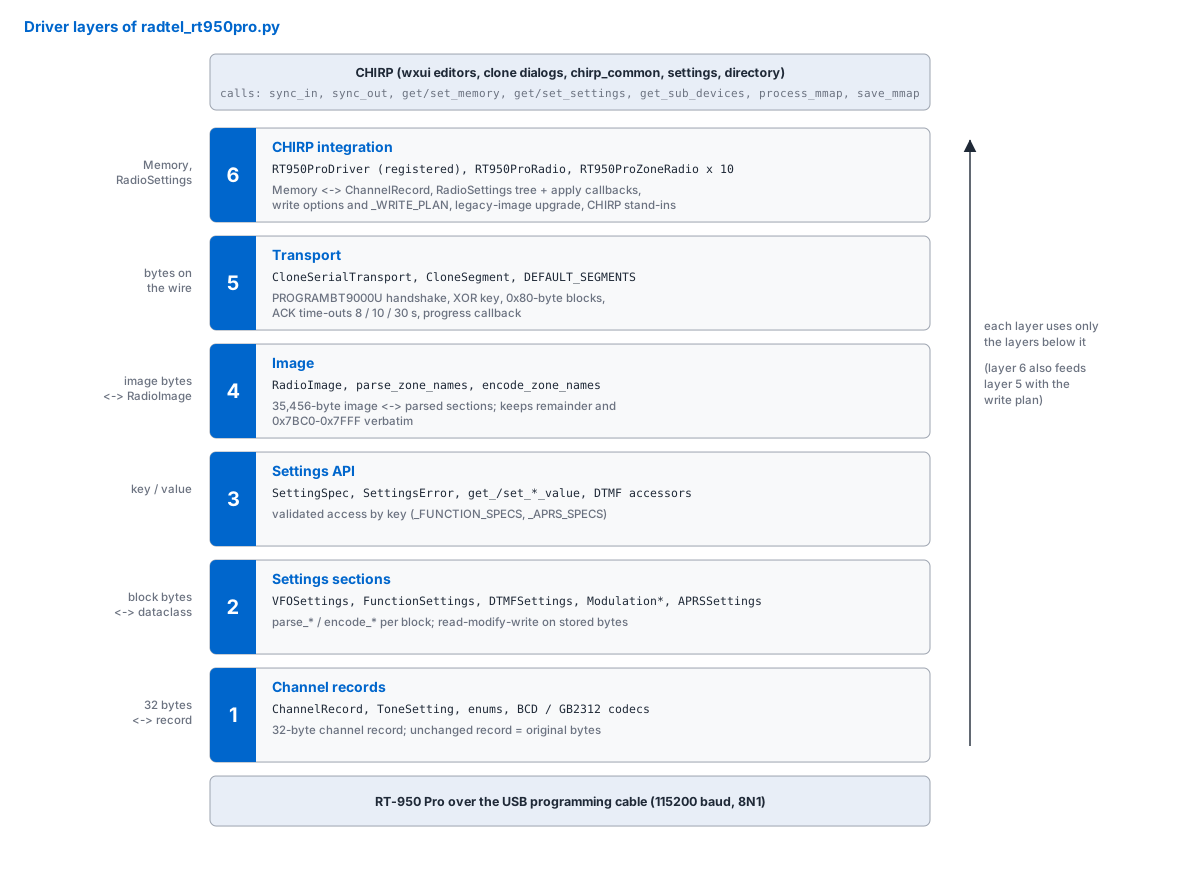
The file is divided into six layers, from raw bytes up to CHIRP. Each layer uses only the layers below it; layer 6 drives layer 5 (transport) and layer 4 (image).
| Layer | Banner | Responsibility | Main objects |
|---|---|---|---|
| 1 | Channel records | 32-byte channel record and its codecs | ToneSetting, ChannelRecord, ToneMode, PowerLevel, Bandwidth, Modulation, _encode/_decode_frequency, _encode/_decode_name, FHSS codec |
| 2 | Settings sections | one dataclass and one parse_*/encode_* pair per settings block |
VFOSettings, FunctionSettings, DTMFSettings, ModulationSettings, ModulationChannelEntry, APRSSettings |
| 3 | Settings API | validated access by key | SettingSpec, SettingsError, get_/set_function_value, get_/set_aprs_value, DTMF accessors |
| 4 | Image | complete clone image ↔ parsed structure | RadioImage, parse_zone_names, encode_zone_names, layout constants |
| 5 | Transport | serial clone protocol | CloneSerialTransport, CloneSegment, CloneSerialConfig, CloneTransportError, DEFAULT_SEGMENTS |
| 6 | CHIRP integration | CHIRP radio classes, memory and settings translation, write plan | RT950ProRadio, RT950ProZoneRadio, RT950ProDriver, _WRITE_PLAN, settings builders and apply callbacks, CHIRP stand-ins, MEM_FORMAT |
The public API is listed in __all__ (53 names); everything with a leading
underscore is internal.
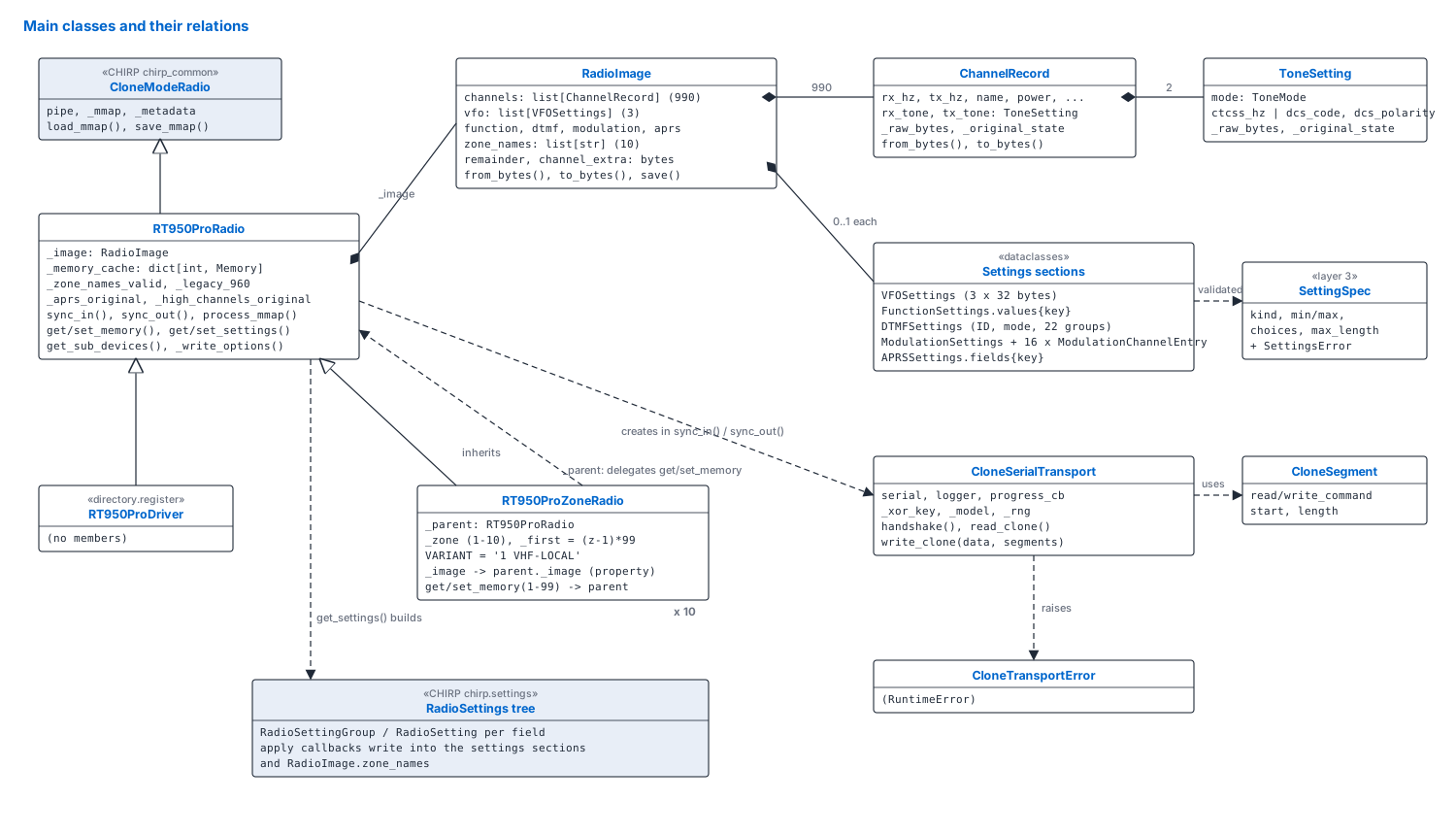
B3. Design principles
- One source of truth. All data lives in one
RadioImage. CHIRP's memory map is parsed into it inprocess_mmap()and derived from it (_build_clone_payload) on save and upload. - Change tracking instead of re-encoding.
ToneSetting,ChannelRecordandVFOSettingsremember the bytes they were decoded from (_raw_bytes) and a tuple of their visible fields (_original_state).to_bytes()/encode_vfo_section()return the original bytes while the state is unchanged. After encoding, the new bytes become the reference. - Read-modify-write for settings. Section encoders start from the
stored bytes (
RadioImage.remainder) and replace only the bits of known fields. The modulation and APRS encoders write a field only when its value differs from what was read, so an unedited block stays byte-identical. One deviation is documented in the code: a field byte holding0xFFis treated as 0 before its bits are merged. - Write less than you read. The write plan is a filtered, re-ordered subset of the read layout (§B8).
- Fail before sending. The complete payload is built before the serial session starts, so encoding errors never leave a half-written radio.
B4. Data model
B4.1 Clone image
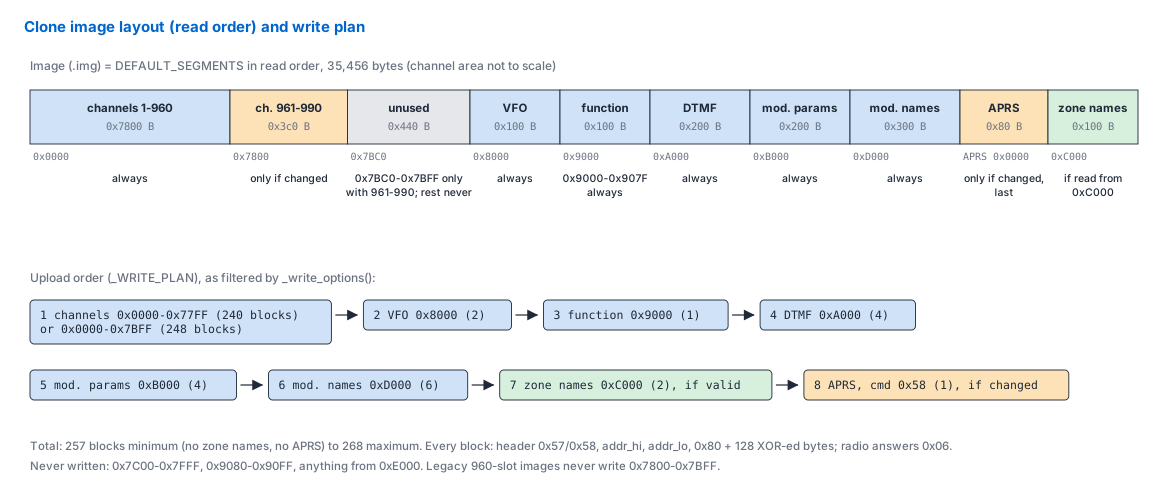
The image is the concatenation of DEFAULT_SEGMENTS in read order, 35,456
bytes (_SEGMENT_LENGTH):
| Image offset | Length | Radio address | Content | Parsed into |
|---|---|---|---|---|
0x0000 |
0x7BC0 |
0x0000 |
990 × 32-byte channel records | channels |
0x7BC0 |
0x440 |
0x7BC0 |
unused | channel_extra (verbatim) |
0x8000 |
0x100 |
0x8000 |
VFO A/B/C (96 bytes used) | vfo |
0x8100 |
0x100 |
0x9000 |
function settings (96 used) | function |
0x8200 |
0x200 |
0xA000 |
DTMF (384 used) | dtmf |
0x8400 |
0x200 |
0xB000 |
modulation parameters (256 used) | modulation |
0x8600 |
0x300 |
0xD000 |
modulation names | modulation |
0x8900 |
0x80 |
APRS 0x0000 |
APRS block | aprs |
0x8980 |
0x100 |
0xC000 |
zone names, 10 × 16 bytes | zone_names |
Image offsets differ from radio addresses from 0x8100 on: the image is
packed, the radio address space is not.
RadioImage.remainder holds all bytes from image offset 0x8000 as read;
encoders use it as the base, so bytes the driver does not understand
survive.
B4.2 Channel record (32 bytes)
| Offset | Field | Encoding |
|---|---|---|
| 0–3 | RX frequency | packed BCD, 10 Hz units, least significant byte first; all 0x00/0xFF = empty slot |
| 4–7 | TX frequency | same |
| 8–9 | RX tone | 00 00 / FF FF off; nn 00 DCS index 1–210 into _DCS_CODES; otherwise CTCSS in 0.1 Hz, little-endian |
| 10–11 | TX tone | same |
| 12 | signalling group | low nibble |
| 13 | PTT ID | low nibble |
| 14 | scrambler / power | high nibble / low nibble (0 high, 1 medium, 2 low) |
| 15 | flags | b7 learn FHSS, b6 narrow, b5–4 encryption, b3 busy lockout, b2 scan add, b1 TX enable, b0 AM |
| 16–19 | FHSS code | byte 19 = 0xA0 when set; bytes 18, 17, 16 = six hex digits |
| 20–31 | name | GB2312, padded with 0xFF |
_DCS_CODES has 210 entries: index 1–105 normal (N), 106–210 inverted
(I).
Name encoding (_encode_name): if the name is not GB2312-encodable it is
NFKD-normalised and reduced to ASCII; characters that still cannot be
encoded are dropped; the result is cut to 12 bytes without splitting a
character. Every alteration is logged.
B4.3 Settings sections
| Section | Dataclass | Storage | Notes |
|---|---|---|---|
| VFO | VFOSettings × 3 |
typed fields, change tracking | frequency 8 digits (10 Hz), offset 7 digits (100 Hz), one decimal digit per byte |
| Function | FunctionSettings.values |
dict[key → int or None] |
57 keys in _FUNCTION_SPECS; mostly low nibble per byte; byte 26 packs work_mode_a/b/c |
| DTMF | DTMFSettings |
ID (5), PTT ID mode, two timing values, 22 code groups (6 symbols) | symbols 0-9 A-D * #, 0xFF terminates |
| Modulation | ModulationSettings + 16 × ModulationChannelEntry |
global values + FM/AM/SSB memories | frequencies in 10 kHz units; names in a separate block |
| APRS | APRSSettings.fields |
dict[key → int, str or None] |
39 keys in _APRS_SPECS; lat/lon as letter + minute/degree/second; altitude signed 16-bit; custom message at offset 79, 40 bytes |
| Zone names | RadioImage.zone_names |
list[str] × 10 |
read up to 16 bytes; an edited name is written max. 12, an unedited one as read; padding byte of the slot kept |
None in a section means "byte was 0xFF (not set)".
B5. Layer 1 — channel records
ChannelRecord.from_bytes()decodes all fields and stores_raw_bytesand_original_state. A power nibble above 2 decodes as LOW.ChannelRecord.to_bytes()returns_raw_byteswhen the state is unchanged. Otherwise it rebuilds the record from0xFF: known fields only, bytes 12 and 13 keep their high nibble (0 when the old byte was0xFF), the FHSS field is0xFF × 4without a code, the name is padded with0xFF. The new bytes become the reference.ToneSettingfollows the same pattern for its two bytes, so an unknown DCS index (decoded as OFF and logged) is written back unchanged unless the tone is edited.- Errors (
ValueError): record not 32 bytes, non-BCD nibble, frequency not a multiple of 10 Hz or above 8 digits, unknown DCS code, CTCSS out of 0.1–6553.5 Hz, FHSS code not 6 hex digits.
B6. Layers 2 and 3 — settings
Parsing (parse_*_section) takes the used part of a block and returns
its dataclass; length errors raise ValueError.
Encoding (encode_*_section(settings, raw)) starts from raw (or
0xFF when raw has the wrong length), returns raw unchanged when
settings is None, and otherwise writes only known bits:
| Encoder | Specific behaviour |
|---|---|
encode_vfo_section |
unchanged entries copied verbatim; rx_hz/offset_hz None keep the stored digits; entries beyond the third ignored |
encode_function_section |
value None or missing key writes 0xFF over the whole byte; byte 26 becomes 0xFF if any work mode is None |
encode_dtmf_section |
own ID and code groups rewritten only when their text changed (a rewritten group gets 0xFF in bytes 6–15); info bytes 6–8 always written to the low nibble |
encode_modulation_sections |
each field compared with the value parsed from the stored blocks and written only when it differs; a global field that is None (not set) is never written; names only when the text changed; entries beyond len(channels) cleared to 0xFF |
encode_aprs_section |
each field and text compared with the value parsed from the stored block and written only when it differs, so unusual stored bytes (hemisphere letters, position digits, altitude, icon) are kept |
encode_zone_names |
unchanged names byte-identical; changed name cut to 12 ASCII characters, padded with the slot's own padding byte (0x00 or 0xFF) |
Settings API (layer 3). SettingSpec(kind, min_value, max_value,
choices, max_length) describes one setting; _validate() enforces it
(bool accepts True/False/0/1, int a range, enum a set of values;
strings are checked in set_aprs_value). Violations raise SettingsError
(a ValueError); an unknown key raises KeyError. None marks a setting
as not set. DTMF has dedicated accessors that check the symbol set and
maximum length.
B7. Layer 4 — image
RadioImage.from_bytes(blob):
- Rejects data shorter than
0x8000. - Decodes 990 channel records from
0x0000–0x7BBF. - Parses each following section only if the blob is long enough for it;
otherwise that section stays
None. - Stores
remainder = blob[0x8000:]andchannel_extra = blob[0x7BC0:0x8000].
- Requires exactly 990 channels.
- Pads
remainderwith0xFFto the known length (KNOWN_SEGMENT_BYTES). - Re-encodes each section in place within that tail (VFO, function, DTMF, modulation, APRS, zone names).
- Builds the channel segment:
channel_extraverbatim, then every channel'sto_bytes(). - Returns channel segment + tail. Side effect: change-tracking snapshots of edited channels and VFO entries are updated.
_build_clone_payload(image) (layer 6) calls to_bytes() and checks the
result is exactly _SEGMENT_LENGTH bytes.
B8. Layer 5 — transport
CloneSerialTransport wraps an open port (CHIRP's pipe) or opens one with
open(CloneSerialConfig).
| Step | Bytes | Answer | Failure |
|---|---|---|---|
| Enter clone mode | PROGRAMBT9000U |
0x06 |
Handshake ACK not received |
| Identify | F |
16 bytes (logged) | time-out |
| Model | M |
12 bytes ASCII | Radio did not return a model identifier |
| Key | 25-byte SEND frame |
0x06 |
Encryption ACK not received |
| Read block | cmd, hi, lo, 0x80 |
4 + 128 bytes | Serial read timed out |
| Write block | cmd, hi, lo, 0x80 + 128 bytes |
0x06 |
No ACK for write cmd … address …, Write ACK mismatch at … |
| End | E |
– | – |
Key selection (_build_encryption_frame): bytes 0–3 SEND; byte 4 a
random code 0x10–0x14 or 0x20–0x24; bytes 5–23 random indexes 0–19;
byte 24 0x00. Code 0x1n selects frame[5 + 2n], code 0x2n selects
frame[6 + 2n]; that byte indexes ENCRYPT_STRINGS (20 four-byte keys).
The random source can be injected (rng) for reproducible tests.
XOR (_apply_xor): byte i uses key byte i mod 4; a byte stays
unchanged if it is 0x00 or 0xFF, equals the key byte or its complement,
or if the key byte is 0x20.
Timing: port time-outs are raised to at least 3 s. During a write the
time-out for the ACK is set per block (8 s channels, 10 s from 0x8000,
30 s APRS) and restored after a successful ACK (a failure leaves before the
restore); pauses of 0.05 s (from 0x8000) and
0.1 s + 0.5 s (APRS) follow the ACK. Values follow NeonPlug's RT-950 Pro
pacing.
Progress: optional progress_cb(done, total, phase) after every block;
exceptions in the callback are swallowed so progress can never break a
clone.
B9. Layer 6 — CHIRP integration
B9.1 Classes
| Class | Base | Purpose |
|---|---|---|
RT950ProRadio |
chirp_common.CloneModeRadio |
all behaviour; memories 1–990 |
RT950ProDriver |
RT950ProRadio |
the registered class (@directory.register); empty |
RT950ProZoneRadio |
RT950ProRadio |
one zone as a sub-device (Zone CH Mode only); maps 1–99 to the parent; no own data, does not call CHIRP's constructor |
B9.2 State of RT950ProRadio
| Attribute | Set in | Meaning |
|---|---|---|
_image |
process_mmap |
the parsed RadioImage, or None |
_memory_cache |
get_memory, set_memory; cleared in process_mmap, set_settings |
Memory objects by number 1–990, shared with the zones |
_memobj |
_parse_memobj |
bitwise view for the developer Browser tab only |
_zone_names_valid |
process_mmap |
image size complete and rt950_layout ≥ 4 → zone names may be written |
_legacy_960 |
process_mmap |
image of the old 960-slot driver → never write 0x7800–0x7BFF |
_aprs_original |
process_mmap |
APRS block at load time; None disables the APRS write |
_high_channels_original |
process_mmap |
bytes 0x7800–0x7BFF at load time; None disables writing them |
_metadata |
CHIRP, sync_in |
image metadata; sync_in sets {'rt950_layout': 4} |
__init__ sets all of these before calling CHIRP's constructor, because
that constructor may already call process_mmap().
B9.3 Image versions
_LAYOUT_VERSION = 4 is stored in the .img metadata as rt950_layout.
process_mmap() recognises: complete images (35,456 bytes) with or without
a valid layout version, images without the zone-name segment (35,200), and
images of the old 960-slot driver (33,152). Older images are padded with
0xFF so all offsets line up; their zone names are never written, and
legacy images never write channels 961–990 (table in
chirp-interface.md §6).
B9.4 Memory translation
_channel_to_memory, _apply_offset, _apply_tones (radio → CHIRP) and
_apply_memory_to_channel, _update_tones_from_memory (CHIRP → radio).
Field and tone mapping tables are in
chirp-interface.md §8.
Extra per-memory settings (scrambler, encryption) travel in
Memory.extra as a RadioSettingGroup (_build_memory_extra,
_extract_memory_extra, which accepts a dict as well).
B9.5 Settings UI
The UI tables _FUNCTION_UI (27 keys) and _APRS_UI (11 keys) map a key
to label, type (bool, int, enum, string) and range or choices. A
_FUNCTION_UI entry with 'volatile': True (only Channel Divide) is marked
volatile by _create_function_setting, so CHIRP rebuilds the editor after
it is changed (chirp-interface.md §7.4).
_build_setting_value() turns an entry into the matching CHIRP value object;
_create_function_setting / _create_aprs_setting attach
_apply_function_setting / _apply_aprs_setting as callback. VFO,
modulation, DTMF and zone names have hand-written builders: VFO lists use
one shared builder and callback (_make_list_setting, _apply_list_choice,
which leaves a value outside the list unchanged), tones _apply_vfo_tone,
frequencies _apply_vfo_frequency (which also sets Freq Band: UHF from
300 MHz) and _apply_vfo_offset; Freq Band is read-only without callback;
modulation uses _apply_modulation_int for the three current channels
(0–14) and the same list builder for work mode, modulation mode, AM/SSB step
and AM/SSB Rx Gain, with the CPS labels; DTMF has one per kind (ID, mode, group), zone names one
(_apply_zone_name). Value readers _value_as_bool,
_value_as_int, _value_as_index (index or label lookup) and
_value_as_string hide the difference between CHIRP's value objects and
plain values.
B9.6 Write plan
_WRITE_PLAN lists (index into DEFAULT_SEGMENTS, length) in write order:
channels (0x7C00), VFO, function (0x80: only 0x9000–0x907F; the
meaning of 0x9080–0x90FF is unknown and the radio changes it), DTMF,
modulation parameters, modulation names, zone names, APRS. _write_options() decides three switches;
_build_write_plan(payload, write_zone_names, channel_bytes, write_aprs)
applies them:
| Condition | Channels written | Zone names | APRS | Blocks |
|---|---|---|---|---|
| nothing optional | 0x0000–0x77FF |
no | no | 257 |
| typical (fresh download, no APRS edit) | 0x0000–0x77FF |
yes | no | 259 |
| ch. 961–990 edited, APRS edited | 0x0000–0x7BFF |
yes | yes (0x58, last) |
268 |
B9.7 Error mapping
| Origin | Mapped to |
|---|---|
any exception in read_clone |
RadioError('Clone read failed: …') |
CloneTransportError with cmd 0x58 |
RadioError with the APRS explanation |
| any other exception in the write | RadioError('Clone write failed: …') |
ValueError in RadioImage.from_bytes |
RadioError('Failed to parse memory map: …') |
| exceptions in an apply callback | RadioError(message) for function and APRS (all four kinds), partly for DTMF and VFO; modulation-memory frequency raises a plain ValueError (table in chirp-interface §10) |
| memory number out of range, no image, no port | RadioError |
Errors are swallowed (broad except Exception) only where a failure must
not stop the main operation: progress reporting and Status creation, the
Browser view, the snapshots in process_mmap, adjusting port time-outs,
closing the port, and the fallbacks of _value_as_int / _value_as_index.
Each place is commented in the code.
B10. Processing flows
| Flow | Steps | Diagram |
|---|---|---|
| Load driver | import → register RT950ProDriver |
chirp-interface §3 |
| Download | transport handshake → 277 blocks → _metadata → process_mmap |
§4, §5 |
Open .img |
metadata match → load_mmap → process_mmap (upgrade) |
§6 |
| Show memories | zone → parent → cache or _channel_to_memory |
§7 |
| Edit memory | zone copy → parent → _apply_memory_to_channel → cache |
§9 |
| Settings | builders → callbacks → sections | §10 |
| Save | to_bytes → MemoryMapBytes → CHIRP writes file + metadata |
§11 |
| Upload | payload → options → plan → handshake → blocks → E |
§12 |
B11. Logging
| Logger | Name | Content |
|---|---|---|
LOG |
module name | driver warnings (old images, parse problems, unknown DCS index), diagnostic text in 0x7BC0–0x7FFF, and the protocol trace of sync_in/sync_out (debug) |
CHANNEL_LOG |
module name + .image |
decoding and encoding warnings of RadioImage (invalid GB2312, altered or truncated names) |
| transport default | module name + .transport |
protocol trace when a transport is created without a logger |
LOG is first defined in layer 1 (.channel) and rebound in layer 6;
functions look it up at call time, so all direct LOG use goes to the
final driver logger.
B12. Testing
Tests run against a CHIRP source tree:
git clone https://github.com/kk7ds/chirp ~/src/chirp
CHIRP_SRC=~/src/chirp python3 -m pytest tests
tests/sample.py builds a neutral two-zone image (VHF-LOCAL,
UHF-LOCAL, eight invented channels) and loads it as if freshly read.
| Test | Checks |
|---|---|
test_layout_constants |
990 channels, 0x7BC0, 0xC000, APRS write command 0x58 |
test_zone_mapping |
10 sub-devices, zone/channel → memory mapping |
test_zone_names_and_labels |
zone names and tab labels |
test_untouched_roundtrip_is_byte_identical |
S-01 / S-02 |
test_aprs_message_nul_padding |
custom message NUL padding kept |
test_set_memory_does_not_modify_frozen_input |
zone path does not modify CHIRP's memory |
test_zone_name_via_settings |
zone name edit reaches the saved image |
test_edits_reach_saved_image |
memory edit reaches the saved image |
test_plan_unchanged_skips_aprs_and_high_channels |
S-03 / S-06 without edits |
test_plan_writes_high_channels_only_when_changed |
S-03 |
test_plan_writes_aprs_last_with_0x58_when_changed |
S-06 |
test_old_images_never_write_zone_names |
S-05 |
test_legacy_960_image_never_writes_past_0x7800 |
S-03 for legacy images |
test_write_error_names_command_and_address |
S-08, transport message only (the dedicated APRS RadioError in sync_out is not tested) |
tests/test_radio_values.py pins down values measured on a radio with the
CPS (encodings from the radio, frequencies invented):
| Test | Checks |
|---|---|
test_vfo_power_decodes_all_three_levels |
VFO power 0/1/2 decodes as High/Middle/Low |
test_settings_apply_without_edit_keeps_vfo_bytes |
a settings apply without an edit leaves the VFO bytes unchanged (S-02) |
test_vfo_screen_follows_cps_labels_and_order |
VFO-A to VFO-C with the CPS fields in CPS order |
test_vfo_screen_shows_measured_values |
every VFO field shows what the CPS showed for the same bytes |
test_vfo_choice_lists_match_cps |
Step Freq, Tx Power, Scramble, Signalling, Offset Dir, Encryption and tone lists |
test_vfo_freq_band_is_read_only |
Freq Band read-only, no callback |
test_vfo_edit_writes_cps_encoding |
edited step, power, signalling and tone stored as the CPS stores them |
test_vfo_value_outside_list_is_left_alone |
a value the CPS does not offer is shown as unknown and kept |
test_channel_encryption_3_is_kept |
channel encryption 3 and scramble 8 |
test_side_key_ranges_match_cps |
PF1 0-7, PF2 0-6 |
test_aprs_ranges_match_cps |
Timed Beacon Time 0-9, Radio Symbol 0-4 |
test_zone_name_of_twelve_characters_loads_and_saves |
12-character zone names |
test_zone_name_longer_than_twelve_is_shown_and_kept |
a longer name written by other software loads and is kept |
test_vfo_group_builds_with_the_stand_in_classes |
the VFO group also builds without CHIRP |
test_vfo_band_follows_rx_freq |
Freq Band becomes VHF below and UHF from 300 MHz when Rx Freq is edited |
test_modulation_screen_uses_cps_lists |
modulation labels and lists as in the CPS |
test_modulation_edit_and_unset_value |
an edited modulation list is stored; a value that is not set is shown as such and kept |
test_modulation_current_channel_range_matches_decoding |
current channels 0–14 |
tests/test_known_issues.py covers the known issues 2–4, 7, 8 and 10 of
status.md (1, 6 and 9 are in test_radio_values.py) and three
smaller fixes of 0.1.5 (GB2312 cut, DTMF index, function segment):
| Test | Checks |
|---|---|
test_inverted_dcs_reads_as_chirp_reverse_polarity |
radio I → CHIRP R |
test_chirp_reverse_polarity_is_written_as_inverted |
CHIRP R → radio I |
test_mixed_tones_are_shown_as_cross_and_written_back |
RX-only and mixed tones as CHIRP Cross, written back unchanged (seven cross modes) |
test_features_offer_cross_modes |
Cross and CHIRP's cross modes in the features |
test_set_memory_does_not_change_the_callers_memory |
set_memory leaves CHIRP's memory unchanged |
test_edited_channel_keeps_high_nibbles_of_bytes_12_and_13 |
unused nibbles of an edited channel record kept |
test_settings_apply_writes_only_the_changed_setting |
an apply runs only the callback of the changed setting |
test_unset_modulation_block_is_written_back_unchanged |
an all-0xFF modulation block stays 0xFF |
test_modulation_bandwidth_zero_is_kept |
SSB bandwidth 0 kept |
test_unusual_aprs_bytes_are_written_back_unchanged |
unusual stored APRS bytes kept |
test_gb2312_text_is_not_cut_inside_a_character |
a GB2312 name is cut between characters |
test_negative_dtmf_code_group_index_is_refused |
DTMF code group index below 0 refused |
test_function_segment_write_stops_before_0x9080 |
function segment written as one block (S-04) |
tests/test_ident_dump.py checks tools/ident_dump.py against a simulated
radio with invented answers:
| Test | Checks |
|---|---|
test_identify_records_all_answers_and_ends_session |
all four answers recorded; only the handshake string, F, M, the SEND frame and E are sent (5 writes); port closed |
test_find_version_reports_answer_and_offset |
an ASCII version is found with answer number and offset |
test_find_version_bcd_and_binary |
BCD and binary forms are found |
test_version_patterns_rejects_bad_input |
a version that is not <major>.<minor> is refused |
test_main_prints_answers |
hex/ASCII output and search result on the command line |
test_empty_expect_is_refused |
an empty --expect stops with exit code 2 |
test_version_patterns_rejects_non_ascii_digits |
non-ASCII digits are refused |
tests/test_cleanup.py covers the clean-up of 0.1.6:
| Test | Checks |
|---|---|
test_duplex_follows_the_bands |
simplex, - 600 kHz, + 7.6 MHz within one band; RX 145.5 / TX 435.0 MHz is split |
test_split_channel_round_trips |
a split channel entered in CHIRP (RX and TX in different bands) is written with TX = offset and read back as split |
test_unused_tone_info_class_is_gone |
_ToneInfo removed |
test_without_chirp_the_driver_says_chirp_is_required |
with CHIRP blocked (subprocess) HAVE_CHIRP is False and get_features, get_settings, get_memory, set_memory raise RadioError naming CHIRP |
test_with_chirp_the_flag_is_set |
HAVE_CHIRP is True with CHIRP |
test_find_zone_names_usage_has_a_single_backslash |
the usage text of find_zone_names.py continues the shell line |
tests/test_channel_divide.py covers Channel Divide (values measured on a
radio: byte 0x9026, 0 Zone CH Mode, 1 All CH Mode):
| Test | Checks |
|---|---|
test_measured_values |
constants 0 and 1, offset 0x9026 |
test_setting_follows_cps_label_and_list |
label Channel Divide, CPS choices in CPS order, volatile |
test_stored_value_is_shown |
0 and 1 are shown as the matching choice |
test_zone_mode_shows_ten_zone_tabs |
Zone CH Mode: ten sub-devices of 99, has_dynamic_subdevices |
test_all_mode_shows_one_list_of_990 |
All CH Mode: no sub-devices, bounds 1–990 |
test_all_mode_numbering_keeps_empty_channels |
channel n is slot n; empty channels stay in place |
test_unset_value_shows_zones_and_is_kept |
0xFF shows the zones and is kept without an edit |
test_changing_the_setting_switches_view_and_one_byte |
an edit in both directions changes only 0x9026 and switches the view without a reload |
test_all_mode_edit_writes_the_same_slot |
a memory edited in the single list lands in the same zone slot |
tests/test_check_docstrings.py checks tools/check_docstrings.py and the
repository itself:
| Test | Checks |
|---|---|
test_reports_public_private_nested_and_stand_in_objects |
public, private, nested and except-block functions without a docstring are reported |
test_reports_missing_module_docstring |
a module without a docstring is reported |
test_main_exit_status |
exit status 1 with a report line, 0 when complete |
test_repository_is_fully_documented |
the driver, tools/*.py and docs/build.py pass |
test_unreadable_file_is_reported_not_raised |
a file that is not UTF-8 is reported, not a traceback |
Tools: tools/make_sample_image.py (sample .img),
tools/find_zone_names.py (read-only scan of unread address ranges; found
0xC000), tools/raw_dump.py (read-only dump of the clone image,
XOR-decoded, without the driver's encoders), tools/ident_dump.py
(read-only: every byte of the handshake answers, with a search for the
firmware version), tools/check_docstrings.py (every object has a
docstring), tools/chirp_list_left.py
(optional CHIRP patch).
B13. Documentation build
docs/build.py builds one page, radtel_rt950pro.html:
- Documents.
fto.mdandchirp-interface.md(listDOCUMENTS) are converted from Markdown with pdoc's markdown2 settings and placed above the API reference, with a Documents group in the side menu. Headings get the anchor GitHub would give them, prefixed per document (design-,interface-), so the same links work on GitHub and on the page. Links to other Markdown files go to GitHub for the branch being built; names in code font are linked to the API by pdoc'slinkify; diagrams are copied next to the page and open full size on click. A link between documents to a missing anchor stops the build. Each layer heading of the API links back to its design chapter (B5–B9). - API reference. pdoc renders the module, grouped by the layer and section banners in the source; private objects are included (closed lock) next to public ones (open lock).
The GitHub Action .github/workflows/docs.yml checks the driver's
docstrings with pydocstyle, pylint and pydoclint, then builds main into the
site root and develop into /develop/ and publishes both to GitHub Pages on
every push to either branch. The checks cover the driver, docs/build.py
and tools/*.py. pydocstyle only checks public names (in a module with
__all__: the names in it); pylint's
missing-docstring checks (with no exemption for names starting with _)
cover every other module-level class, function and method; neither looks
at nested functions. tools/check_docstrings.py closes that gap: it walks
the syntax tree and reports every module, class and function without a
docstring, nested functions and the CHIRP stand-ins in the except branch
included. The Action runs it only in a checkout that contains it (0.1.6 and
later), so an older main still builds.
Diagrams. The SVG files in docs/diagrams are generated, not drawn by
hand:
| Script | Writes |
|---|---|
tools/make_diagrams.py |
the sequence diagrams seq-01 to seq-09, one function per diagram, rendered with tools/seqsvg.py |
tools/make_fto_diagrams.py |
the structure diagrams fto-layers, fto-classes and fto-write-plan |
After changing a diagram, run both from the repository root and check the result in a browser (text widths are estimated, positions are fixed):
python3 tools/make_diagrams.py
python3 tools/make_fto_diagrams.py
Both write to docs/diagrams by default, or to the directory given as the
first argument. Only the standard library is needed.
B14. Known issues and observations
Known issues are listed in status.md; they are not repeated
here. Still open: a VFO tone with a DCS index the driver does not know,
which is shown as OFF (choosing OFF then does not clear it). Known issues
1–4 and 6–10 are fixed in 0.1.5, each with a test; the unused _ToneInfo
(5) is removed in 0.1.6.
Additional observations from the interface analysis (snapshots not refreshed
after an upload, comments lost after a zone rename, progress text past
channel 990, repeated payload builds, comments that differ per Channel
Divide view) are in
chirp-interface.md §15.
B15. Open items
From status.md:
- a VFO tone with a DCS index the driver does not know is shown as OFF;
- find out what
0x9080–0x90FFis; - detect the firmware layout (960 vs 990 channels) before writing;
- compare the handshake with CHIRP's RT-920 driver;
- await the maintainers' response to the proposal in #12180.
The route to official CHIRP support (subclass of the RT-920 driver, GPLv3,
test image) is described separately in status.md.
Glossary
| Term | Meaning |
|---|---|
| ACK | 0x06, the radio's acknowledgement of a command or block |
| Block | 0x80 (128) bytes, the unit of every read and write |
Clone image / .img |
the complete memory as CHIRP stores it, plus CHIRP metadata |
| CPS | the vendor's programming software (RT-950PRO_CPS) |
| Payload | the 35,456 image bytes in DEFAULT_SEGMENTS order |
| Segment | a contiguous address range with its read and write command (CloneSegment) |
| Slot | 0-based channel position 0–989 in RadioImage.channels |
| Sub-device | a CHIRP radio object that shows part of a radio as its own tab (here: a zone) |
VARIANT |
CHIRP's variant name; for a zone the tab suffix, e.g. 1 VHF-LOCAL |
| Write plan | the ordered, filtered list of segments sent on upload |
| XOR key | one of 20 four-byte strings selected during the handshake |
CHIRP ↔ driver interface
Document · names in code font link to the API reference
This document describes how CHIRP and the RT-950 Pro driver
(radtel_rt950pro.py) work together: which CHIRP calls reach the driver, in
which order, what the driver does with them, and what it hands back. The
driver's internal design is described in fto.md; the byte layout
in memory-map.md and the wire protocol in
protocol.md.
| Driver | radtel_rt950pro.py, version 0.1.8 (2026-11-15) |
| CHIRP reference | kk7ds/chirp at commit 0a9be8e (2026-10-17), wxPython UI (chirp/wxui); the rebuild of the editor after a volatile setting (§7.4) checked at commit c604141 (2026-10-23) |
| Radio | Radtel RT-950 Pro, firmware 0.29 (10 zones × 99 channels) |
The CHIRP behaviour described here was read from the CHIRP source at the
commit above (chirp/chirp_common.py, chirp/directory.py,
chirp/settings.py, chirp/wxui/main.py, clone.py, memedit.py,
settingsedit.py). Other CHIRP versions may differ in detail.
1. Overview
CHIRP treats the RT-950 Pro as a clone-mode radio: the whole memory is downloaded into an image, edited offline, and uploaded again. The driver plugs into CHIRP through one registered class and, in Zone CH Mode, ten sub-devices (in All CH Mode CHIRP uses the registered class itself as the only memory list; see §7.4):
| Object | Role towards CHIRP |
|---|---|
RT950ProDriver |
The class registered with @directory.register. CHIRP instantiates it for Download, for Open of an .img file, and keeps it as the radio behind the editor. It adds nothing to RT950ProRadio. |
RT950ProRadio |
Shared base class with all behaviour: clone (sync_in/sync_out), image handling (process_mmap, get_mmap, save_mmap), memories 1–990, settings, sub-devices. Subclass of chirp_common.CloneModeRadio. |
RT950ProZoneRadio |
One object per zone (10), only in Zone CH Mode. CHIRP shows each as a memory tab with memories 1–99. It owns no data: every call is mapped to the parent's memory (zone − 1) × 99 + n. |
All channel and settings data lives in one RadioImage object owned by the
parent (RT950ProRadio._image). CHIRP's own memory map (_mmap) is rebuilt
from that object when the image is saved; an upload builds its own payload
from it.
1.1 Entry points
| CHIRP action | CHIRP calls | Driver method(s) | Diagram |
|---|---|---|---|
| Start CHIRP / Load module from issue | import_drivers() / load_module() |
module import, @directory.register |
1 |
| Radio → Download from radio | RT950ProDriver(serial), sync_in() |
__init__, sync_in, process_mmap |
2, 3 |
File → Open .img |
get_radio_by_image() → DynamicRadioAlias(filename) |
__init__, process_mmap |
8 |
| Editor opens | get_features(), get_sub_devices(), link_device_metadata() |
get_features, get_sub_devices |
4 |
| Show a row | get_memory(n) on the zone |
RT950ProZoneRadio.get_memory → RT950ProRadio.get_memory |
4 |
| Edit / delete a row | set_memory(FrozenMemory) / erase_memory(n) on the zone |
RT950ProZoneRadio.set_memory → RT950ProRadio.set_memory |
5 |
| Settings tab | get_settings(), set_settings(copy) |
get_settings, set_settings + apply callbacks |
6 |
| File → Save | save(filename) |
save_mmap |
7 |
| Radio → Upload to radio | set_pipe(serial), sync_out() |
sync_out, _write_options, _build_write_plan |
9 |
| Developer Browser tab | reads radio._memobj |
_parse_memobj (MEM_FORMAT), run in process_mmap, save_mmap, sync_out |
– |
2. What the driver declares
2.1 Class attributes
| Attribute | Value | Used by CHIRP for |
|---|---|---|
VENDOR |
"Radtel" |
radio list, image metadata, driver id |
MODEL |
"RT-950 Pro" |
radio list, image metadata, driver id |
BAUD_RATE |
115200 |
opening the serial port |
_memsize |
35,456 (_SEGMENT_LENGTH) |
get_memsize(), radio-info dialog only |
The directory id built by CHIRP (radio_class_id) is Radtel_RT-950_Pro.
2.2 get_features()
| Feature | Parent (RT950ProRadio) |
Zone (RT950ProZoneRadio) |
|---|---|---|
memory_bounds |
(1, 990) |
(1, 99) |
has_sub_devices |
True in Zone CH Mode, False in All CH Mode (§7.4) |
False |
has_dynamic_subdevices |
True (left out on CHIRP versions without it) |
False |
has_settings |
True |
False |
has_bank, has_bank_names |
False |
False |
has_name, valid_name_length |
True, 12 |
same |
valid_characters |
chirp_common.CHARSET_ASCII |
same |
valid_modes |
FM, NFM, AM |
same |
valid_tmodes |
"", Tone, TSQL, DTCS, Cross |
same |
has_cross, valid_cross_modes |
True, chirp_common.CROSS_MODES |
same |
valid_duplexes |
"", +, -, split (can_odd_split) |
same |
valid_dtcs_pols |
NN, NR, RN, RR |
same |
valid_dtcs_codes |
chirp_common.DTCS_CODES |
same |
valid_power_levels |
Low 1 W, Medium 5 W, High 10 W (nominal) | same |
valid_skips |
"", S |
same |
valid_bands |
18–64, 70–118, 118–137, 136–174, 174–400, 400–480, 480–580 MHz | same |
has_tuning_step, has_nostep_tuning |
False, True: no tuning step required (0.1.8) |
same |
has_comment |
not set (CHIRP default False) |
same |
The radio stores frequencies in 10 Hz units and has no per-channel tuning
step. With has_nostep_tuning CHIRP's validate_memory() skips its two
step checks, so a frequency such as UK CB 27.60125 MHz (10 kHz raster,
1.25 kHz offset) can be pasted, edited and imported. CHIRP's airband check
(108–137 MHz) still applies: there a frequency must be on the 25 kHz or
8.33 kHz raster, so e.g. 118.020 MHz is refused. The driver's own
validate_memory() adds an error for an RX or TX frequency that is not a
multiple of 10 Hz, before set_memory() would fail on it. Up to 0.1.7 the
driver set valid_tuning_steps to 2.5–25 kHz, which refused such channels
(issue 12180).
Because has_comment is False, CHIRP keeps memory comments itself, in the
image metadata (mem_extra), not in the radio (see §7.3).
3. Loading the driver
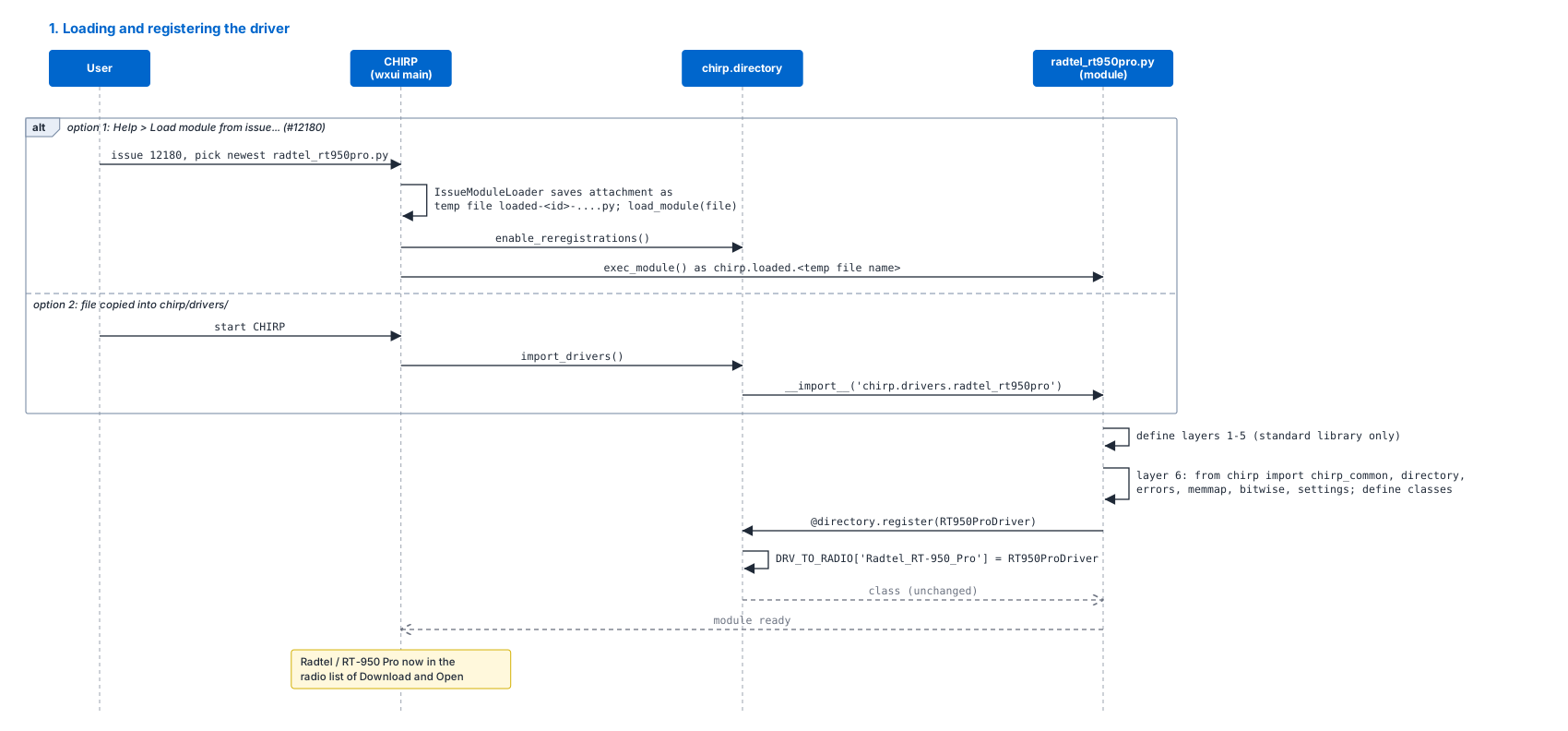
There are two ways in, as described in the README:
- Load module from issue (#12180). CHIRP saves the chosen attachment
to a temporary file (
loaded-<attachment id>-….py) and callsload_module(). That first callsdirectory.enable_reregistrations(), so the module may replace a driver with the same id, then executes the file aschirp.loaded.<temporary file name>. The module is gone when CHIRP exits. - Copy into
chirp/drivers/. At start-updirectory.import_drivers()imports every*.pyin that directory. The Windows installer build does not scan the directory (it imports the names inchirp.drivers.__all__), so this route does not work there.
Executing the module:
- defines layers 1–5 (standard library only);
- at the start of layer 6 imports
chirp_common,directory,errors,memmap,bitwiseandchirp.settings. If that import fails (no CHIRP, e.g. pydoc), the module defines small stand-ins so it still imports (§14); - defines the rest of layer 6;
- registers
RT950ProDriverwith@directory.register.RT950ProRadioitself is not registered; - sets
DRIVER_CLASS = RT950ProDriverfor loaders that look for that name.
4. Download from the radio
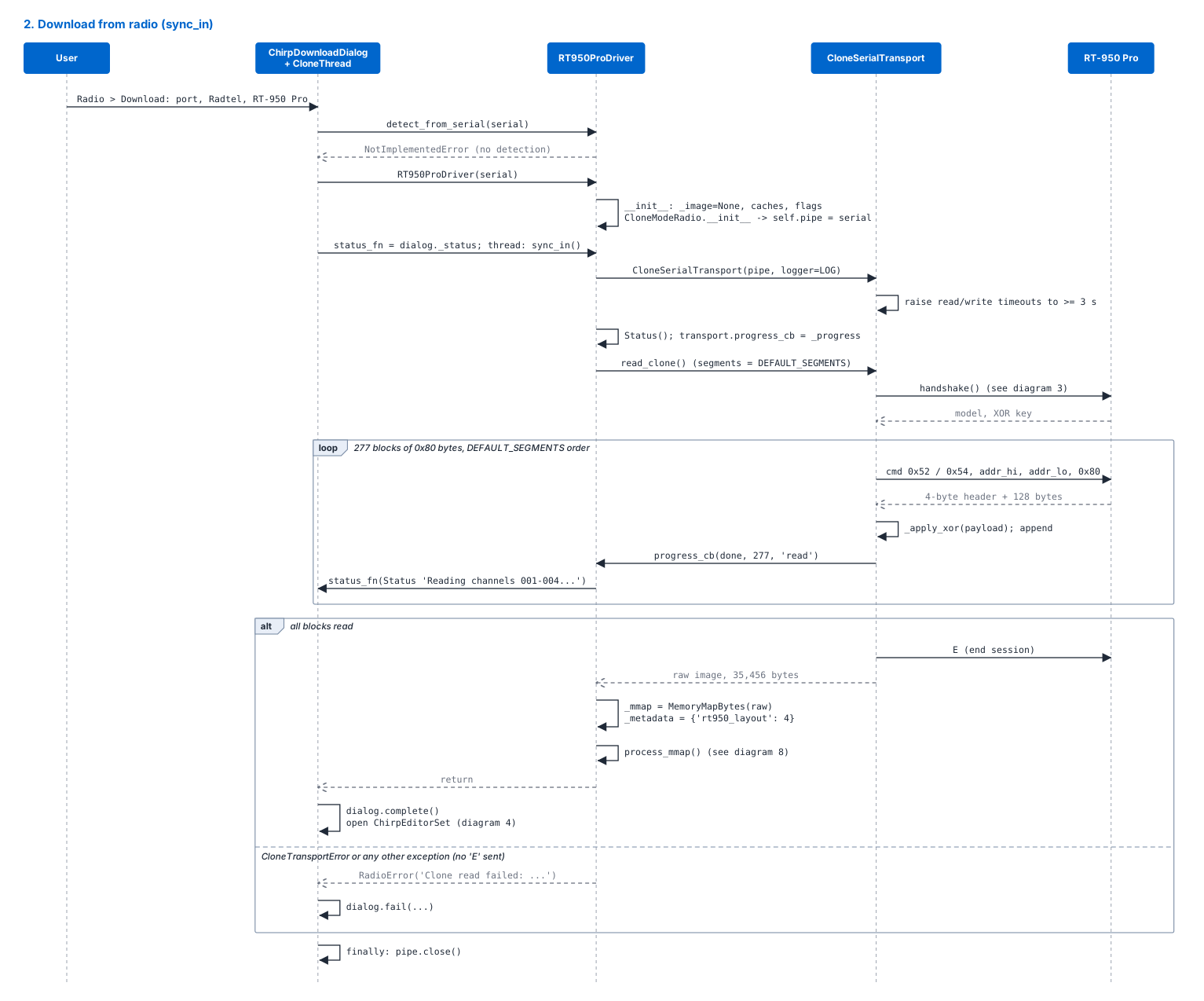
- CHIRP's download dialog opens the port and first calls
detect_from_serial(). The driver does not implement detection, so the default raisesNotImplementedErrorand CHIRP keeps the chosen class. - CHIRP creates
RT950ProDriver(serial). The driver's__init__sets its own state before calling CHIRP's constructor, because CHIRP's constructor may callprocess_mmap()(it does so for a file name or aMemoryMapBytes; for a serial port it resetserrors,_mmap,_memobj,_metadataand storesself.pipe). - CHIRP's
CloneThreadsetsradio.status_fnand runssync_in()in a background thread. sync_in()wraps the port in aCloneSerialTransport(read and write time-outs raised to at least 3 s), attaches a progress callback and callsread_clone(). The transport reads allDEFAULT_SEGMENTS: 277 blocks of 0x80 bytes, 35,456 bytes in total.- After every block the progress callback converts the block count into a
chirp_common.Statusand callsstatus_fn. Messages areReading channels 001-004…for the channel segment (4 channels per block) andReading VFO settings…,Reading Zone names…etc. for the others. - On success the driver stores the bytes as
MemoryMapBytes, replaces_metadatawith{'rt950_layout': 4}and callsprocess_mmap()(§6). - Any exception in the read is re-raised as
errors.RadioError('Clone read failed: …'), which CHIRP shows in the dialog. CHIRP closes the port in all cases.
Read order (= image order, DEFAULT_SEGMENTS):
| # | Command | Address | Length | Blocks | Content |
|---|---|---|---|---|---|
| 0 | 0x52 |
0x0000 |
0x8000 |
256 | channels 1–990 + 0x7BC0–0x7FFF |
| 1 | 0x52 |
0x8000 |
0x100 |
2 | VFO A/B/C |
| 2 | 0x52 |
0x9000 |
0x100 |
2 | function settings |
| 3 | 0x52 |
0xA000 |
0x200 |
4 | DTMF |
| 4 | 0x52 |
0xB000 |
0x200 |
4 | modulation parameters |
| 5 | 0x52 |
0xD000 |
0x300 |
6 | modulation names |
| 6 | 0x54 |
APRS 0x0000 |
0x80 |
1 | APRS (separate address space) |
| 7 | 0x52 |
0xC000 |
0x100 |
2 | zone names |
5. Clone session on the wire
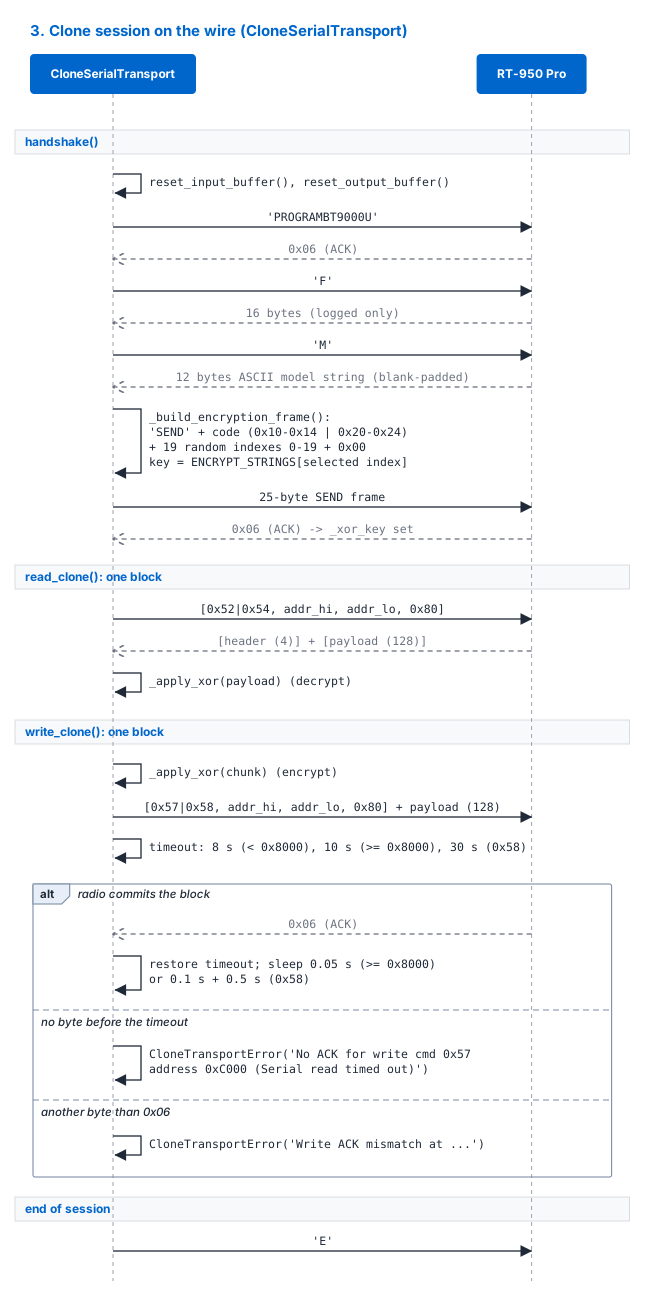
CloneSerialTransport implements the session for both directions:
- Handshake:
PROGRAMBT9000U→0x06;F→ 16 bytes (only logged);M→ 12-byte model string (an empty string is an error); a 25-byteSENDframe that selects one of 20 four-byte XOR keys (ENCRYPT_STRINGS) →0x06. - Read block:
cmd, addr_hi, addr_lo, 0x80→ 4-byte header + 128 bytes; the payload is XOR-decoded. - Write block: header + XOR-encoded 128 bytes →
0x06. The ACK time-out is 8 s below0x8000, 10 s from0x8000, 30 s for command0x58; after the ACK the driver pauses 0.05 s (from0x8000) or 0.1 s + 0.5 s (APRS). - End:
E. It is sent only after the last block; when a block fails, the exception leaves the loop beforeEis sent.
XOR rule: a payload byte is left unchanged when it is 0x00 or 0xFF, equal
to the key byte or its complement, or when the key byte is a space (0x20).
The operation is its own inverse.
6. Opening an .img file (process_mmap)
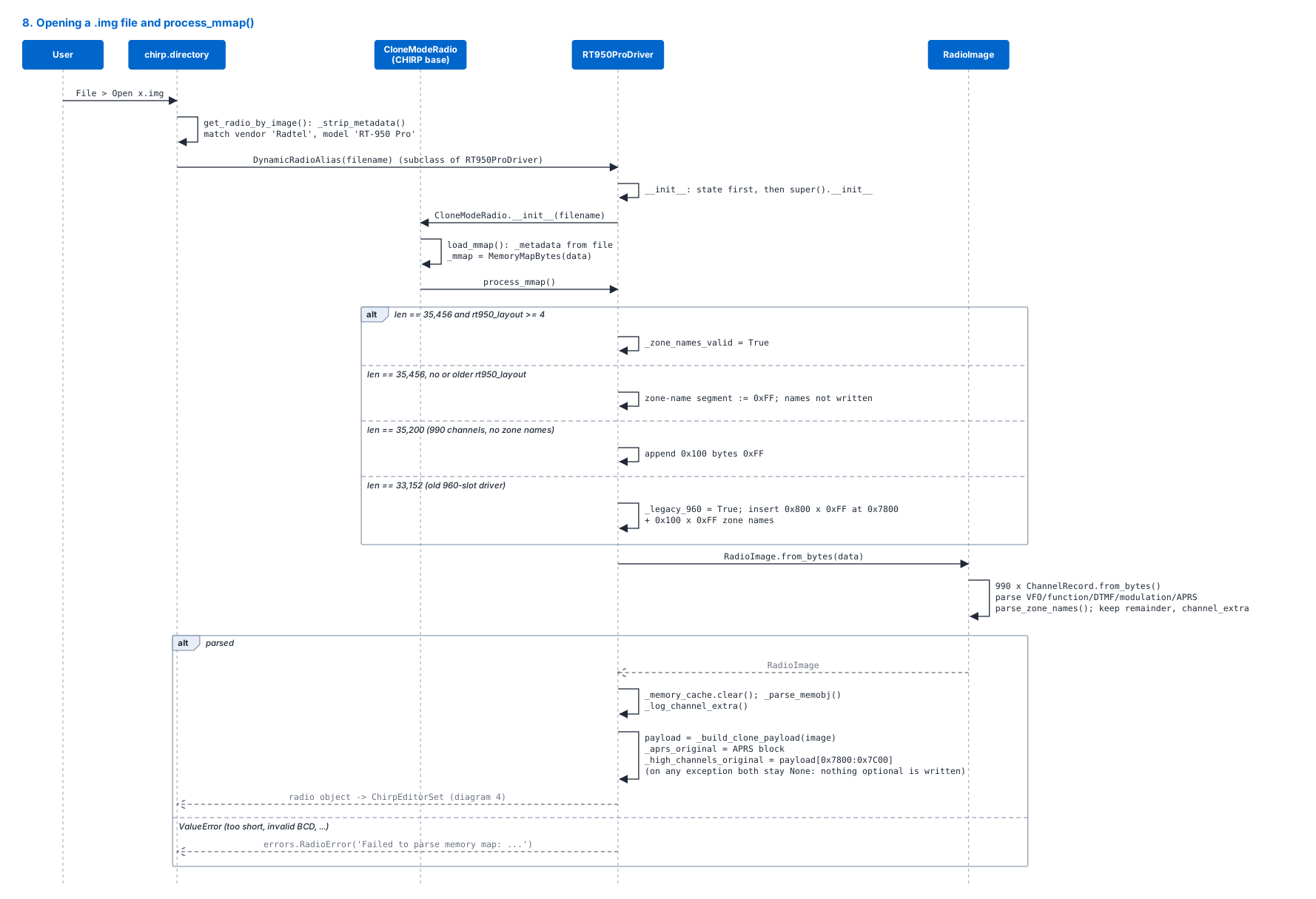
directory.get_radio_by_image() strips CHIRP's metadata block from the file
and matches vendor / model against the registered classes. For a match it
creates a DynamicRadioAlias — a subclass of RT950ProDriver with the
vendor, model and variant from the file — with the file name. CHIRP's
constructor calls load_mmap(), which sets _metadata from the file and
_mmap to the image bytes, and then calls the driver's process_mmap().
process_mmap() recognises three image sizes (four cases), so that images
from earlier driver versions still open safely:
| Image size (bytes) | Origin | Action | Effect on upload |
|---|---|---|---|
35,456 with rt950_layout ≥ 4 |
downloaded with this driver (layout version 4) | none; _zone_names_valid = True |
zone names written |
35,456 without / older rt950_layout |
earlier driver version, from before zone names were read at 0xC000 |
zone-name segment replaced by 0xFF; warning logged |
zone names not written |
35,200 (_MEMSIZE_V1) |
990 channels, no zone-name segment | 0xFF × 0x100 appended |
zone names not written |
33,152 (_LEGACY_MEMSIZE) |
old 960-slot driver | 0xFF × 0x800 inserted at 0x7800, zone segment appended; _legacy_960 = True |
0x7800–0x7BFF never written |
When the bytes are adapted, CHIRP's _mmap is replaced by the adapted
version, so a later save writes the new size.
Then:
RadioImage.from_bytes()parses the 990 channel records and every section that fits in the data. AValueError(image too short, invalid BCD digit, …) becomeserrors.RadioError('Failed to parse memory map: …').- The memory cache is cleared, the developer Browser view is rebuilt
(
bitwise.parse(MEM_FORMAT, _mmap), never fatal) and printable text in0x7BC0–0x7FFFis logged (diagnostic only). - Two snapshots are taken from a freshly built payload: the APRS block
(
_aprs_original) and bytes0x7800–0x7BFF(_high_channels_original). They decide later whether these parts are uploaded (§12). If building the payload fails, both stayNone, which disables both writes.
The same process_mmap() runs after a download (§4), always with the
current layout version.
7. The editor: zones as sub-devices
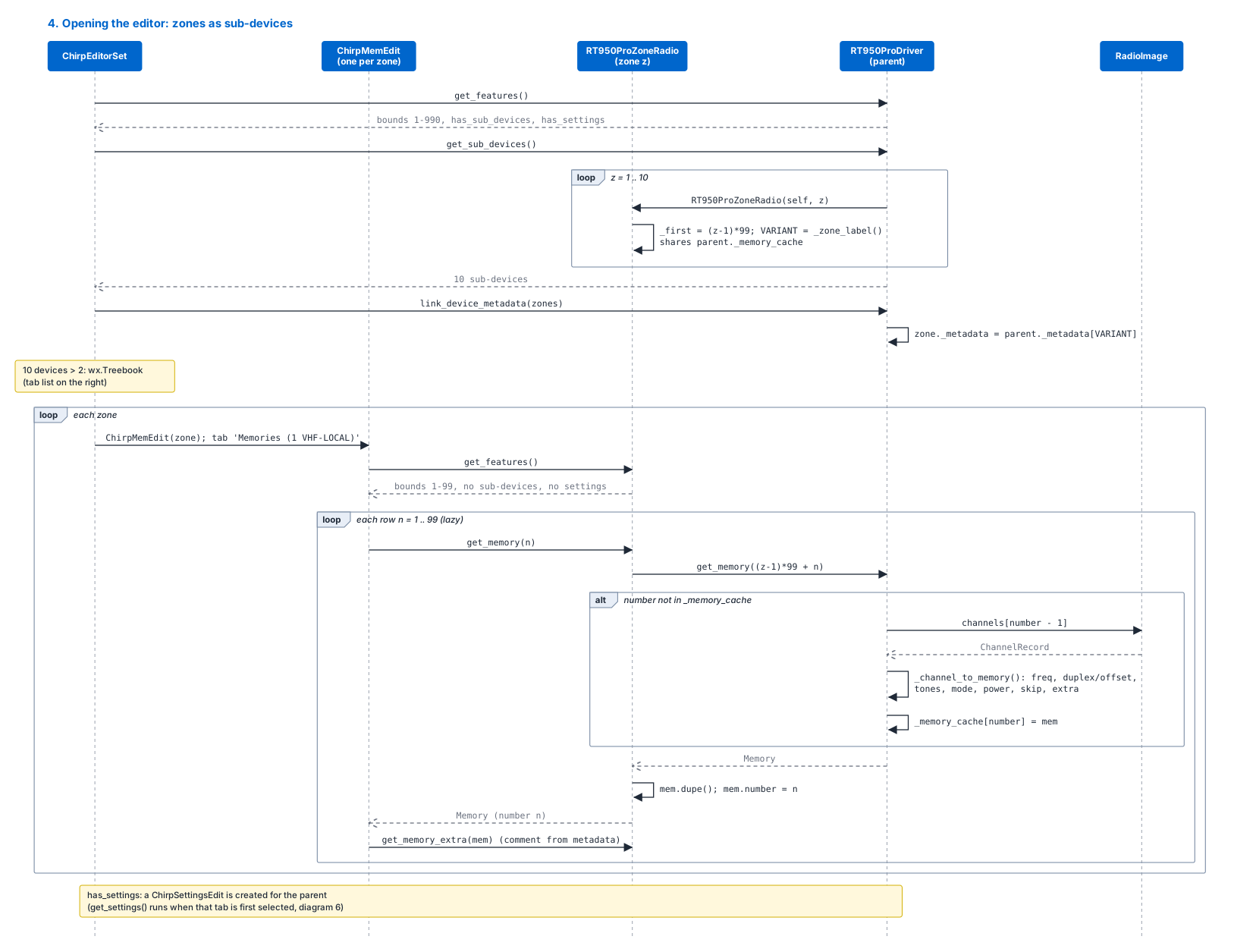
7.1 Tabs
ChirpEditorSet asks the parent for its features. In Zone CH Mode
has_sub_devices is set, so it calls get_sub_devices() and gets ten new
RT950ProZoneRadio objects (All CH Mode: §7.4). Each one:
- stores the parent, its zone number and
_first = (zone − 1) × 99; - sets
VARIANTfrom the zone name:"1 VHF-LOCAL"for a named zone,"Zone 1"for an empty name. CHIRP uses it in the tab titleMemories (1 VHF-LOCAL); - shares the parent's
_memory_cacheand reads the parent's image through the_imageproperty (assignments to_imageon a zone are ignored); - deliberately does not call CHIRP's constructor: it has no port, file
or memory map of its own. It sets the attributes CHIRP expects
(
pipe,_mmap,_memobj,_metadata,errors) itself.
CHIRP then calls link_device_metadata(zones), which points each zone's
_metadata at parent._metadata[VARIANT], so per-zone data ends up in the
parent's image metadata when saving. With more than two devices, or with
has_dynamic_subdevices set (always, since 0.1.7), CHIRP uses a
wx.Treebook, which puts the tab list on the right (the optional
tools/chirp_list_left.py patch moves it).
As has_settings is set on the parent, CHIRP also creates a settings editor
for the parent radio (§10).
7.2 Memory numbering
| View | Numbers | Mapping |
|---|---|---|
| Zone tab z (Zone CH Mode) | 1–99 | parent memory (z − 1) × 99 + n |
| Single list (All CH Mode) | 1–990 | the parent itself: memory n is radio channel n |
| Parent (driver API, tests) | 1–990 | slot number − 1 in RadioImage.channels |
| Radio address | – | (number − 1) × 32 |
RT950ProZoneRadio.get_memory(n) asks the parent for memory
_first + n, takes a dupe() and renumbers it to n. The parent builds the
Memory with _channel_to_memory() on first use and caches it by its
1–990 number until the memory, the settings or the image change.
7.3 Memory comments
The driver does not store comments. CHIRP's ExternalMemoryProperties
(get_memory_extra / set_memory_extra) keeps them in the zone's
_metadata['mem_extra'], which is linked to parent._metadata[VARIANT]
and saved in the .img metadata. They are never sent to the radio. In All
CH Mode CHIRP keeps them in the parent's own _metadata['mem_extra'],
by memory number 1–990 (see §15, item 6).
7.4 Channel Divide: zone tabs or one list
The radio setting Channel Divide (function byte 0x9026: 0 Zone CH
Mode, 1 All CH Mode, measured with the CPS) decides the view. The driver
reads it from the image in _all_channels_mode(); only 1 counts as All
CH Mode, so 0xFF (not set) or an unknown value gives the zone view.
| Zone CH Mode | All CH Mode | |
|---|---|---|
get_features().has_sub_devices |
True |
False |
get_sub_devices() |
ten RT950ProZoneRadio |
[] |
| What CHIRP shows | ten zone tabs, memories 1–99 | one list Memories: the parent, memories 1–990 |
| Empty channels | empty rows in their zone | empty rows at their place in 1–990; nothing is moved up |
The channel records are the same in both modes; only the numbering in the view differs (§7.2).
In the settings the setting is a list Channel Divide (Function Settings)
with the CPS choices Zone CH Mode and All CH Mode. It is marked
volatile (RadioSetting.set_volatile(True)), and get_features() sets
has_dynamic_subdevices. When the user changes it, CHIRP
(settingsedit.py, common.py):
- shows "Changing this setting requires refreshing the settings from the image, which will happen now.";
- calls
set_settings(), which stores the new value in the image (one byte) — synchronously for a clone-mode radio; - because
has_dynamic_subdevicesis set, posts anEditorRefreshevent;_reload_editorset()inmain.pybuilds a newChirpEditorSetfor the same radio object and file name, keeps the modified flag, and replaces the old one. The new editor set callsget_features()andget_sub_devices()again, so it shows the other view.
Nothing is saved or reread from disk; unsaved edits stay in the image. On a
CHIRP version without has_dynamic_subdevices the driver leaves the flag
out; CHIRP then only refreshes the settings tab, and the new view appears
after the image is saved and reopened.
8. Memory ↔ channel record mapping
8.1 Radio → CHIRP (_channel_to_memory)
CHIRP Memory field |
Source in ChannelRecord |
|---|---|
empty |
True when rx_hz is None (RX frequency bytes all 0x00/0xFF); nothing else is filled |
freq |
rx_hz |
duplex, offset |
TX missing or equal to RX → "", 0; RX and TX in different bands of VALID_BANDS (chirp_common.is_split) → split, TX frequency; otherwise TX above RX → +, difference; TX below RX → -, difference |
name |
name, stripped |
tmode, rtone, ctone, dtcs, rx_dtcs, dtcs_polarity |
see §8.3 |
mode |
AM if rx_modulation is AM, else NFM (narrow) or FM (wide) |
power |
PowerLevel → Low / Medium / High |
skip |
"" if scan_add, else S |
extra |
group RT-950 Pro Extras: scrambler (0–8), encryption (0–3) |
Not shown in CHIRP but kept: signalling group, PTT ID, busy lockout, TX-enable flag, and learn-FHSS and FHSS code until the memory is edited (they are then cleared, §8.2). An unedited record is written back byte for byte (§9).
8.2 CHIRP → radio (_apply_memory_to_channel)
ChannelRecord field |
From Memory |
|---|---|
rx_hz, tx_hz, name |
empty memory: None, None, "" (other fields unchanged) |
rx_hz |
freq |
tx_hz |
+: freq + offset; -: freq − offset; split: offset; else freq |
name |
name, stripped (encoded later as GB2312, max. 12 bytes) |
tx_tone, rx_tone |
see §8.3 |
scrambler |
extra['scrambler'], 0–8, otherwise 0 |
encryption |
extra['encryption'], 0–3, otherwise 0 |
learn_fhss, fhss_code |
always cleared |
rx_modulation, bandwidth |
118–137 MHz: AM, wide, tx_enabled = False; 18–64 MHz: FM, narrow for NFM; otherwise AM/wide for AM, FM narrow/wide for NFM/FM |
power |
CHIRP label Low/Medium/High; unknown label leaves it unchanged |
scan_add |
skip != "S" |
tx_enabled is only ever cleared (airband), never set back to True.
8.3 Tones
Both directions use CHIRP's own helpers, so every CHIRP tone mode
including Cross is supported (has_cross = True, valid_cross_modes =
chirp_common.CROSS_MODES).
Radio → CHIRP (_apply_tones): each radio tone becomes a CHIRP tone spec
(_tone_to_chirp) and chirp_common.split_tone_decode picks the mode:
| TX tone | RX tone | CHIRP result |
|---|---|---|
| off | off | tmode = "" |
| CTCSS | off | Tone, rtone = TX |
| CTCSS | same CTCSS | TSQL, ctone = TX tone |
| DCS | same DCS code | DTCS, dtcs = the code (rx_dtcs stays 023), polarity TX + RX |
| any other combination | Cross with the matching cross_mode, e.g. ->Tone (RX tone only), DTCS-> (TX DCS only), Tone->Tone (two different CTCSS tones), DTCS->Tone, Tone->DTCS, DTCS->DTCS (two different codes) |
The radio's inverted DCS polarity I is given to CHIRP as reverse R;
normal stays N. dtcs and rx_dtcs are set to a valid code (023) and
the polarity to NN first, because CHIRP's CSV export checks them even
when tmode is not DTCS.
CHIRP → radio (_update_tones_from_memory): chirp_common.split_tone_encode
gives a TX and an RX tone spec for every mode, including Cross; each spec
becomes a radio tone (_tone_from_chirp). CHIRP's R is stored as the
radio's I. A DCS code of 0 is stored as no tone. The CHIRP memory is not
modified.
In CHIRP's memory grid, choosing Cross as Tone Mode opens a dialog that
asks for the cross mode; in the memory's Properties dialog all tone
fields can be set at once.
9. Editing and deleting a memory
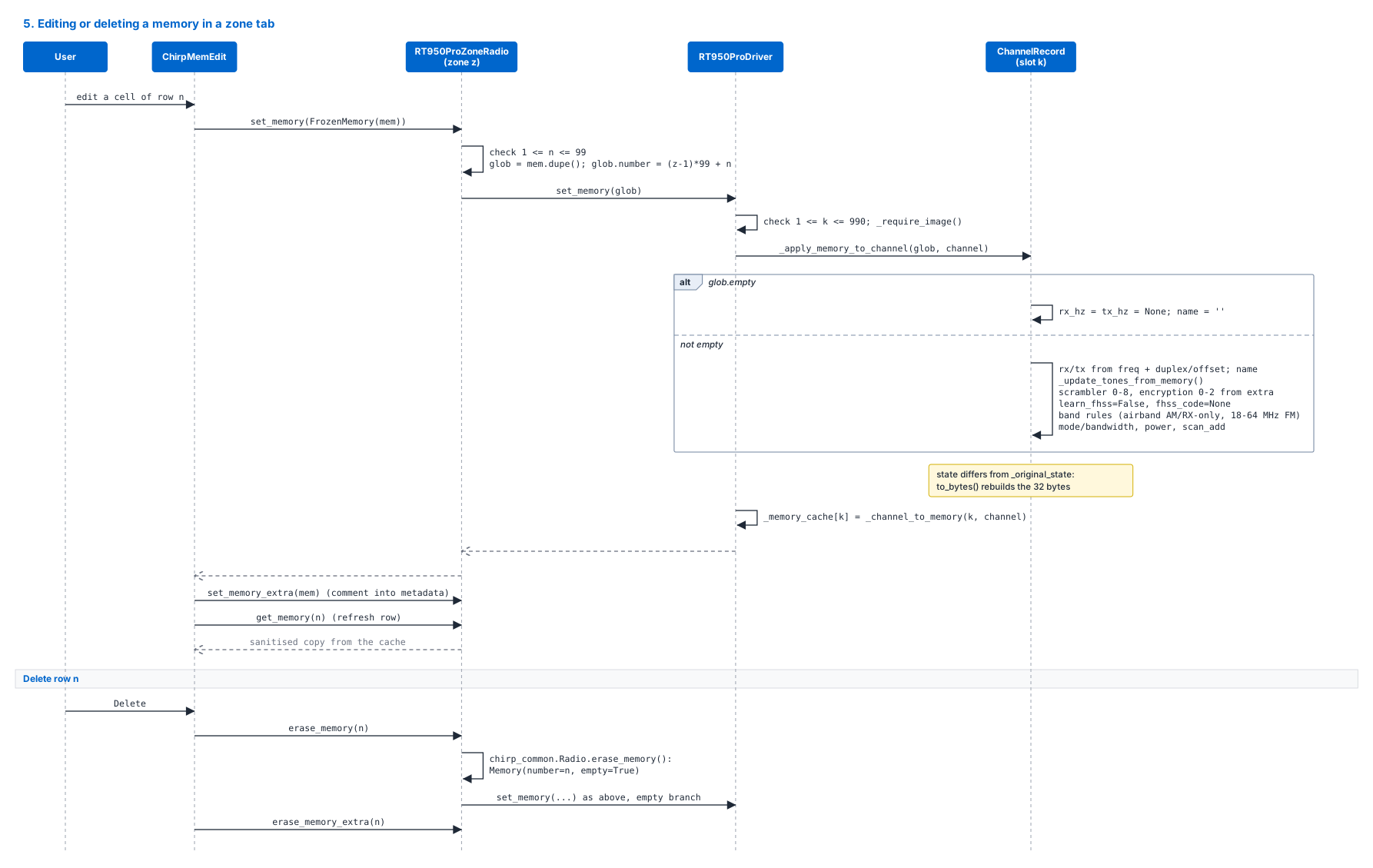
- CHIRP's memory editor wraps the edited memory in
FrozenMemory(mem, strict=False)and callsset_memory()on the zone. The zone checks the number (1–99), takes adupe(), renumbers it to(zone − 1) × 99 + nand passes the copy to the parent, so CHIRP's frozen object is never modified on this path. - The parent checks the number (1–990), updates the
ChannelRecordin place (§8.2), converts the record back to aMemoryand caches that sanitised version. CHIRP's refresh (get_memory) shows it, so the user sees what will actually be written (e.g. AM forced in the airband). - The record now differs from its
_original_state; at the nextto_bytes()it is rebuilt from its fields instead of returning the original 32 bytes. - Deleting uses CHIRP's default
Radio.erase_memory(): it buildsMemory(number=n, empty=True)and calls the zone'sset_memory(). The driver then clears RX, TX and name only; the RX frequency0xFF × 4marks the slot empty on the radio.
No serial traffic happens while editing; everything changes the in-memory
RadioImage only.
10. Settings
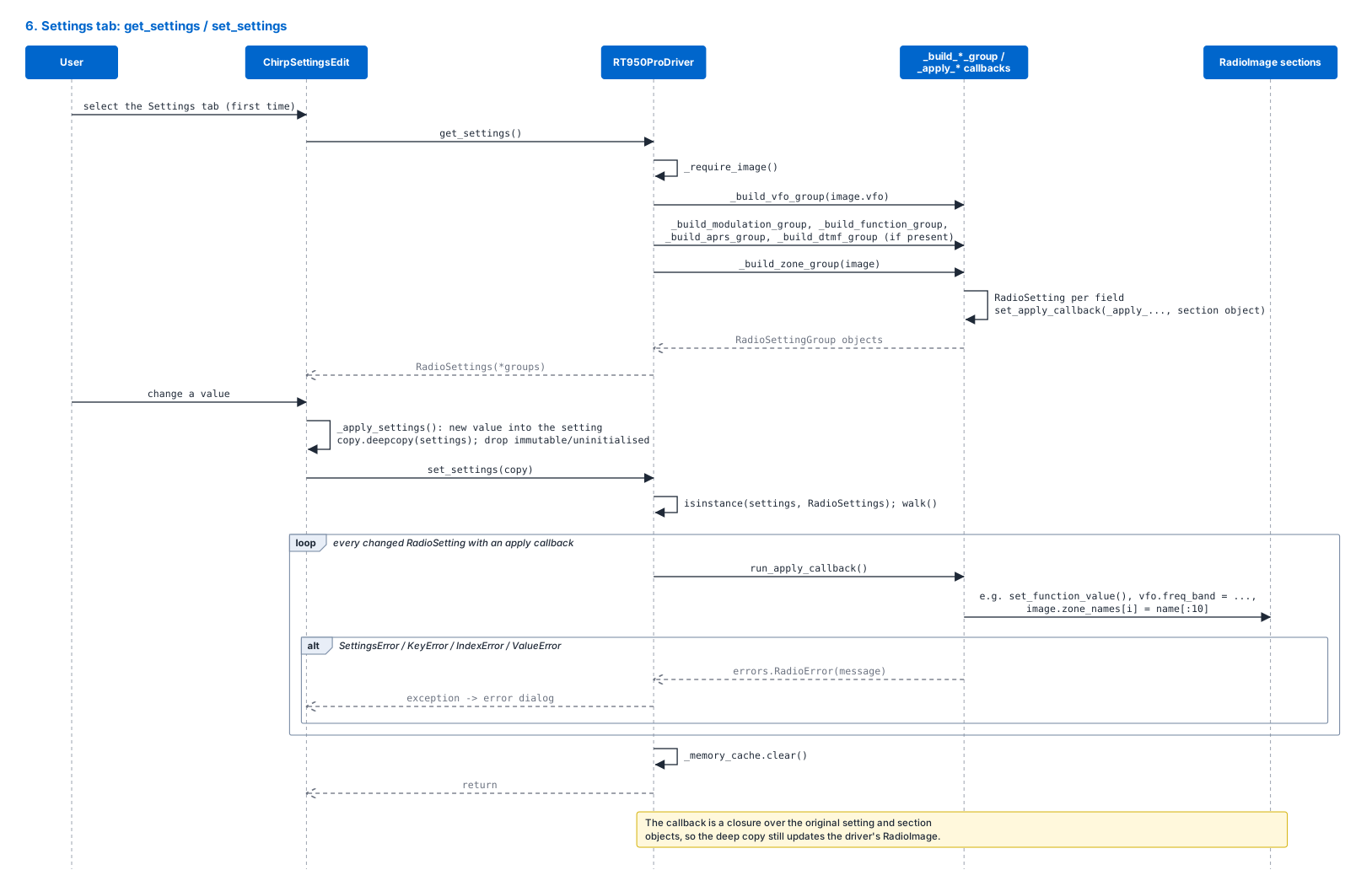
CHIRP calls get_settings() the first time the Settings tab is selected.
The driver builds a RadioSettings tree from the image; a group is left out
when its section is missing from the image (VFO also when the list is empty),
except Zone Names, which is always present:
| Group | Builder | Content |
|---|---|---|
| VFO Profiles | _build_vfo_group |
per VFO (VFO-A to VFO-C) the fields of the CPS VFO Mode screen, with its labels, choices and order: Rx Freq, Rx QT/DQT, Tx QT/DQT, Busy Lockout, Offset Dir, Signalling, Tx Power, Scramble, Bandwidth, Encryption, RxModulation, Freq Band (read-only), Step Freq, Offset Freq |
| Broadcast/Modulation | _build_modulation_group |
current FM/AM/SSB channel, work mode, modulation mode, AM/SSB step and RX gain; FM, AM and SSB memories (frequency, name; SSB also bandwidth and beat offset) |
| Function Settings | _build_function_group |
the 27 keys of _FUNCTION_UI (squelch, VOX, time-out, beeps, display modes, …, Channel Divide) |
| APRS Settings | _build_aprs_group |
the 11 keys of _APRS_UI (enable, GPS, callsign, SSID, priority, custom message, …) |
| DTMF Settings | _build_dtmf_group |
own ID, PTT ID mode, code groups 1–5 (of 22) |
| Zone Names | _build_zone_group |
ten strings, max. 12 ASCII characters |
Every RadioSetting gets an apply callback bound to the object it
changes (a VFOSettings entry, the FunctionSettings, APRSSettings,
DTMFSettings, ModulationSettings, or the RadioImage for zone names).
When the user changes a value, CHIRP puts the new value into its settings
tree, makes a copy.deepcopy() of the tree, removes immutable and
uninitialised settings, and calls set_settings(copy). The driver walks the
tree and runs the apply callback only of settings whose changed() is
True; CHIRP marks a setting as changed once its value has been set in this
editor session, and the mark stays until CHIRP rebuilds the settings tab
with get_settings() (for example when the image is reopened). A setting
object without changed() always has its callback run. The callbacks still
update the driver's own objects: CHIRP stores the callback
as a closure (lambda: callback(self, *args)), and deepcopy keeps
functions by reference, so the closure still refers to the original setting
and section objects. The callbacks validate through the settings API
(set_function_value, set_aprs_value, set_dtmf_*). Error wrapping
differs per group:
| Callbacks | Wrapped into errors.RadioError |
|---|---|
_apply_function_setting, _apply_aprs_setting |
SettingsError, KeyError, IndexError, ValueError |
_apply_dtmf_id, _apply_dtmf_mode |
SettingsError |
_apply_dtmf_group |
SettingsError, IndexError |
_apply_vfo_frequency, _apply_vfo_offset |
ValueError |
_apply_modulation_channel_frequency |
none: an invalid frequency raises a plain ValueError |
CHIRP shows any exception from set_settings() as an error dialog. Because
the callbacks run in tree order, an exception also stops the callbacks after
it. If all succeed, the memory cache is cleared.
Because only changed settings are applied, opening the Settings tab and
applying an edit of one setting leaves all other settings as they were read.
The list callbacks (VFO, modulation) also store a value only when the chosen
label is one of the offered choices, so a stored value shown as
Unknown (<value>) is kept. Two VFO values are not shown as unknown: a
power nibble above 2 is read as Low, and a tone with a DCS index the driver
does not know is shown as OFF.
A renamed zone gets its new tab title only when the sub-devices are created again, i.e. after the image is reopened (or after Channel Divide is changed, which rebuilds the editor; §7.4).
11. Saving an .img file
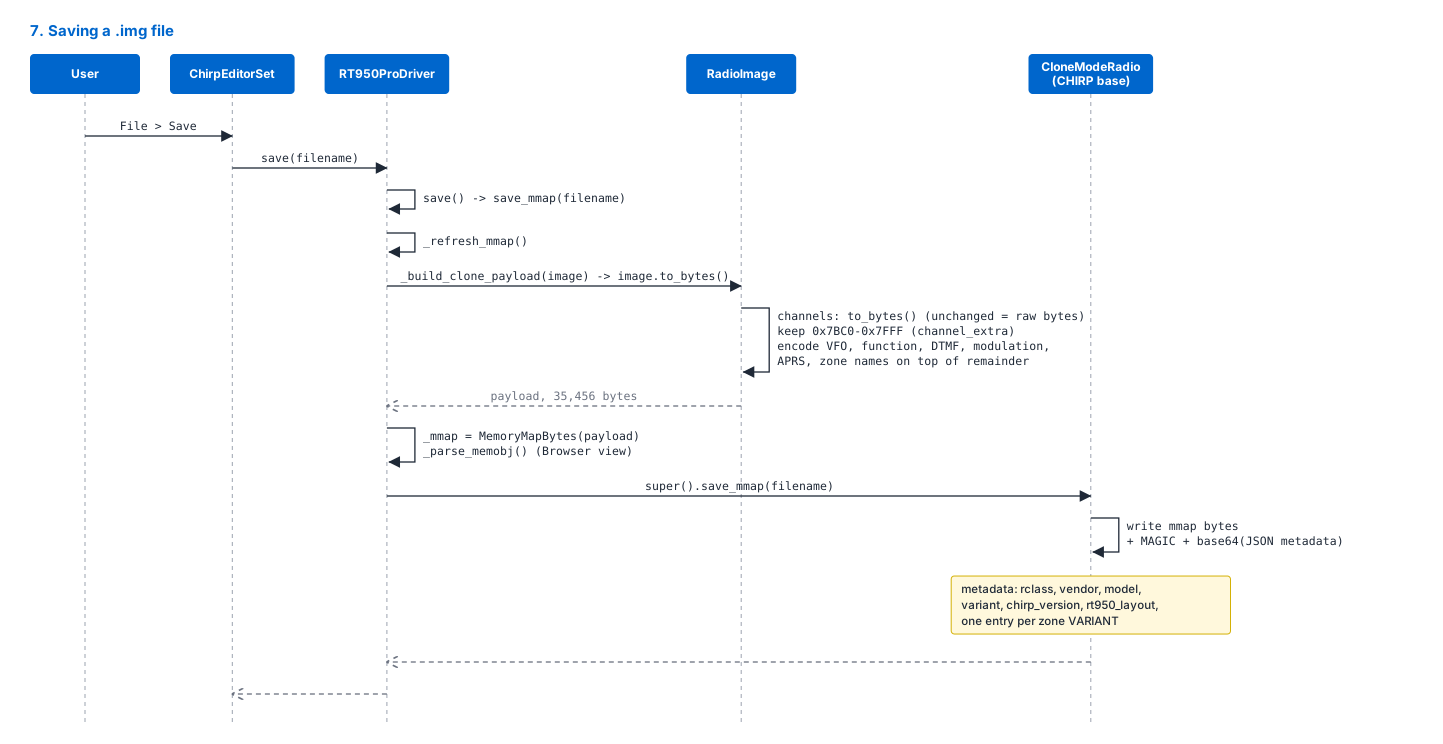
CHIRP's save() calls save_mmap(). The driver first rebuilds CHIRP's memory
map from the RadioImage (_refresh_mmap → _build_clone_payload →
RadioImage.to_bytes()), then lets CHIRP's CloneModeRadio.save_mmap()
write the file:
[35,456 image bytes] [MAGIC b'\x00\xffchirp\xeeimg\x00\x01'] [base64(JSON metadata)]
The metadata contains CHIRP's own keys (rclass, vendor, model,
variant, chirp_version), the driver's rt950_layout (when the image
came from a download, or from a file that already had it) and one entry per
zone VARIANT with that zone's mem_extra comments.
to_bytes() writes unedited channel records and VFO entries back
byte-identical and keeps 0x7BC0–0x7FFF and unknown bytes. The modulation
and APRS encoders compare each field with the bytes that were read and write
only the fields that were edited, so an unedited image is saved
byte-identical. An edited channel record keeps the high nibbles of bytes 12
and 13, which the driver does not use.
12. Upload to the radio
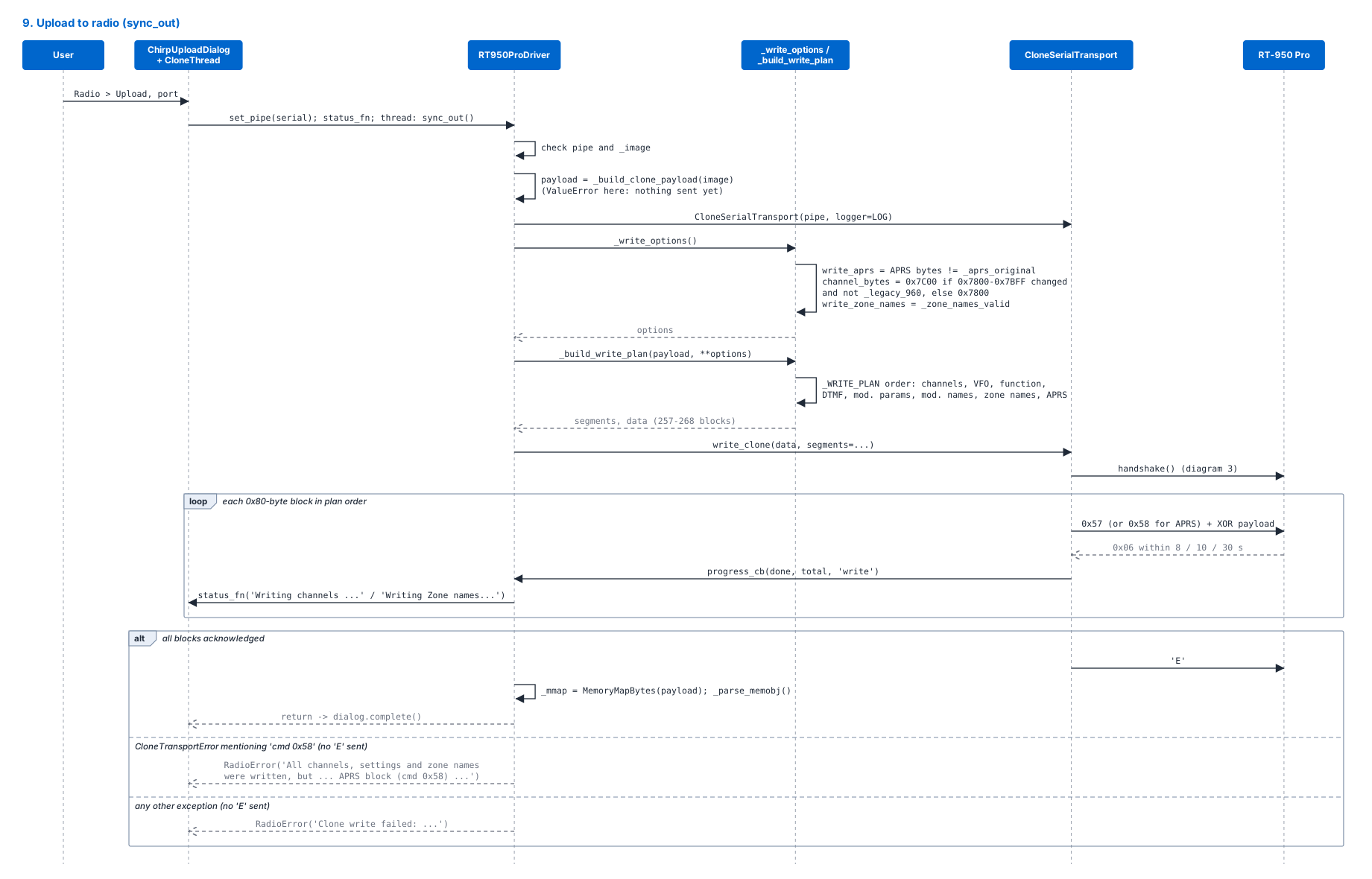
CHIRP's upload dialog opens the port, calls set_pipe(serial) on the radio
that is open in the editor and runs sync_out() in a CloneThread.
sync_out()refuses to start without a port or an image (RadioError).- It builds the complete payload. A record that cannot be encoded
raises
ValueErrorhere, before anything is sent. _write_options()decides the optional parts:Option Rule channel_bytes0x7C00(channels 1–990) only when bytes0x7800–0x7BFFdiffer from the snapshot taken inprocess_mmap()and the image is not a legacy 960-slot image; otherwise0x7800(channels 1–960)write_zone_names_zone_names_valid(zone names were read from0xC000)write_aprsthe APRS block differs from its snapshot _build_write_plan()cuts the payload into segments in_WRITE_PLANorder: channels, VFO, function, DTMF, modulation parameters, modulation names, zone names, APRS last. Of the function segment only0x9000–0x907Fis written (one block);0x9080–0x90FFis left to the radio, seememory-map.md. That is 257 blocks minimum (no zone names, no APRS), 259 typically, 268 maximum.write_clone()performs the handshake and writes block by block; the progress callback reportsWriting channels …/Writing Zone names….- Errors:
- a missing ACK on the APRS block (message contains
cmd 0x58) →RadioError('All channels, settings and zone names were written, but the radio did not acknowledge the APRS block (cmd 0x58); APRS changes may NOT be saved. Power-cycle the radio and read back.'); - any other failure →
RadioError('Clone write failed: …'), e.g.No ACK for write cmd 0x57 address 0xC000 (Serial read timed out). This includes a wrong ACK byte on the APRS block (Write ACK mismatch at 0x0000: …), which does not containcmd 0x58.
- a missing ACK on the APRS block (message contains
- On success CHIRP's memory map is replaced by the payload that was built in step 2.
Never written: 0x7C00–0x7FFF, 0x9080–0x90FF and anything from 0xE000.
13. Errors and logging
| Situation | Raised in driver | What CHIRP shows |
|---|---|---|
| Serial time-out, missing or wrong ACK, short write | CloneTransportError |
wrapped: Clone read failed: … / Clone write failed: … |
| APRS block: no ACK | CloneTransportError (cmd 0x58) |
dedicated RadioError message (§12) |
| APRS block: wrong ACK byte | CloneTransportError (Write ACK mismatch) |
generic Clone write failed: … |
| No port / no image | RadioError |
message in the clone dialog |
| Image cannot be parsed | ValueError → RadioError('Failed to parse memory map: …') |
open fails |
| Memory number out of range | RadioError |
row error |
| Setting value rejected | SettingsError etc., mostly wrapped in RadioError (§10) |
error dialog in the settings tab |
| Record cannot be encoded (e.g. an unsupported CTCSS tone) | ValueError |
save / upload fails before sending |
Loggers are named after the module: chirp.drivers.radtel_rt950pro when
copied into the driver directory, chirp.loaded.<file name> when loaded as a
module (from the issue that is a temporary loaded-… name):
- the module name itself (
LOG): driver messages and, becausesync_in()andsync_out()passlogger=LOGto the transport, also the protocol trace at debug level (commands, addresses, XOR key); ….image(CHANNEL_LOG): decode and encode warnings ofRadioImage, such as altered channel names;….transport: only used when a transport is created without a logger (external callers; the tools and tests in this repository passLOG).
Inside CHIRP these messages appear in CHIRP's debug log.
14. Running without CHIRP
When from chirp import … fails, the module defines minimal stand-ins for
chirp_common (Memory, RadioFeatures, CloneModeRadio, PowerLevel,
format_freq, parse_freq), directory.register, errors.RadioError,
memmap.MemoryMapBytes and the chirp.settings classes. They exist so that
pydoc and docs/build.py can import the module. There is no bitwise
stand-in, so _parse_memobj() fails silently and _memobj stays None.
The stand-ins lack, among others, chirp_common.Status, DTCS_CODES,
CHARSET_ASCII, CROSS_MODES, is_split and split_tone_decode/encode.
HAVE_CHIRP is then False, and get_features(), get_settings(),
get_memory() and set_memory() raise RadioError ("… needs CHIRP …")
before using them; other methods may fail with AttributeError.
The tests in tests/ therefore run against a CHIRP source tree
(CHIRP_SRC); tests/test_cleanup.py checks the error in a subprocess
with CHIRP blocked.
15. Observations from this analysis
Found while tracing the interface; not in the known-issues list of
status.md and not changed in the code.
- Snapshots are not refreshed after an upload.
_aprs_originaland_high_channels_originalare only set inprocess_mmap(). After a successfulsync_out()the driver replaces_mmapbut keeps the old snapshots, so a second upload in the same session writes the APRS block (and0x7800–0x7BFF) again if they differ from the download, even when nothing changed since the first upload. Effect: an extra, slow APRS write; no wrong data. - Zone rename and memory comments. CHIRP stores memory comments under
the zone's
VARIANT(§7.3), andVARIANTcontains the zone name. After a rename, a save and a reopen, the zone has a newVARIANT, so comments saved under the old name are no longer found (they remain in the file's metadata). - Progress text past channel 990. The channel segment is read as 256
blocks, but blocks 249–256 (
0x7C00–0x7FFF) contain no channels. The read progress then showsReading channels 993-990…up toReading channels 1021-990…. Cosmetic. - Repeated work in
sync_out(). With a status callback,_write_options()runs three times and the payload is built four times (once insync_out(), once in each_write_options()call). Correct but redundant. - Developer Browser tab is a snapshot. CHIRP's Browser reads
radio._memobj, which is rebuilt only inprocess_mmap(),save_mmap()and aftersync_out(). After a memory or settings edit it shows the old bytes until the next save or upload. Edits made in the Browser are never parsed back into theRadioImageand are overwritten by the next_refresh_mmap(). - Memory comments differ per view. CHIRP keys comments by memory
number in the metadata of the device that shows the memory (§7.3): in
Zone CH Mode per zone (
_metadata[VARIANT], numbers 1–99), in All CH Mode in the parent (numbers 1–990). A comment made in one view is not shown in the other (it remains in the file's metadata).
Sources
- Driver:
radtel_rt950pro.py0.1.6,docs/memory-map.md,docs/protocol.md,docs/status.md. - CHIRP: kk7ds/chirp at commit
0a9be8e—chirp/chirp_common.py(CloneModeRadio,ExternalMemoryProperties,Radio.erase_memory),chirp/directory.py(register,get_radio_by_image,import_drivers),chirp/settings.py(RadioSetting.set_apply_callback),chirp/wxui/main.py(ChirpEditorSet,load_module),chirp/wxui/clone.py(CloneThread, download and upload dialogs),chirp/wxui/memedit.py(set_memory,erase_memory),chirp/wxui/settingsedit.py(_changed). - CHIRP issue #12180.
API reference
Every class, function, method, field and constant, public and private, grouped by driver layer.
1. Channel records
ToneSetting, ChannelRecord and the BCD/GB2312 codecs for the 32-byte channel structure.
Design: B5
416class ToneMode(Enum):
417    """Kind of sub-audio tone used by a channel for transmit or receive."""
418
419    OFF = "off"
420    """No tone; carrier squelch."""
421    CTCSS = "ctcss"
422    """Analog sub-audio tone (``ctcss_hz``)."""
423    DCS = "dcs"
424    """Digital coded squelch (``dcs_code`` and ``dcs_polarity``)."""
Kind of sub-audio tone used by a channel for transmit or receive.
427@dataclass(slots=True)
428class ToneSetting:
429    """Transmit or receive tone of one channel or VFO.
430
431    The radio stores a tone in two bytes:
432
433    * ``00 00`` (or ``FF FF``): no tone.
434    * ``nn 00``: DCS, ``nn`` is a 1-based index into ``_DCS_CODES``.
435    * otherwise: CTCSS in tenths of a hertz, little-endian.
436
437    An instance remembers the bytes it was decoded from. As long as the
438    tone is not changed, :meth:`to_bytes` returns those original bytes, so
439    unknown encodings survive a read/write cycle unchanged.
440    """
441
442    mode: ToneMode
443    """Tone kind."""
444    ctcss_hz: Optional[float] = None
445    """CTCSS frequency in Hz when ``mode`` is CTCSS."""
446    dcs_code: Optional[int] = None
447    """DCS code as an octal-looking integer (e.g. ``23`` for D023) when
448    ``mode`` is DCS.
449    """
450    dcs_polarity: Optional[str] = None
451    """``"N"`` (normal) or ``"I"`` (inverted) for DCS."""
452    _raw_bytes: bytes = field(default=b"", repr=False, compare=False)
453    """The two bytes this tone was decoded from (empty for a new tone).
454    Returned unchanged by :meth:`to_bytes` while the tone is not edited.
455    """
456    _original_state: Optional[tuple] = field(
457        default=None, repr=False, compare=False)
458    """``(mode, ctcss_hz, dcs_code, dcs_polarity)`` when the tone was
459    created or last encoded; compared with the current state to detect an
460    edit.
461    """
462
463    def __post_init__(self) -> None:
464        """Snapshot the initial state for change tracking."""
465        if self._original_state is None:
466            object.__setattr__(self, "_original_state", self._state_tuple())
467
468    def _state_tuple(self) -> tuple:
469        """Return the user-visible fields as a tuple for change detection.
470
471        Returns:
472            tuple: ``(mode, ctcss_hz, dcs_code, dcs_polarity)``.
473        """
474        return (
475            self.mode,
476            self.ctcss_hz,
477            self.dcs_code,
478            self.dcs_polarity,
479        )
480
481    @property
482    def is_off(self) -> bool:
483        """Whether no tone is set (``mode`` is OFF)."""
484        return self.mode is ToneMode.OFF
485
486    @classmethod
487    def off(cls) -> "ToneSetting":
488        """Create a tone setting without a tone.
489
490        Returns:
491            ToneSetting: A setting with ``mode`` OFF.
492        """
493        return cls(ToneMode.OFF)
494
495    @classmethod
496    def ctcss(cls, hz: float) -> "ToneSetting":
497        """Create a CTCSS tone setting.
498
499        Args:
500            hz: CTCSS frequency in hertz, e.g. ``88.5``.
501
502        Returns:
503            ToneSetting: A setting with ``mode`` CTCSS.
504        """
505        return cls(ToneMode.CTCSS, ctcss_hz=hz)
506
507    @classmethod
508    def dcs(cls, code: int, polarity: str) -> "ToneSetting":
509        """Create a DCS tone setting.
510
511        Args:
512            code: DCS code as written, e.g. ``23`` for D023.
513            polarity: ``"N"`` or ``"I"`` (case-insensitive).
514
515        Returns:
516            ToneSetting: A setting with ``mode`` DCS.
517        """
518        return cls(ToneMode.DCS, dcs_code=code, dcs_polarity=polarity.upper())
519
520    def to_display(self) -> str:
521        """Format the tone the way the CPS shows it.
522
523        Returns:
524            str: ``"OFF"``, a CTCSS value such as ``"88.5"`` or a DCS code
525            such as ``"D023N"``.
526        """
527        if self.mode is ToneMode.OFF:
528            return "OFF"
529        if self.mode is ToneMode.CTCSS and self.ctcss_hz is not None:
530            return f"{self.ctcss_hz:.1f}"
531        if (self.mode is ToneMode.DCS and self.dcs_code is not None
532                and self.dcs_polarity):
533            return f"D{self.dcs_code:03}{self.dcs_polarity.upper()}"
534        return "OFF"
535
536    def to_bytes(self) -> bytes:
537        """Encode the tone into the radio's two-byte format.
538
539        Unchanged tones return the bytes they were decoded from. A DCS or
540        CTCSS tone without a code, polarity or frequency encodes as ``00 00``
541        (no tone). After encoding, the new bytes become the reference for
542        the next change check.
543
544        Returns:
545            bytes: Two bytes as stored in a channel or VFO record.
546
547        Raises:
548            ValueError: If the DCS code is not in ``_DCS_CODES`` or the
549                CTCSS value is not within 0.1-6553.5 Hz.
550        """
551        current_state = self._state_tuple()
552        if (
553            self._original_state is not None
554            and current_state == self._original_state
555            and self._raw_bytes
556        ):
557            return self._raw_bytes
558
559        if self.mode is ToneMode.OFF:
560            result = b"\x00\x00"
561        elif self.mode is ToneMode.DCS and self.dcs_code is not None and self.dcs_polarity:
562            token = f"D{self.dcs_code:03}{self.dcs_polarity.upper()}"
563            try:
564                index = _DCS_CODES.index(token)
565            except ValueError as exc:
566                raise ValueError(f"Unsupported DCS code {token}") from exc
567            result = bytes((index + 1, 0x00))
568        elif self.mode is ToneMode.CTCSS and self.ctcss_hz is not None:
569            value = int(round(self.ctcss_hz * 10))
570            if value <= 0 or value > 0xFFFF:
571                raise ValueError(f"CTCSS value out of range: {self.ctcss_hz}")
572            result = bytes((value & 0xFF, (value >> 8) & 0xFF))
573        else:
574            result = b"\x00\x00"
575
576        object.__setattr__(self, "_raw_bytes", result)
577        object.__setattr__(self, "_original_state", current_state)
578        return result
579
580    @staticmethod
581    def from_bytes(raw: bytes) -> "ToneSetting":
582        """Decode a two-byte tone field.
583
584        Unknown DCS indexes are logged and decoded as OFF; the original bytes
585        are kept, so they are written back unchanged unless the tone is edited.
586
587        Args:
588            raw: The two tone bytes from a channel or VFO record.
589
590        Returns:
591            ToneSetting: The decoded tone, remembering ``raw``.
592
593        Raises:
594            ValueError: If ``raw`` is not exactly two bytes long.
595        """
596        if len(raw) != 2:
597            raise ValueError("Tone bytes must be length 2")
598        first, second = raw
599        if first == 0 and second == 0:
600            setting = ToneSetting.off()
601        elif second == 0:
602            index = first
603            if 1 <= index <= len(_DCS_CODES):
604                token = _DCS_CODES[index - 1]
605                code = int(token[1:4])
606                polarity = token[4]
607                setting = ToneSetting.dcs(code, polarity)
608            else:
609                LOG.warning("Unknown DCS index %s", index)
610                setting = ToneSetting.off()
611        else:
612            value = (second << 8) | first
613            if value == 0xFFFF:
614                setting = ToneSetting.off()
615            else:
616                hz = value / 10.0
617                setting = ToneSetting.ctcss(hz)
618
619        object.__setattr__(setting, "_raw_bytes", bytes(raw))
620        object.__setattr__(setting, "_original_state", setting._state_tuple())
621        return setting
Transmit or receive tone of one channel or VFO.
The radio stores a tone in two bytes:
00 00(orFF FF): no tone.nn 00: DCS,nnis a 1-based index into_DCS_CODES.- otherwise: CTCSS in tenths of a hertz, little-endian.
An instance remembers the bytes it was decoded from. As long as the
tone is not changed, to_bytes() returns those original bytes, so
unknown encodings survive a read/write cycle unchanged.
The two bytes this tone was decoded from (empty for a new tone).
Returned unchanged by to_bytes() while the tone is not edited.
(mode, ctcss_hz, dcs_code, dcs_polarity) when the tone was
created or last encoded; compared with the current state to detect an
edit.
481    @property
482    def is_off(self) -> bool:
483        """Whether no tone is set (``mode`` is OFF)."""
484        return self.mode is ToneMode.OFF
Whether no tone is set (mode is OFF).
463    def __post_init__(self) -> None:
464        """Snapshot the initial state for change tracking."""
465        if self._original_state is None:
466            object.__setattr__(self, "_original_state", self._state_tuple())
Snapshot the initial state for change tracking.
495    @classmethod
496    def ctcss(cls, hz: float) -> "ToneSetting":
497        """Create a CTCSS tone setting.
498
499        Args:
500            hz: CTCSS frequency in hertz, e.g. ``88.5``.
501
502        Returns:
503            ToneSetting: A setting with ``mode`` CTCSS.
504        """
505        return cls(ToneMode.CTCSS, ctcss_hz=hz)
Create a CTCSS tone setting.
Arguments:
- hz: CTCSS frequency in hertz, e.g.
88.5.
Returns:
ToneSetting: A setting with
modeCTCSS.
507    @classmethod
508    def dcs(cls, code: int, polarity: str) -> "ToneSetting":
509        """Create a DCS tone setting.
510
511        Args:
512            code: DCS code as written, e.g. ``23`` for D023.
513            polarity: ``"N"`` or ``"I"`` (case-insensitive).
514
515        Returns:
516            ToneSetting: A setting with ``mode`` DCS.
517        """
518        return cls(ToneMode.DCS, dcs_code=code, dcs_polarity=polarity.upper())
Create a DCS tone setting.
Arguments:
- code: DCS code as written, e.g.
23for D023. - polarity:
"N"or"I"(case-insensitive).
Returns:
ToneSetting: A setting with
modeDCS.
520    def to_display(self) -> str:
521        """Format the tone the way the CPS shows it.
522
523        Returns:
524            str: ``"OFF"``, a CTCSS value such as ``"88.5"`` or a DCS code
525            such as ``"D023N"``.
526        """
527        if self.mode is ToneMode.OFF:
528            return "OFF"
529        if self.mode is ToneMode.CTCSS and self.ctcss_hz is not None:
530            return f"{self.ctcss_hz:.1f}"
531        if (self.mode is ToneMode.DCS and self.dcs_code is not None
532                and self.dcs_polarity):
533            return f"D{self.dcs_code:03}{self.dcs_polarity.upper()}"
534        return "OFF"
Format the tone the way the CPS shows it.
Returns:
str:
"OFF", a CTCSS value such as"88.5"or a DCS code such as"D023N".
536    def to_bytes(self) -> bytes:
537        """Encode the tone into the radio's two-byte format.
538
539        Unchanged tones return the bytes they were decoded from. A DCS or
540        CTCSS tone without a code, polarity or frequency encodes as ``00 00``
541        (no tone). After encoding, the new bytes become the reference for
542        the next change check.
543
544        Returns:
545            bytes: Two bytes as stored in a channel or VFO record.
546
547        Raises:
548            ValueError: If the DCS code is not in ``_DCS_CODES`` or the
549                CTCSS value is not within 0.1-6553.5 Hz.
550        """
551        current_state = self._state_tuple()
552        if (
553            self._original_state is not None
554            and current_state == self._original_state
555            and self._raw_bytes
556        ):
557            return self._raw_bytes
558
559        if self.mode is ToneMode.OFF:
560            result = b"\x00\x00"
561        elif self.mode is ToneMode.DCS and self.dcs_code is not None and self.dcs_polarity:
562            token = f"D{self.dcs_code:03}{self.dcs_polarity.upper()}"
563            try:
564                index = _DCS_CODES.index(token)
565            except ValueError as exc:
566                raise ValueError(f"Unsupported DCS code {token}") from exc
567            result = bytes((index + 1, 0x00))
568        elif self.mode is ToneMode.CTCSS and self.ctcss_hz is not None:
569            value = int(round(self.ctcss_hz * 10))
570            if value <= 0 or value > 0xFFFF:
571                raise ValueError(f"CTCSS value out of range: {self.ctcss_hz}")
572            result = bytes((value & 0xFF, (value >> 8) & 0xFF))
573        else:
574            result = b"\x00\x00"
575
576        object.__setattr__(self, "_raw_bytes", result)
577        object.__setattr__(self, "_original_state", current_state)
578        return result
Encode the tone into the radio's two-byte format.
Unchanged tones return the bytes they were decoded from. A DCS or
CTCSS tone without a code, polarity or frequency encodes as 00 00
(no tone). After encoding, the new bytes become the reference for
the next change check.
Returns:
bytes: Two bytes as stored in a channel or VFO record.
Raises:
- ValueError: If the DCS code is not in
_DCS_CODESor the CTCSS value is not within 0.1-6553.5 Hz.
580    @staticmethod
581    def from_bytes(raw: bytes) -> "ToneSetting":
582        """Decode a two-byte tone field.
583
584        Unknown DCS indexes are logged and decoded as OFF; the original bytes
585        are kept, so they are written back unchanged unless the tone is edited.
586
587        Args:
588            raw: The two tone bytes from a channel or VFO record.
589
590        Returns:
591            ToneSetting: The decoded tone, remembering ``raw``.
592
593        Raises:
594            ValueError: If ``raw`` is not exactly two bytes long.
595        """
596        if len(raw) != 2:
597            raise ValueError("Tone bytes must be length 2")
598        first, second = raw
599        if first == 0 and second == 0:
600            setting = ToneSetting.off()
601        elif second == 0:
602            index = first
603            if 1 <= index <= len(_DCS_CODES):
604                token = _DCS_CODES[index - 1]
605                code = int(token[1:4])
606                polarity = token[4]
607                setting = ToneSetting.dcs(code, polarity)
608            else:
609                LOG.warning("Unknown DCS index %s", index)
610                setting = ToneSetting.off()
611        else:
612            value = (second << 8) | first
613            if value == 0xFFFF:
614                setting = ToneSetting.off()
615            else:
616                hz = value / 10.0
617                setting = ToneSetting.ctcss(hz)
618
619        object.__setattr__(setting, "_raw_bytes", bytes(raw))
620        object.__setattr__(setting, "_original_state", setting._state_tuple())
621        return setting
Decode a two-byte tone field.
Unknown DCS indexes are logged and decoded as OFF; the original bytes are kept, so they are written back unchanged unless the tone is edited.
Arguments:
- raw: The two tone bytes from a channel or VFO record.
Returns:
ToneSetting: The decoded tone, remembering
raw.
Raises:
- ValueError: If
rawis not exactly two bytes long.
468    def _state_tuple(self) -> tuple:
469        """Return the user-visible fields as a tuple for change detection.
470
471        Returns:
472            tuple: ``(mode, ctcss_hz, dcs_code, dcs_polarity)``.
473        """
474        return (
475            self.mode,
476            self.ctcss_hz,
477            self.dcs_code,
478            self.dcs_polarity,
479        )
Return the user-visible fields as a tuple for change detection.
Returns:
tuple:
(mode, ctcss_hz, dcs_code, dcs_polarity).
623class PowerLevel(Enum):
624    """Transmit power as stored in the low nibble of channel byte 14."""
625
626    HIGH = 0
627    """High power (stored value 0)."""
628    MEDIUM = 1
629    """Medium power (stored value 1)."""
630    LOW = 2
631    """Low power (stored value 2)."""
Transmit power as stored in the low nibble of channel byte 14.
633class Bandwidth(Enum):
634    """FM channel bandwidth (bit 6 of the channel flags byte).
635
636    Note:
637        The enum values do not equal the stored bit; the codecs translate.
638    """
639
640    NARROW = 0
641    """Narrow FM, 12.5 kHz; stored as bit 6 = 1."""
642    WIDE = 1
643    """Wide FM, 25 kHz; stored as bit 6 = 0."""
FM channel bandwidth (bit 6 of the channel flags byte).
Note:
The enum values do not equal the stored bit; the codecs translate.
645class Modulation(Enum):
646    """Receive modulation (bit 0 of the channel flags byte)."""
647
648    FM = 0
649    """Frequency modulation; stored as bit 0 = 0."""
650    AM = 1
651    """Amplitude modulation, e.g. airband; stored as bit 0 = 1."""
Receive modulation (bit 0 of the channel flags byte).
653@dataclass(slots=True)
654class ChannelRecord:
655    """One 32-byte memory channel.
656
657    Byte layout:
658
659        0-3    RX frequency, packed BCD, 10 Hz units, little-endian
660        4-7    TX frequency, same format
661        8-9    RX tone (see ToneSetting)
662        10-11  TX tone
663        12     signalling group (low nibble); high nibble unknown, kept
664        13     PTT ID (low nibble); high nibble unknown, kept
665        14     scrambler (high nibble) | power (low nibble)
666        15     flags: b7 learn FHSS, b6 narrow, b5-4 encryption,
667               b3 busy lockout, b2 scan add, b1 TX enabled, b0 AM
668        16-19  FHSS code (byte 3 == 0xA0 when set)
669        20-31  name, GB2312, padded with 0xFF
670
671    An unchanged record serialises to exactly the bytes it was read from.
672    """
673
674    rx_hz: Optional[int]
675    """Receive frequency in Hz, or ``None`` for an empty slot."""
676    tx_hz: Optional[int]
677    """Transmit frequency in Hz, or ``None``."""
678    rx_tone: ToneSetting
679    """Receive (decode) tone."""
680    tx_tone: ToneSetting
681    """Transmit (encode) tone."""
682    signalling_group: int
683    """DTMF signalling group, 0-15."""
684    ptt_id: int
685    """PTT ID mode, 0-15."""
686    power: PowerLevel
687    """Transmit power."""
688    scrambler: int
689    """Scrambler code, 0-15 (0 = off)."""
690    learn_fhss: bool
691    """Learn-FHSS flag."""
692    bandwidth: Bandwidth
693    """FM bandwidth."""
694    encryption: int
695    """Encryption mode, 0-3 (0 = off)."""
696    busy_lockout: bool
697    """Busy-channel lockout."""
698    scan_add: bool
699    """``True`` if the channel is included in scanning."""
700    tx_enabled: bool
701    """TX-enable flag as stored by the radio."""
702    rx_modulation: Modulation
703    """Receive modulation."""
704    fhss_code: Optional[str]
705    """Six hex digits, or ``None``."""
706    name: str
707    """Channel name, up to 12 bytes in GB2312."""
708    _raw_bytes: bytes = field(default=b"", repr=False, compare=False)
709    """The 32 bytes this record was decoded from (empty for a new record).
710    Returned unchanged by :meth:`to_bytes` while the record is not edited,
711    so unknown bits survive a read/write cycle.
712    """
713    _original_state: Optional[tuple] = field(default=None, repr=False, compare=False)
714    """Result of ``_state_tuple()`` when the record was decoded or last
715    encoded, or ``None`` for a new record; used to detect an edit.
716    """
717
718    @classmethod
719    def from_bytes(cls, data: bytes, *, logger: Optional[logging.Logger] = None) -> "ChannelRecord":
720        """Parse a raw 32-byte channel record.
721
722        A power nibble above 2 is decoded as LOW; the raw bytes are kept, so
723        they are written back unchanged unless the record is edited.
724
725        Args:
726            data: Exactly 32 bytes from the channel area.
727            logger: Logger for name-decoding warnings; defaults to ``LOG``.
728
729        Returns:
730            ChannelRecord: The decoded record, remembering ``data``.
731
732        Raises:
733            ValueError: If ``data`` is not 32 bytes or holds invalid BCD.
734        """
735        if len(data) != 32:
736            raise ValueError("Channel record must be exactly 32 bytes")
737        logger = logger or LOG
738        rx_hz = _decode_frequency(data[0:4])
739        tx_hz = _decode_frequency(data[4:8])
740        rx_tone = ToneSetting.from_bytes(data[8:10])
741        tx_tone = ToneSetting.from_bytes(data[10:12])
742        signalling_group = data[12] & 0x0F
743        ptt_id = data[13] & 0x0F
744        power = PowerLevel(min(data[14] & 0x0F, 2))
745        scrambler = (data[14] >> 4) & 0x0F
746        flags = data[15]
747        learn_fhss = bool(flags & 0x80)
748        # Radio uses bit6: 1 = NARROW, 0 = WIDE
749        bandwidth = Bandwidth.NARROW if ((flags >> 6) & 0x01) else Bandwidth.WIDE
750        encryption = (flags >> 4) & 0x03
751        busy_lockout = bool(flags & 0x08)
752        scan_add = bool(flags & 0x04)
753        tx_enabled = bool(flags & 0x02)
754        rx_modulation = Modulation(flags & 0x01)
755        fhss_code = _decode_fhss_code(data[16:20])
756        name = _decode_name(data[20:32], logger)
757        record = cls(
758            rx_hz=rx_hz,
759            tx_hz=tx_hz,
760            rx_tone=rx_tone,
761            tx_tone=tx_tone,
762            signalling_group=signalling_group,
763            ptt_id=ptt_id,
764            power=power,
765            scrambler=scrambler,
766            learn_fhss=learn_fhss,
767            bandwidth=bandwidth,
768            encryption=encryption,
769            busy_lockout=busy_lockout,
770            scan_add=scan_add,
771            tx_enabled=tx_enabled,
772            rx_modulation=rx_modulation,
773            fhss_code=fhss_code,
774            name=name,
775        )
776        record._raw_bytes = bytes(data)
777        record._original_state = record._state_tuple()
778        return record
779
780    def to_bytes(self, *, logger: Optional[logging.Logger] = None) -> bytes:
781        """Serialise the record into the radio's 32-byte format.
782
783        An unchanged record returns its original bytes. A changed record is
784        rebuilt from scratch; the new bytes then become the reference for the
785        next change check. Rebuilding writes the known fields; the high
786        nibbles of bytes 12 and 13 (meaning unknown) are taken from the
787        original bytes (0 if that byte was 0xFF), the FHSS field becomes
788        0xFF x 4 when no code is set, and the name is padded with 0xFF.
789
790        Args:
791            logger: Logger for name-encoding warnings; defaults to ``LOG``.
792
793        Returns:
794            bytes: 32 bytes ready to be written to the channel area.
795
796        Raises:
797            ValueError: If a frequency, tone or FHSS code cannot be encoded.
798        """
799        logger = logger or LOG
800
801        current_state = self._state_tuple()
802        if self._original_state is not None and current_state == self._original_state:
803            if self._raw_bytes:
804                return self._raw_bytes
805
806        buf = bytearray(b"\xFF" * 32)
807        buf[0:4] = _encode_frequency(self.rx_hz)
808        buf[4:8] = _encode_frequency(self.tx_hz)
809        buf[8:10] = self.rx_tone.to_bytes()
810        buf[10:12] = self.tx_tone.to_bytes()
811        # Keep the high nibbles of bytes 12-13 (meaning unknown) from the
812        # bytes this record was decoded from; 0xFF counts as 0.
813        old = self._raw_bytes if len(self._raw_bytes) == 32 else b""
814        high12 = old[12] & 0xF0 if old and old[12] != 0xFF else 0
815        high13 = old[13] & 0xF0 if old and old[13] != 0xFF else 0
816        buf[12] = high12 | (self.signalling_group & 0x0F)
817        buf[13] = high13 | (self.ptt_id & 0x0F)
818        scram = self.scrambler & 0x0F
819        power_value = self.power.value & 0x0F
820        buf[14] = (scram << 4) | power_value
821        flags = 0
822        if self.learn_fhss:
823            flags |= 0x80
824        # Radio uses bit6: 1 = NARROW, 0 = WIDE
825        if self.bandwidth is Bandwidth.NARROW:
826            flags |= 0x40
827        flags |= (self.encryption & 0x03) << 4
828        if self.busy_lockout:
829            flags |= 0x08
830        if self.scan_add:
831            flags |= 0x04
832        if self.tx_enabled:
833            flags |= 0x02
834        if self.rx_modulation is Modulation.AM:
835            flags |= 0x01
836        buf[15] = flags
837        buf[16:20] = _encode_fhss_code(self.fhss_code)
838        buf[20:32] = _encode_name(self.name, logger)
839        result = bytes(buf)
840        self._raw_bytes = result
841        self._original_state = current_state
842        return result
843
844    def _state_tuple(self) -> tuple:
845        """Return all user-visible fields as a tuple for change detection.
846
847        Returns:
848            tuple: The field values, with tones reduced to their own state
849            tuples.
850        """
851        return (
852            self.rx_hz,
853            self.tx_hz,
854            self.rx_tone._state_tuple(),
855            self.tx_tone._state_tuple(),
856            self.signalling_group,
857            self.ptt_id,
858            self.power,
859            self.scrambler,
860            self.learn_fhss,
861            self.bandwidth,
862            self.encryption,
863            self.busy_lockout,
864            self.scan_add,
865            self.tx_enabled,
866            self.rx_modulation,
867            self.fhss_code,
868            self.name,
869        )
One 32-byte memory channel.
Byte layout:
0-3 RX frequency, packed BCD, 10 Hz units, little-endian 4-7 TX frequency, same format 8-9 RX tone (see ToneSetting) 10-11 TX tone 12 signalling group (low nibble); high nibble unknown, kept 13 PTT ID (low nibble); high nibble unknown, kept 14 scrambler (high nibble) | power (low nibble) 15 flags: b7 learn FHSS, b6 narrow, b5-4 encryption, b3 busy lockout, b2 scan add, b1 TX enabled, b0 AM 16-19 FHSS code (byte 3 == 0xA0 when set) 20-31 name, GB2312, padded with 0xFF
An unchanged record serialises to exactly the bytes it was read from.
The 32 bytes this record was decoded from (empty for a new record).
Returned unchanged by to_bytes() while the record is not edited,
so unknown bits survive a read/write cycle.
Result of _state_tuple() when the record was decoded or last
encoded, or None for a new record; used to detect an edit.
718    @classmethod
719    def from_bytes(cls, data: bytes, *, logger: Optional[logging.Logger] = None) -> "ChannelRecord":
720        """Parse a raw 32-byte channel record.
721
722        A power nibble above 2 is decoded as LOW; the raw bytes are kept, so
723        they are written back unchanged unless the record is edited.
724
725        Args:
726            data: Exactly 32 bytes from the channel area.
727            logger: Logger for name-decoding warnings; defaults to ``LOG``.
728
729        Returns:
730            ChannelRecord: The decoded record, remembering ``data``.
731
732        Raises:
733            ValueError: If ``data`` is not 32 bytes or holds invalid BCD.
734        """
735        if len(data) != 32:
736            raise ValueError("Channel record must be exactly 32 bytes")
737        logger = logger or LOG
738        rx_hz = _decode_frequency(data[0:4])
739        tx_hz = _decode_frequency(data[4:8])
740        rx_tone = ToneSetting.from_bytes(data[8:10])
741        tx_tone = ToneSetting.from_bytes(data[10:12])
742        signalling_group = data[12] & 0x0F
743        ptt_id = data[13] & 0x0F
744        power = PowerLevel(min(data[14] & 0x0F, 2))
745        scrambler = (data[14] >> 4) & 0x0F
746        flags = data[15]
747        learn_fhss = bool(flags & 0x80)
748        # Radio uses bit6: 1 = NARROW, 0 = WIDE
749        bandwidth = Bandwidth.NARROW if ((flags >> 6) & 0x01) else Bandwidth.WIDE
750        encryption = (flags >> 4) & 0x03
751        busy_lockout = bool(flags & 0x08)
752        scan_add = bool(flags & 0x04)
753        tx_enabled = bool(flags & 0x02)
754        rx_modulation = Modulation(flags & 0x01)
755        fhss_code = _decode_fhss_code(data[16:20])
756        name = _decode_name(data[20:32], logger)
757        record = cls(
758            rx_hz=rx_hz,
759            tx_hz=tx_hz,
760            rx_tone=rx_tone,
761            tx_tone=tx_tone,
762            signalling_group=signalling_group,
763            ptt_id=ptt_id,
764            power=power,
765            scrambler=scrambler,
766            learn_fhss=learn_fhss,
767            bandwidth=bandwidth,
768            encryption=encryption,
769            busy_lockout=busy_lockout,
770            scan_add=scan_add,
771            tx_enabled=tx_enabled,
772            rx_modulation=rx_modulation,
773            fhss_code=fhss_code,
774            name=name,
775        )
776        record._raw_bytes = bytes(data)
777        record._original_state = record._state_tuple()
778        return record
Parse a raw 32-byte channel record.
A power nibble above 2 is decoded as LOW; the raw bytes are kept, so they are written back unchanged unless the record is edited.
Arguments:
- data: Exactly 32 bytes from the channel area.
- logger: Logger for name-decoding warnings; defaults to
LOG.
Returns:
ChannelRecord: The decoded record, remembering
data.
Raises:
- ValueError: If
datais not 32 bytes or holds invalid BCD.
780    def to_bytes(self, *, logger: Optional[logging.Logger] = None) -> bytes:
781        """Serialise the record into the radio's 32-byte format.
782
783        An unchanged record returns its original bytes. A changed record is
784        rebuilt from scratch; the new bytes then become the reference for the
785        next change check. Rebuilding writes the known fields; the high
786        nibbles of bytes 12 and 13 (meaning unknown) are taken from the
787        original bytes (0 if that byte was 0xFF), the FHSS field becomes
788        0xFF x 4 when no code is set, and the name is padded with 0xFF.
789
790        Args:
791            logger: Logger for name-encoding warnings; defaults to ``LOG``.
792
793        Returns:
794            bytes: 32 bytes ready to be written to the channel area.
795
796        Raises:
797            ValueError: If a frequency, tone or FHSS code cannot be encoded.
798        """
799        logger = logger or LOG
800
801        current_state = self._state_tuple()
802        if self._original_state is not None and current_state == self._original_state:
803            if self._raw_bytes:
804                return self._raw_bytes
805
806        buf = bytearray(b"\xFF" * 32)
807        buf[0:4] = _encode_frequency(self.rx_hz)
808        buf[4:8] = _encode_frequency(self.tx_hz)
809        buf[8:10] = self.rx_tone.to_bytes()
810        buf[10:12] = self.tx_tone.to_bytes()
811        # Keep the high nibbles of bytes 12-13 (meaning unknown) from the
812        # bytes this record was decoded from; 0xFF counts as 0.
813        old = self._raw_bytes if len(self._raw_bytes) == 32 else b""
814        high12 = old[12] & 0xF0 if old and old[12] != 0xFF else 0
815        high13 = old[13] & 0xF0 if old and old[13] != 0xFF else 0
816        buf[12] = high12 | (self.signalling_group & 0x0F)
817        buf[13] = high13 | (self.ptt_id & 0x0F)
818        scram = self.scrambler & 0x0F
819        power_value = self.power.value & 0x0F
820        buf[14] = (scram << 4) | power_value
821        flags = 0
822        if self.learn_fhss:
823            flags |= 0x80
824        # Radio uses bit6: 1 = NARROW, 0 = WIDE
825        if self.bandwidth is Bandwidth.NARROW:
826            flags |= 0x40
827        flags |= (self.encryption & 0x03) << 4
828        if self.busy_lockout:
829            flags |= 0x08
830        if self.scan_add:
831            flags |= 0x04
832        if self.tx_enabled:
833            flags |= 0x02
834        if self.rx_modulation is Modulation.AM:
835            flags |= 0x01
836        buf[15] = flags
837        buf[16:20] = _encode_fhss_code(self.fhss_code)
838        buf[20:32] = _encode_name(self.name, logger)
839        result = bytes(buf)
840        self._raw_bytes = result
841        self._original_state = current_state
842        return result
Serialise the record into the radio's 32-byte format.
An unchanged record returns its original bytes. A changed record is rebuilt from scratch; the new bytes then become the reference for the next change check. Rebuilding writes the known fields; the high nibbles of bytes 12 and 13 (meaning unknown) are taken from the original bytes (0 if that byte was 0xFF), the FHSS field becomes 0xFF x 4 when no code is set, and the name is padded with 0xFF.
Arguments:
- logger: Logger for name-encoding warnings; defaults to
LOG.
Returns:
bytes: 32 bytes ready to be written to the channel area.
Raises:
- ValueError: If a frequency, tone or FHSS code cannot be encoded.
844    def _state_tuple(self) -> tuple:
845        """Return all user-visible fields as a tuple for change detection.
846
847        Returns:
848            tuple: The field values, with tones reduced to their own state
849            tuples.
850        """
851        return (
852            self.rx_hz,
853            self.tx_hz,
854            self.rx_tone._state_tuple(),
855            self.tx_tone._state_tuple(),
856            self.signalling_group,
857            self.ptt_id,
858            self.power,
859            self.scrambler,
860            self.learn_fhss,
861            self.bandwidth,
862            self.encryption,
863            self.busy_lockout,
864            self.scan_add,
865            self.tx_enabled,
866            self.rx_modulation,
867            self.fhss_code,
868            self.name,
869        )
Return all user-visible fields as a tuple for change detection.
Returns:
tuple: The field values, with tones reduced to their own state tuples.
871def _decode_frequency(raw: bytes) -> Optional[int]:
872    """Decode a channel frequency field.
873
874    The four bytes are packed BCD, least significant byte first, in units
875    of 10 Hz (``50 12 52 14`` is 145.21250 MHz).
876
877    Args:
878        raw: Four frequency bytes.
879
880    Returns:
881        int | None: Frequency in Hz, or ``None`` if all bytes are 0x00/0xFF.
882
883    Raises:
884        ValueError: If ``raw`` is not four bytes or contains a non-BCD nibble.
885    """
886    if len(raw) != 4:
887        raise ValueError("Frequency field must be 4 bytes")
888    if all(b in (0x00, 0xFF) for b in raw):
889        return None
890    digits = []
891    for byte in raw:
892        high = (byte >> 4) & 0x0F
893        low = byte & 0x0F
894        if high > 9 or low > 9:
895            raise ValueError(f"Invalid BCD digit in frequency byte {byte:02X}")
896        digits.append(high * 10 + low)
897    value = 0
898    for chunk in reversed(digits):
899        value = value * 100 + chunk
900    return value * 10
Decode a channel frequency field.
The four bytes are packed BCD, least significant byte first, in units
of 10 Hz (50 12 52 14 is 145.21250 MHz).
Arguments:
- raw: Four frequency bytes.
Returns:
int | None: Frequency in Hz, or
Noneif all bytes are 0x00/0xFF.
Raises:
- ValueError: If
rawis not four bytes or contains a non-BCD nibble.
902def _encode_frequency(hz: Optional[int]) -> bytes:
903    """Encode a frequency into the four-byte channel format.
904
905    Args:
906        hz: Frequency in Hz; ``None`` or 0 gives an empty field (0xFF x 4).
907
908    Returns:
909        bytes: Four bytes, packed BCD, 10 Hz units, least significant first.
910
911    Raises:
912        ValueError: If ``hz`` is not a multiple of 10 or exceeds 8 digits.
913    """
914    if hz is None or hz == 0:
915        return b"\xFF" * 4
916    if hz % 10 != 0:
917        raise ValueError("Frequency must align to 10 Hz steps")
918    value = hz // 10
919    digits = []
920    for _ in range(4):
921        digits.append(value % 100)
922        value //= 100
923    if value:
924        raise ValueError("Frequency value exceeds 32-bit packed BCD range")
925    out = bytearray()
926    for chunk in digits:
927        high = chunk // 10
928        low = chunk % 10
929        out.append((high << 4) | low)
930    return bytes(out)
Encode a frequency into the four-byte channel format.
Arguments:
- hz: Frequency in Hz;
Noneor 0 gives an empty field (0xFF x 4).
Returns:
bytes: Four bytes, packed BCD, 10 Hz units, least significant first.
Raises:
- ValueError: If
hzis not a multiple of 10 or exceeds 8 digits.
932def _decode_fhss_code(raw: bytes) -> Optional[str]:
933    """Decode the FHSS code field.
934
935    Byte 3 is 0xA0 when a code is set; bytes 2, 1, 0 hold its six hex
936    digits from most to least significant.
937
938    Args:
939        raw: Four FHSS bytes.
940
941    Returns:
942        str | None: Six upper-case hex digits, or ``None`` if not set.
943
944    Raises:
945        ValueError: If ``raw`` is not four bytes.
946    """
947    if len(raw) != 4:
948        raise ValueError("FHSS field must be 4 bytes")
949    if raw[3] != 0xA0:
950        return None
951    digits = "0123456789ABCDEF"
952    parts = []
953    for byte in reversed(raw[:3]):
954        parts.append(digits[(byte >> 4) & 0x0F])
955        parts.append(digits[byte & 0x0F])
956    return "".join(parts)
Decode the FHSS code field.
Byte 3 is 0xA0 when a code is set; bytes 2, 1, 0 hold its six hex digits from most to least significant.
Arguments:
- raw: Four FHSS bytes.
Returns:
str | None: Six upper-case hex digits, or
Noneif not set.
Raises:
- ValueError: If
rawis not four bytes.
958def _encode_fhss_code(code: Optional[str]) -> bytes:
959    """Encode an FHSS code into its four-byte field.
960
961    Args:
962        code: Six hex digits, or empty/``None`` for no code.
963
964    Returns:
965        bytes: Four bytes; 0xFF x 4 when no code is given.
966
967    Raises:
968        ValueError: If ``code`` is not six hex characters.
969    """
970    buf = bytearray(b"\xFF\xFF\xFF\xFF")
971    if not code:
972        return bytes(buf)
973    token = code.strip().upper()
974    if len(token) != 6 or any(c not in "0123456789ABCDEF" for c in token):
975        raise ValueError(f"FHSS code must be 6 hex characters: {code}")
976    buf[3] = 0xA0
977    digits = "0123456789ABCDEF"
978    buf[2] = (digits.index(token[0]) << 4) | digits.index(token[1])
979    buf[1] = (digits.index(token[2]) << 4) | digits.index(token[3])
980    buf[0] = (digits.index(token[4]) << 4) | digits.index(token[5])
981    return bytes(buf)
Encode an FHSS code into its four-byte field.
Arguments:
- code: Six hex digits, or empty/
Nonefor no code.
Returns:
bytes: Four bytes; 0xFF x 4 when no code is given.
Raises:
- ValueError: If
codeis not six hex characters.
 983def _decode_name(raw: bytes, logger: logging.Logger) -> str:
 984    """Decode a channel name.
 985
 986    Decoding stops at the first 0x00 or 0xFF byte. Invalid GB2312 bytes
 987    are replaced and logged.
 988
 989    Args:
 990        raw: The 12-byte name field.
 991        logger: Logger for decoding warnings.
 992
 993    Returns:
 994        str: The name, or ``""`` if empty.
 995    """
 996    data = bytearray()
 997    for byte in raw:
 998        if byte in (0xFF, 0x00):
 999            break
1000        data.append(byte)
1001    if not data:
1002        return ""
1003    try:
1004        return data.decode("gb2312")
1005    except UnicodeDecodeError:
1006        name = data.decode("gb2312", errors="replace")
1007        logger.warning("Channel name contained invalid GB2312 bytes: %s", data.hex())
1008        return name
Decode a channel name.
Decoding stops at the first 0x00 or 0xFF byte. Invalid GB2312 bytes are replaced and logged.
Arguments:
- raw: The 12-byte name field.
- logger: Logger for decoding warnings.
Returns:
str: The name, or
""if empty.
1010def _encode_name(name: str, logger: logging.Logger) -> bytes:
1011    """Encode a channel name into the 12-byte GB2312 field.
1012
1013    If the name cannot be encoded as GB2312, the whole name is
1014    NFKD-normalised and reduced to its ASCII characters (all non-ASCII
1015    characters, including valid GB2312 ones, are dropped); if nothing ASCII
1016    remains, the GB2312-encodable characters are kept instead. Characters
1017    that still cannot be encoded are dropped, and the result is truncated to
1018    12 bytes without splitting a character. Every change is logged.
1019
1020    Args:
1021        name: Channel name.
1022        logger: Logger for warnings about altered names.
1023
1024    Returns:
1025        bytes: 12 bytes, padded with 0xFF.
1026    """
1027    if not name:
1028        return b"\xFF" * 12
1029    working = name
1030    try:
1031        working.encode("gb2312")
1032    except UnicodeEncodeError:
1033        normalised = unicodedata.normalize("NFKD", working)
1034        ascii_only = normalised.encode("ascii", errors="ignore").decode("ascii")
1035        if not ascii_only:
1036            ascii_only = normalised.encode("gb2312", errors="ignore").decode(
1037                "gb2312", errors="ignore"
1038            )
1039        logger.warning(
1040            "Channel name '%s' contains non-GB2312 characters; stored as '%s'",
1041            name,
1042            ascii_only,
1043        )
1044        working = ascii_only
1045    encoded = bytearray()
1046    for char in working:
1047        try:
1048            char_bytes = char.encode("gb2312")
1049        except UnicodeEncodeError:
1050            logger.warning(
1051                "Dropping character '%s' from channel name '%s' during encoding",
1052                char,
1053                name,
1054            )
1055            continue
1056        if len(encoded) + len(char_bytes) > 12:
1057            logger.warning("Channel name '%s' truncated to 12 bytes", name)
1058            break
1059        encoded.extend(char_bytes)
1060    while len(encoded) < 12:
1061        encoded.append(0xFF)
1062    return bytes(encoded[:12])
Encode a channel name into the 12-byte GB2312 field.
If the name cannot be encoded as GB2312, the whole name is NFKD-normalised and reduced to its ASCII characters (all non-ASCII characters, including valid GB2312 ones, are dropped); if nothing ASCII remains, the GB2312-encodable characters are kept instead. Characters that still cannot be encoded are dropped, and the result is truncated to 12 bytes without splitting a character. Every change is logged.
Arguments:
- name: Channel name.
- logger: Logger for warnings about altered names.
Returns:
bytes: 12 bytes, padded with 0xFF.
Driver logger; rebinds the section-1 LOG (see there).
DCS codes in radio order.
A tone field with second byte 0x00 stores a DCS code as a 1-based index
into this list: indexes 1-105 are normal polarity (N) and 106-210 are
inverted (I).
2. Settings sections: data structures and codecs
dataclasses plus parse_*/encode_* functions for the VFO, function, DTMF, modulation and APRS blocks.
Design: B6
1075@dataclass(slots=True)
1076class VFOSettings:
1077    """One 32-byte VFO entry (VFO A, B or C) from the block at 0x8000.
1078
1079    Byte layout:
1080
1081        0-7    RX frequency, one decimal digit per byte, 10 Hz units
1082        8-9    RX tone
1083        10-11  TX tone
1084        13     b0 busy lockout
1085        14     b5-4 offset direction | b3-0 signalling group
1086        16     scrambler (high nibble) | power (low nibble)
1087        17     b7 learn FHSS, b6 narrow, b5-4 encryption, b0 AM
1088        18     frequency band (low nibble)
1089        19     step index (low nibble)
1090        20-26  offset, one decimal digit per byte, 100 Hz units
1091
1092    Bits and bytes not listed are preserved when encoding, except that a
1093    listed byte holding 0xFF is treated as 0 before its fields are written.
1094    """
1095
1096    rx_hz: Optional[int]
1097    """Receive frequency in Hz, or ``None``."""
1098    offset_hz: Optional[int]
1099    """Repeater offset in Hz, or ``None``."""
1100    rx_tone: ToneSetting
1101    """Receive tone."""
1102    tx_tone: ToneSetting
1103    """Transmit tone."""
1104    busy_lockout: bool
1105    """Busy-channel lockout."""
1106    offset_direction: int
1107    """0 none, 1 plus, 2 minus (CPS *Offset Dir*). 3 (split) is not offered
1108    by the CPS or in CHIRP; a stored 3 is kept."""
1109    signalling_group: int
1110    """DTMF signalling group as stored, 0-14; the CPS shows it plus one
1111    (1-15)."""
1112    tx_power: PowerLevel
1113    """Transmit power: stored 0 High, 1 Middle (``MEDIUM``), 2 Low."""
1114    scrambler: int
1115    """Scrambler code, 0 (off) to 8; the nibble can hold up to 15."""
1116    learn_fhss: bool
1117    """Learn-FHSS flag; not shown in the CPS *VFO Mode* screen or in CHIRP,
1118    kept as stored."""
1119    bandwidth: Bandwidth
1120    """FM bandwidth."""
1121    encryption: int
1122    """Encryption mode, 0-3."""
1123    rx_modulation: Modulation
1124    """Receive modulation."""
1125    freq_band: int
1126    """Frequency band, 0 VHF or 1 UHF (see ``_VFO_BAND_CHOICES``)."""
1127    step_freq_index: int
1128    """Step index 0-9, 2.5 kHz to 100 kHz (see ``_VFO_STEP_CHOICES``)."""
1129    _raw_bytes: bytes = field(default=b"", repr=False, compare=False)
1130    """The 32-byte VFO entry this object was decoded from (empty when new).
1131    Written back unchanged by :func:`encode_vfo_section` while the entry
1132    is not edited.
1133    """
1134    _original_state: Optional[tuple] = field(default=None, repr=False, compare=False)
1135    """Result of ``_state_tuple()`` when the entry was decoded or last
1136    encoded, or ``None`` when new; used to detect an edit.
1137    """
1138
1139    def _state_tuple(self) -> tuple:
1140        """Return all user-visible fields as a tuple for change detection.
1141
1142        Returns:
1143            tuple: The field values, with tones reduced to their own state
1144            tuples.
1145        """
1146        return (
1147            self.rx_hz,
1148            self.offset_hz,
1149            self.rx_tone._state_tuple(),
1150            self.tx_tone._state_tuple(),
1151            self.busy_lockout,
1152            self.offset_direction,
1153            self.signalling_group,
1154            self.tx_power,
1155            self.scrambler,
1156            self.learn_fhss,
1157            self.bandwidth,
1158            self.encryption,
1159            self.rx_modulation,
1160            self.freq_band,
1161            self.step_freq_index,
1162        )
One 32-byte VFO entry (VFO A, B or C) from the block at 0x8000.
Byte layout:
0-7 RX frequency, one decimal digit per byte, 10 Hz units 8-9 RX tone 10-11 TX tone 13 b0 busy lockout 14 b5-4 offset direction | b3-0 signalling group 16 scrambler (high nibble) | power (low nibble) 17 b7 learn FHSS, b6 narrow, b5-4 encryption, b0 AM 18 frequency band (low nibble) 19 step index (low nibble) 20-26 offset, one decimal digit per byte, 100 Hz units
Bits and bytes not listed are preserved when encoding, except that a listed byte holding 0xFF is treated as 0 before its fields are written.
0 none, 1 plus, 2 minus (CPS Offset Dir). 3 (split) is not offered by the CPS or in CHIRP; a stored 3 is kept.
The 32-byte VFO entry this object was decoded from (empty when new).
Written back unchanged by encode_vfo_section() while the entry
is not edited.
Result of _state_tuple() when the entry was decoded or last
encoded, or None when new; used to detect an edit.
1139    def _state_tuple(self) -> tuple:
1140        """Return all user-visible fields as a tuple for change detection.
1141
1142        Returns:
1143            tuple: The field values, with tones reduced to their own state
1144            tuples.
1145        """
1146        return (
1147            self.rx_hz,
1148            self.offset_hz,
1149            self.rx_tone._state_tuple(),
1150            self.tx_tone._state_tuple(),
1151            self.busy_lockout,
1152            self.offset_direction,
1153            self.signalling_group,
1154            self.tx_power,
1155            self.scrambler,
1156            self.learn_fhss,
1157            self.bandwidth,
1158            self.encryption,
1159            self.rx_modulation,
1160            self.freq_band,
1161            self.step_freq_index,
1162        )
Return all user-visible fields as a tuple for change detection.
Returns:
tuple: The field values, with tones reduced to their own state tuples.
1164@dataclass(slots=True)
1165class FunctionSettings:
1166    """Function settings from the 96-byte block at 0x9000.
1167
1168    Values are kept in a flat dictionary keyed by the names used in
1169    ``_FUNCTION_SPECS`` (e.g. ``"sql"``, ``"tot"``, ``"key1_long"``).
1170    """
1171
1172    values: Dict[str, Optional[int]] = field(default_factory=dict)
1173    """Setting name to raw integer value; ``None`` means the byte was 0xFF (not
1174    set).
1175    """
Function settings from the 96-byte block at 0x9000.
Values are kept in a flat dictionary keyed by the names used in
_FUNCTION_SPECS (e.g. "sql", "tot", "key1_long").
1177@dataclass(slots=True)
1178class DTMFSettings:
1179    """DTMF settings from the 384-byte block at 0xA000.
1180
1181    Layout: a 32-byte info part followed by 22 code groups of 16 bytes.
1182    """
1183
1184    current_id: str
1185    """Own DTMF ID, up to 5 symbols."""
1186    ptt_id_mode: Optional[int]
1187    """PTT ID mode 0-3 (off, BOT, EOT, both), or ``None``."""
1188    last_time_send: Optional[int]
1189    """Raw "last time send" value, or ``None``."""
1190    last_time_stop: Optional[int]
1191    """Raw "last time stop" value, or ``None``."""
1192    code_groups: List[str]
1193    """The 22 code groups, up to 6 symbols each."""
DTMF settings from the 384-byte block at 0xA000.
Layout: a 32-byte info part followed by 22 code groups of 16 bytes.
1195@dataclass(slots=True)
1196class ModulationChannelEntry:
1197    """One of the 16 broadcast/SSB memory entries of the modulation screen.
1198
1199    Each entry holds an FM, an AM and an SSB memory side by side.
1200    """
1201
1202    fm_frequency: Optional[int]
1203    """FM broadcast frequency in Hz (stored in 10 kHz units), or ``None``."""
1204    fm_name: str
1205    """FM memory name."""
1206    am_frequency: Optional[int]
1207    """AM broadcast frequency in Hz (stored in 10 kHz units), or ``None``."""
1208    am_name: str
1209    """AM memory name."""
1210    ssb_frequency: Optional[int]
1211    """SSB frequency in Hz (stored in 10 kHz units), or ``None``."""
1212    ssb_bandwidth: Optional[int]
1213    """Raw SSB bandwidth index, or ``None``."""
1214    ssb_beat_offset: Optional[int]
1215    """SSB BFO offset (signed), or ``None``."""
1216    ssb_name: str
1217    """SSB memory name."""
One of the 16 broadcast/SSB memory entries of the modulation screen.
Each entry holds an FM, an AM and an SSB memory side by side.
1219@dataclass(slots=True)
1220class ModulationSettings:
1221    """Contents of the modulation blocks (parameters at 0xB000, names at 0xD000)."""
1222
1223    fm_current_channel: Optional[int]
1224    """Selected FM memory, 0-14, or ``None``."""
1225    am_current_channel: Optional[int]
1226    """Selected AM memory, 0-14, or ``None``."""
1227    ssb_current_channel: Optional[int]
1228    """Selected SSB memory, 0-14, or ``None``."""
1229    work_mode: Optional[int]
1230    """Work mode, 0-1, or ``None``."""
1231    modulation_mode: Optional[int]
1232    """Modulation mode, 0-4, or ``None``."""
1233    am_step_index: Optional[int]
1234    """AM step index, 0-3, or ``None``."""
1235    am_rx_gain: Optional[int]
1236    """AM RX gain, 0-36, or ``None``."""
1237    ssb_step_index: Optional[int]
1238    """SSB step index, 0-5, or ``None``."""
1239    ssb_rx_gain: Optional[int]
1240    """SSB RX gain, 0-36, or ``None``."""
1241    channels: List[ModulationChannelEntry]
1242    """The 16 :class:`ModulationChannelEntry` items."""
Contents of the modulation blocks (parameters at 0xB000, names at 0xD000).
1244@dataclass(slots=True)
1245class APRSSettings:
1246    """APRS settings from the separate 128-byte APRS space.
1247
1248    Values are kept in a flat dictionary keyed by the names used in
1249    ``_APRS_SPECS`` (e.g. ``"call_sign"``, ``"ssid"``, ``"altitude"``).
1250    """
1251
1252    fields: Dict[str, Optional[object]] = field(default_factory=dict)
1253    """Setting name to value (int or str); ``None`` means not set."""
APRS settings from the separate 128-byte APRS space.
Values are kept in a flat dictionary keyed by the names used in
_APRS_SPECS (e.g. "call_sign", "ssid", "altitude").
1255def parse_vfo_section(section: bytes) -> List[VFOSettings]:
1256    """Decode the VFO block into VFO entries.
1257
1258    Args:
1259        section: The used part of the VFO block (normally 96 bytes, three
1260            32-byte entries).
1261
1262    Returns:
1263        list[VFOSettings]: One entry per 32 bytes, in order A, B, C. Each
1264        entry remembers its raw bytes.
1265
1266    Raises:
1267        ValueError: If the length is not a multiple of 32.
1268
1269    Note:
1270        The power nibble (byte 16) holds 0 High, 1 Middle, 2 Low; a higher
1271        value is decoded as Low, as for channels, and written back as 2 only
1272        if that VFO entry is re-encoded because another field changed.
1273    """
1274    if len(section) % 32 != 0:
1275        raise ValueError("VFO section must be a multiple of 32 bytes")
1276    entries: List[VFOSettings] = []
1277    for offset in range(0, len(section), 32):
1278        chunk = section[offset : offset + 32]
1279        rx_hz = _decode_vfo_frequency(chunk[0:8])
1280        rx_tone = ToneSetting.from_bytes(bytes(chunk[8:10]))
1281        tx_tone = ToneSetting.from_bytes(bytes(chunk[10:12]))
1282        busy_lockout = bool(chunk[13] & 0x01)
1283        offset_dir = (chunk[14] >> 4) & 0x03
1284        signalling_group = chunk[14] & 0x0F
1285        tx_power_raw = chunk[16] & 0x0F
1286        tx_power = PowerLevel(min(tx_power_raw, PowerLevel.LOW.value))
1287        scrambler = (chunk[16] >> 4) & 0x0F
1288        learn_fhss = bool((chunk[17] >> 7) & 0x01)
1289        # Radio uses bit6: 1 = NARROW, 0 = WIDE
1290        bandwidth = Bandwidth.NARROW if ((chunk[17] >> 6) & 0x01) else Bandwidth.WIDE
1291        encryption = (chunk[17] >> 4) & 0x03
1292        rx_modulation = Modulation.AM if (chunk[17] & 0x01) else Modulation.FM
1293        freq_band = chunk[18] & 0x0F
1294        step_freq = chunk[19] & 0x0F
1295        offset_hz = _decode_offset_frequency(chunk[20:27])
1296        entry = VFOSettings(
1297            rx_hz=rx_hz,
1298            offset_hz=offset_hz,
1299            rx_tone=rx_tone,
1300            tx_tone=tx_tone,
1301            busy_lockout=busy_lockout,
1302            offset_direction=offset_dir,
1303            signalling_group=signalling_group,
1304            tx_power=tx_power,
1305            scrambler=scrambler,
1306            learn_fhss=learn_fhss,
1307            bandwidth=bandwidth,
1308            encryption=encryption,
1309            rx_modulation=rx_modulation,
1310            freq_band=freq_band,
1311            step_freq_index=step_freq,
1312        )
1313        entry._raw_bytes = bytes(chunk)
1314        entry._original_state = entry._state_tuple()
1315        entries.append(entry)
1316    return entries
Decode the VFO block into VFO entries.
Arguments:
- section: The used part of the VFO block (normally 96 bytes, three 32-byte entries).
Returns:
list[VFOSettings]: One entry per 32 bytes, in order A, B, C. Each entry remembers its raw bytes.
Raises:
- ValueError: If the length is not a multiple of 32.
Note:
The power nibble (byte 16) holds 0 High, 1 Middle, 2 Low; a higher value is decoded as Low, as for channels, and written back as 2 only if that VFO entry is re-encoded because another field changed.
1318def parse_function_section(section: bytes) -> FunctionSettings:
1319    """Decode the 96-byte function block.
1320
1321    The block is read as three 32-byte parts; each known byte is mapped to
1322    a named setting (see the ``_set`` calls for the offsets). Each value is
1323    the low nibble of its byte (5 bits for ``key*_long``); byte 26 holds
1324    ``work_mode_a/b/c`` in bits 1-0, 3-2 and 5-4.
1325
1326    Args:
1327        section: Exactly 96 bytes.
1328
1329    Returns:
1330        FunctionSettings: All known settings; 0xFF bytes become ``None``.
1331
1332    Raises:
1333        ValueError: If ``section`` is not 96 bytes.
1334    """
1335    if len(section) != 96:
1336        raise ValueError("Function config section must be 96 bytes")
1337    part1 = section[0:32]
1338    part2 = section[32:64]
1339    part3 = section[64:96]
1340    values: Dict[str, Optional[int]] = {}
1341
1342    def _masked(byte: int, mask: int = 0x0F, shift: int = 0) -> Optional[int]:
1343        """Extract a bit field from one byte; 0xFF (not set) gives ``None``.
1344
1345        Args:
1346            byte: Raw byte value from the function block.
1347            mask: Bit mask applied after shifting (default ``0x0F``).
1348            shift: Number of bits to shift right before masking.
1349
1350        Returns:
1351            Optional[int]: ``(byte >> shift) & mask``, or ``None`` if ``byte`` is 0xFF.
1352        """
1353        if byte == 0xFF:
1354            return None
1355        return (byte >> shift) & mask
1356
1357    def _set(name: str, byte: int, mask: int = 0x0F, shift: int = 0) -> None:
1358        """Store the masked value of ``byte`` under ``name``.
1359
1360        Args:
1361            name: Setting key in the ``values`` dictionary.
1362            byte: Raw byte value from the function block.
1363            mask: Bit mask passed to ``_masked`` (default ``0x0F``).
1364            shift: Right shift passed to ``_masked``.
1365        """
1366        values[name] = _masked(byte, mask, shift)
1367
1368    _set("sql", part1[0])
1369    _set("save_mode", part1[1])
1370    _set("vox", part1[2])
1371    _set("auto_backlight", part1[3])
1372    _set("tdr", part1[4])
1373    _set("tot", part1[5])
1374    _set("beep_prompt", part1[6])
1375    _set("voice_prompt", part1[7])
1376    _set("language", part1[8])
1377    _set("dtmf_mode", part1[9])
1378    _set("scan_mode", part1[10])
1379    _set("ptt_id", part1[11])
1380    _set("send_id_delay", part1[12])
1381    _set("display_mode_a", part1[13])
1382    _set("display_mode_b", part1[14])
1383    _set("display_mode_c", part1[15])
1384    _set("auto_key_lock", part1[16])
1385    _set("alarm_mode", part1[17])
1386    _set("alarm_sound", part1[18])
1387    _set("tail_noise_clear", part1[20])
1388    _set("pass_repeater_noise_clear", part1[21])
1389    _set("pass_repeater_noise_detect", part1[22])
1390    _set("sound_tx_end", part1[23])
1391    _set("current_work_mode", part1[24])
1392    _set("fm_radio", part1[25])
1393    if part1[26] == 0xFF:
1394        values["work_mode_a"] = None
1395        values["work_mode_b"] = None
1396        values["work_mode_c"] = None
1397    else:
1398        values["work_mode_a"] = part1[26] & 0x03
1399        values["work_mode_b"] = (part1[26] >> 2) & 0x03
1400        values["work_mode_c"] = (part1[26] >> 4) & 0x03
1401    _set("lock_keyboard", part1[27])
1402    _set("power_on_message", part1[28])
1403    _set("bt_write_switch", part1[29])
1404    _set("rtone", part1[30])
1405
1406    _set("vox_delay", part2[0])
1407    _set("timer_menu_quit", part2[1])
1408    _set("weather_channel", part2[5])
1409    _set("divide_channel", part2[6])
1410    _set("subaudio_scan_save", part2[7])
1411    _set("vox_switch", part2[8])
1412    _set("key_side1_short", part2[9])
1413    _set("key_side1_long", part2[10])
1414    _set("key_side2_short", part2[11])
1415    _set("key_side2_long", part2[12])
1416    _set("current_work_area_a", part2[13])
1417    _set("current_work_area_b", part2[14])
1418    _set("current_work_area_c", part2[15])
1419    _set("ab_uv_transfer", part2[25])
1420    _set("sound_transfer", part2[26])
1421    _set("key0_long", part2[27], mask=0x1F)
1422    _set("key1_long", part2[28], mask=0x1F)
1423    _set("key2_long", part2[29], mask=0x1F)
1424    _set("key3_long", part2[30], mask=0x1F)
1425    _set("key4_long", part2[31], mask=0x1F)
1426
1427    _set("key5_long", part3[0], mask=0x1F)
1428    _set("key6_long", part3[1], mask=0x1F)
1429    _set("key7_long", part3[2], mask=0x1F)
1430    _set("key8_long", part3[3], mask=0x1F)
1431    _set("key9_long", part3[4], mask=0x1F)
1432
1433    return FunctionSettings(values=values)
Decode the 96-byte function block.
The block is read as three 32-byte parts; each known byte is mapped to
a named setting (see the _set calls for the offsets). Each value is
the low nibble of its byte (5 bits for key*_long); byte 26 holds
work_mode_a/b/c in bits 1-0, 3-2 and 5-4.
Arguments:
- section: Exactly 96 bytes.
Returns:
FunctionSettings: All known settings; 0xFF bytes become
None.
Raises:
- ValueError: If
sectionis not 96 bytes.
1435def parse_dtmf_section(section: bytes) -> DTMFSettings:
1436    """Decode the 384-byte DTMF block.
1437
1438    Args:
1439        section: Exactly 384 bytes: 32 info bytes plus 22 code groups of
1440            16 bytes.
1441
1442    Returns:
1443        DTMFSettings: Own ID, PTT ID mode, timing values and code groups.
1444
1445    Raises:
1446        ValueError: If ``section`` is not 384 bytes.
1447    """
1448    if len(section) != 384:
1449        raise ValueError("DTMF section must be 384 bytes")
1450    info = section[0:32]
1451    groups = section[32:]
1452    current_id = _decode_dtmf_sequence(info[0:5])
1453    ptt_id = info[6] & 0x0F if info[6] != 0xFF else None
1454    last_send = info[7] & 0x0F if info[7] != 0xFF else None
1455    last_stop = info[8] & 0x0F if info[8] != 0xFF else None
1456    code_groups: List[str] = []
1457    for offset in range(0, len(groups), 16):
1458        code_groups.append(_decode_dtmf_sequence(groups[offset : offset + 16], max_len=6))
1459    return DTMFSettings(
1460        current_id=current_id,
1461        ptt_id_mode=ptt_id,
1462        last_time_send=last_send,
1463        last_time_stop=last_stop,
1464        code_groups=code_groups,
1465    )
Decode the 384-byte DTMF block.
Arguments:
- section: Exactly 384 bytes: 32 info bytes plus 22 code groups of 16 bytes.
Returns:
DTMFSettings: Own ID, PTT ID mode, timing values and code groups.
Raises:
- ValueError: If
sectionis not 384 bytes.
1467def parse_modulation_sections(mod_block: bytes, name_block: bytes) -> ModulationSettings:
1468    """Decode the modulation parameter and name blocks.
1469
1470    Parameter block layout (offsets in bytes):
1471
1472        0-31     16 FM frequencies, LE uint16, 10 kHz units
1473        32       FM current channel     33  work mode
1474        34-65    16 AM frequencies, LE uint16, 10 kHz units
1475        66       AM current channel     67  modulation mode   68  AM RX gain
1476        69-148   16 SSB entries of 5 bytes: freq (LE uint16, 10 kHz units),
1477                 bandwidth (u8), beat offset (LE int16)
1478        149      SSB current channel   150  SSB step   151  AM step
1479        152      SSB RX gain
1480
1481    Name block: three tables (FM, AM, SSB) of 16 names x 16 bytes, GB2312.
1482
1483    Args:
1484        mod_block: Exactly 256 parameter bytes.
1485        name_block: Exactly 768 name bytes.
1486
1487    Returns:
1488        ModulationSettings: Decoded parameters and the 16 entries.
1489
1490    Raises:
1491        ValueError: If a block has the wrong length.
1492    """
1493    if len(mod_block) != 256:
1494        raise ValueError("Modulation parameter block must be 256 bytes")
1495    if len(name_block) != 768:
1496        raise ValueError("Modulation name block must be 768 bytes")
1497
1498    channels: List[ModulationChannelEntry] = []
1499
1500    def _optional(value: int, modulus: int) -> Optional[int]:
1501        """Return ``value % modulus``, or ``None`` for 0xFF (not set).
1502
1503        Args:
1504            value: Raw byte value from the modulation parameter block.
1505            modulus: Number of valid values; the result is wrapped into ``0..modulus-1``.
1506
1507        Returns:
1508            Optional[int]: ``value % modulus``, or ``None`` if ``value`` is 0xFF.
1509        """
1510        if value == 0xFF:
1511            return None
1512        return value % modulus
1513
1514    fm_freqs = [_decode_le_uint16(mod_block, idx * 2) for idx in range(16)]
1515    fm_current = _optional(mod_block[32], 15)
1516    work_mode = _optional(mod_block[33], 2)
1517    am_freqs = [_decode_le_uint16(mod_block, 34 + idx * 2) for idx in range(16)]
1518    am_current = _optional(mod_block[66], 15)
1519    modulation_mode = _optional(mod_block[67], 5)
1520    am_rx_gain = _optional(mod_block[68], 37)
1521    ssb_freqs = []
1522    ssb_bandwidths = []
1523    ssb_offsets = []
1524    for idx in range(16):
1525        base = 69 + idx * 5
1526        ssb_freqs.append(_decode_le_uint16(mod_block, base))
1527        ssb_bandwidths.append(mod_block[base + 2])
1528        ssb_offsets.append(_decode_le_int16(mod_block, base + 3))
1529    ssb_current = _optional(mod_block[149], 15)
1530    ssb_step = _optional(mod_block[150], 6)
1531    am_step = _optional(mod_block[151], 4)
1532    ssb_rx_gain = _optional(mod_block[152], 37)
1533
1534    fm_names = [_decode_gb2312(name_block, idx * 16) for idx in range(16)]
1535    am_names = [_decode_gb2312(name_block, 256 + idx * 16) for idx in range(16)]
1536    ssb_names = [_decode_gb2312(name_block, 512 + idx * 16) for idx in range(16)]
1537
1538    def _scale_freq(value: int) -> Optional[int]:
1539        """Convert a stored 10 kHz-unit value to Hz; 0 and 0xFFFF mean empty.
1540
1541        Args:
1542            value: Stored LE uint16 frequency in 10 kHz units.
1543
1544        Returns:
1545            Optional[int]: Frequency in Hz, or ``None`` for 0 or 0xFFFF.
1546        """
1547        if value in (0, 0xFFFF):
1548            return None
1549        return value * 10_000
1550
1551    for idx in range(16):
1552        fm_freq = _scale_freq(fm_freqs[idx])
1553        am_freq = _scale_freq(am_freqs[idx])
1554        ssb_freq = _scale_freq(ssb_freqs[idx])
1555        channels.append(
1556            ModulationChannelEntry(
1557                fm_frequency=fm_freq,
1558                fm_name=fm_names[idx],
1559                am_frequency=am_freq,
1560                am_name=am_names[idx],
1561                ssb_frequency=ssb_freq,
1562                ssb_bandwidth=(
1563                    None if ssb_bandwidths[idx] in (0, 0xFF) else int(ssb_bandwidths[idx])
1564                ),
1565                ssb_beat_offset=ssb_offsets[idx] if ssb_freq is not None else None,
1566                ssb_name=ssb_names[idx],
1567            )
1568        )
1569
1570    return ModulationSettings(
1571        fm_current_channel=fm_current,
1572        am_current_channel=am_current,
1573        ssb_current_channel=ssb_current,
1574        work_mode=work_mode,
1575        modulation_mode=modulation_mode,
1576        am_step_index=am_step,
1577        am_rx_gain=am_rx_gain,
1578        ssb_step_index=ssb_step,
1579        ssb_rx_gain=ssb_rx_gain,
1580        channels=channels,
1581    )
Decode the modulation parameter and name blocks.
Parameter block layout (offsets in bytes):
0-31     16 FM frequencies, LE uint16, 10 kHz units
32       FM current channel     33  work mode
34-65    16 AM frequencies, LE uint16, 10 kHz units
66       AM current channel     67  modulation mode   68  AM RX gain
69-148   16 SSB entries of 5 bytes: freq (LE uint16, 10 kHz units),
         bandwidth (u8), beat offset (LE int16)
149      SSB current channel   150  SSB step   151  AM step
152      SSB RX gain
Name block: three tables (FM, AM, SSB) of 16 names x 16 bytes, GB2312.
Arguments:
- mod_block: Exactly 256 parameter bytes.
- name_block: Exactly 768 name bytes.
Returns:
ModulationSettings: Decoded parameters and the 16 entries.
Raises:
- ValueError: If a block has the wrong length.
1583def parse_aprs_section(section: bytes) -> APRSSettings:
1584    """Decode the 128-byte APRS block.
1585
1586    Latitude is stored at bytes 7-10 (N/S letter, minute, degree, second)
1587    and longitude at bytes 11-14 (W/E letter, minute, degree, second).
1588    ``north_south``/``east_west`` decode ``N``/``W`` as 0 and any other byte
1589    as 1. Minutes and seconds are clamped to 59, degrees to 90/180.
1590    Altitude (bytes 15-16) is a little-endian signed 16-bit value clamped to
1591    +/-10000. Single-byte settings keep their low nibble (byte 6: 5 bits,
1592    byte 27: 7 bits). Text fields are ASCII (call sign, routes) or GB2312
1593    (custom message).
1594
1595    Args:
1596        section: Exactly 128 bytes.
1597
1598    Returns:
1599        APRSSettings: All known fields; 0xFF bytes become ``None``.
1600
1601    Raises:
1602        ValueError: If ``section`` is not 128 bytes.
1603    """
1604    if len(section) != 128:
1605        raise ValueError("APRS section must be 128 bytes")
1606    data = section
1607    fields: Dict[str, Optional[object]] = {}
1608
1609    def _set(name: str, idx: int, mask: int = 0x0F) -> None:
1610        """Store the masked byte at ``idx`` under ``name``; 0xFF gives ``None``.
1611
1612        Args:
1613            name: Field key in the ``fields`` dictionary.
1614            idx: Byte offset within the 128-byte APRS block.
1615            mask: Bit mask applied to the byte (default ``0x0F``).
1616        """
1617        byte = data[idx]
1618        if byte == 0xFF:
1619            fields[name] = None
1620        else:
1621            fields[name] = byte & mask
1622
1623    _set("aprs_switch", 0)
1624    _set("gps_switch", 1)
1625    _set("latlon_unit", 2)
1626    _set("speed_unit", 3)
1627    _set("distance_unit", 4)
1628    _set("altitude_unit", 5)
1629    _set("time_zone", 6, mask=0x1F)
1630    north_byte = data[7]
1631    if north_byte == 0xFF:
1632        fields["north_south"] = None
1633    else:
1634        fields["north_south"] = 0 if north_byte == 0x4E else 1
1635    fields["latitude_minute"] = None if data[8] == 0xFF else min(59, data[8])
1636    fields["latitude_degree"] = None if data[9] == 0xFF else min(90, data[9])
1637    fields["latitude_second"] = None if data[10] == 0xFF else min(59, data[10])
1638    east_byte = data[11]
1639    if east_byte == 0xFF:
1640        fields["east_west"] = None
1641    else:
1642        fields["east_west"] = 0 if east_byte == 0x57 else 1
1643    fields["longitude_minute"] = None if data[12] == 0xFF else min(59, data[12])
1644    fields["longitude_degree"] = None if data[13] == 0xFF else min(180, data[13])
1645    fields["longitude_second"] = None if data[14] == 0xFF else min(59, data[14])
1646    alt_bytes = data[15:17]
1647    if all(b == 0xFF for b in alt_bytes):
1648        fields["altitude"] = None
1649    else:
1650        altitude = int.from_bytes(bytes(alt_bytes), "little", signed=True)
1651        fields["altitude"] = max(-10000, min(10000, altitude))
1652
1653    fields["call_sign"] = _decode_ascii(data, 17, 6)
1654    _set("ssid", 23)
1655    _set("routing_select", 24)
1656    _set("my_position", 25)
1657    _set("radio_symbol", 26)
1658    if data[27] == 0xFF:
1659        fields["user_defined_icon"] = None
1660    else:
1661        fields["user_defined_icon"] = data[27] & 0x7F
1662    _set("aprs_priority", 29)
1663    _set("data_tx_delay", 30)
1664    _set("aprs_decode_prompt_tone", 32)
1665    _set("aprs_rx_auto_popup", 33)
1666    _set("beacon_tx_type", 34)
1667    _set("timed_beacon_time", 36)
1668    _set("mice_type", 38)
1669    _set("tnc_data_type", 39)
1670    _set("aprs_forward_channel", 40)
1671    _set("aprs_forward_routing", 41)
1672    _set("aprs_wait_forward", 42)
1673    fields["custom_routing_one"] = _decode_ascii(data, 43, 6)
1674    _set("custom_routing_one_ssid", 49)
1675    fields["custom_routing_two"] = _decode_ascii(data, 50, 6)
1676    _set("custom_routing_two_ssid", 56)
1677    _set("send_custom_messages", 78)
1678    fields["custom_messages"] = _decode_gb2312(data, 79, max_len=40)
1679
1680    return APRSSettings(fields=fields)
Decode the 128-byte APRS block.
Latitude is stored at bytes 7-10 (N/S letter, minute, degree, second)
and longitude at bytes 11-14 (W/E letter, minute, degree, second).
north_south/east_west decode N/W as 0 and any other byte
as 1. Minutes and seconds are clamped to 59, degrees to 90/180.
Altitude (bytes 15-16) is a little-endian signed 16-bit value clamped to
+/-10000. Single-byte settings keep their low nibble (byte 6: 5 bits,
byte 27: 7 bits). Text fields are ASCII (call sign, routes) or GB2312
(custom message).
Arguments:
- section: Exactly 128 bytes.
Returns:
APRSSettings: All known fields; 0xFF bytes become
None.
Raises:
- ValueError: If
sectionis not 128 bytes.
DTMF symbols in radio order; a stored byte is an index into this string.
0xFF terminates a sequence.
Encoding helpers
1686def encode_vfo_section(vfos: Optional[List[VFOSettings]], raw: Optional[bytes]) -> bytes:
1687    """Encode VFO entries into the 96-byte VFO block.
1688
1689    Unchanged entries are copied back verbatim. Changed entries are written
1690    over their previous bytes, so bits the driver does not know survive,
1691    except that a field byte holding 0xFF is treated as 0 first.
1692    ``rx_hz`` or ``offset_hz`` of ``None`` keeps the stored digits. Entries
1693    beyond the third are ignored. Each re-encoded entry's change-tracking
1694    snapshot is updated to the new bytes.
1695
1696    Args:
1697        vfos: Up to three entries; ``None`` or empty leaves ``raw`` as is.
1698        raw: The original 96 bytes; anything else starts from 0xFF.
1699
1700    Returns:
1701        bytes: The 96-byte VFO block.
1702    """
1703    if raw and len(raw) == 96:
1704        buffer = bytearray(raw)
1705    else:
1706        buffer = bytearray(b"\xFF" * 96)
1707    if not vfos:
1708        return bytes(buffer)
1709    mv = memoryview(buffer)
1710    for idx, entry in enumerate(vfos[:3]):
1711        start = idx * 32
1712        current_state = entry._state_tuple()
1713        if (
1714            entry._original_state is not None
1715            and current_state == entry._original_state
1716            and entry._raw_bytes
1717        ):
1718            mv[start : start + 32] = entry._raw_bytes
1719            continue
1720        source = (
1721            entry._raw_bytes if len(entry._raw_bytes) == 32 else bytes(mv[start : start + 32])
1722        )
1723        chunk = bytearray(source)
1724        if entry.rx_hz is not None:
1725            chunk[0:8] = _encode_vfo_frequency(entry.rx_hz)
1726        chunk[8:10] = entry.rx_tone.to_bytes()
1727        chunk[10:12] = entry.tx_tone.to_bytes()
1728        base13 = 0 if chunk[13] == 0xFF else chunk[13] & ~0x01
1729        chunk[13] = base13 | (0x01 if entry.busy_lockout else 0x00)
1730        preserved14 = 0 if chunk[14] == 0xFF else chunk[14] & 0xC0
1731        chunk[14] = (
1732            preserved14
1733            | ((entry.offset_direction & 0x03) << 4)
1734            | (entry.signalling_group & 0x0F)
1735        )
1736        chunk[16] = ((entry.scrambler & 0x0F) << 4) | (entry.tx_power.value & 0x0F)
1737        flags = 0 if chunk[17] == 0xFF else chunk[17] & ~(0x80 | 0x40 | 0x30 | 0x01)
1738        if entry.learn_fhss:
1739            flags |= 0x80
1740        # Radio uses bit6: 1 = NARROW, 0 = WIDE
1741        if entry.bandwidth is Bandwidth.NARROW:
1742            flags |= 0x40
1743        flags |= (entry.encryption & 0x03) << 4
1744        if entry.rx_modulation is Modulation.AM:
1745            flags |= 0x01
1746        chunk[17] = flags
1747        preserved18 = 0 if chunk[18] == 0xFF else chunk[18] & 0xF0
1748        chunk[18] = preserved18 | (entry.freq_band & 0x0F)
1749        preserved19 = 0 if chunk[19] == 0xFF else chunk[19] & 0xF0
1750        chunk[19] = preserved19 | (entry.step_freq_index & 0x0F)
1751        if entry.offset_hz is not None:
1752            chunk[20:27] = _encode_offset_frequency(entry.offset_hz)
1753        encoded = bytes(chunk)
1754        mv[start : start + 32] = encoded
1755        entry._raw_bytes = encoded
1756        entry._original_state = entry._state_tuple()
1757    return bytes(buffer)
Encode VFO entries into the 96-byte VFO block.
Unchanged entries are copied back verbatim. Changed entries are written
over their previous bytes, so bits the driver does not know survive,
except that a field byte holding 0xFF is treated as 0 first.
rx_hz or offset_hz of None keeps the stored digits. Entries
beyond the third are ignored. Each re-encoded entry's change-tracking
snapshot is updated to the new bytes.
Arguments:
- vfos: Up to three entries;
Noneor empty leavesrawas is. - raw: The original 96 bytes; anything else starts from 0xFF.
Returns:
bytes: The 96-byte VFO block.
1759def encode_function_section(settings: Optional[FunctionSettings], raw: Optional[bytes]) -> bytes:
1760    """Encode function settings into the 96-byte function block.
1761
1762    Only the bits of each field are replaced; other bits in the same byte
1763    are preserved, but a byte holding 0xFF is treated as 0 when merging
1764    bits. A value of ``None``, or a key missing from ``settings.values``,
1765    writes 0xFF over the whole byte. Byte 26 packs ``work_mode_a/b/c``
1766    (bits 1-0, 3-2, 5-4); it becomes 0xFF if any of the three is ``None``.
1767
1768    Args:
1769        settings: Settings to write; ``None`` leaves ``raw`` as is.
1770        raw: The original 96 bytes; anything else starts from 0xFF.
1771
1772    Returns:
1773        bytes: The 96-byte function block.
1774    """
1775    if raw and len(raw) == 96:
1776        buffer = bytearray(raw)
1777    else:
1778        buffer = bytearray(b"\xFF" * 96)
1779    if settings is None:
1780        return bytes(buffer)
1781    part1 = memoryview(buffer)[0:32]
1782    part2 = memoryview(buffer)[32:64]
1783    part3 = memoryview(buffer)[64:96]
1784    values = settings.values
1785
1786    def _set(part: memoryview, index: int, key: str, mask: int = 0x0F, shift: int = 0) -> None:
1787        """Write ``values[key]`` into ``part[index]`` under ``mask``/``shift``.
1788
1789        ``None`` writes 0xFF; otherwise bits outside ``mask << shift`` are kept,
1790        except that a 0xFF byte is treated as 0.
1791
1792        Args:
1793            part: 32-byte view of one third of the function block.
1794            index: Byte offset within ``part`` (0-31).
1795            key: Setting key in ``settings.values``.
1796            mask: Bit mask of the field before shifting (default ``0x0F``).
1797            shift: Bit position of the field within the byte.
1798        """
1799        value = values.get(key)
1800        if value is None:
1801            part[index] = 0xFF
1802            return
1803        encoded = (int(value) & mask) << shift
1804        current = part[index]
1805        if current == 0xFF:
1806            base = 0
1807        else:
1808            base = current & ~(mask << shift)
1809        part[index] = base | encoded
1810
1811    _set(part1, 0, "sql")
1812    _set(part1, 1, "save_mode")
1813    _set(part1, 2, "vox")
1814    _set(part1, 3, "auto_backlight")
1815    _set(part1, 4, "tdr")
1816    _set(part1, 5, "tot")
1817    _set(part1, 6, "beep_prompt")
1818    _set(part1, 7, "voice_prompt")
1819    _set(part1, 8, "language")
1820    _set(part1, 9, "dtmf_mode")
1821    _set(part1, 10, "scan_mode")
1822    _set(part1, 11, "ptt_id")
1823    _set(part1, 12, "send_id_delay")
1824    _set(part1, 13, "display_mode_a")
1825    _set(part1, 14, "display_mode_b")
1826    _set(part1, 15, "display_mode_c")
1827    _set(part1, 16, "auto_key_lock")
1828    _set(part1, 17, "alarm_mode")
1829    _set(part1, 18, "alarm_sound")
1830    _set(part1, 20, "tail_noise_clear")
1831    _set(part1, 21, "pass_repeater_noise_clear")
1832    _set(part1, 22, "pass_repeater_noise_detect")
1833    _set(part1, 23, "sound_tx_end")
1834    _set(part1, 24, "current_work_mode")
1835    _set(part1, 25, "fm_radio")
1836    a = values.get("work_mode_a")
1837    b = values.get("work_mode_b")
1838    c = values.get("work_mode_c")
1839    if any(v is None for v in (a, b, c)):
1840        part1[26] = 0xFF
1841    else:
1842        preserved = 0 if part1[26] == 0xFF else part1[26] & 0xC0
1843        part1[26] = preserved | ((int(c) & 0x03) << 4) | ((int(b) & 0x03) << 2) | (int(a) & 0x03)
1844    _set(part1, 27, "lock_keyboard")
1845    _set(part1, 28, "power_on_message")
1846    _set(part1, 29, "bt_write_switch")
1847    _set(part1, 30, "rtone")
1848
1849    _set(part2, 0, "vox_delay")
1850    _set(part2, 1, "timer_menu_quit")
1851    _set(part2, 5, "weather_channel")
1852    _set(part2, 6, "divide_channel")
1853    _set(part2, 7, "subaudio_scan_save")
1854    _set(part2, 8, "vox_switch")
1855    _set(part2, 9, "key_side1_short")
1856    _set(part2, 10, "key_side1_long")
1857    _set(part2, 11, "key_side2_short")
1858    _set(part2, 12, "key_side2_long")
1859    _set(part2, 13, "current_work_area_a")
1860    _set(part2, 14, "current_work_area_b")
1861    _set(part2, 15, "current_work_area_c")
1862    _set(part2, 25, "ab_uv_transfer")
1863    _set(part2, 26, "sound_transfer")
1864    _set(part2, 27, "key0_long", mask=0x1F)
1865    _set(part2, 28, "key1_long", mask=0x1F)
1866    _set(part2, 29, "key2_long", mask=0x1F)
1867    _set(part2, 30, "key3_long", mask=0x1F)
1868    _set(part2, 31, "key4_long", mask=0x1F)
1869
1870    _set(part3, 0, "key5_long", mask=0x1F)
1871    _set(part3, 1, "key6_long", mask=0x1F)
1872    _set(part3, 2, "key7_long", mask=0x1F)
1873    _set(part3, 3, "key8_long", mask=0x1F)
1874    _set(part3, 4, "key9_long", mask=0x1F)
1875
1876    return bytes(buffer)
Encode function settings into the 96-byte function block.
Only the bits of each field are replaced; other bits in the same byte
are preserved, but a byte holding 0xFF is treated as 0 when merging
bits. A value of None, or a key missing from settings.values,
writes 0xFF over the whole byte. Byte 26 packs work_mode_a/b/c
(bits 1-0, 3-2, 5-4); it becomes 0xFF if any of the three is None.
Arguments:
- settings: Settings to write;
Noneleavesrawas is. - raw: The original 96 bytes; anything else starts from 0xFF.
Returns:
bytes: The 96-byte function block.
1878def encode_dtmf_section(settings: Optional[DTMFSettings], raw: Optional[bytes]) -> bytes:
1879    """Encode DTMF settings into the 384-byte DTMF block.
1880
1881    The own ID and code groups are rewritten only when their text changed,
1882    so the radio's original padding bytes survive otherwise. A rewritten
1883    code group has bytes 6-15 set to 0xFF; groups missing from
1884    ``settings.code_groups`` are encoded as empty. Info bytes 6-8 (PTT ID
1885    mode, last-time send/stop) are always written to the low nibble.
1886
1887    Args:
1888        settings: Settings to write; ``None`` leaves ``raw`` as is.
1889        raw: The original 384 bytes; anything else starts from 0xFF.
1890
1891    Returns:
1892        bytes: The 384-byte DTMF block.
1893    """
1894    if raw and len(raw) == 384:
1895        buffer = bytearray(raw)
1896    else:
1897        buffer = bytearray(b"\xFF" * 384)
1898    if settings is None:
1899        return bytes(buffer)
1900    info = memoryview(buffer)[0:32]
1901    groups = memoryview(buffer)[32:384]
1902
1903    current_raw_id = _decode_dtmf_sequence(bytes(info[0:5]))
1904    if settings.current_id != current_raw_id:
1905        info[0:5] = _encode_dtmf_sequence(settings.current_id, 5)
1906
1907    def _write_mode(index: int, value: Optional[int]) -> None:
1908        """Write a nibble value at info byte ``index``; ``None`` writes 0xFF.
1909
1910        Args:
1911            index: Byte offset within the 32-byte DTMF info area (6, 7 or 8).
1912            value: Value for the low nibble; the high nibble is kept unless 0xFF.
1913        """
1914        if value is None:
1915            info[index] = 0xFF
1916        else:
1917            current = info[index]
1918            base = 0 if current == 0xFF else current & 0xF0
1919            info[index] = base | (int(value) & 0x0F)
1920
1921    _write_mode(6, settings.ptt_id_mode)
1922    _write_mode(7, settings.last_time_send)
1923    _write_mode(8, settings.last_time_stop)
1924
1925    for idx in range(22):
1926        start = idx * 16
1927        seq = settings.code_groups[idx] if idx < len(settings.code_groups) else ""
1928        encoded = _encode_dtmf_sequence(seq, 6)
1929        chunk = bytearray(groups[start : start + 16])
1930        raw_sequence = _decode_dtmf_sequence(bytes(chunk[:16]), max_len=6)
1931        if seq == raw_sequence:
1932            continue
1933        chunk[0:6] = encoded
1934        chunk[6:16] = b"\xFF" * 10
1935        groups[start : start + 16] = chunk
1936
1937    return bytes(buffer)
Encode DTMF settings into the 384-byte DTMF block.
The own ID and code groups are rewritten only when their text changed,
so the radio's original padding bytes survive otherwise. A rewritten
code group has bytes 6-15 set to 0xFF; groups missing from
settings.code_groups are encoded as empty. Info bytes 6-8 (PTT ID
mode, last-time send/stop) are always written to the low nibble.
Arguments:
- settings: Settings to write;
Noneleavesrawas is. - raw: The original 384 bytes; anything else starts from 0xFF.
Returns:
bytes: The 384-byte DTMF block.
1939def encode_modulation_sections(
1940    settings: Optional[ModulationSettings],
1941    params_raw: Optional[bytes],
1942    names_raw: Optional[bytes],
1943) -> tuple[bytes, bytes]:
1944    """Encode modulation settings into the parameter and name blocks.
1945
1946    Every field is only rewritten when its value differs from what
1947    :func:`parse_modulation_sections` decodes from the original blocks, so
1948    unedited blocks, including unset (0xFF) fields, are written back
1949    byte-identical. A rewritten frequency of ``None`` is stored as 0x0000,
1950    a bandwidth or beat offset of ``None`` as 0. Entries beyond
1951    ``len(settings.channels)`` (up to 16) are cleared to 0xFF. Parameter
1952    bytes 32, 33, 66-68 and 149-152 are written when their value differs
1953    (``None`` never overwrites).
1954
1955    Args:
1956        settings: Settings to write; ``None`` leaves both blocks as is.
1957        params_raw: The original 256 parameter bytes.
1958        names_raw: The original 768 name bytes.
1959
1960    Returns:
1961        tuple[bytes, bytes]: The 256-byte parameter block and the 768-byte
1962        name block.
1963    """
1964    params = (
1965        bytearray(params_raw) if params_raw and len(params_raw) == 256 else bytearray(b"\xff" * 256)
1966    )
1967    names = (
1968        bytearray(names_raw) if names_raw and len(names_raw) == 768 else bytearray(b"\xff" * 768)
1969    )
1970    if settings is None:
1971        return bytes(params), bytes(names)
1972
1973    stored = parse_modulation_sections(bytes(params), bytes(names))
1974    channels = settings.channels[:16]
1975
1976    def _encode_freq(value: Optional[int]) -> bytes:
1977        """Convert Hz to a LE uint16 in 10 kHz units; ``None``/<=0 gives 0.
1978
1979        Args:
1980            value: Frequency in Hz, or ``None``.
1981
1982        Returns:
1983            bytes: Two bytes, LE uint16 of ``value / 10000`` rounded and clamped
1984            to 0-0xFFFF.
1985        """
1986        if value is None or value <= 0:
1987            return b'\x00\x00'
1988        scaled = max(0, min(0xFFFF, int(round(value / 10_000))))
1989        return _encode_le_uint16(scaled)
1990
1991    for idx, channel in enumerate(channels):
1992        old = stored.channels[idx]
1993        if channel.fm_frequency != old.fm_frequency:
1994            params[idx * 2 : idx * 2 + 2] = _encode_freq(channel.fm_frequency)
1995        if channel.am_frequency != old.am_frequency:
1996            params[34 + idx * 2 : 36 + idx * 2] = _encode_freq(channel.am_frequency)
1997        base = 69 + idx * 5
1998        if channel.ssb_frequency != old.ssb_frequency:
1999            params[base : base + 2] = _encode_freq(channel.ssb_frequency)
2000        if channel.ssb_bandwidth != old.ssb_bandwidth:
2001            params[base + 2] = 0 if channel.ssb_bandwidth is None else channel.ssb_bandwidth & 0xFF
2002        if channel.ssb_beat_offset != old.ssb_beat_offset:
2003            beat_value = (
2004                0
2005                if channel.ssb_beat_offset is None
2006                else max(-32768, min(32767, int(channel.ssb_beat_offset)))
2007            )
2008            params[base + 3 : base + 5] = _encode_le_int16(beat_value)
2009
2010        for table, new_name, old_name in ((0, channel.fm_name, old.fm_name),
2011                                          (256, channel.am_name, old.am_name),
2012                                          (512, channel.ssb_name, old.ssb_name)):
2013            if new_name.rstrip('\x00') != old_name.rstrip('\x00'):
2014                offset = table + idx * 16
2015                names[offset : offset + 16] = _encode_gb2312(new_name, 16)
2016
2017    for idx in range(len(channels), 16):
2018        params[idx * 2 : idx * 2 + 2] = b"\xFF\xFF"
2019        params[34 + idx * 2 : 34 + idx * 2 + 2] = b"\xFF\xFF"
2020        base = 69 + idx * 5
2021        params[base : base + 5] = b"\xFF" * 5
2022        names[idx * 16 : idx * 16 + 16] = b"\xFF" * 16
2023        names[256 + idx * 16 : 256 + idx * 16 + 16] = b"\xFF" * 16
2024        names[512 + idx * 16 : 512 + idx * 16 + 16] = b"\xFF" * 16
2025
2026    for index, attr in ((32, 'fm_current_channel'), (33, 'work_mode'),
2027                        (66, 'am_current_channel'), (67, 'modulation_mode'),
2028                        (68, 'am_rx_gain'), (149, 'ssb_current_channel'),
2029                        (150, 'ssb_step_index'), (151, 'am_step_index'),
2030                        (152, 'ssb_rx_gain')):
2031        value = getattr(settings, attr)
2032        if value is not None and value != getattr(stored, attr):
2033            params[index] = value & 0xFF
2034
2035    return bytes(params), bytes(names)
Encode modulation settings into the parameter and name blocks.
Every field is only rewritten when its value differs from what
parse_modulation_sections() decodes from the original blocks, so
unedited blocks, including unset (0xFF) fields, are written back
byte-identical. A rewritten frequency of None is stored as 0x0000,
a bandwidth or beat offset of None as 0. Entries beyond
len(settings.channels) (up to 16) are cleared to 0xFF. Parameter
bytes 32, 33, 66-68 and 149-152 are written when their value differs
(None never overwrites).
Arguments:
- settings: Settings to write;
Noneleaves both blocks as is. - params_raw: The original 256 parameter bytes.
- names_raw: The original 768 name bytes.
Returns:
tuple[bytes, bytes]: The 256-byte parameter block and the 768-byte name block.
2037def encode_aprs_section(settings: Optional[APRSSettings], raw: Optional[bytes]) -> bytes:
2038    """Encode APRS settings into the 128-byte APRS block.
2039
2040    Every field is only changed when its value differs from what
2041    :func:`parse_aprs_section` decodes from ``raw``, so an unedited block is
2042    written back byte-identical, including stored values outside the normal
2043    ranges (an N/S or W/E byte other than the letters, minutes above 59, bit
2044    7 of byte 27). A changed field is written normalised. A key missing from
2045    ``settings.fields`` writes 0xFF.
2046
2047    Args:
2048        settings: Settings to write; ``None`` leaves ``raw`` as is.
2049        raw: The original 128 bytes; anything else starts from 0xFF.
2050
2051    Returns:
2052        bytes: The 128-byte APRS block.
2053    """
2054    if raw and len(raw) == 128:
2055        data = bytearray(raw)
2056    else:
2057        data = bytearray(b"\xFF" * 128)
2058    if settings is None:
2059        return bytes(data)
2060
2061    fields = settings.fields
2062    stored = parse_aprs_section(bytes(data)).fields
2063
2064    def _edited(key: str) -> bool:
2065        """Return whether ``fields[key]`` differs from the value decoded from ``raw``.
2066
2067        Args:
2068            key: Field key in ``settings.fields``.
2069
2070        Returns:
2071            bool: ``True`` if the field must be written.
2072        """
2073        return fields.get(key) != stored.get(key)
2074
2075    def _set(idx: int, key: str, mask: int = 0x0F) -> None:
2076        """Write ``fields[key]`` at ``idx`` under ``mask``; ``None`` writes 0xFF.
2077
2078        Args:
2079            idx: Byte offset within the 128-byte APRS block.
2080            key: Field key in ``settings.fields``.
2081            mask: Bit mask of the field (default ``0x0F``).
2082        """
2083        value = fields.get(key)
2084        current = data[idx]
2085        if value is None:
2086            if current != 0xFF:
2087                data[idx] = 0xFF
2088            return
2089        encoded = int(value) & mask
2090        base = 0 if current == 0xFF else current & ~mask
2091        new_value = base | encoded
2092        if new_value != current:
2093            data[idx] = new_value
2094
2095    _set(0, "aprs_switch")
2096    _set(1, "gps_switch")
2097    _set(2, "latlon_unit")
2098    _set(3, "speed_unit")
2099    _set(4, "distance_unit")
2100    _set(5, "altitude_unit")
2101    _set(6, "time_zone", mask=0x1F)
2102
2103    if _edited("north_south"):
2104        north = fields.get("north_south")
2105        data[7] = 0xFF if north is None else (0x4E if int(north) == 0 else 0x53)
2106    for idx, key, limit in ((8, "latitude_minute", 59), (9, "latitude_degree", 90),
2107                            (10, "latitude_second", 59), (12, "longitude_minute", 59),
2108                            (13, "longitude_degree", 180), (14, "longitude_second", 59)):
2109        if _edited(key):
2110            data[idx] = _encode_optional_bounded(fields.get(key), limit)
2111    if _edited("east_west"):
2112        east = fields.get("east_west")
2113        data[11] = 0xFF if east is None else (0x57 if int(east) == 0 else 0x45)
2114
2115    if _edited("altitude"):
2116        altitude = fields.get("altitude")
2117        if altitude is None:
2118            data[15:17] = b"\xFF\xFF"
2119        else:
2120            alt = max(-10000, min(10000, int(altitude)))
2121            data[15:17] = alt.to_bytes(2, "little", signed=True)
2122
2123    call_sign_value = fields.get("call_sign")
2124    raw_call_sign_bytes = data[17:23]
2125    raw_call_sign = _decode_ascii(data, 17, 6)
2126    if call_sign_value is None:
2127        if any(b != 0xFF for b in raw_call_sign_bytes):
2128            data[17:23] = _encode_ascii(None, 6)
2129    elif call_sign_value != raw_call_sign:
2130        data[17:23] = _encode_ascii(call_sign_value, 6)
2131    _set(23, "ssid")
2132    _set(24, "routing_select")
2133    _set(25, "my_position")
2134    _set(26, "radio_symbol")
2135    if _edited("user_defined_icon"):
2136        icon = fields.get("user_defined_icon")
2137        data[27] = 0xFF if icon is None else int(icon) & 0x7F
2138    _set(29, "aprs_priority")
2139    _set(30, "data_tx_delay")
2140    _set(32, "aprs_decode_prompt_tone")
2141    _set(33, "aprs_rx_auto_popup")
2142    _set(34, "beacon_tx_type")
2143    _set(36, "timed_beacon_time")
2144    _set(38, "mice_type")
2145    _set(39, "tnc_data_type")
2146    _set(40, "aprs_forward_channel")
2147    _set(41, "aprs_forward_routing")
2148    _set(42, "aprs_wait_forward")
2149    custom_one = fields.get("custom_routing_one")
2150    raw_custom_one_bytes = data[43:49]
2151    raw_custom_one = _decode_ascii(data, 43, 6)
2152    if custom_one is None:
2153        if any(b != 0xFF for b in raw_custom_one_bytes):
2154            data[43:49] = _encode_ascii(None, 6)
2155    elif custom_one != raw_custom_one:
2156        data[43:49] = _encode_ascii(custom_one, 6)
2157    _set(49, "custom_routing_one_ssid")
2158    custom_two = fields.get("custom_routing_two")
2159    raw_custom_two_bytes = data[50:56]
2160    raw_custom_two = _decode_ascii(data, 50, 6)
2161    if custom_two is None:
2162        if any(b != 0xFF for b in raw_custom_two_bytes):
2163            data[50:56] = _encode_ascii(None, 6)
2164    elif custom_two != raw_custom_two:
2165        data[50:56] = _encode_ascii(custom_two, 6)
2166    _set(56, "custom_routing_two_ssid")
2167    _set(78, "send_custom_messages")
2168    custom_messages = fields.get("custom_messages")
2169    raw_custom_messages_bytes = data[79:119]
2170    raw_custom_messages = _decode_gb2312(data, 79, max_len=40)
2171    if custom_messages is None:
2172        if any(b != 0xFF for b in raw_custom_messages_bytes):
2173            data[79:119] = b"\xFF" * 40
2174    elif custom_messages != raw_custom_messages:
2175        data[79:119] = _encode_gb2312(custom_messages, 40)
2176
2177    return bytes(data)
Encode APRS settings into the 128-byte APRS block.
Every field is only changed when its value differs from what
parse_aprs_section() decodes from raw, so an unedited block is
written back byte-identical, including stored values outside the normal
ranges (an N/S or W/E byte other than the letters, minutes above 59, bit
7 of byte 27). A changed field is written normalised. A key missing from
settings.fields writes 0xFF.
Arguments:
- settings: Settings to write;
Noneleavesrawas is. - raw: The original 128 bytes; anything else starts from 0xFF.
Returns:
bytes: The 128-byte APRS block.
Decode helpers
2183def _decode_vfo_frequency(digits: bytes) -> Optional[int]:
2184    """Decode an 8-byte VFO frequency (one decimal digit per byte).
2185
2186    The digits read as MHz with five decimals: ``1 4 5 5 0 0 0 0`` is
2187    145.50000 MHz.
2188
2189    Args:
2190        digits: Eight bytes, each 0-9. Bytes outside 0-9 are not validated
2191            and produce a wrong value.
2192
2193    Returns:
2194        int | None: Frequency in Hz, or ``None`` if all bytes are 0x00/0xFF.
2195    """
2196    if all(b in (0x00, 0xFF) for b in digits):
2197        return None
2198    value = int("".join(str(b) for b in digits))
2199    mhz = value / 100000.0
2200    return int(round(mhz * 1_000_000))
Decode an 8-byte VFO frequency (one decimal digit per byte).
The digits read as MHz with five decimals: 1 4 5 5 0 0 0 0 is
145.50000 MHz.
Arguments:
- digits: Eight bytes, each 0-9. Bytes outside 0-9 are not validated and produce a wrong value.
Returns:
int | None: Frequency in Hz, or
Noneif all bytes are 0x00/0xFF.
2202def _decode_offset_frequency(digits: bytes) -> Optional[int]:
2203    """Decode a 7-byte VFO offset (one decimal digit per byte).
2204
2205    The digits read as MHz with four decimals: ``0 0 0 6 0 0 0`` is
2206    0.6000 MHz.
2207
2208    Args:
2209        digits: Seven bytes, each 0-9.
2210
2211    Returns:
2212        int | None: Offset in Hz, or ``None`` if all bytes are 0x00/0xFF.
2213    """
2214    if all(b in (0x00, 0xFF) for b in digits):
2215        return None
2216    value = int("".join(str(b) for b in digits))
2217    mhz = value / 10000.0
2218    return int(round(mhz * 1_000_000))
Decode a 7-byte VFO offset (one decimal digit per byte).
The digits read as MHz with four decimals: 0 0 0 6 0 0 0 is
0.6000 MHz.
Arguments:
- digits: Seven bytes, each 0-9.
Returns:
int | None: Offset in Hz, or
Noneif all bytes are 0x00/0xFF.
2220def _decode_dtmf_sequence(data: bytes, *, max_len: int = 5) -> str:
2221    """Decode a DTMF sequence stored as indexes into ``_DTMF_DIGITS``.
2222
2223    Args:
2224        data: The stored bytes.
2225        max_len: Maximum number of symbols to read.
2226
2227    Returns:
2228        str: The symbols up to the first 0xFF or ``max_len`` bytes; bytes
2229        that are not valid symbol indexes are skipped.
2230    """
2231    sequence = []
2232    for byte in data[:max_len]:
2233        if byte == 0xFF:
2234            break
2235        if 0 <= byte < len(_DTMF_DIGITS):
2236            sequence.append(_DTMF_DIGITS[byte])
2237    return "".join(sequence)
Decode a DTMF sequence stored as indexes into _DTMF_DIGITS.
Arguments:
- data: The stored bytes.
- max_len: Maximum number of symbols to read.
Returns:
str: The symbols up to the first 0xFF or
max_lenbytes; bytes that are not valid symbol indexes are skipped.
2239def _decode_le_uint16(buffer: bytes, offset: int) -> int:
2240    """Read an unsigned little-endian 16-bit value at ``offset``.
2241
2242    Args:
2243        buffer: Source bytes.
2244        offset: Byte offset of the low byte.
2245
2246    Returns:
2247        int: The value, 0-65535.
2248    """
2249    return int.from_bytes(buffer[offset : offset + 2], "little")
Read an unsigned little-endian 16-bit value at offset.
Arguments:
- buffer: Source bytes.
- offset: Byte offset of the low byte.
Returns:
int: The value, 0-65535.
2251def _decode_le_int16(buffer: bytes, offset: int) -> int:
2252    """Read a signed little-endian 16-bit value at ``offset``.
2253
2254    Args:
2255        buffer: Source bytes.
2256        offset: Byte offset of the low byte.
2257
2258    Returns:
2259        int: The value, -32768 to 32767.
2260    """
2261    return int.from_bytes(buffer[offset : offset + 2], "little", signed=True)
Read a signed little-endian 16-bit value at offset.
Arguments:
- buffer: Source bytes.
- offset: Byte offset of the low byte.
Returns:
int: The value, -32768 to 32767.
2263def _decode_gb2312(buffer: bytes, offset: int, max_len: int = 12) -> str:
2264    """Decode a GB2312 string of at most ``max_len`` bytes.
2265
2266    Bytes >= 0xA1 start a two-byte character. Decoding stops at 0x00 or
2267    0xFF; invalid sequences are replaced.
2268
2269    Args:
2270        buffer: Source bytes.
2271        offset: Start of the string.
2272        max_len: Maximum number of bytes to consume.
2273
2274    Returns:
2275        str: The decoded, stripped text.
2276    """
2277    data = bytearray()
2278    consumed = 0
2279    buf_len = len(buffer)
2280    while consumed < max_len and (offset + consumed) < buf_len:
2281        byte = buffer[offset + consumed]
2282        if byte in (0xFF, 0x00):
2283            break
2284        if (
2285            byte >= 0xA1
2286            and consumed + 1 < max_len
2287            and (offset + consumed + 1) < buf_len
2288        ):
2289            data.extend(buffer[offset + consumed : offset + consumed + 2])
2290            consumed += 2
2291        else:
2292            data.append(byte)
2293            consumed += 1
2294    if not data:
2295        return ""
2296    return bytes(data).decode("gb2312", errors="replace").strip()
Decode a GB2312 string of at most max_len bytes.
Bytes >= 0xA1 start a two-byte character. Decoding stops at 0x00 or 0xFF; invalid sequences are replaced.
Arguments:
- buffer: Source bytes.
- offset: Start of the string.
- max_len: Maximum number of bytes to consume.
Returns:
str: The decoded, stripped text.
2298def _decode_ascii(buffer: bytes, offset: int, max_len: int) -> str:
2299    """Decode an ASCII string of at most ``max_len`` bytes.
2300
2301    Args:
2302        buffer: Source bytes.
2303        offset: Start of the string.
2304        max_len: Maximum length; 0x00 or 0xFF ends the string earlier.
2305
2306    Returns:
2307        str: The decoded, stripped text; non-ASCII bytes are dropped.
2308    """
2309    length = 0
2310    buf_len = len(buffer)
2311    for idx in range(max_len):
2312        if (offset + idx) >= buf_len:
2313            break
2314        if buffer[offset + idx] in (0xFF, 0x00):
2315            break
2316        length += 1
2317    if length == 0:
2318        return ""
2319    return buffer[offset : offset + length].decode("ascii", errors="ignore").strip()
Decode an ASCII string of at most max_len bytes.
Arguments:
- buffer: Source bytes.
- offset: Start of the string.
- max_len: Maximum length; 0x00 or 0xFF ends the string earlier.
Returns:
str: The decoded, stripped text; non-ASCII bytes are dropped.
Encode helper utilities
2325def _encode_vfo_frequency(hz: Optional[int]) -> bytes:
2326    """Encode a frequency into 8 VFO digit bytes (MHz with five decimals).
2327
2328    Args:
2329        hz: Frequency in Hz, or ``None`` for 0xFF x 8.
2330
2331    Returns:
2332        bytes: Eight bytes, one decimal digit each.
2333    """
2334    if hz is None:
2335        return b"\xFF" * 8
2336    mhz = hz / 1_000_000.0
2337    digits = f"{mhz:0.5f}".replace(".", "")
2338    digits = digits[:8].rjust(8, "0")
2339    return bytes(int(ch) for ch in digits)
Encode a frequency into 8 VFO digit bytes (MHz with five decimals).
Arguments:
- hz: Frequency in Hz, or
Nonefor 0xFF x 8.
Returns:
bytes: Eight bytes, one decimal digit each.
2341def _encode_offset_frequency(hz: Optional[int]) -> bytes:
2342    """Encode an offset into 7 VFO digit bytes (MHz with four decimals).
2343
2344    Args:
2345        hz: Offset in Hz, or ``None`` for 0xFF x 7.
2346
2347    Returns:
2348        bytes: Seven bytes, one decimal digit each.
2349    """
2350    if hz is None:
2351        return b"\xFF" * 7
2352    value = int(round((hz / 1_000_000.0) * 10000))
2353    digits = f"{value:07d}"
2354    return bytes(int(ch) for ch in digits)
Encode an offset into 7 VFO digit bytes (MHz with four decimals).
Arguments:
- hz: Offset in Hz, or
Nonefor 0xFF x 7.
Returns:
bytes: Seven bytes, one decimal digit each.
2356def _encode_dtmf_sequence(seq: str, max_len: int) -> bytes:
2357    """Encode DTMF symbols as indexes into ``_DTMF_DIGITS``.
2358
2359    Unknown symbols are skipped (their position stays 0xFF).
2360
2361    Args:
2362        seq: DTMF symbols, e.g. ``"123A#"``.
2363        max_len: Field length in bytes.
2364
2365    Returns:
2366        bytes: ``max_len`` bytes padded with 0xFF.
2367    """
2368    out = bytearray(b"\xFF" * max_len)
2369    if not seq:
2370        return bytes(out)
2371    for idx, char in enumerate(seq[:max_len]):
2372        pos = _DTMF_DIGITS.find(char)
2373        if pos == -1:
2374            pos = _DTMF_DIGITS.find(char.upper())
2375        if pos == -1:
2376            continue
2377        out[idx] = pos
2378    return bytes(out)
Encode DTMF symbols as indexes into _DTMF_DIGITS.
Unknown symbols are skipped (their position stays 0xFF).
Arguments:
- seq: DTMF symbols, e.g.
"123A#". - max_len: Field length in bytes.
Returns:
bytes:
max_lenbytes padded with 0xFF.
2380def _encode_le_uint16(value: int) -> bytes:
2381    """Encode a value as unsigned little-endian 16-bit; negatives become 0.
2382
2383    Args:
2384        value: Value to encode; must not exceed 0xFFFF.
2385
2386    Returns:
2387        bytes: Two bytes, low byte first.
2388    """
2389    return int(max(0, value)).to_bytes(2, "little", signed=False)
Encode a value as unsigned little-endian 16-bit; negatives become 0.
Arguments:
- value: Value to encode; must not exceed 0xFFFF.
Returns:
bytes: Two bytes, low byte first.
2391def _encode_le_int16(value: int) -> bytes:
2392    """Encode a value as signed little-endian 16-bit.
2393
2394    Args:
2395        value: Value to encode, -32768 to 32767.
2396
2397    Returns:
2398        bytes: Two bytes, low byte first (two's complement).
2399    """
2400    return int(value).to_bytes(2, "little", signed=True)
Encode a value as signed little-endian 16-bit.
Arguments:
- value: Value to encode, -32768 to 32767.
Returns:
bytes: Two bytes, low byte first (two's complement).
2402def _encode_gb2312(text: Optional[str], max_len: int) -> bytes:
2403    """Encode text as GB2312 into a fixed-length field.
2404
2405    Text longer than ``max_len`` bytes is cut before the first character
2406    that does not fit completely, so a two-byte character is never halved.
2407
2408    Args:
2409        text: Text to encode; unencodable characters are dropped.
2410        max_len: Field length in bytes.
2411
2412    Returns:
2413        bytes: ``max_len`` bytes padded with 0xFF.
2414    """
2415    if not text:
2416        return b"\xFF" * max_len
2417    encoded = bytearray()
2418    for char in text:
2419        char_bytes = char.encode("gb2312", errors="ignore")
2420        if len(encoded) + len(char_bytes) > max_len:
2421            break
2422        encoded += char_bytes
2423    return bytes(encoded) + b"\xFF" * (max_len - len(encoded))
Encode text as GB2312 into a fixed-length field.
Text longer than max_len bytes is cut before the first character
that does not fit completely, so a two-byte character is never halved.
Arguments:
- text: Text to encode; unencodable characters are dropped.
- max_len: Field length in bytes.
Returns:
bytes:
max_lenbytes padded with 0xFF.
2425def _encode_ascii(text: Optional[str], length: int) -> bytes:
2426    """Encode text as ASCII into a fixed-length field.
2427
2428    Args:
2429        text: Text to encode; non-ASCII characters are dropped.
2430        length: Field length in bytes.
2431
2432    Returns:
2433        bytes: ``length`` bytes padded with 0xFF.
2434    """
2435    if not text:
2436        return b"\xFF" * length
2437    encoded = text.encode("ascii", errors="ignore")[:length]
2438    return encoded + b"\xFF" * (length - len(encoded))
Encode text as ASCII into a fixed-length field.
Arguments:
- text: Text to encode; non-ASCII characters are dropped.
- length: Field length in bytes.
Returns:
bytes:
lengthbytes padded with 0xFF.
2440def _encode_optional_bounded(value: Optional[object], maximum: int) -> int:
2441    """Encode an optional value as one byte, capped at ``maximum``.
2442
2443    Args:
2444        value: Value to encode, or ``None``.
2445        maximum: Upper bound.
2446
2447    Returns:
2448        int: 0xFF for ``None``, otherwise ``min(maximum, value)``.
2449    """
2450    if value is None:
2451        return 0xFF
2452    return min(maximum, int(value)) & 0xFF
Encode an optional value as one byte, capped at maximum.
Arguments:
- value: Value to encode, or
None. - maximum: Upper bound.
Returns:
int: 0xFF for
None, otherwisemin(maximum, value).
3. Settings API: validated access to the settings sections
validated getters and setters (get_*/set_*).
Design: B6
2459class SettingsError(ValueError):
2460    """Raised when a setting is given a value outside its allowed range."""
Raised when a setting is given a value outside its allowed range.
2462@dataclass(frozen=True)
2463class SettingSpec:
2464    """Validation rule for one setting."""
2465
2466    kind: str  # "bool", "int", "enum", "string"
2467    """``"bool"``, ``"int"``, ``"enum"`` or ``"string"``."""
2468    min_value: Optional[int] = None
2469    """Lowest allowed value for ``"int"``."""
2470    max_value: Optional[int] = None
2471    """Highest allowed value for ``"int"``."""
2472    choices: Optional[Iterable[int]] = None
2473    """Allowed values for ``"enum"``."""
2474    max_length: Optional[int] = None
2475    """Maximum length for ``"string"``."""
Validation rule for one setting.
Function block helpers
2561def function_keys() -> Iterable[str]:
2562    """List the names of all function settings.
2563
2564    Returns:
2565        Iterable[str]: Keys accepted by :func:`get_function_value` and
2566        :func:`set_function_value`.
2567    """
2568    return _FUNCTION_SPECS.keys()
List the names of all function settings.
Returns:
Iterable[str]: Keys accepted by
get_function_value()andset_function_value().
2619def get_function_value(settings: FunctionSettings, key: str):
2620    """Read one function setting.
2621
2622    Args:
2623        settings: Function settings.
2624        key: Setting name (see :func:`function_keys`).
2625
2626    Returns:
2627        bool | int | None: A ``bool`` for boolean settings, otherwise the
2628        stored integer; ``None`` if not set.
2629
2630    Raises:
2631        KeyError: If ``key`` is unknown.
2632    """
2633    if key not in _FUNCTION_SPECS:
2634        raise KeyError(key)
2635    value = settings.values.get(key)
2636    if value is None:
2637        return None
2638    spec = _FUNCTION_SPECS[key]
2639    if spec.kind == "bool":
2640        return bool(value)
2641    return value
Read one function setting.
Arguments:
- settings: Function settings.
- key: Setting name (see
function_keys()).
Returns:
bool | int | None: A
boolfor boolean settings, otherwise the stored integer;Noneif not set.
Raises:
- KeyError: If
keyis unknown.
2643def set_function_value(settings: FunctionSettings, key: str, value) -> None:
2644    """Validate and store one function setting.
2645
2646    Args:
2647        settings: Function settings to update.
2648        key: Setting name (see :func:`function_keys`).
2649        value: New value, or ``None`` to mark it as not set.
2650
2651    Raises:
2652        KeyError: If ``key`` is unknown.
2653        SettingsError: If ``value`` is not allowed.
2654    """
2655    if key not in _FUNCTION_SPECS:
2656        raise KeyError(key)
2657    if value is None:
2658        settings.values[key] = None
2659        return
2660    spec = _FUNCTION_SPECS[key]
2661    encoded = _validate(spec, value)
2662    settings.values[key] = encoded
Validate and store one function setting.
Arguments:
- settings: Function settings to update.
- key: Setting name (see
function_keys()). - value: New value, or
Noneto mark it as not set.
Raises:
- KeyError: If
keyis unknown. - SettingsError: If
valueis not allowed.
2570def _coerce_bool(value) -> int:
2571    """Convert ``True``/``False``/0/1 to 0 or 1.
2572
2573    Args:
2574        value: Proposed value for a boolean setting.
2575
2576    Returns:
2577        int: 1 for ``True``/1, 0 for ``False``/0.
2578
2579    Raises:
2580        SettingsError: For any other value.
2581    """
2582    if isinstance(value, bool):
2583        return 1 if value else 0
2584    if value in (0, 1):
2585        return int(value)
2586    raise SettingsError("Boolean setting expects True/False or 0/1")
Convert True/False/0/1 to 0 or 1.
Arguments:
- value: Proposed value for a boolean setting.
Returns:
int: 1 for
True/1, 0 forFalse/0.
Raises:
- SettingsError: For any other value.
2588def _validate(spec: SettingSpec, value) -> int:
2589    """Check ``value`` against ``spec`` and return the value to store.
2590
2591    Args:
2592        spec: Validation rule.
2593        value: Proposed value.
2594
2595    Returns:
2596        int: The value to store (0/1 for booleans).
2597
2598    Raises:
2599        SettingsError: If the value is of the wrong type or out of range, or
2600            if ``spec.kind`` is not ``bool``/``int``/``enum`` (strings are
2601            validated by :func:`set_aprs_value`).
2602    """
2603    if spec.kind == "bool":
2604        return _coerce_bool(value)
2605    if not isinstance(value, int):
2606        raise SettingsError("Setting expects integer value")
2607    if spec.kind == "int":
2608        if spec.min_value is not None and value < spec.min_value:
2609            raise SettingsError(f"Value {value} below minimum {spec.min_value}")
2610        if spec.max_value is not None and value > spec.max_value:
2611            raise SettingsError(f"Value {value} above maximum {spec.max_value}")
2612        return value
2613    if spec.kind == "enum":
2614        if spec.choices is not None and value not in spec.choices:
2615            raise SettingsError(f"Value {value} not in allowed choices {tuple(spec.choices)}")
2616        return value
2617    raise SettingsError(f"Unsupported setting kind {spec.kind}")
Check value against spec and return the value to store.
Arguments:
- spec: Validation rule.
- value: Proposed value.
Returns:
int: The value to store (0/1 for booleans).
Raises:
- SettingsError: If the value is of the wrong type or out of range, or
if
spec.kindis notbool/int/enum(strings are validated byset_aprs_value()).
Value of the function setting divide_channel (byte 0x9026) for the
CPS choice Zone CH Mode: the radio shows 10 zones of 99 channels.
Measured on hardware (firmware 0.29, CPS v1.3.3).
Value of the function setting divide_channel (byte 0x9026) for the
CPS choice All CH Mode: the radio shows one list of channels 1-990, the
zones placed one after the other; empty channels stay empty. Measured on
hardware (firmware 0.29, CPS v1.3.3); switching the mode changed no other
byte of the clone image.
Validation rule per function setting, keyed by the names in
FunctionSettings.
key_side1_short/long are PF1 Short/Long in the CPS (8 functions: Radio,
Moni, Scan, Search, SOS, Spectrum, BeaconTx, PTTC = 0-7); key_side2_*
are PF2 (the same without PTTC, 0-6). Confirmed on a radio.
APRS helpers
2719def aprs_keys() -> Iterable[str]:
2720    """List the names of all APRS settings.
2721
2722    Returns:
2723        Iterable[str]: Keys accepted by :func:`get_aprs_value` and
2724        :func:`set_aprs_value`.
2725    """
2726    return _APRS_SPECS.keys()
List the names of all APRS settings.
Returns:
Iterable[str]: Keys accepted by
get_aprs_value()andset_aprs_value().
2728def get_aprs_value(settings: APRSSettings, key: str):
2729    """Read one APRS setting.
2730
2731    Args:
2732        settings: APRS settings.
2733        key: Setting name (see :func:`aprs_keys`).
2734
2735    Returns:
2736        bool | int | str | None: A ``bool`` for boolean settings, otherwise
2737        the stored value; ``None`` if not set.
2738
2739    Raises:
2740        KeyError: If ``key`` is unknown.
2741    """
2742    if key not in _APRS_SPECS:
2743        raise KeyError(key)
2744    value = settings.fields.get(key)
2745    spec = _APRS_SPECS[key]
2746    if value is None:
2747        return None
2748    if spec.kind == "bool":
2749        return bool(value)
2750    return value
Read one APRS setting.
Arguments:
- settings: APRS settings.
- key: Setting name (see
aprs_keys()).
Returns:
bool | int | str | None: A
boolfor boolean settings, otherwise the stored value;Noneif not set.
Raises:
- KeyError: If
keyis unknown.
2752def set_aprs_value(settings: APRSSettings, key: str, value) -> None:
2753    """Validate and store one APRS setting.
2754
2755    Args:
2756        settings: APRS settings to update.
2757        key: Setting name (see :func:`aprs_keys`).
2758        value: New value, or ``None`` to mark it as not set.
2759
2760    Raises:
2761        KeyError: If ``key`` is unknown.
2762        SettingsError: If ``value`` is not allowed.
2763    """
2764    if key not in _APRS_SPECS:
2765        raise KeyError(key)
2766    if value is None:
2767        settings.fields[key] = None
2768        return
2769    spec = _APRS_SPECS[key]
2770    if spec.kind == "string":
2771        if not isinstance(value, str):
2772            raise SettingsError("String setting expects str value")
2773        if spec.max_length is not None and len(value) > spec.max_length:
2774            raise SettingsError(
2775                f"String '{value}' longer than allowed {spec.max_length} characters"
2776            )
2777        settings.fields[key] = value
2778        return
2779    encoded = _validate(spec, value)
2780    settings.fields[key] = encoded
Validate and store one APRS setting.
Arguments:
- settings: APRS settings to update.
- key: Setting name (see
aprs_keys()). - value: New value, or
Noneto mark it as not set.
Raises:
- KeyError: If
keyis unknown. - SettingsError: If
valueis not allowed.
Validation rule per APRS setting, keyed by the names in
APRSSettings.
timed_beacon_time is the index of CPS Timed Beacon Time (30 sec, 1, 2,
3, 5, 10, 15, 20, 30, 60 min = 0-9; 30 sec = 0 confirmed on a radio, the
rest follows the CPS list order). radio_symbol is the index of CPS
Radio Symbol (Pedestrians, Bicycles, Cars, RecreationalVehicles,
UserDefined = 0-4; 0 and 4 confirmed on a radio).
DTMF helpers
2812def get_dtmf_current_id(settings: DTMFSettings) -> str:
2813    """Return the radio's own DTMF ID.
2814
2815    Args:
2816        settings: DTMF settings to read.
2817
2818    Returns:
2819        str: The own ID as DTMF symbols (up to 5).
2820    """
2821    return settings.current_id
Return the radio's own DTMF ID.
Arguments:
- settings: DTMF settings to read.
Returns:
str: The own ID as DTMF symbols (up to 5).
2823def set_dtmf_current_id(settings: DTMFSettings, value: str) -> None:
2824    """Set the radio's own DTMF ID (up to 5 symbols).
2825
2826    Args:
2827        settings: DTMF settings to update.
2828        value: New ID; surrounding whitespace is stripped.
2829
2830    Raises:
2831        SettingsError: If the ID is invalid.
2832    """
2833    settings.current_id = _validate_dtmf_string(value, 5)
Set the radio's own DTMF ID (up to 5 symbols).
Arguments:
- settings: DTMF settings to update.
- value: New ID; surrounding whitespace is stripped.
Raises:
- SettingsError: If the ID is invalid.
2835def get_dtmf_ptt_mode(settings: DTMFSettings) -> Optional[int]:
2836    """Return the PTT ID mode (0 off, 1 BOT, 2 EOT, 3 both), or ``None``.
2837
2838    Args:
2839        settings: DTMF settings to read.
2840
2841    Returns:
2842        Optional[int]: The mode, or ``None`` if not set.
2843    """
2844    return settings.ptt_id_mode
Return the PTT ID mode (0 off, 1 BOT, 2 EOT, 3 both), or None.
Arguments:
- settings: DTMF settings to read.
Returns:
Optional[int]: The mode, or
Noneif not set.
2846def set_dtmf_ptt_mode(settings: DTMFSettings, value: Optional[int]) -> None:
2847    """Set the PTT ID mode.
2848
2849    Args:
2850        settings: DTMF settings to update.
2851        value: 0 off, 1 BOT, 2 EOT, 3 both, or ``None`` for not set.
2852
2853    Raises:
2854        SettingsError: If ``value`` is not 0-3 or ``None``.
2855    """
2856    if value is None:
2857        settings.ptt_id_mode = None
2858        return
2859    if value not in (0, 1, 2, 3):
2860        raise SettingsError("DTMF PTT mode must be 0-3")
2861    settings.ptt_id_mode = value
Set the PTT ID mode.
Arguments:
- settings: DTMF settings to update.
- value: 0 off, 1 BOT, 2 EOT, 3 both, or
Nonefor not set.
Raises:
- SettingsError: If
valueis not 0-3 orNone.
2863def get_dtmf_code_group(settings: DTMFSettings, index: int) -> str:
2864    """Return DTMF code group ``index`` (0-based).
2865
2866    Args:
2867        settings: DTMF settings to read.
2868        index: Code group number, 0-based.
2869
2870    Returns:
2871        str: The code group as DTMF symbols (up to 6).
2872
2873    Raises:
2874        IndexError: If ``index`` is negative or not below the number of
2875            code groups.
2876    """
2877    if not 0 <= index < len(settings.code_groups):
2878        raise IndexError(index)
2879    return settings.code_groups[index]
Return DTMF code group index (0-based).
Arguments:
- settings: DTMF settings to read.
- index: Code group number, 0-based.
Returns:
str: The code group as DTMF symbols (up to 6).
Raises:
- IndexError: If
indexis negative or not below the number of code groups.
2881def set_dtmf_code_group(settings: DTMFSettings, index: int, value: str) -> None:
2882    """Set DTMF code group ``index`` (0-based, up to 6 symbols).
2883
2884    Args:
2885        settings: DTMF settings to update.
2886        index: Code group number, 0-based.
2887        value: New code; surrounding whitespace is stripped.
2888
2889    Raises:
2890        IndexError: If ``index`` is out of range.
2891        SettingsError: If the code is invalid.
2892    """
2893    if not 0 <= index < len(settings.code_groups):
2894        raise IndexError(index)
2895    settings.code_groups[index] = _validate_dtmf_string(value, 6)
Set DTMF code group index (0-based, up to 6 symbols).
Arguments:
- settings: DTMF settings to update.
- index: Code group number, 0-based.
- value: New code; surrounding whitespace is stripped.
Raises:
- IndexError: If
indexis out of range. - SettingsError: If the code is invalid.
2789def _validate_dtmf_string(value: str, max_len: int) -> str:
2790    """Check a DTMF string and return it stripped.
2791
2792    Args:
2793        value: DTMF symbols (``0-9``, ``A-D``, ``*``, ``#``).
2794        max_len: Maximum number of symbols.
2795
2796    Returns:
2797        str: The stripped value.
2798
2799    Raises:
2800        SettingsError: If the value is not a string, too long or contains
2801            other characters.
2802    """
2803    if not isinstance(value, str):
2804        raise SettingsError("DTMF sequence must be a string")
2805    filtered = value.strip()
2806    if len(filtered) > max_len:
2807        raise SettingsError(f"DTMF value '{value}' exceeds {max_len} characters")
2808    if not all(ch in _ALLOWED_DTMF for ch in filtered):
2809        raise SettingsError("DTMF value contains invalid characters")
2810    return filtered
Check a DTMF string and return it stripped.
Arguments:
- value: DTMF symbols (
0-9,A-D,*,#). - max_len: Maximum number of symbols.
Returns:
str: The stripped value.
Raises:
- SettingsError: If the value is not a string, too long or contains other characters.
Characters accepted in DTMF IDs and code groups.
4. Image: the parsed form of a complete clone image
RadioImage, the parsed form of a complete clone image.
Design: B7
3056@dataclass
3057class RadioImage:
3058    """Parsed contents of a complete clone image.
3059
3060    The image bytes are the concatenation of ``DEFAULT_SEGMENTS``: the
3061    0x8000-byte channel segment followed by the settings segments, the APRS
3062    block and the zone names. :meth:`from_bytes` and :meth:`to_bytes`
3063    convert between bytes and this structure.
3064    """
3065
3066    channels: List[ChannelRecord]
3067    """The 990 channel records, slot 0 first."""
3068    vfo: Optional[List[VFOSettings]] = None
3069    """VFO A/B/C, or ``None`` if the image is too short."""
3070    function: Optional[FunctionSettings] = None
3071    """Function settings, or ``None``."""
3072    dtmf: Optional[DTMFSettings] = None
3073    """DTMF settings, or ``None``."""
3074    modulation: Optional[ModulationSettings] = None
3075    """Modulation settings, or ``None``."""
3076    aprs: Optional[APRSSettings] = None
3077    """APRS settings, or ``None``."""
3078    remainder: bytes = b""
3079    """All bytes after the channel segment, as read. Used as the base when re-
3080    encoding, so unknown bytes survive.
3081    """
3082    channel_extra: bytes = b""
3083    """Bytes 0x7BC0-0x7FFF after the last channel, kept verbatim."""
3084    zone_names: Optional[List[str]] = None
3085    """Ten zone names, or ``None`` if not present."""
3086
3087    @classmethod
3088    def from_bytes(
3089        cls,
3090        blob: bytes,
3091        *,
3092        logger: Optional[logging.Logger] = None,
3093    ) -> "RadioImage":
3094        """Parse a raw clone image.
3095
3096        Sections beyond the end of ``blob`` are left as ``None``.
3097
3098        Args:
3099            blob: Image bytes in ``DEFAULT_SEGMENTS`` order; at least the
3100                0x8000-byte channel segment.
3101            logger: Logger for decoding warnings; defaults to ``CHANNEL_LOG``.
3102
3103        Returns:
3104            RadioImage: The parsed image.
3105
3106        Raises:
3107            ValueError: If ``blob`` is shorter than the channel segment or a
3108                channel cannot be decoded.
3109        """
3110        logger = logger or CHANNEL_LOG
3111        if len(blob) < CHANNEL_SECTION_BYTES:
3112            raise ValueError(
3113                f"Clone image is too small ({len(blob)} bytes); "
3114                f"expected at least {CHANNEL_SECTION_BYTES}"
3115            )
3116
3117        channel_bytes = memoryview(blob)[:CHANNEL_DATA_BYTES]
3118        channels: List[ChannelRecord] = []
3119        for index, chunk in enumerate(_chunk(channel_bytes, CHANNEL_SIZE)):
3120            try:
3121                record = ChannelRecord.from_bytes(chunk, logger=logger)
3122            except ValueError as exc:
3123                raise ValueError(f"Failed to decode channel {index}: {exc}") from exc
3124            channels.append(record)
3125
3126        offset = CHANNEL_SECTION_BYTES
3127        vfo: Optional[List[VFOSettings]] = None
3128        function: Optional[FunctionSettings] = None
3129        dtmf: Optional[DTMFSettings] = None
3130        modulation: Optional[ModulationSettings] = None
3131        aprs: Optional[APRSSettings] = None
3132
3133        if len(blob) >= offset + VFO_SEGMENT_BYTES:
3134            vfo_segment = bytes(blob[offset : offset + VFO_SEGMENT_BYTES])
3135            vfo = parse_vfo_section(vfo_segment[:VFO_DATA_BYTES])
3136        offset += VFO_SEGMENT_BYTES
3137
3138        if len(blob) >= offset + FUNCTION_SEGMENT_BYTES:
3139            function_segment = bytes(blob[offset : offset + FUNCTION_SEGMENT_BYTES])
3140            function = parse_function_section(function_segment[:FUNCTION_DATA_BYTES])
3141        offset += FUNCTION_SEGMENT_BYTES
3142
3143        if len(blob) >= offset + DTMF_SEGMENT_BYTES:
3144            dtmf_segment = bytes(blob[offset : offset + DTMF_SEGMENT_BYTES])
3145            dtmf = parse_dtmf_section(dtmf_segment[:DTMF_DATA_BYTES])
3146        offset += DTMF_SEGMENT_BYTES
3147
3148        if len(blob) >= offset + MODULATION_PARAM_SEGMENT_BYTES + MODULATION_NAME_SEGMENT_BYTES:
3149            params_segment = bytes(blob[offset : offset + MODULATION_PARAM_SEGMENT_BYTES])
3150            names_segment = bytes(
3151                blob[
3152                    offset
3153                    + MODULATION_PARAM_SEGMENT_BYTES : offset
3154                    + MODULATION_PARAM_SEGMENT_BYTES
3155                    + MODULATION_NAME_SEGMENT_BYTES
3156                ]
3157            )
3158            modulation = parse_modulation_sections(
3159                params_segment[:MODULATION_PARAM_DATA_BYTES],
3160                names_segment[:MODULATION_NAME_SEGMENT_BYTES],
3161            )
3162        offset += MODULATION_PARAM_SEGMENT_BYTES + MODULATION_NAME_SEGMENT_BYTES
3163
3164        if len(blob) >= offset + APRS_SEGMENT_BYTES:
3165            aprs_data = bytes(blob[offset : offset + APRS_SEGMENT_BYTES])
3166            aprs = parse_aprs_section(aprs_data[:APRS_SEGMENT_BYTES])
3167        offset += APRS_SEGMENT_BYTES
3168
3169        zone_names: Optional[List[str]] = None
3170        if len(blob) >= offset + ZONE_NAME_SEGMENT_BYTES:
3171            zone_names = parse_zone_names(bytes(blob[offset : offset + ZONE_NAME_SEGMENT_BYTES]))
3172
3173        remainder = bytes(blob[CHANNEL_SECTION_BYTES:])
3174        channel_extra = bytes(blob[CHANNEL_DATA_BYTES:CHANNEL_SECTION_BYTES])
3175        return cls(
3176            channels=channels,
3177            vfo=vfo,
3178            function=function,
3179            dtmf=dtmf,
3180            modulation=modulation,
3181            aprs=aprs,
3182            remainder=remainder,
3183            channel_extra=channel_extra,
3184            zone_names=zone_names,
3185        )
3186
3187    @classmethod
3188    def from_file(
3189        cls,
3190        path: Path,
3191        *,
3192        logger: Optional[logging.Logger] = None,
3193    ) -> "RadioImage":
3194        """Load and parse an image file.
3195
3196        Args:
3197            path: File containing a raw clone image.
3198            logger: Logger for decoding warnings.
3199
3200        Returns:
3201            RadioImage: The parsed image (see :meth:`from_bytes`).
3202
3203        Raises:
3204            ValueError: If the file cannot be read or parsed.
3205        """
3206        try:
3207            data = path.read_bytes()
3208        except OSError as exc:
3209            raise ValueError(f"Unable to read image file {path}: {exc}") from exc
3210        return cls.from_bytes(data, logger=logger)
3211
3212    def to_bytes(self, *, logger: Optional[logging.Logger] = None) -> bytes:
3213        """Serialise the image back into clone-image bytes.
3214
3215        Each settings section is re-encoded on top of its original bytes from
3216        ``remainder``; channels use their own change tracking. Zone names are
3217        re-encoded the same way. A missing or short ``remainder`` is padded
3218        with 0xFF. Encoding updates the change-tracking snapshots of edited
3219        channels and VFO entries.
3220
3221        Args:
3222            logger: Logger for encoding warnings; defaults to ``CHANNEL_LOG``.
3223
3224        Returns:
3225            bytes: Image bytes in ``DEFAULT_SEGMENTS`` order.
3226
3227        Raises:
3228            ValueError: If the image does not hold exactly ``CHANNEL_COUNT``
3229                channels or a channel cannot be encoded.
3230        """
3231        logger = logger or CHANNEL_LOG
3232        if len(self.channels) != CHANNEL_COUNT:
3233            raise ValueError(
3234                f"Image must contain {CHANNEL_COUNT} channels; has {len(self.channels)}"
3235            )
3236
3237        tail = bytearray(self.remainder)
3238        if len(tail) < KNOWN_SEGMENT_BYTES:
3239            tail.extend(b"\xFF" * (KNOWN_SEGMENT_BYTES - len(tail)))
3240
3241        offset = 0
3242
3243        vfo_segment = bytearray(tail[offset : offset + VFO_SEGMENT_BYTES])
3244        vfo_encoded = encode_vfo_section(self.vfo, bytes(vfo_segment[:VFO_DATA_BYTES]))
3245        vfo_segment[:VFO_DATA_BYTES] = vfo_encoded
3246        tail[offset : offset + VFO_SEGMENT_BYTES] = vfo_segment
3247        offset += VFO_SEGMENT_BYTES
3248
3249        function_segment = bytearray(tail[offset : offset + FUNCTION_SEGMENT_BYTES])
3250        function_encoded = encode_function_section(
3251            self.function, bytes(function_segment[:FUNCTION_DATA_BYTES])
3252        )
3253        function_segment[:FUNCTION_DATA_BYTES] = function_encoded
3254        tail[offset : offset + FUNCTION_SEGMENT_BYTES] = function_segment
3255        offset += FUNCTION_SEGMENT_BYTES
3256
3257        dtmf_segment = bytearray(tail[offset : offset + DTMF_SEGMENT_BYTES])
3258        dtmf_encoded = encode_dtmf_section(self.dtmf, bytes(dtmf_segment[:DTMF_DATA_BYTES]))
3259        dtmf_segment[:DTMF_DATA_BYTES] = dtmf_encoded
3260        tail[offset : offset + DTMF_SEGMENT_BYTES] = dtmf_segment
3261        offset += DTMF_SEGMENT_BYTES
3262
3263        params_offset = offset
3264        names_offset = params_offset + MODULATION_PARAM_SEGMENT_BYTES
3265
3266        params_segment = bytearray(
3267            tail[params_offset : params_offset + MODULATION_PARAM_SEGMENT_BYTES]
3268        )
3269        names_segment = bytearray(tail[names_offset : names_offset + MODULATION_NAME_SEGMENT_BYTES])
3270        params_raw = bytes(params_segment[:MODULATION_PARAM_DATA_BYTES])
3271        names_raw = bytes(names_segment[:MODULATION_NAME_SEGMENT_BYTES])
3272        mod_params, mod_names = encode_modulation_sections(
3273            self.modulation, params_raw, names_raw
3274        )
3275        params_segment[:MODULATION_PARAM_DATA_BYTES] = mod_params
3276        names_segment[:MODULATION_NAME_SEGMENT_BYTES] = mod_names
3277        tail[params_offset : params_offset + MODULATION_PARAM_SEGMENT_BYTES] = params_segment
3278        tail[names_offset : names_offset + MODULATION_NAME_SEGMENT_BYTES] = names_segment
3279        offset = names_offset + MODULATION_NAME_SEGMENT_BYTES
3280
3281        aprs_segment = bytearray(tail[offset : offset + APRS_SEGMENT_BYTES])
3282        aprs_encoded = encode_aprs_section(self.aprs, bytes(aprs_segment))
3283        tail[offset : offset + APRS_SEGMENT_BYTES] = aprs_encoded
3284        offset += APRS_SEGMENT_BYTES
3285
3286        zone_segment = bytes(tail[offset : offset + ZONE_NAME_SEGMENT_BYTES])
3287        tail[offset : offset + ZONE_NAME_SEGMENT_BYTES] = encode_zone_names(
3288            self.zone_names, zone_segment
3289        )
3290
3291        buffer = bytearray(CHANNEL_SECTION_BYTES + len(tail))
3292        extra = bytes(self.channel_extra[: CHANNEL_SECTION_BYTES - CHANNEL_DATA_BYTES])
3293        extra = extra.ljust(CHANNEL_SECTION_BYTES - CHANNEL_DATA_BYTES, b"\xFF")
3294        buffer[CHANNEL_DATA_BYTES:CHANNEL_SECTION_BYTES] = extra
3295        for index, channel in enumerate(self.channels):
3296            start = index * CHANNEL_SIZE
3297            buffer[start : start + CHANNEL_SIZE] = channel.to_bytes(logger=logger)
3298
3299        buffer[CHANNEL_SECTION_BYTES:] = tail
3300        return bytes(buffer)
3301
3302    def empty_slot_indexes(self) -> List[int]:
3303        """Return the 0-based slots that have no receive frequency.
3304
3305        Returns:
3306            list[int]: Indexes of empty channels.
3307        """
3308        return [idx for idx, channel in enumerate(self.channels) if channel.rx_hz is None]
3309
3310    def iter_populated_channels(self) -> Iterable[tuple[int, ChannelRecord]]:
3311        """Iterate over channels that have a receive frequency.
3312
3313        Yields:
3314            tuple[int, ChannelRecord]: 0-based slot index and its record.
3315        """
3316        for index, channel in enumerate(self.channels):
3317            if channel.rx_hz is not None:
3318                yield index, channel
3319
3320    def save(self, path: Path, *, logger: Optional[logging.Logger] = None) -> None:
3321        """Write the image to a file.
3322
3323        Args:
3324            path: Destination file.
3325            logger: Logger for encoding warnings.
3326
3327        Raises:
3328            ValueError: If the image cannot be encoded or written.
3329        """
3330        data = self.to_bytes(logger=logger)
3331        try:
3332            path.write_bytes(data)
3333        except OSError as exc:
3334            raise ValueError(f"Unable to write image file {path}: {exc}") from exc
Parsed contents of a complete clone image.
The image bytes are the concatenation of DEFAULT_SEGMENTS: the
0x8000-byte channel segment followed by the settings segments, the APRS
block and the zone names. from_bytes() and to_bytes()
convert between bytes and this structure.
All bytes after the channel segment, as read. Used as the base when re- encoding, so unknown bytes survive.
3087    @classmethod
3088    def from_bytes(
3089        cls,
3090        blob: bytes,
3091        *,
3092        logger: Optional[logging.Logger] = None,
3093    ) -> "RadioImage":
3094        """Parse a raw clone image.
3095
3096        Sections beyond the end of ``blob`` are left as ``None``.
3097
3098        Args:
3099            blob: Image bytes in ``DEFAULT_SEGMENTS`` order; at least the
3100                0x8000-byte channel segment.
3101            logger: Logger for decoding warnings; defaults to ``CHANNEL_LOG``.
3102
3103        Returns:
3104            RadioImage: The parsed image.
3105
3106        Raises:
3107            ValueError: If ``blob`` is shorter than the channel segment or a
3108                channel cannot be decoded.
3109        """
3110        logger = logger or CHANNEL_LOG
3111        if len(blob) < CHANNEL_SECTION_BYTES:
3112            raise ValueError(
3113                f"Clone image is too small ({len(blob)} bytes); "
3114                f"expected at least {CHANNEL_SECTION_BYTES}"
3115            )
3116
3117        channel_bytes = memoryview(blob)[:CHANNEL_DATA_BYTES]
3118        channels: List[ChannelRecord] = []
3119        for index, chunk in enumerate(_chunk(channel_bytes, CHANNEL_SIZE)):
3120            try:
3121                record = ChannelRecord.from_bytes(chunk, logger=logger)
3122            except ValueError as exc:
3123                raise ValueError(f"Failed to decode channel {index}: {exc}") from exc
3124            channels.append(record)
3125
3126        offset = CHANNEL_SECTION_BYTES
3127        vfo: Optional[List[VFOSettings]] = None
3128        function: Optional[FunctionSettings] = None
3129        dtmf: Optional[DTMFSettings] = None
3130        modulation: Optional[ModulationSettings] = None
3131        aprs: Optional[APRSSettings] = None
3132
3133        if len(blob) >= offset + VFO_SEGMENT_BYTES:
3134            vfo_segment = bytes(blob[offset : offset + VFO_SEGMENT_BYTES])
3135            vfo = parse_vfo_section(vfo_segment[:VFO_DATA_BYTES])
3136        offset += VFO_SEGMENT_BYTES
3137
3138        if len(blob) >= offset + FUNCTION_SEGMENT_BYTES:
3139            function_segment = bytes(blob[offset : offset + FUNCTION_SEGMENT_BYTES])
3140            function = parse_function_section(function_segment[:FUNCTION_DATA_BYTES])
3141        offset += FUNCTION_SEGMENT_BYTES
3142
3143        if len(blob) >= offset + DTMF_SEGMENT_BYTES:
3144            dtmf_segment = bytes(blob[offset : offset + DTMF_SEGMENT_BYTES])
3145            dtmf = parse_dtmf_section(dtmf_segment[:DTMF_DATA_BYTES])
3146        offset += DTMF_SEGMENT_BYTES
3147
3148        if len(blob) >= offset + MODULATION_PARAM_SEGMENT_BYTES + MODULATION_NAME_SEGMENT_BYTES:
3149            params_segment = bytes(blob[offset : offset + MODULATION_PARAM_SEGMENT_BYTES])
3150            names_segment = bytes(
3151                blob[
3152                    offset
3153                    + MODULATION_PARAM_SEGMENT_BYTES : offset
3154                    + MODULATION_PARAM_SEGMENT_BYTES
3155                    + MODULATION_NAME_SEGMENT_BYTES
3156                ]
3157            )
3158            modulation = parse_modulation_sections(
3159                params_segment[:MODULATION_PARAM_DATA_BYTES],
3160                names_segment[:MODULATION_NAME_SEGMENT_BYTES],
3161            )
3162        offset += MODULATION_PARAM_SEGMENT_BYTES + MODULATION_NAME_SEGMENT_BYTES
3163
3164        if len(blob) >= offset + APRS_SEGMENT_BYTES:
3165            aprs_data = bytes(blob[offset : offset + APRS_SEGMENT_BYTES])
3166            aprs = parse_aprs_section(aprs_data[:APRS_SEGMENT_BYTES])
3167        offset += APRS_SEGMENT_BYTES
3168
3169        zone_names: Optional[List[str]] = None
3170        if len(blob) >= offset + ZONE_NAME_SEGMENT_BYTES:
3171            zone_names = parse_zone_names(bytes(blob[offset : offset + ZONE_NAME_SEGMENT_BYTES]))
3172
3173        remainder = bytes(blob[CHANNEL_SECTION_BYTES:])
3174        channel_extra = bytes(blob[CHANNEL_DATA_BYTES:CHANNEL_SECTION_BYTES])
3175        return cls(
3176            channels=channels,
3177            vfo=vfo,
3178            function=function,
3179            dtmf=dtmf,
3180            modulation=modulation,
3181            aprs=aprs,
3182            remainder=remainder,
3183            channel_extra=channel_extra,
3184            zone_names=zone_names,
3185        )
Parse a raw clone image.
Sections beyond the end of blob are left as None.
Arguments:
- blob: Image bytes in
DEFAULT_SEGMENTSorder; at least the 0x8000-byte channel segment. - logger: Logger for decoding warnings; defaults to
CHANNEL_LOG.
Returns:
RadioImage: The parsed image.
Raises:
- ValueError: If
blobis shorter than the channel segment or a channel cannot be decoded.
3187    @classmethod
3188    def from_file(
3189        cls,
3190        path: Path,
3191        *,
3192        logger: Optional[logging.Logger] = None,
3193    ) -> "RadioImage":
3194        """Load and parse an image file.
3195
3196        Args:
3197            path: File containing a raw clone image.
3198            logger: Logger for decoding warnings.
3199
3200        Returns:
3201            RadioImage: The parsed image (see :meth:`from_bytes`).
3202
3203        Raises:
3204            ValueError: If the file cannot be read or parsed.
3205        """
3206        try:
3207            data = path.read_bytes()
3208        except OSError as exc:
3209            raise ValueError(f"Unable to read image file {path}: {exc}") from exc
3210        return cls.from_bytes(data, logger=logger)
Load and parse an image file.
Arguments:
- path: File containing a raw clone image.
- logger: Logger for decoding warnings.
Returns:
RadioImage: The parsed image (see
from_bytes()).
Raises:
- ValueError: If the file cannot be read or parsed.
3212    def to_bytes(self, *, logger: Optional[logging.Logger] = None) -> bytes:
3213        """Serialise the image back into clone-image bytes.
3214
3215        Each settings section is re-encoded on top of its original bytes from
3216        ``remainder``; channels use their own change tracking. Zone names are
3217        re-encoded the same way. A missing or short ``remainder`` is padded
3218        with 0xFF. Encoding updates the change-tracking snapshots of edited
3219        channels and VFO entries.
3220
3221        Args:
3222            logger: Logger for encoding warnings; defaults to ``CHANNEL_LOG``.
3223
3224        Returns:
3225            bytes: Image bytes in ``DEFAULT_SEGMENTS`` order.
3226
3227        Raises:
3228            ValueError: If the image does not hold exactly ``CHANNEL_COUNT``
3229                channels or a channel cannot be encoded.
3230        """
3231        logger = logger or CHANNEL_LOG
3232        if len(self.channels) != CHANNEL_COUNT:
3233            raise ValueError(
3234                f"Image must contain {CHANNEL_COUNT} channels; has {len(self.channels)}"
3235            )
3236
3237        tail = bytearray(self.remainder)
3238        if len(tail) < KNOWN_SEGMENT_BYTES:
3239            tail.extend(b"\xFF" * (KNOWN_SEGMENT_BYTES - len(tail)))
3240
3241        offset = 0
3242
3243        vfo_segment = bytearray(tail[offset : offset + VFO_SEGMENT_BYTES])
3244        vfo_encoded = encode_vfo_section(self.vfo, bytes(vfo_segment[:VFO_DATA_BYTES]))
3245        vfo_segment[:VFO_DATA_BYTES] = vfo_encoded
3246        tail[offset : offset + VFO_SEGMENT_BYTES] = vfo_segment
3247        offset += VFO_SEGMENT_BYTES
3248
3249        function_segment = bytearray(tail[offset : offset + FUNCTION_SEGMENT_BYTES])
3250        function_encoded = encode_function_section(
3251            self.function, bytes(function_segment[:FUNCTION_DATA_BYTES])
3252        )
3253        function_segment[:FUNCTION_DATA_BYTES] = function_encoded
3254        tail[offset : offset + FUNCTION_SEGMENT_BYTES] = function_segment
3255        offset += FUNCTION_SEGMENT_BYTES
3256
3257        dtmf_segment = bytearray(tail[offset : offset + DTMF_SEGMENT_BYTES])
3258        dtmf_encoded = encode_dtmf_section(self.dtmf, bytes(dtmf_segment[:DTMF_DATA_BYTES]))
3259        dtmf_segment[:DTMF_DATA_BYTES] = dtmf_encoded
3260        tail[offset : offset + DTMF_SEGMENT_BYTES] = dtmf_segment
3261        offset += DTMF_SEGMENT_BYTES
3262
3263        params_offset = offset
3264        names_offset = params_offset + MODULATION_PARAM_SEGMENT_BYTES
3265
3266        params_segment = bytearray(
3267            tail[params_offset : params_offset + MODULATION_PARAM_SEGMENT_BYTES]
3268        )
3269        names_segment = bytearray(tail[names_offset : names_offset + MODULATION_NAME_SEGMENT_BYTES])
3270        params_raw = bytes(params_segment[:MODULATION_PARAM_DATA_BYTES])
3271        names_raw = bytes(names_segment[:MODULATION_NAME_SEGMENT_BYTES])
3272        mod_params, mod_names = encode_modulation_sections(
3273            self.modulation, params_raw, names_raw
3274        )
3275        params_segment[:MODULATION_PARAM_DATA_BYTES] = mod_params
3276        names_segment[:MODULATION_NAME_SEGMENT_BYTES] = mod_names
3277        tail[params_offset : params_offset + MODULATION_PARAM_SEGMENT_BYTES] = params_segment
3278        tail[names_offset : names_offset + MODULATION_NAME_SEGMENT_BYTES] = names_segment
3279        offset = names_offset + MODULATION_NAME_SEGMENT_BYTES
3280
3281        aprs_segment = bytearray(tail[offset : offset + APRS_SEGMENT_BYTES])
3282        aprs_encoded = encode_aprs_section(self.aprs, bytes(aprs_segment))
3283        tail[offset : offset + APRS_SEGMENT_BYTES] = aprs_encoded
3284        offset += APRS_SEGMENT_BYTES
3285
3286        zone_segment = bytes(tail[offset : offset + ZONE_NAME_SEGMENT_BYTES])
3287        tail[offset : offset + ZONE_NAME_SEGMENT_BYTES] = encode_zone_names(
3288            self.zone_names, zone_segment
3289        )
3290
3291        buffer = bytearray(CHANNEL_SECTION_BYTES + len(tail))
3292        extra = bytes(self.channel_extra[: CHANNEL_SECTION_BYTES - CHANNEL_DATA_BYTES])
3293        extra = extra.ljust(CHANNEL_SECTION_BYTES - CHANNEL_DATA_BYTES, b"\xFF")
3294        buffer[CHANNEL_DATA_BYTES:CHANNEL_SECTION_BYTES] = extra
3295        for index, channel in enumerate(self.channels):
3296            start = index * CHANNEL_SIZE
3297            buffer[start : start + CHANNEL_SIZE] = channel.to_bytes(logger=logger)
3298
3299        buffer[CHANNEL_SECTION_BYTES:] = tail
3300        return bytes(buffer)
Serialise the image back into clone-image bytes.
Each settings section is re-encoded on top of its original bytes from
remainder; channels use their own change tracking. Zone names are
re-encoded the same way. A missing or short remainder is padded
with 0xFF. Encoding updates the change-tracking snapshots of edited
channels and VFO entries.
Arguments:
- logger: Logger for encoding warnings; defaults to
CHANNEL_LOG.
Returns:
bytes: Image bytes in
DEFAULT_SEGMENTSorder.
Raises:
- ValueError: If the image does not hold exactly
CHANNEL_COUNTchannels or a channel cannot be encoded.
3302    def empty_slot_indexes(self) -> List[int]:
3303        """Return the 0-based slots that have no receive frequency.
3304
3305        Returns:
3306            list[int]: Indexes of empty channels.
3307        """
3308        return [idx for idx, channel in enumerate(self.channels) if channel.rx_hz is None]
Return the 0-based slots that have no receive frequency.
Returns:
list[int]: Indexes of empty channels.
3310    def iter_populated_channels(self) -> Iterable[tuple[int, ChannelRecord]]:
3311        """Iterate over channels that have a receive frequency.
3312
3313        Yields:
3314            tuple[int, ChannelRecord]: 0-based slot index and its record.
3315        """
3316        for index, channel in enumerate(self.channels):
3317            if channel.rx_hz is not None:
3318                yield index, channel
Iterate over channels that have a receive frequency.
Yields:
tuple[int, ChannelRecord]: 0-based slot index and its record.
3320    def save(self, path: Path, *, logger: Optional[logging.Logger] = None) -> None:
3321        """Write the image to a file.
3322
3323        Args:
3324            path: Destination file.
3325            logger: Logger for encoding warnings.
3326
3327        Raises:
3328            ValueError: If the image cannot be encoded or written.
3329        """
3330        data = self.to_bytes(logger=logger)
3331        try:
3332            path.write_bytes(data)
3333        except OSError as exc:
3334            raise ValueError(f"Unable to write image file {path}: {exc}") from exc
Write the image to a file.
Arguments:
- path: Destination file.
- logger: Logger for encoding warnings.
Raises:
- ValueError: If the image cannot be encoded or written.
2994def parse_zone_names(segment: bytes) -> List[str]:
2995    """Decode the ten zone names from the zone-name segment.
2996
2997    Args:
2998        segment: The segment read from 0xC000 (at least 160 bytes).
2999
3000    Returns:
3001        list[str]: Ten names; ``""`` means no name is set.
3002    """
3003    return [
3004        _decode_zone_name(segment[i * ZONE_NAME_STRIDE : (i + 1) * ZONE_NAME_STRIDE])
3005        for i in range(ZONE_COUNT)
3006    ]
Decode the ten zone names from the zone-name segment.
Arguments:
- segment: The segment read from 0xC000 (at least 160 bytes).
Returns:
list[str]: Ten names;
""means no name is set.
3009def encode_zone_names(names: Optional[List[str]], raw: bytes) -> bytes:
3010    """Write changed zone names into the zone-name segment.
3011
3012    Unchanged names stay byte-identical. A changed name is cut to
3013    ``ZONE_NAME_LENGTH`` ASCII characters and padded with the padding byte
3014    (0x00 or 0xFF) the slot already used.
3015
3016    Args:
3017        names: Ten names, or ``None`` to leave the segment untouched.
3018        raw: The original segment; padded with 0xFF to
3019            ``ZONE_NAME_SEGMENT_BYTES``.
3020
3021    Returns:
3022        bytes: The segment, ``ZONE_NAME_SEGMENT_BYTES`` long.
3023    """
3024    data = bytearray(raw.ljust(ZONE_NAME_SEGMENT_BYTES, b"\xFF"))
3025    if names is None:
3026        return bytes(data)
3027    for i, name in enumerate(names[:ZONE_COUNT]):
3028        start = i * ZONE_NAME_STRIDE
3029        if name == _decode_zone_name(data[start : start + ZONE_NAME_STRIDE]):
3030            continue
3031        encoded = name.encode("ascii", errors="ignore")[:ZONE_NAME_LENGTH]
3032        old = bytes(data[start : start + ZONE_NAME_STRIDE])
3033        # keep the padding byte the radio already uses for this slot
3034        used = len(old.rstrip(b"\x00\xFF"))
3035        pad = 0x00 if used < len(old) and old[used] == 0x00 else 0xFF
3036        width = max(ZONE_NAME_LENGTH, used)
3037        data[start : start + width] = encoded.ljust(width, bytes([pad]))
3038    return bytes(data)
Write changed zone names into the zone-name segment.
Unchanged names stay byte-identical. A changed name is cut to
ZONE_NAME_LENGTH ASCII characters and padded with the padding byte
(0x00 or 0xFF) the slot already used.
Arguments:
- names: Ten names, or
Noneto leave the segment untouched. - raw: The original segment; padded with 0xFF to
ZONE_NAME_SEGMENT_BYTES.
Returns:
bytes: The segment,
ZONE_NAME_SEGMENT_BYTESlong.
2977def _decode_zone_name(raw: bytes) -> str:
2978    """Decode one 16-byte zone-name slot as ASCII up to the first 0x00/0xFF.
2979
2980    Args:
2981        raw: The slot bytes; only the first ``ZONE_NAME_READ_LENGTH`` are used.
2982
2983    Returns:
2984        str: The stripped name; invalid bytes are replaced, ``""`` if empty.
2985    """
2986    text = bytearray()
2987    for byte in raw[:ZONE_NAME_READ_LENGTH]:
2988        if byte in (0x00, 0xFF):
2989            break
2990        text.append(byte)
2991    return text.decode("ascii", errors="replace").strip()
Decode one 16-byte zone-name slot as ASCII up to the first 0x00/0xFF.
Arguments:
- raw: The slot bytes; only the first
ZONE_NAME_READ_LENGTHare used.
Returns:
str: The stripped name; invalid bytes are replaced,
""if empty.
3041def _chunk(iterable: Sequence[int], size: int) -> Iterable[bytes]:
3042    """Yield consecutive ``size``-byte chunks; a short final chunk is dropped.
3043
3044    Args:
3045        iterable: Byte sequence to split (the channel segment).
3046        size: Chunk length in bytes (``CHANNEL_SIZE`` at the call site).
3047
3048    Yields:
3049        bytes: The next chunk of exactly ``size`` bytes.
3050    """
3051    for i in range(0, len(iterable), size):
3052        chunk = iterable[i : i + size]
3053        if len(chunk) == size:
3054            yield bytes(chunk)
Yield consecutive size-byte chunks; a short final chunk is dropped.
Arguments:
- iterable: Byte sequence to split (the channel segment).
- size: Chunk length in bytes (
CHANNEL_SIZEat the call site).
Yields:
bytes: The next chunk of exactly
sizebytes.
Number of zones in the radio (CPS: arrayZoneName[10]).
Channels per zone (CPS: channelList[990] = 10 x 99).
Total number of memory channels supported by the radio (990).
Size in bytes of a single channel record.
Total byte length of the channel segment within the clone image.
The segment runs up to the VFO block at 0x8000. Bytes after the last channel record (0x7BC0-0x7FFF) are kept verbatim in the image; the driver never writes past 0x7BFF.
Default logger for RadioImage parsing and serialisation.
Bytes occupied by the 990 channel records (0x0000-0x7BBF).
Channel segment size used by older versions of this driver (960 slots).
Used bytes of the VFO segment (three 32-byte entries).
Size of the VFO segment read from 0x8000.
Used bytes of the function segment.
Size of the function segment read from 0x9000.
Used bytes of the DTMF segment (32 info + 22 x 16 code groups).
Size of the DTMF segment read from 0xA000.
Used bytes of the modulation parameter segment.
Size of the modulation parameter segment read from 0xB000.
Size of the modulation name segment read from 0xD000 (3 tables x 16 names x 16 bytes).
Size of the APRS block (separate address space, commands 0x54/0x58).
Zone names at radio address 0xC000: 10 x 16 bytes (confirmed on a real RT-950 Pro: zone 1 at 0xC000, zone 2 at 0xC010 ... zone 10 at 0xC090). Read as two 0x80 blocks (0xC000-0xC0FF).
Radio address of the first zone name.
Distance in bytes between consecutive zone-name slots.
Decode up to the full 16-byte slot, stopping at 0x00/0xFF padding.
Maximum length of a zone name: the CPS (Cur Zone Name) cuts a name to 12 characters, confirmed on a radio. The 16-byte slot is padded after it.
Total size of all segments after the channel segment.
5. Transport: serial clone protocol
CloneSerialTransport, the serial clone protocol (PROGRAMBT9000U handshake and XOR-obfuscated 0x80-byte blocks).
Design: B8
3381@dataclass(slots=True)
3382class CloneSegment:
3383    """A contiguous memory region transferred in 0x80-byte blocks."""
3384
3385    read_command: int
3386    """Command byte for reading (0x52, or 0x54 for APRS)."""
3387    write_command: int
3388    """Command byte for writing (0x57, or 0x58 for APRS)."""
3389    start: int
3390    """Start address in the radio."""
3391    length: int
3392    """Length in bytes; a multiple of ``READ_BLOCK``."""
A contiguous memory region transferred in 0x80-byte blocks.
3415class CloneTransportError(RuntimeError):
3416    """Raised when the serial clone protocol fails.
3417
3418    Causes include a timeout, a missing ACK, a short write or unexpected
3419    data.
3420    """
Raised when the serial clone protocol fails.
Causes include a timeout, a missing ACK, a short write or unexpected data.
3422@dataclass(slots=True)
3423class CloneSerialConfig:
3424    """Settings for opening the programming cable's serial port."""
3425
3426    port: str
3427    """Device name, e.g. ``"/dev/ttyUSB0"`` or ``"COM3"``."""
3428    baudrate: int = 115200
3429    """Serial speed."""
3430    timeout: float = 1.0
3431    """Read timeout in seconds (raised to at least 3 s)."""
3432    write_timeout: float = 1.0
3433    """Write timeout in seconds (raised to at least 3 s)."""
Settings for opening the programming cable's serial port.
3435class CloneSerialTransport:
3436    """The RT-950 Pro serial clone protocol.
3437
3438    Session outline:
3439
3440    1. Send ``PROGRAMBT9000U``; the radio answers ACK (0x06).
3441    2. ``F``: the radio returns a 16-byte blob (logged only).
3442    3. ``M``: the radio returns its 12-byte model string.
3443    4. Send a 25-byte ``SEND`` frame whose random contents select one of
3444       ``ENCRYPT_STRINGS`` as the 4-byte XOR key; the radio answers ACK.
3445    5. Transfer 0x80-byte blocks: header ``cmd, addr_hi, addr_lo, 0x80``;
3446       reads return header plus payload, writes are answered with ACK.
3447    6. Send ``E`` to end the session.
3448
3449    Payload bytes are XOR-ed with the key, except 0x00, 0xFF, the key byte
3450    itself and its complement, and positions where the key byte is a space.
3451    """
3452
3453    def __init__(
3454        self,
3455        serial_port,
3456        *,
3457        logger=None,
3458        rng: Optional[random.Random] = None,
3459    ) -> None:
3460        """Wrap an already open port.
3461
3462        Read and write timeouts below 3 s are raised to 3 s.
3463
3464        Args:
3465            serial_port: Open serial port or CHIRP pipe.
3466            logger: Logger for protocol tracing; defaults to the module's
3467                transport logger.
3468            rng: Random source for the key-selection frame; inject a seeded
3469                one for reproducible tests.
3470        """
3471        self.serial = serial_port
3472        """The open port or CHIRP pipe; its timeouts are raised to at least 3 s."""
3473        self.logger = logger or logging.getLogger(__name__ + ".transport")
3474        """Logger for protocol tracing (debug level: commands, addresses)."""
3475        # Enforce sensible minimums to avoid premature timeouts during clone.
3476        # The port object may be any pipe-like object, so any failure while
3477        # inspecting it falls back to the minimum.
3478        try:
3479            to = getattr(self.serial, "timeout", None)
3480            if to is None or float(to) < 3.0:
3481                self.serial.timeout = 3.0
3482        except Exception:  # pylint: disable=broad-exception-caught
3483            self.serial.timeout = 3.0
3484        try:
3485            wto = getattr(self.serial, "write_timeout", None)
3486            if wto is None or float(wto) < 3.0:
3487                self.serial.write_timeout = 3.0
3488        except Exception:  # pylint: disable=broad-exception-caught
3489            self.serial.write_timeout = 3.0
3490        self._rng = rng or random.Random()
3491        """Random source for the 25-byte ``SEND`` frame that selects the key."""
3492        self._xor_key: Optional[bytearray] = None
3493        """4-byte XOR key chosen during :meth:`handshake`; ``None`` before."""
3494        self._model: Optional[str] = None
3495        """Model string reported by the radio (``M`` command); ``None`` before
3496        :meth:`handshake`."""
3497        self.progress_cb: Optional[Callable[[int, int, str], None]] = None
3498        """Optional ``callback(done, total, phase)`` called after every block;
3499        ``phase`` is ``"read"`` or ``"write"``."""
3500
3501    @classmethod
3502    def open(
3503        cls,
3504        config: CloneSerialConfig,
3505        *,
3506        logger=None,
3507        rng: Optional[random.Random] = None,
3508        serial_class=None,
3509    ) -> "CloneSerialTransport":
3510        """Open a real serial port and return a transport on it.
3511
3512        Args:
3513            config: Port name and timing.
3514            logger: Logger for protocol tracing; defaults to the module's
3515                transport logger.
3516            rng: Random source for the key-selection frame; inject a seeded
3517                one for reproducible tests.
3518            serial_class: Port class to instantiate; defaults to
3519                ``serial.Serial`` (pyserial).
3520
3521        Returns:
3522            CloneSerialTransport: Transport on the opened port.
3523
3524        Raises:
3525            CloneTransportError: If no ``serial_class`` is given and
3526                pyserial is not installed. Errors raised by ``serial_class``
3527                (e.g. ``serial.SerialException``) propagate unchanged.
3528        """
3529        if serial_class is None:
3530            if serial is None:
3531                raise CloneTransportError("pyserial is not installed")
3532            serial_class = serial.Serial
3533        port = serial_class(
3534            config.port,
3535            baudrate=config.baudrate,
3536            timeout=config.timeout,
3537            write_timeout=config.write_timeout,
3538        )
3539        return cls(port, logger=logger, rng=rng)
3540
3541    def __enter__(self) -> "CloneSerialTransport":
3542        """Return the transport itself for use in a ``with`` statement.
3543
3544        Returns:
3545            CloneSerialTransport: This transport.
3546        """
3547        return self
3548
3549    def __exit__(self, exc_type, exc, tb) -> None:  # type: ignore[override]
3550        """Close the port when leaving a ``with`` block.
3551
3552        Exceptions are not suppressed.
3553
3554        Args:
3555            exc_type: Exception class raised in the block, or ``None``; unused.
3556            exc: Exception instance, or ``None``; unused.
3557            tb: Traceback, or ``None``; unused.
3558        """
3559        self.close()
3560
3561    @property
3562    def model(self) -> Optional[str]:
3563        """Model string reported during the handshake, or ``None`` before it."""
3564        return self._model
3565
3566    def close(self) -> None:
3567        """Close the underlying port, ignoring any error."""
3568        try:
3569            self.serial.close()
3570        # Closing must never raise during cleanup.
3571        except Exception:  # pragma: no cover  # pylint: disable=broad-exception-caught
3572            pass
3573
3574    def handshake(self) -> str:
3575        """Enter clone mode and negotiate the XOR key.
3576
3577        Returns:
3578            str: The model string reported by the radio.
3579
3580        Raises:
3581            CloneTransportError: If an ACK is missing or wrong, the model
3582                string is empty, a read times out or a write is short.
3583        """
3584        self.logger.debug("Starting clone handshake")
3585        if hasattr(self.serial, "reset_input_buffer"):
3586            self.serial.reset_input_buffer()
3587        if hasattr(self.serial, "reset_output_buffer"):
3588            self.serial.reset_output_buffer()
3589
3590        self._write(HANDSHAKE_STRING)
3591        if self._read_exact(1) != ACK:
3592            raise CloneTransportError("Handshake ACK not received")
3593
3594        self._write(b"F")
3595        blob = self._read_exact(16)
3596        self.logger.debug("Received handshake blob: %s", blob.hex())
3597
3598        self._write(b"M")
3599        model_raw = self._read_exact(12)
3600        self._model = model_raw.decode("ascii", errors="ignore").strip("\x00 ")
3601        if not self._model:
3602            raise CloneTransportError("Radio did not return a model identifier")
3603        self.logger.debug("Radio model reported as %s", self._model)
3604
3605        frame, key = self._build_encryption_frame()
3606        self._write(frame)
3607        if self._read_exact(1) != ACK:
3608            raise CloneTransportError("Encryption ACK not received")
3609        self._xor_key = key
3610        self.logger.debug("Negotiated XOR key: %s", key.hex())
3611        return self._model
3612
3613    def read_clone(self, *, segments: Sequence[CloneSegment] | None = None) -> bytes:
3614        """Read memory from the radio.
3615
3616        Performs the handshake first if needed and ends the session with
3617        ``E``.
3618
3619        Args:
3620            segments: Regions to read, in order; defaults to
3621                ``DEFAULT_SEGMENTS``.
3622
3623        Returns:
3624            bytes: The decrypted payloads concatenated in segment order.
3625
3626        Raises:
3627            CloneTransportError: On a timeout or protocol error.
3628        """
3629        if segments is None:
3630            segments = DEFAULT_SEGMENTS
3631        if self._xor_key is None:
3632            self.handshake()
3633
3634        raw = bytearray()
3635        total_blocks = sum(seg.length for seg in segments) // READ_BLOCK
3636        done = 0
3637        for command, address in self._iter_read_commands(segments):
3638            header = bytes((command, (address >> 8) & 0xFF, address & 0xFF, READ_BLOCK))
3639            self.logger.debug(
3640                "Requesting block: command=0x%02X address=0x%04X", command, address
3641            )
3642            self._write(header)
3643            block = self._read_exact(BLOCK_HEADER + READ_BLOCK)
3644            payload = bytearray(block[BLOCK_HEADER:])
3645            decrypted = self._apply_xor(payload)
3646            raw.extend(decrypted)
3647            done += 1
3648            if self.progress_cb:
3649                try:
3650                    self.progress_cb(done, total_blocks, "read")
3651                # Progress reporting must never break the clone operation.
3652                except Exception:  # pylint: disable=broad-exception-caught
3653                    pass
3654        self._write(END_COMMAND)
3655        return bytes(raw)
3656
3657    def write_clone(self, data: bytes, *, segments: Sequence[CloneSegment] | None = None) -> None:
3658        """Write memory to the radio.
3659
3660        Each block must be acknowledged. Flash commits are slow, so the ACK
3661        timeout is 8 s for channel blocks, 10 s for settings blocks (address
3662        >= 0x8000) and 30 s for the APRS block (command 0x58). Performs the
3663        handshake first if needed and ends the session with ``E``. Pauses:
3664        0.05 s after blocks at >= 0x8000, 0.1 s + 0.5 s after the APRS block.
3665
3666        Args:
3667            data: Payloads concatenated in segment order; its length must equal
3668                the total segment length.
3669            segments: Regions to write, in order; defaults to
3670                ``DEFAULT_SEGMENTS``.
3671
3672        Raises:
3673            CloneTransportError: On a length mismatch, timeout, missing ACK
3674                or wrong ACK byte.
3675        """
3676        if segments is None:
3677            segments = DEFAULT_SEGMENTS
3678        if self._xor_key is None:
3679            self.handshake()
3680
3681        expected = sum(segment.length for segment in segments)
3682        if len(data) != expected:
3683            raise CloneTransportError(
3684                f"Write buffer length {len(data)} does not match expected {expected}"
3685            )
3686
3687        offset = 0
3688        total_blocks = sum(seg.length for seg in segments) // READ_BLOCK
3689        done = 0
3690        for command, address in self._iter_write_commands(segments):
3691            chunk = data[offset : offset + READ_BLOCK]
3692            if len(chunk) != READ_BLOCK:
3693                raise CloneTransportError("Write chunk size mismatch")
3694            payload = self._apply_xor(bytearray(chunk))
3695            header = bytes((command, (address >> 8) & 0xFF, address & 0xFF, READ_BLOCK))
3696            self.logger.debug("Writing block: command=0x%02X address=0x%04X", command, address)
3697            self._write(header + payload)
3698            # Flash commits can take seconds: settings blocks up to 10 s,
3699            # APRS up to 30 s (pacing as in NeonPlug's RT-950 Pro support).
3700            if command == 0x58:
3701                ack_timeout, pause = 30.0, 0.1
3702            elif address >= 0x8000:
3703                ack_timeout, pause = 10.0, 0.05
3704            else:
3705                ack_timeout, pause = 8.0, 0.0
3706            old_timeout = getattr(self.serial, "timeout", None)
3707            # Pipe-like objects may not support changing the timeout.
3708            try:
3709                self.serial.timeout = ack_timeout
3710            except Exception:  # pylint: disable=broad-exception-caught
3711                pass
3712            try:
3713                ack = self._read_exact(1)
3714            except CloneTransportError as exc:
3715                raise CloneTransportError(
3716                    f"No ACK for write cmd 0x{command:02X} address 0x{address:04X} ({exc})"
3717                ) from exc
3718            if ack != ACK:
3719                raise CloneTransportError(
3720                    f"Write ACK mismatch at 0x{address:04X}: expected 0x06, got {ack.hex()}"
3721                )
3722            self.logger.debug("Received ACK for 0x%04X", address)
3723            try:
3724                self.serial.timeout = old_timeout
3725            except Exception:  # pylint: disable=broad-exception-caught
3726                pass
3727            if pause:
3728                time.sleep(pause)
3729            if command == 0x58:
3730                time.sleep(0.5)  # let the APRS commit settle before 'E'
3731            offset += READ_BLOCK
3732            done += 1
3733            if self.progress_cb:
3734                try:
3735                    self.progress_cb(done, total_blocks, "write")
3736                # Progress reporting must never break the clone operation.
3737                except Exception:  # pylint: disable=broad-exception-caught
3738                    pass
3739
3740        self._write(END_COMMAND)
3741
3742    # ------------------------------------------------------------------
3743    # Internal helpers
3744    # ------------------------------------------------------------------
3745
3746    def _write(self, data: bytes) -> None:
3747        """Send bytes to the radio.
3748
3749        Args:
3750            data: Raw bytes to write; empty data sends nothing.
3751
3752        Raises:
3753            CloneTransportError: If the port reports a short write.
3754        """
3755        if not data:
3756            return
3757        written = self.serial.write(data)
3758        if written is None:
3759            return
3760        if written != len(data):
3761            raise CloneTransportError("Serial write truncated")
3762
3763    def _read_exact(self, size: int) -> bytes:
3764        """Read exactly ``size`` bytes.
3765
3766        Args:
3767            size: Number of bytes to read.
3768
3769        Returns:
3770            bytes: Exactly ``size`` bytes as received (not XOR-decoded).
3771
3772        Raises:
3773            CloneTransportError: If the port times out first.
3774        """
3775        buf = bytearray()
3776        while len(buf) < size:
3777            chunk = self.serial.read(size - len(buf))
3778            if not chunk:
3779                raise CloneTransportError("Serial read timed out")
3780            buf.extend(chunk)
3781        return bytes(buf)
3782
3783    def _build_encryption_frame(self) -> Tuple[bytes, bytearray]:
3784        """Build the 25-byte ``SEND`` frame and the key it selects.
3785
3786        Bytes 0-3 are ``SEND``. Byte 4 is a random code 0x10-0x14 or
3787        0x20-0x24. Bytes 5-23 are random indexes 0-19. Byte 24 is 0. Code
3788        0x1n selects ``frame[5 + 2n]``, code 0x2n selects ``frame[6 + 2n]``;
3789        that byte is the index into ``ENCRYPT_STRINGS`` of the key.
3790
3791        Returns:
3792            tuple[bytes, bytearray]: The frame to send and the 4-byte XOR key.
3793        """
3794        frame = bytearray(25)
3795        frame[0:4] = b"SEND"
3796        frame[4] = (self._rng.randint(1, 2) << 4) | self._rng.randint(0, 4)
3797        for index in range(19):
3798            frame[5 + index] = self._rng.randint(0, 19)
3799        code = frame[4]
3800        if code & 0x20:
3801            idx = (code - 0x20) * 2 + 1
3802        else:
3803            idx = (code - 0x10) * 2
3804        idx += 1
3805        symbol_index = frame[4 + idx]
3806        key = bytearray(ENCRYPT_STRINGS[symbol_index])
3807        return bytes(frame), key
3808
3809    def _apply_xor(self, payload: bytearray) -> bytearray:
3810        """XOR a payload in place with the session key and return it.
3811
3812        The operation is its own inverse, so it both encrypts and decrypts.
3813
3814        Bytes 0x00 and 0xFF, bytes equal to the key byte or its complement, and
3815        positions where the key byte is a space (0x20) are left unchanged.
3816
3817        Args:
3818            payload: Block payload; modified in place.
3819
3820        Returns:
3821            bytearray: The same ``payload`` object after XOR.
3822        """
3823        assert self._xor_key is not None, "XOR key not initialised"
3824        key = self._xor_key
3825        key_idx = 0
3826        for i, value in enumerate(payload):
3827            k = key[key_idx]
3828            key_idx = (key_idx + 1) % len(key)
3829            if k != 0x20 and value not in (0x00, 0xFF) and value not in (k, k ^ 0xFF):
3830                payload[i] = value ^ k
3831        return payload
3832
3833    @staticmethod
3834    def _iter_read_commands(segments: Sequence[CloneSegment]) -> Iterable[Tuple[int, int]]:
3835        """Yield ``(read_command, address)`` for every block of ``segments``.
3836
3837        Args:
3838            segments: Regions to read, in order.
3839
3840        Yields:
3841            tuple[int, int]: The segment's read command and the start address of
3842            each ``READ_BLOCK``-byte block.
3843        """
3844        for segment in segments:
3845            for offset in range(0, segment.length, READ_BLOCK):
3846                yield segment.read_command, segment.start + offset
3847
3848    @staticmethod
3849    def _iter_write_commands(segments: Sequence[CloneSegment]) -> Iterable[Tuple[int, int]]:
3850        """Yield ``(write_command, address)`` for every block of ``segments``.
3851
3852        Args:
3853            segments: Regions to write, in order.
3854
3855        Yields:
3856            tuple[int, int]: The segment's write command and the start address of
3857            each ``READ_BLOCK``-byte block.
3858        """
3859        for segment in segments:
3860            for offset in range(0, segment.length, READ_BLOCK):
3861                yield segment.write_command, segment.start + offset
The RT-950 Pro serial clone protocol.
Session outline:
- Send
PROGRAMBT9000U; the radio answers ACK (0x06). F: the radio returns a 16-byte blob (logged only).M: the radio returns its 12-byte model string.- Send a 25-byte
SENDframe whose random contents select one ofENCRYPT_STRINGSas the 4-byte XOR key; the radio answers ACK. - Transfer 0x80-byte blocks: header
cmd, addr_hi, addr_lo, 0x80; reads return header plus payload, writes are answered with ACK. - Send
Eto end the session.
Payload bytes are XOR-ed with the key, except 0x00, 0xFF, the key byte itself and its complement, and positions where the key byte is a space.
3453    def __init__(
3454        self,
3455        serial_port,
3456        *,
3457        logger=None,
3458        rng: Optional[random.Random] = None,
3459    ) -> None:
3460        """Wrap an already open port.
3461
3462        Read and write timeouts below 3 s are raised to 3 s.
3463
3464        Args:
3465            serial_port: Open serial port or CHIRP pipe.
3466            logger: Logger for protocol tracing; defaults to the module's
3467                transport logger.
3468            rng: Random source for the key-selection frame; inject a seeded
3469                one for reproducible tests.
3470        """
3471        self.serial = serial_port
3472        """The open port or CHIRP pipe; its timeouts are raised to at least 3 s."""
3473        self.logger = logger or logging.getLogger(__name__ + ".transport")
3474        """Logger for protocol tracing (debug level: commands, addresses)."""
3475        # Enforce sensible minimums to avoid premature timeouts during clone.
3476        # The port object may be any pipe-like object, so any failure while
3477        # inspecting it falls back to the minimum.
3478        try:
3479            to = getattr(self.serial, "timeout", None)
3480            if to is None or float(to) < 3.0:
3481                self.serial.timeout = 3.0
3482        except Exception:  # pylint: disable=broad-exception-caught
3483            self.serial.timeout = 3.0
3484        try:
3485            wto = getattr(self.serial, "write_timeout", None)
3486            if wto is None or float(wto) < 3.0:
3487                self.serial.write_timeout = 3.0
3488        except Exception:  # pylint: disable=broad-exception-caught
3489            self.serial.write_timeout = 3.0
3490        self._rng = rng or random.Random()
3491        """Random source for the 25-byte ``SEND`` frame that selects the key."""
3492        self._xor_key: Optional[bytearray] = None
3493        """4-byte XOR key chosen during :meth:`handshake`; ``None`` before."""
3494        self._model: Optional[str] = None
3495        """Model string reported by the radio (``M`` command); ``None`` before
3496        :meth:`handshake`."""
3497        self.progress_cb: Optional[Callable[[int, int, str], None]] = None
3498        """Optional ``callback(done, total, phase)`` called after every block;
3499        ``phase`` is ``"read"`` or ``"write"``."""
Wrap an already open port.
Read and write timeouts below 3 s are raised to 3 s.
Arguments:
- serial_port: Open serial port or CHIRP pipe.
- logger: Logger for protocol tracing; defaults to the module's transport logger.
- rng: Random source for the key-selection frame; inject a seeded one for reproducible tests.
Optional callback(done, total, phase) called after every block;
phase is "read" or "write".
3561    @property
3562    def model(self) -> Optional[str]:
3563        """Model string reported during the handshake, or ``None`` before it."""
3564        return self._model
Model string reported during the handshake, or None before it.
3501    @classmethod
3502    def open(
3503        cls,
3504        config: CloneSerialConfig,
3505        *,
3506        logger=None,
3507        rng: Optional[random.Random] = None,
3508        serial_class=None,
3509    ) -> "CloneSerialTransport":
3510        """Open a real serial port and return a transport on it.
3511
3512        Args:
3513            config: Port name and timing.
3514            logger: Logger for protocol tracing; defaults to the module's
3515                transport logger.
3516            rng: Random source for the key-selection frame; inject a seeded
3517                one for reproducible tests.
3518            serial_class: Port class to instantiate; defaults to
3519                ``serial.Serial`` (pyserial).
3520
3521        Returns:
3522            CloneSerialTransport: Transport on the opened port.
3523
3524        Raises:
3525            CloneTransportError: If no ``serial_class`` is given and
3526                pyserial is not installed. Errors raised by ``serial_class``
3527                (e.g. ``serial.SerialException``) propagate unchanged.
3528        """
3529        if serial_class is None:
3530            if serial is None:
3531                raise CloneTransportError("pyserial is not installed")
3532            serial_class = serial.Serial
3533        port = serial_class(
3534            config.port,
3535            baudrate=config.baudrate,
3536            timeout=config.timeout,
3537            write_timeout=config.write_timeout,
3538        )
3539        return cls(port, logger=logger, rng=rng)
Open a real serial port and return a transport on it.
Arguments:
- config: Port name and timing.
- logger: Logger for protocol tracing; defaults to the module's transport logger.
- rng: Random source for the key-selection frame; inject a seeded one for reproducible tests.
- serial_class: Port class to instantiate; defaults to
serial.Serial(pyserial).
Returns:
CloneSerialTransport: Transport on the opened port.
Raises:
- CloneTransportError: If no
serial_classis given and pyserial is not installed. Errors raised byserial_class(e.g.serial.SerialException) propagate unchanged.
3541    def __enter__(self) -> "CloneSerialTransport":
3542        """Return the transport itself for use in a ``with`` statement.
3543
3544        Returns:
3545            CloneSerialTransport: This transport.
3546        """
3547        return self
Return the transport itself for use in a with statement.
Returns:
CloneSerialTransport: This transport.
3549    def __exit__(self, exc_type, exc, tb) -> None:  # type: ignore[override]
3550        """Close the port when leaving a ``with`` block.
3551
3552        Exceptions are not suppressed.
3553
3554        Args:
3555            exc_type: Exception class raised in the block, or ``None``; unused.
3556            exc: Exception instance, or ``None``; unused.
3557            tb: Traceback, or ``None``; unused.
3558        """
3559        self.close()
Close the port when leaving a with block.
Exceptions are not suppressed.
Arguments:
- exc_type: Exception class raised in the block, or
None; unused. - exc: Exception instance, or
None; unused. - tb: Traceback, or
None; unused.
3566    def close(self) -> None:
3567        """Close the underlying port, ignoring any error."""
3568        try:
3569            self.serial.close()
3570        # Closing must never raise during cleanup.
3571        except Exception:  # pragma: no cover  # pylint: disable=broad-exception-caught
3572            pass
Close the underlying port, ignoring any error.
3574    def handshake(self) -> str:
3575        """Enter clone mode and negotiate the XOR key.
3576
3577        Returns:
3578            str: The model string reported by the radio.
3579
3580        Raises:
3581            CloneTransportError: If an ACK is missing or wrong, the model
3582                string is empty, a read times out or a write is short.
3583        """
3584        self.logger.debug("Starting clone handshake")
3585        if hasattr(self.serial, "reset_input_buffer"):
3586            self.serial.reset_input_buffer()
3587        if hasattr(self.serial, "reset_output_buffer"):
3588            self.serial.reset_output_buffer()
3589
3590        self._write(HANDSHAKE_STRING)
3591        if self._read_exact(1) != ACK:
3592            raise CloneTransportError("Handshake ACK not received")
3593
3594        self._write(b"F")
3595        blob = self._read_exact(16)
3596        self.logger.debug("Received handshake blob: %s", blob.hex())
3597
3598        self._write(b"M")
3599        model_raw = self._read_exact(12)
3600        self._model = model_raw.decode("ascii", errors="ignore").strip("\x00 ")
3601        if not self._model:
3602            raise CloneTransportError("Radio did not return a model identifier")
3603        self.logger.debug("Radio model reported as %s", self._model)
3604
3605        frame, key = self._build_encryption_frame()
3606        self._write(frame)
3607        if self._read_exact(1) != ACK:
3608            raise CloneTransportError("Encryption ACK not received")
3609        self._xor_key = key
3610        self.logger.debug("Negotiated XOR key: %s", key.hex())
3611        return self._model
Enter clone mode and negotiate the XOR key.
Returns:
str: The model string reported by the radio.
Raises:
- CloneTransportError: If an ACK is missing or wrong, the model string is empty, a read times out or a write is short.
3613    def read_clone(self, *, segments: Sequence[CloneSegment] | None = None) -> bytes:
3614        """Read memory from the radio.
3615
3616        Performs the handshake first if needed and ends the session with
3617        ``E``.
3618
3619        Args:
3620            segments: Regions to read, in order; defaults to
3621                ``DEFAULT_SEGMENTS``.
3622
3623        Returns:
3624            bytes: The decrypted payloads concatenated in segment order.
3625
3626        Raises:
3627            CloneTransportError: On a timeout or protocol error.
3628        """
3629        if segments is None:
3630            segments = DEFAULT_SEGMENTS
3631        if self._xor_key is None:
3632            self.handshake()
3633
3634        raw = bytearray()
3635        total_blocks = sum(seg.length for seg in segments) // READ_BLOCK
3636        done = 0
3637        for command, address in self._iter_read_commands(segments):
3638            header = bytes((command, (address >> 8) & 0xFF, address & 0xFF, READ_BLOCK))
3639            self.logger.debug(
3640                "Requesting block: command=0x%02X address=0x%04X", command, address
3641            )
3642            self._write(header)
3643            block = self._read_exact(BLOCK_HEADER + READ_BLOCK)
3644            payload = bytearray(block[BLOCK_HEADER:])
3645            decrypted = self._apply_xor(payload)
3646            raw.extend(decrypted)
3647            done += 1
3648            if self.progress_cb:
3649                try:
3650                    self.progress_cb(done, total_blocks, "read")
3651                # Progress reporting must never break the clone operation.
3652                except Exception:  # pylint: disable=broad-exception-caught
3653                    pass
3654        self._write(END_COMMAND)
3655        return bytes(raw)
Read memory from the radio.
Performs the handshake first if needed and ends the session with
E.
Arguments:
- segments: Regions to read, in order; defaults to
DEFAULT_SEGMENTS.
Returns:
bytes: The decrypted payloads concatenated in segment order.
Raises:
- CloneTransportError: On a timeout or protocol error.
3657    def write_clone(self, data: bytes, *, segments: Sequence[CloneSegment] | None = None) -> None:
3658        """Write memory to the radio.
3659
3660        Each block must be acknowledged. Flash commits are slow, so the ACK
3661        timeout is 8 s for channel blocks, 10 s for settings blocks (address
3662        >= 0x8000) and 30 s for the APRS block (command 0x58). Performs the
3663        handshake first if needed and ends the session with ``E``. Pauses:
3664        0.05 s after blocks at >= 0x8000, 0.1 s + 0.5 s after the APRS block.
3665
3666        Args:
3667            data: Payloads concatenated in segment order; its length must equal
3668                the total segment length.
3669            segments: Regions to write, in order; defaults to
3670                ``DEFAULT_SEGMENTS``.
3671
3672        Raises:
3673            CloneTransportError: On a length mismatch, timeout, missing ACK
3674                or wrong ACK byte.
3675        """
3676        if segments is None:
3677            segments = DEFAULT_SEGMENTS
3678        if self._xor_key is None:
3679            self.handshake()
3680
3681        expected = sum(segment.length for segment in segments)
3682        if len(data) != expected:
3683            raise CloneTransportError(
3684                f"Write buffer length {len(data)} does not match expected {expected}"
3685            )
3686
3687        offset = 0
3688        total_blocks = sum(seg.length for seg in segments) // READ_BLOCK
3689        done = 0
3690        for command, address in self._iter_write_commands(segments):
3691            chunk = data[offset : offset + READ_BLOCK]
3692            if len(chunk) != READ_BLOCK:
3693                raise CloneTransportError("Write chunk size mismatch")
3694            payload = self._apply_xor(bytearray(chunk))
3695            header = bytes((command, (address >> 8) & 0xFF, address & 0xFF, READ_BLOCK))
3696            self.logger.debug("Writing block: command=0x%02X address=0x%04X", command, address)
3697            self._write(header + payload)
3698            # Flash commits can take seconds: settings blocks up to 10 s,
3699            # APRS up to 30 s (pacing as in NeonPlug's RT-950 Pro support).
3700            if command == 0x58:
3701                ack_timeout, pause = 30.0, 0.1
3702            elif address >= 0x8000:
3703                ack_timeout, pause = 10.0, 0.05
3704            else:
3705                ack_timeout, pause = 8.0, 0.0
3706            old_timeout = getattr(self.serial, "timeout", None)
3707            # Pipe-like objects may not support changing the timeout.
3708            try:
3709                self.serial.timeout = ack_timeout
3710            except Exception:  # pylint: disable=broad-exception-caught
3711                pass
3712            try:
3713                ack = self._read_exact(1)
3714            except CloneTransportError as exc:
3715                raise CloneTransportError(
3716                    f"No ACK for write cmd 0x{command:02X} address 0x{address:04X} ({exc})"
3717                ) from exc
3718            if ack != ACK:
3719                raise CloneTransportError(
3720                    f"Write ACK mismatch at 0x{address:04X}: expected 0x06, got {ack.hex()}"
3721                )
3722            self.logger.debug("Received ACK for 0x%04X", address)
3723            try:
3724                self.serial.timeout = old_timeout
3725            except Exception:  # pylint: disable=broad-exception-caught
3726                pass
3727            if pause:
3728                time.sleep(pause)
3729            if command == 0x58:
3730                time.sleep(0.5)  # let the APRS commit settle before 'E'
3731            offset += READ_BLOCK
3732            done += 1
3733            if self.progress_cb:
3734                try:
3735                    self.progress_cb(done, total_blocks, "write")
3736                # Progress reporting must never break the clone operation.
3737                except Exception:  # pylint: disable=broad-exception-caught
3738                    pass
3739
3740        self._write(END_COMMAND)
Write memory to the radio.
Each block must be acknowledged. Flash commits are slow, so the ACK timeout is 8 s for channel blocks, 10 s for settings blocks (address
= 0x8000) and 30 s for the APRS block (command 0x58). Performs the handshake first if needed and ends the session with
E. Pauses: 0.05 s after blocks at >= 0x8000, 0.1 s + 0.5 s after the APRS block.
Arguments:
- data: Payloads concatenated in segment order; its length must equal the total segment length.
- segments: Regions to write, in order; defaults to
DEFAULT_SEGMENTS.
Raises:
- CloneTransportError: On a length mismatch, timeout, missing ACK or wrong ACK byte.
3746    def _write(self, data: bytes) -> None:
3747        """Send bytes to the radio.
3748
3749        Args:
3750            data: Raw bytes to write; empty data sends nothing.
3751
3752        Raises:
3753            CloneTransportError: If the port reports a short write.
3754        """
3755        if not data:
3756            return
3757        written = self.serial.write(data)
3758        if written is None:
3759            return
3760        if written != len(data):
3761            raise CloneTransportError("Serial write truncated")
Send bytes to the radio.
Arguments:
- data: Raw bytes to write; empty data sends nothing.
Raises:
- CloneTransportError: If the port reports a short write.
3763    def _read_exact(self, size: int) -> bytes:
3764        """Read exactly ``size`` bytes.
3765
3766        Args:
3767            size: Number of bytes to read.
3768
3769        Returns:
3770            bytes: Exactly ``size`` bytes as received (not XOR-decoded).
3771
3772        Raises:
3773            CloneTransportError: If the port times out first.
3774        """
3775        buf = bytearray()
3776        while len(buf) < size:
3777            chunk = self.serial.read(size - len(buf))
3778            if not chunk:
3779                raise CloneTransportError("Serial read timed out")
3780            buf.extend(chunk)
3781        return bytes(buf)
Read exactly size bytes.
Arguments:
- size: Number of bytes to read.
Returns:
bytes: Exactly
sizebytes as received (not XOR-decoded).
Raises:
- CloneTransportError: If the port times out first.
3783    def _build_encryption_frame(self) -> Tuple[bytes, bytearray]:
3784        """Build the 25-byte ``SEND`` frame and the key it selects.
3785
3786        Bytes 0-3 are ``SEND``. Byte 4 is a random code 0x10-0x14 or
3787        0x20-0x24. Bytes 5-23 are random indexes 0-19. Byte 24 is 0. Code
3788        0x1n selects ``frame[5 + 2n]``, code 0x2n selects ``frame[6 + 2n]``;
3789        that byte is the index into ``ENCRYPT_STRINGS`` of the key.
3790
3791        Returns:
3792            tuple[bytes, bytearray]: The frame to send and the 4-byte XOR key.
3793        """
3794        frame = bytearray(25)
3795        frame[0:4] = b"SEND"
3796        frame[4] = (self._rng.randint(1, 2) << 4) | self._rng.randint(0, 4)
3797        for index in range(19):
3798            frame[5 + index] = self._rng.randint(0, 19)
3799        code = frame[4]
3800        if code & 0x20:
3801            idx = (code - 0x20) * 2 + 1
3802        else:
3803            idx = (code - 0x10) * 2
3804        idx += 1
3805        symbol_index = frame[4 + idx]
3806        key = bytearray(ENCRYPT_STRINGS[symbol_index])
3807        return bytes(frame), key
Build the 25-byte SEND frame and the key it selects.
Bytes 0-3 are SEND. Byte 4 is a random code 0x10-0x14 or
0x20-0x24. Bytes 5-23 are random indexes 0-19. Byte 24 is 0. Code
0x1n selects frame[5 + 2n], code 0x2n selects frame[6 + 2n];
that byte is the index into ENCRYPT_STRINGS of the key.
Returns:
tuple[bytes, bytearray]: The frame to send and the 4-byte XOR key.
3809    def _apply_xor(self, payload: bytearray) -> bytearray:
3810        """XOR a payload in place with the session key and return it.
3811
3812        The operation is its own inverse, so it both encrypts and decrypts.
3813
3814        Bytes 0x00 and 0xFF, bytes equal to the key byte or its complement, and
3815        positions where the key byte is a space (0x20) are left unchanged.
3816
3817        Args:
3818            payload: Block payload; modified in place.
3819
3820        Returns:
3821            bytearray: The same ``payload`` object after XOR.
3822        """
3823        assert self._xor_key is not None, "XOR key not initialised"
3824        key = self._xor_key
3825        key_idx = 0
3826        for i, value in enumerate(payload):
3827            k = key[key_idx]
3828            key_idx = (key_idx + 1) % len(key)
3829            if k != 0x20 and value not in (0x00, 0xFF) and value not in (k, k ^ 0xFF):
3830                payload[i] = value ^ k
3831        return payload
XOR a payload in place with the session key and return it.
The operation is its own inverse, so it both encrypts and decrypts.
Bytes 0x00 and 0xFF, bytes equal to the key byte or its complement, and positions where the key byte is a space (0x20) are left unchanged.
Arguments:
- payload: Block payload; modified in place.
Returns:
bytearray: The same
payloadobject after XOR.
3833    @staticmethod
3834    def _iter_read_commands(segments: Sequence[CloneSegment]) -> Iterable[Tuple[int, int]]:
3835        """Yield ``(read_command, address)`` for every block of ``segments``.
3836
3837        Args:
3838            segments: Regions to read, in order.
3839
3840        Yields:
3841            tuple[int, int]: The segment's read command and the start address of
3842            each ``READ_BLOCK``-byte block.
3843        """
3844        for segment in segments:
3845            for offset in range(0, segment.length, READ_BLOCK):
3846                yield segment.read_command, segment.start + offset
Yield (read_command, address) for every block of segments.
Arguments:
- segments: Regions to read, in order.
Yields:
tuple[int, int]: The segment's read command and the start address of each
READ_BLOCK-byte block.
3848    @staticmethod
3849    def _iter_write_commands(segments: Sequence[CloneSegment]) -> Iterable[Tuple[int, int]]:
3850        """Yield ``(write_command, address)`` for every block of ``segments``.
3851
3852        Args:
3853            segments: Regions to write, in order.
3854
3855        Yields:
3856            tuple[int, int]: The segment's write command and the start address of
3857            each ``READ_BLOCK``-byte block.
3858        """
3859        for segment in segments:
3860            for offset in range(0, segment.length, READ_BLOCK):
3861                yield segment.write_command, segment.start + offset
Yield (write_command, address) for every block of segments.
Arguments:
- segments: Regions to write, in order.
Yields:
tuple[int, int]: The segment's write command and the start address of each
READ_BLOCK-byte block.
Clone image layout, in image order.
Reading follows this order; the image (.img) is the concatenation of
these segments. Writing uses these segments in the order and lengths given
by _WRITE_PLAN / _build_write_plan(): the channel segment is cut to
0x7800 or 0x7C00, and zone names and APRS are optional.
Magic string that puts the radio into clone mode.
Single-byte acknowledgement sent by the radio.
Command that ends a clone session.
Payload size in bytes of every read and write block.
Size of the block header: command, address high, address low, length.
Candidate 4-byte XOR keys; the handshake frame selects one of them.
CHIRP compatibility layer
4525def _require_chirp(what: str) -> None:
4526    """Raise a clear error when CHIRP is not available.
4527
4528    Args:
4529        what: Name of the method that needs CHIRP, used in the message.
4530
4531    Raises:
4532        RadioError: If :data:`HAVE_CHIRP` is ``False``; the message names
4533            ``what`` and the original import error.
4534    """
4535    if not HAVE_CHIRP:
4536        raise errors.RadioError(
4537            f"{what} needs CHIRP, which could not be imported "
4538            f"({_CHIRP_IMPORT_ERROR}); without CHIRP the driver only loads "
4539            "for documentation builds"
4540        )
Raise a clear error when CHIRP is not available.
Arguments:
- what: Name of the method that needs CHIRP, used in the message.
Raises:
- RadioError: If
HAVE_CHIRPisFalse; the message nameswhatand the original import error.
True when the real CHIRP modules were imported.
False means the stand-ins above are in use: the module imports (for
documentation builds) but RT950ProRadio.get_features(),
RT950ProRadio.get_settings(), RT950ProRadio.get_memory() and
RT950ProRadio.set_memory() (and the same methods of a zone) raise
RadioError.
Constants and lookup tables for the CHIRP layer
4772def _build_memory_extra(channel: ChannelRecord) -> RadioSettingGroup:
4773    """Build the per-channel *RT-950 Pro Extras* settings shown by CHIRP.
4774
4775    Args:
4776        channel: The channel record.
4777
4778    Returns:
4779        RadioSettingGroup: Scrambler code and encryption mode.
4780    """
4781    group = RadioSettingGroup('rt950_extra', 'RT-950 Pro Extras')
4782    scrambler_value = RadioSettingValueInteger(0, 8, channel.scrambler or 0)
4783    scrambler = RadioSetting('scrambler', 'Scrambler Code', scrambler_value)
4784    group.append(scrambler)
4785    encryption_raw = channel.encryption if channel.encryption is not None else 0
4786    encryption_value = RadioSettingValueInteger(0, 3, encryption_raw)
4787    encryption = RadioSetting('encryption', 'Encryption Mode', encryption_value)
4788    group.append(encryption)
4789    return group
Build the per-channel RT-950 Pro Extras settings shown by CHIRP.
Arguments:
- channel: The channel record.
Returns:
RadioSettingGroup: Scrambler code and encryption mode.
4791def _extract_memory_extra(mem) -> Dict[str, int]:
4792    """Collect the extra settings from a CHIRP memory.
4793
4794    Accepts both a plain dict and a CHIRP settings group in ``mem.extra``.
4795
4796    Args:
4797        mem: A CHIRP ``Memory``.
4798
4799    Returns:
4800        dict[str, int]: Setting name to value.
4801    """
4802    extras: Dict[str, int] = {}
4803    container = getattr(mem, 'extra', None)
4804    if isinstance(container, dict):
4805        for key in ('scrambler', 'encryption'):
4806            value = container.get(key)
4807            if value is not None:
4808                extras[key] = value
4809        return extras
4810    if container is None:
4811        return extras
4812    if hasattr(container, 'walk'):
4813        iterable = list(container.walk())
4814    else:
4815        try:
4816            iterable = list(container)
4817        except TypeError:
4818            iterable = []
4819    for setting in iterable:
4820        if not isinstance(setting, RadioSetting):
4821            continue
4822        value_obj = getattr(setting, 'value', None)
4823        if hasattr(value_obj, 'get_value'):
4824            raw = value_obj.get_value()
4825        else:
4826            raw = value_obj
4827        extras[setting.get_name()] = raw
4828    return extras
Collect the extra settings from a CHIRP memory.
Accepts both a plain dict and a CHIRP settings group in mem.extra.
Arguments:
- mem: A CHIRP
Memory.
Returns:
dict[str, int]: Setting name to value.
4830def _format_frequency(hz: Optional[int]) -> str:
4831    """Format Hz for a text setting; ``None`` and 0 give ``""``.
4832
4833    Args:
4834        hz: Frequency in Hz, or ``None``.
4835
4836    Returns:
4837        str: The text from ``chirp_common.format_freq``, or ``""``.
4838    """
4839    if hz in (None, 0):
4840        return ""
4841    return chirp_common.format_freq(hz)
Format Hz for a text setting; None and 0 give "".
Arguments:
- hz: Frequency in Hz, or
None.
Returns:
str: The text from
chirp_common.format_freq, or"".
4843def _parse_frequency(text: str) -> Optional[int]:
4844    """Parse a frequency text as CHIRP does.
4845
4846    Args:
4847        text: Frequency text, e.g. ``"145.500"``.
4848
4849    Returns:
4850        int | None: Frequency in Hz, or ``None`` for empty text.
4851
4852    Raises:
4853        ValueError: If the text is invalid or not positive.
4854    """
4855    value = text.strip()
4856    if not value:
4857        return None
4858    hz = chirp_common.parse_freq(value)
4859    if hz <= 0:
4860        raise ValueError("Frequency must be positive")
4861    return hz
Parse a frequency text as CHIRP does.
Arguments:
- text: Frequency text, e.g.
"145.500".
Returns:
int | None: Frequency in Hz, or
Nonefor empty text.
Raises:
- ValueError: If the text is invalid or not positive.
4883def _make_integer_setting(
4884    name: str, label: str, current: Optional[int], minimum: int, maximum: int, callback, *args
4885) -> RadioSetting:
4886    """Create an integer ``RadioSetting`` with an apply callback.
4887
4888    Args:
4889        name: Internal setting name.
4890        label: Label shown in CHIRP.
4891        current: Current value; ``None`` shows ``minimum``.
4892        minimum: Lowest allowed value.
4893        maximum: Highest allowed value.
4894        callback: Called as ``callback(setting, *args)`` on apply.
4895        *args: Extra arguments for ``callback``.
4896
4897    Returns:
4898        RadioSetting: The configured setting.
4899    """
4900    active = minimum if current is None else int(current)
4901    setting = RadioSetting(name, label, RadioSettingValueInteger(minimum, maximum, active))
4902    setting.set_apply_callback(callback, *args)
4903    return setting
Create an integer RadioSetting with an apply callback.
Arguments:
- name: Internal setting name.
- label: Label shown in CHIRP.
- current: Current value;
Noneshowsminimum. - minimum: Lowest allowed value.
- maximum: Highest allowed value.
- callback: Called as
callback(setting, *args)on apply. - *args: Extra arguments for
callback.
Returns:
RadioSetting: The configured setting.
4906def _unknown_label(value) -> str:
4907    """Return the list label for a stored value the CPS does not offer.
4908
4909    Args:
4910        value: The stored value (e.g. ``3`` for an offset direction).
4911
4912    Returns:
4913        str: ``"Unknown (<value>)"``, e.g. ``"Unknown (3)"``.
4914    """
4915    return f'Unknown ({value})'
Return the list label for a stored value the CPS does not offer.
Arguments:
- value: The stored value (e.g.
3for an offset direction).
Returns:
str:
"Unknown (<value>)", e.g."Unknown (3)".
4918def _make_list_setting(name: str, label: str, choices, current, target, attr: str) -> RadioSetting:
4919    """Create a list setting for one field of a settings object.
4920
4921    Used for the VFO and modulation screens. The options are the labels of
4922    ``choices``. A current value that is not in ``choices`` gets an extra
4923    option, which is selected: ``Not set`` for ``None`` (byte 0xFF), else
4924    one made by :func:`_unknown_label`. Choosing it (or leaving it) keeps the
4925    stored value, see :func:`_apply_list_choice`.
4926
4927    Args:
4928        name: Internal setting name, e.g. ``"vfo.0.step"``.
4929        label: Label shown in CHIRP, as in the CPS (e.g. ``"Step Freq"``).
4930        choices: ``(label, value)`` pairs in CPS order.
4931        current: The field's current value.
4932        target: Object the callback updates (a :class:`VFOSettings` or
4933            :class:`ModulationSettings`).
4934        attr: Name of the field on ``target``.
4935
4936    Returns:
4937        RadioSetting: The setting, wired to :func:`_apply_list_choice`.
4938    """
4939    labels = [text for text, _ in choices]
4940    values = [value for _, value in choices]
4941    if current in values:
4942        index = values.index(current)
4943    else:
4944        labels.append('Not set' if current is None else _unknown_label(current))
4945        index = len(labels) - 1
4946    setting = RadioSetting(name, label, RadioSettingValueList(labels, current_index=index))
4947    setting.set_apply_callback(_apply_list_choice, target, attr, choices)
4948    return setting
Create a list setting for one field of a settings object.
Used for the VFO and modulation screens. The options are the labels of
choices. A current value that is not in choices gets an extra
option, which is selected: Not set for None (byte 0xFF), else
one made by _unknown_label(). Choosing it (or leaving it) keeps the
stored value, see _apply_list_choice().
Arguments:
- name: Internal setting name, e.g.
"vfo.0.step". - label: Label shown in CHIRP, as in the CPS (e.g.
"Step Freq"). - choices:
(label, value)pairs in CPS order. - current: The field's current value.
- target: Object the callback updates (a
VFOSettingsorModulationSettings). - attr: Name of the field on
target.
Returns:
RadioSetting: The setting, wired to
_apply_list_choice().
4951def _make_vfo_tone(name: str, label: str, tone: ToneSetting, vfo, attr: str) -> RadioSetting:
4952    """Create a Rx or Tx QT/DQT list setting for one VFO.
4953
4954    The options are ``_VFO_TONE_LABELS``. A tone that is not in that list
4955    (a non-standard CTCSS value) gets an extra option made by
4956    :func:`_unknown_label` with the tone as the CPS writes it; it stays
4957    unchanged unless another tone is chosen (see :func:`_apply_vfo_tone`).
4958    An unknown DCS index is decoded as OFF and shown as OFF; its bytes are
4959    kept unless another tone is chosen.
4960
4961    Args:
4962        name: Internal setting name, e.g. ``"vfo.0.rx_tone"``.
4963        label: ``"Rx QT/DQT"`` or ``"Tx QT/DQT"``.
4964        tone: The current tone.
4965        vfo: VFO entry the callback updates.
4966        attr: ``"rx_tone"`` or ``"tx_tone"``.
4967
4968    Returns:
4969        RadioSetting: The setting, wired to :func:`_apply_vfo_tone`.
4970    """
4971    labels = list(_VFO_TONE_LABELS)
4972    shown = tone.to_display()
4973    if shown in labels:
4974        index = labels.index(shown)
4975    else:
4976        labels.append(_unknown_label(shown))
4977        index = len(labels) - 1
4978    setting = RadioSetting(name, label, RadioSettingValueList(labels, current_index=index))
4979    setting.set_apply_callback(_apply_vfo_tone, vfo, attr)
4980    return setting
Create a Rx or Tx QT/DQT list setting for one VFO.
The options are _VFO_TONE_LABELS. A tone that is not in that list
(a non-standard CTCSS value) gets an extra option made by
_unknown_label() with the tone as the CPS writes it; it stays
unchanged unless another tone is chosen (see _apply_vfo_tone()).
An unknown DCS index is decoded as OFF and shown as OFF; its bytes are
kept unless another tone is chosen.
Arguments:
- name: Internal setting name, e.g.
"vfo.0.rx_tone". - label:
"Rx QT/DQT"or"Tx QT/DQT". - tone: The current tone.
- vfo: VFO entry the callback updates.
- attr:
"rx_tone"or"tx_tone".
Returns:
RadioSetting: The setting, wired to
_apply_vfo_tone().
4983def _make_vfo_frequency(name: str, label: str, hz: Optional[int], callback, vfo) -> RadioSetting:
4984    """Create a frequency text setting (MHz) for one VFO.
4985
4986    Args:
4987        name: Internal setting name, e.g. ``"vfo.0.freq"``.
4988        label: ``"Rx Freq"`` or ``"Offset Freq"``.
4989        hz: Current frequency in Hz, or ``None`` (shown empty).
4990        callback: :func:`_apply_vfo_frequency` or :func:`_apply_vfo_offset`.
4991        vfo: VFO entry the callback updates.
4992
4993    Returns:
4994        RadioSetting: The setting, wired to ``callback``.
4995    """
4996    value = RadioSettingValueString(0, 12, _format_frequency(hz) or '', autopad=False)
4997    setting = RadioSetting(name, label, value)
4998    setting.set_apply_callback(callback, vfo)
4999    return setting
Create a frequency text setting (MHz) for one VFO.
Arguments:
- name: Internal setting name, e.g.
"vfo.0.freq". - label:
"Rx Freq"or"Offset Freq". - hz: Current frequency in Hz, or
None(shown empty). - callback:
_apply_vfo_frequency()or_apply_vfo_offset(). - vfo: VFO entry the callback updates.
Returns:
RadioSetting: The setting, wired to
callback.
5002def _build_vfo_group(vfos: Optional[List[VFOSettings]]) -> RadioSettingGroup:
5003    """Build the *VFO Profiles* settings group (one subgroup per VFO).
5004
5005    Each subgroup (``VFO-A`` to ``VFO-C``) shows the fields of the CPS
5006    *VFO Mode* screen, with its labels, choices and order: Rx Freq,
5007    Rx QT/DQT, Tx QT/DQT, Busy Lockout, Offset Dir, Signalling, Tx Power,
5008    Scramble, Bandwidth, Encryption, RxModulation, Freq Band (read-only, no
5009    callback), Step Freq and Offset Freq. Learn FHSS and the offset
5010    direction "split" are not shown, as in the CPS; their stored bits are
5011    kept. A stored value outside a list is shown as ``Unknown (<value>)``
5012    and left unchanged on apply. Exceptions: a power nibble above 2 is shown
5013    as Low and an unknown DCS index as OFF; both are kept unless that field
5014    is edited, and OFF cannot be chosen to clear such a DCS index.
5015
5016    Args:
5017        vfos: VFO entries, or ``None``.
5018
5019    Returns:
5020        RadioSettingGroup: One subgroup per VFO; empty if ``vfos`` is empty
5021        or ``None``.
5022    """
5023    group = RadioSettingGroup('vfo', 'VFO Profiles')
5024    if not vfos:
5025        return group
5026    for idx, vfo in enumerate(vfos):
5027        letter = _VFO_LABELS[idx] if idx < len(_VFO_LABELS) else str(idx)
5028        sub = RadioSettingGroup(f'vfo.{idx}', f'VFO-{letter}')
5029        key = f'vfo.{idx}'
5030        sub.append(_make_vfo_frequency(f'{key}.freq', 'Rx Freq', vfo.rx_hz,
5031                                       _apply_vfo_frequency, vfo))
5032        sub.append(_make_vfo_tone(f'{key}.rx_tone', 'Rx QT/DQT', vfo.rx_tone, vfo, 'rx_tone'))
5033        sub.append(_make_vfo_tone(f'{key}.tx_tone', 'Tx QT/DQT', vfo.tx_tone, vfo, 'tx_tone'))
5034        sub.append(_make_list_setting(f'{key}.busy_lockout', 'Busy Lockout',
5035                                  _VFO_BUSY_LOCKOUT_CHOICES, vfo.busy_lockout, vfo,
5036                                  'busy_lockout'))
5037        sub.append(_make_list_setting(f'{key}.offset_direction', 'Offset Dir',
5038                                  _VFO_OFFSET_CHOICES, vfo.offset_direction, vfo,
5039                                  'offset_direction'))
5040        sub.append(_make_list_setting(f'{key}.signalling_group', 'Signalling',
5041                                  _VFO_SIGNALLING_CHOICES, vfo.signalling_group, vfo,
5042                                  'signalling_group'))
5043        sub.append(_make_list_setting(f'{key}.power', 'Tx Power', _VFO_POWER_CHOICES,
5044                                  vfo.tx_power, vfo, 'tx_power'))
5045        sub.append(_make_list_setting(f'{key}.scrambler', 'Scramble', _VFO_SCRAMBLE_CHOICES,
5046                                  vfo.scrambler, vfo, 'scrambler'))
5047        sub.append(_make_list_setting(f'{key}.bandwidth', 'Bandwidth', _VFO_BANDWIDTH_CHOICES,
5048                                  vfo.bandwidth, vfo, 'bandwidth'))
5049        sub.append(_make_list_setting(f'{key}.encryption', 'Encryption', _VFO_ENCRYPTION_CHOICES,
5050                                  vfo.encryption, vfo, 'encryption'))
5051        sub.append(_make_list_setting(f'{key}.modulation', 'RxModulation',
5052                                  _VFO_MODULATION_CHOICES, vfo.rx_modulation, vfo,
5053                                  'rx_modulation'))
5054        band_labels = [text for text, _ in _VFO_BAND_CHOICES]
5055        band_values = [value for _, value in _VFO_BAND_CHOICES]
5056        if vfo.freq_band in band_values:
5057            band_index = band_values.index(vfo.freq_band)
5058        else:
5059            band_labels.append(_unknown_label(vfo.freq_band))
5060            band_index = len(band_labels) - 1
5061        band_value = RadioSettingValueList(band_labels, current_index=band_index)
5062        band_value.set_mutable(False)
5063        sub.append(RadioSetting(f'{key}.freq_band', 'Freq Band', band_value))
5064        sub.append(_make_list_setting(f'{key}.step', 'Step Freq', _VFO_STEP_CHOICES,
5065                                  vfo.step_freq_index, vfo, 'step_freq_index'))
5066        sub.append(_make_vfo_frequency(f'{key}.offset', 'Offset Freq', vfo.offset_hz,
5067                                       _apply_vfo_offset, vfo))
5068        group.append(sub)
5069    return group
Build the VFO Profiles settings group (one subgroup per VFO).
Each subgroup (VFO-A to VFO-C) shows the fields of the CPS
VFO Mode screen, with its labels, choices and order: Rx Freq,
Rx QT/DQT, Tx QT/DQT, Busy Lockout, Offset Dir, Signalling, Tx Power,
Scramble, Bandwidth, Encryption, RxModulation, Freq Band (read-only, no
callback), Step Freq and Offset Freq. Learn FHSS and the offset
direction "split" are not shown, as in the CPS; their stored bits are
kept. A stored value outside a list is shown as Unknown (<value>)
and left unchanged on apply. Exceptions: a power nibble above 2 is shown
as Low and an unknown DCS index as OFF; both are kept unless that field
is edited, and OFF cannot be chosen to clear such a DCS index.
Arguments:
- vfos: VFO entries, or
None.
Returns:
RadioSettingGroup: One subgroup per VFO; empty if
vfosis empty orNone.
5071def _build_modulation_group(modulation: ModulationSettings) -> RadioSettingGroup:
5072    """Build the *Broadcast/Modulation* settings group.
5073
5074    The global settings follow the CPS screen *FM/AM/SSB Modulation*: Work
5075    Mode, Modulation Mode, AM/SSB Step Freq and AM/SSB Rx Gain are lists with
5076    the CPS labels (``_MOD_*_CHOICES``); a field that is not set (0xFF) shows
5077    ``Not set`` and is left unchanged unless a value is chosen. The current
5078    FM/AM/SSB channel is a number 0-14, the range the decoder returns (the
5079    CPS does not show it).
5080
5081    Args:
5082        modulation: Modulation settings.
5083
5084    Returns:
5085        RadioSettingGroup: Global parameters, plus FM, AM and SSB memory
5086        subgroups when ``modulation.channels`` is not empty.
5087    """
5088    group = RadioSettingGroup('modulation', 'Broadcast/Modulation')
5089    global_group = RadioSettingGroup('modulation.global', 'Global Settings')
5090    for key, label in (('fm_current_channel', 'FM Current Channel'),
5091                       ('am_current_channel', 'AM Current Channel'),
5092                       ('ssb_current_channel', 'SSB Current Channel')):
5093        global_group.append(
5094            _make_integer_setting(
5095                f'modulation.{key}', label, getattr(modulation, key), 0, 14,
5096                _apply_modulation_int, modulation, key,
5097            )
5098        )
5099    for key, label, choices, attr in (
5100            ('work_mode', 'Work Mode', _MOD_WORK_MODE_CHOICES, 'work_mode'),
5101            ('modulation_mode', 'Modulation Mode', _MOD_MODULATION_CHOICES,
5102             'modulation_mode'),
5103            ('am_step', 'AM Step Freq', _MOD_AM_STEP_CHOICES, 'am_step_index'),
5104            ('am_rx_gain', 'AM Rx Gain', _MOD_RX_GAIN_CHOICES, 'am_rx_gain'),
5105            ('ssb_step', 'SSB Step Freq', _MOD_SSB_STEP_CHOICES, 'ssb_step_index'),
5106            ('ssb_rx_gain', 'SSB Rx Gain', _MOD_RX_GAIN_CHOICES, 'ssb_rx_gain')):
5107        global_group.append(
5108            _make_list_setting(f'modulation.{key}', label, choices,
5109                               getattr(modulation, attr), modulation, attr))
5110    group.append(global_group)
5111
5112    if modulation.channels:
5113        group.append(
5114            _build_modulation_channel_group(
5115                'modulation.fm_channels', 'FM Broadcast Channels', modulation, 'fm'
5116            )
5117        )
5118        group.append(
5119            _build_modulation_channel_group(
5120                'modulation.am_channels', 'AM Broadcast Channels', modulation, 'am'
5121            )
5122        )
5123        group.append(
5124            _build_modulation_channel_group(
5125                'modulation.ssb_channels', 'SSB Channels', modulation, 'ssb'
5126            )
5127        )
5128    return group
Build the Broadcast/Modulation settings group.
The global settings follow the CPS screen FM/AM/SSB Modulation: Work
Mode, Modulation Mode, AM/SSB Step Freq and AM/SSB Rx Gain are lists with
the CPS labels (_MOD_*_CHOICES); a field that is not set (0xFF) shows
Not set and is left unchanged unless a value is chosen. The current
FM/AM/SSB channel is a number 0-14, the range the decoder returns (the
CPS does not show it).
Arguments:
- modulation: Modulation settings.
Returns:
RadioSettingGroup: Global parameters, plus FM, AM and SSB memory subgroups when
modulation.channelsis not empty.
5131def _build_modulation_channel_group(
5132    name_prefix: str, label: str, modulation: ModulationSettings, mode: str
5133) -> RadioSettingGroup:
5134    """Build the settings subgroup for the FM, AM or SSB memories.
5135
5136    Args:
5137        name_prefix: Prefix for the internal setting names.
5138        label: Label shown in CHIRP.
5139        modulation: Modulation settings.
5140        mode: ``"fm"``, ``"am"`` or ``"ssb"``.
5141
5142    Returns:
5143        RadioSettingGroup: One subgroup per memory entry.
5144    """
5145    subgroup = RadioSettingGroup(name_prefix, label)
5146    for idx, channel in enumerate(modulation.channels):
5147        channel_group = RadioSettingGroup(f'{name_prefix}.{idx}', f'Channel {idx + 1}')
5148        if mode == 'fm':
5149            freq_setting = RadioSetting(
5150                f'{name_prefix}.{idx}.freq',
5151                'Frequency',
5152                RadioSettingValueString(
5153                    0, 12, _format_frequency(channel.fm_frequency) or '', autopad=False
5154                ),
5155            )
5156            freq_setting.set_apply_callback(
5157                _apply_modulation_channel_frequency, modulation, idx, 'fm_frequency'
5158            )
5159            channel_group.append(freq_setting)
5160            name_setting = RadioSetting(
5161                f'{name_prefix}.{idx}.name',
5162                'Name',
5163                RadioSettingValueString(0, 16, channel.fm_name or '', autopad=False),
5164            )
5165            name_setting.set_apply_callback(
5166                _apply_modulation_channel_name, modulation, idx, 'fm_name'
5167            )
5168            channel_group.append(name_setting)
5169        elif mode == 'am':
5170            freq_setting = RadioSetting(
5171                f'{name_prefix}.{idx}.freq',
5172                'Frequency',
5173                RadioSettingValueString(
5174                    0, 12, _format_frequency(channel.am_frequency) or '', autopad=False
5175                ),
5176            )
5177            freq_setting.set_apply_callback(
5178                _apply_modulation_channel_frequency, modulation, idx, 'am_frequency'
5179            )
5180            channel_group.append(freq_setting)
5181            name_setting = RadioSetting(
5182                f'{name_prefix}.{idx}.name',
5183                'Name',
5184                RadioSettingValueString(0, 16, channel.am_name or '', autopad=False),
5185            )
5186            name_setting.set_apply_callback(
5187                _apply_modulation_channel_name, modulation, idx, 'am_name'
5188            )
5189            channel_group.append(name_setting)
5190        elif mode == 'ssb':
5191            freq_setting = RadioSetting(
5192                f'{name_prefix}.{idx}.freq',
5193                'Frequency',
5194                RadioSettingValueString(
5195                    0, 12, _format_frequency(channel.ssb_frequency) or '', autopad=False
5196                ),
5197            )
5198            freq_setting.set_apply_callback(
5199                _apply_modulation_channel_frequency, modulation, idx, 'ssb_frequency'
5200            )
5201            channel_group.append(freq_setting)
5202            bandwidth_setting = _make_integer_setting(
5203                f'{name_prefix}.{idx}.bandwidth',
5204                'Bandwidth',
5205                channel.ssb_bandwidth,
5206                0,
5207                255,
5208                _apply_modulation_channel_int,
5209                modulation,
5210                idx,
5211                'ssb_bandwidth'
5212            )
5213            channel_group.append(bandwidth_setting)
5214            beat_setting = RadioSetting(
5215                f'{name_prefix}.{idx}.beat',
5216                'Beat Offset',
5217                RadioSettingValueInteger(-32768, 32767, int(channel.ssb_beat_offset or 0)),
5218            )
5219            beat_setting.set_apply_callback(_apply_modulation_channel_beat, modulation, idx)
5220            channel_group.append(beat_setting)
5221            name_setting = RadioSetting(
5222                f'{name_prefix}.{idx}.name',
5223                'Name',
5224                RadioSettingValueString(0, 16, channel.ssb_name or '', autopad=False),
5225            )
5226            name_setting.set_apply_callback(
5227                _apply_modulation_channel_name, modulation, idx, 'ssb_name'
5228            )
5229            channel_group.append(name_setting)
5230        subgroup.append(channel_group)
5231    return subgroup
Build the settings subgroup for the FM, AM or SSB memories.
Arguments:
- name_prefix: Prefix for the internal setting names.
- label: Label shown in CHIRP.
- modulation: Modulation settings.
- mode:
"fm","am"or"ssb".
Returns:
RadioSettingGroup: One subgroup per memory entry.
5234def _apply_modulation_int(rsetting, modulation, attr):
5235    """Settings callback: store a non-negative integer in ``modulation.attr``.
5236
5237    Args:
5238        rsetting: The ``RadioSetting`` being applied; its ``value`` is read.
5239        modulation: Modulation settings to update.
5240        attr: Attribute name on ``modulation``, e.g. ``"fm_current_channel"``.
5241    """
5242    setattr(modulation, attr, max(0, _value_as_int(rsetting.value)))
Settings callback: store a non-negative integer in modulation.attr.
Arguments:
- rsetting: The
RadioSettingbeing applied; itsvalueis read. - modulation: Modulation settings to update.
- attr: Attribute name on
modulation, e.g."fm_current_channel".
5244def _apply_modulation_channel_frequency(rsetting, modulation, index, attr):
5245    """Settings callback: store a parsed frequency (or ``None``) in an entry.
5246
5247    Empty text stores ``None``; otherwise the text is parsed to Hz.
5248
5249    Args:
5250        rsetting: The ``RadioSetting`` being applied; its ``value`` is read.
5251        modulation: Modulation settings to update.
5252        index: Index into ``modulation.channels`` (0-15).
5253        attr: ``"fm_frequency"``, ``"am_frequency"`` or ``"ssb_frequency"``.
5254
5255    Raises:
5256        ValueError: If the text is not a valid positive frequency.
5257    """
5258    try:
5259        value = _value_as_string(rsetting.value).strip()
5260    except AttributeError:
5261        value = str(rsetting.value).strip()
5262    freq = _parse_frequency(value) if value else None
5263    setattr(modulation.channels[index], attr, freq)
Settings callback: store a parsed frequency (or None) in an entry.
Empty text stores None; otherwise the text is parsed to Hz.
Arguments:
- rsetting: The
RadioSettingbeing applied; itsvalueis read. - modulation: Modulation settings to update.
- index: Index into
modulation.channels(0-15). - attr:
"fm_frequency","am_frequency"or"ssb_frequency".
Raises:
- ValueError: If the text is not a valid positive frequency.
5265def _apply_modulation_channel_name(rsetting, modulation, index, attr):
5266    """Settings callback: store a memory name in an entry.
5267
5268    Args:
5269        rsetting: The ``RadioSetting`` being applied; its ``value`` is read.
5270        modulation: Modulation settings to update.
5271        index: Index into ``modulation.channels`` (0-15).
5272        attr: ``"fm_name"``, ``"am_name"`` or ``"ssb_name"``.
5273    """
5274    name = _value_as_string(rsetting.value)
5275    setattr(modulation.channels[index], attr, name)
Settings callback: store a memory name in an entry.
Arguments:
- rsetting: The
RadioSettingbeing applied; itsvalueis read. - modulation: Modulation settings to update.
- index: Index into
modulation.channels(0-15). - attr:
"fm_name","am_name"or"ssb_name".
5277def _apply_modulation_channel_int(rsetting, modulation, index, attr):
5278    """Settings callback: store a non-negative integer in an entry.
5279
5280    Args:
5281        rsetting: The ``RadioSetting`` being applied; its ``value`` is read.
5282        modulation: Modulation settings to update.
5283        index: Index into ``modulation.channels`` (0-15).
5284        attr: Attribute name on the entry (``"ssb_bandwidth"`` at the call site).
5285    """
5286    value = max(0, _value_as_int(rsetting.value))
5287    setattr(modulation.channels[index], attr, value)
Settings callback: store a non-negative integer in an entry.
Arguments:
- rsetting: The
RadioSettingbeing applied; itsvalueis read. - modulation: Modulation settings to update.
- index: Index into
modulation.channels(0-15). - attr: Attribute name on the entry (
"ssb_bandwidth"at the call site).
5289def _apply_modulation_channel_beat(rsetting, modulation, index):
5290    """Settings callback: store the SSB beat offset, clamped to int16.
5291
5292    Args:
5293        rsetting: The ``RadioSetting`` being applied; its ``value`` is read.
5294        modulation: Modulation settings to update.
5295        index: Index into ``modulation.channels`` (0-15).
5296    """
5297    value = _value_as_int(rsetting.value)
5298    if value < -32768:
5299        value = -32768
5300    elif value > 32767:
5301        value = 32767
5302    modulation.channels[index].ssb_beat_offset = value
Settings callback: store the SSB beat offset, clamped to int16.
Arguments:
- rsetting: The
RadioSettingbeing applied; itsvalueis read. - modulation: Modulation settings to update.
- index: Index into
modulation.channels(0-15).
5304def _apply_vfo_frequency(rsetting, vfo):
5305    """Settings callback: set the VFO receive frequency.
5306
5307    An empty field sets ``rx_hz`` to ``None``; :func:`encode_vfo_section`
5308    then keeps the stored digits. A changed frequency also sets
5309    ``freq_band`` as the CPS does: 1 (UHF) from ``_VFO_UHF_FROM_HZ`` (300
5310    MHz) up, else 0 (VHF).
5311
5312    Args:
5313        rsetting: The ``RadioSetting`` being applied; its ``value`` is read.
5314        vfo: VFO entry to update (``rx_hz``, in Hz).
5315
5316    Returns:
5317        None: Nothing; ``vfo`` is updated in place.
5318
5319    Raises:
5320        RadioError: If the text is not a valid frequency.
5321    """
5322    try:
5323        value = _value_as_string(rsetting.value).strip()
5324    except AttributeError:
5325        value = str(rsetting.value).strip()
5326    if not value:
5327        vfo.rx_hz = None
5328        return
5329    try:
5330        rx_hz = _parse_frequency(value)
5331    except ValueError as exc:
5332        raise errors.RadioError(str(exc)) from exc
5333    if rx_hz != vfo.rx_hz:
5334        vfo.rx_hz = rx_hz
5335        vfo.freq_band = 1 if rx_hz >= _VFO_UHF_FROM_HZ else 0
Settings callback: set the VFO receive frequency.
An empty field sets rx_hz to None; encode_vfo_section()
then keeps the stored digits. A changed frequency also sets
freq_band as the CPS does: 1 (UHF) from _VFO_UHF_FROM_HZ (300
MHz) up, else 0 (VHF).
Arguments:
- rsetting: The
RadioSettingbeing applied; itsvalueis read. - vfo: VFO entry to update (
rx_hz, in Hz).
Returns:
None: Nothing;
vfois updated in place.
Raises:
- RadioError: If the text is not a valid frequency.
5337def _apply_vfo_offset(rsetting, vfo):
5338    """Settings callback: set the VFO offset.
5339
5340    An empty field sets ``offset_hz`` to ``None``; :func:`encode_vfo_section`
5341    then keeps the stored digits.
5342
5343    Args:
5344        rsetting: The ``RadioSetting`` being applied; its ``value`` is read.
5345        vfo: VFO entry to update (``offset_hz``, in Hz).
5346
5347    Returns:
5348        None: Nothing; ``vfo`` is updated in place.
5349
5350    Raises:
5351        RadioError: If the text is not a valid frequency.
5352    """
5353    try:
5354        value = _value_as_string(rsetting.value).strip()
5355    except AttributeError:
5356        value = str(rsetting.value).strip()
5357    if not value:
5358        vfo.offset_hz = None
5359        return
5360    try:
5361        vfo.offset_hz = _parse_frequency(value)
5362    except ValueError as exc:
5363        raise errors.RadioError(str(exc)) from exc
Settings callback: set the VFO offset.
An empty field sets offset_hz to None; encode_vfo_section()
then keeps the stored digits.
Arguments:
- rsetting: The
RadioSettingbeing applied; itsvalueis read. - vfo: VFO entry to update (
offset_hz, in Hz).
Returns:
None: Nothing;
vfois updated in place.
Raises:
- RadioError: If the text is not a valid frequency.
5365def _apply_list_choice(rsetting, target, attr, choices):
5366    """Settings callback: set one field from a list choice.
5367
5368    Looks the chosen label up in ``choices`` and stores its value in
5369    ``target.<attr>``. A label that is not in ``choices`` (the ``Not set`` or
5370    ``Unknown (<value>)`` option of :func:`_make_list_setting`) leaves the
5371    field unchanged, so a stored value the CPS does not offer survives a
5372    settings apply.
5373
5374    Args:
5375        rsetting: The ``RadioSetting`` being applied; its ``value`` is read.
5376        target: Object to update (a :class:`VFOSettings` or
5377            :class:`ModulationSettings`).
5378        attr: Name of the field on ``target``.
5379        choices: ``(label, value)`` pairs the setting was built from.
5380
5381    Returns:
5382        None: Nothing; ``target`` is updated in place.
5383    """
5384    chosen = str(rsetting.value)
5385    for text, value in choices:
5386        if text == chosen:
5387            setattr(target, attr, value)
5388            return
Settings callback: set one field from a list choice.
Looks the chosen label up in choices and stores its value in
target.<attr>. A label that is not in choices (the Not set or
Unknown (<value>) option of _make_list_setting()) leaves the
field unchanged, so a stored value the CPS does not offer survives a
settings apply.
Arguments:
- rsetting: The
RadioSettingbeing applied; itsvalueis read. - target: Object to update (a
VFOSettingsorModulationSettings). - attr: Name of the field on
target. - choices:
(label, value)pairs the setting was built from.
Returns:
None: Nothing;
targetis updated in place.
5391def _apply_vfo_tone(rsetting, vfo, attr):
5392    """Settings callback: set the VFO receive or transmit tone.
5393
5394    The tone is only replaced when the chosen label differs from the current
5395    tone as the CPS writes it (:meth:`ToneSetting.to_display`), so an
5396    unchanged tone keeps its original bytes. ``OFF`` clears the tone, a
5397    label starting with ``D`` (``D023N``) sets that DCS code and polarity,
5398    any other label of ``_VFO_TONE_LABELS`` sets that CTCSS tone in Hz. An
5399    ``Unknown (...)`` label leaves the tone unchanged.
5400
5401    Args:
5402        rsetting: The ``RadioSetting`` being applied; its ``value`` is read.
5403        vfo: VFO entry to update.
5404        attr: ``"rx_tone"`` or ``"tx_tone"``.
5405
5406    Returns:
5407        None: Nothing; ``vfo`` is updated in place.
5408    """
5409    chosen = str(rsetting.value)
5410    current = getattr(vfo, attr)
5411    if chosen == current.to_display() or chosen not in _VFO_TONE_LABELS:
5412        return
5413    if chosen == 'OFF':
5414        tone = ToneSetting.off()
5415    elif chosen.startswith('D'):
5416        tone = ToneSetting.dcs(int(chosen[1:4]), chosen[4])
5417    else:
5418        tone = ToneSetting.ctcss(float(chosen))
5419    setattr(vfo, attr, tone)
Settings callback: set the VFO receive or transmit tone.
The tone is only replaced when the chosen label differs from the current
tone as the CPS writes it (ToneSetting.to_display()), so an
unchanged tone keeps its original bytes. OFF clears the tone, a
label starting with D (D023N) sets that DCS code and polarity,
any other label of _VFO_TONE_LABELS sets that CTCSS tone in Hz. An
Unknown (...) label leaves the tone unchanged.
Arguments:
- rsetting: The
RadioSettingbeing applied; itsvalueis read. - vfo: VFO entry to update.
- attr:
"rx_tone"or"tx_tone".
Returns:
None: Nothing;
vfois updated in place.
5421def _build_setting_value(meta, current):
5422    """Create the CHIRP value object described by a UI table entry.
5423
5424    Args:
5425        meta: Entry from ``_FUNCTION_UI`` or ``_APRS_UI`` with ``type`` and
5426            its parameters (``min``/``max``, ``choices`` or ``length``).
5427        current: Current value, or ``None``.
5428
5429    Returns:
5430        RadioSettingValue: Boolean, integer, list or string value.
5431
5432    Raises:
5433        SettingsError: If ``meta['type']`` is unknown.
5434    """
5435    kind = meta['type']
5436    if kind == 'bool':
5437        return RadioSettingValueBoolean(bool(current))
5438    if kind == 'int':
5439        minimum = meta.get('min', 0)
5440        maximum = meta.get('max', minimum)
5441        active = minimum if current is None else int(current)
5442        return RadioSettingValueInteger(minimum, maximum, active)
5443    if kind == 'enum':
5444        choices = meta['choices']
5445        labels = [label for label, _ in choices]
5446        values = [value for _, value in choices]
5447        active = values[0]
5448        if current in values:
5449            active = current
5450        index = values.index(active)
5451        return RadioSettingValueList(labels, current_index=index)
5452    if kind == 'string':
5453        length = meta['length']
5454        return RadioSettingValueString(0, length, (current or ''), autopad=False)
5455    raise SettingsError(f"Unsupported setting type: {kind}")
Create the CHIRP value object described by a UI table entry.
Arguments:
- meta: Entry from
_FUNCTION_UIor_APRS_UIwithtypeand its parameters (min/max,choicesorlength). - current: Current value, or
None.
Returns:
RadioSettingValue: Boolean, integer, list or string value.
Raises:
- SettingsError: If
meta['type']is unknown.
5457def _value_as_bool(value_obj):
5458    """Read a CHIRP value object (or plain value) as ``bool``.
5459
5460    Args:
5461        value_obj: A ``RadioSettingValue*`` object (``get_value`` is used) or a plain value.
5462
5463    Returns:
5464        bool: Truth value of the underlying value.
5465    """
5466    if hasattr(value_obj, 'get_value'):
5467        return bool(value_obj.get_value())
5468    return bool(value_obj)
Read a CHIRP value object (or plain value) as bool.
Arguments:
- value_obj: A
RadioSettingValue*object (get_valueis used) or a plain value.
Returns:
bool: Truth value of the underlying value.
5470def _value_as_int(value_obj, default=0):
5471    """Read a CHIRP value object (or plain value) as ``int``.
5472
5473    Returns ``default`` if the value cannot be converted.
5474
5475    Args:
5476        value_obj: A ``RadioSettingValue*`` object (``get_value`` is used) or a plain value.
5477        default: Value returned when the conversion raises.
5478
5479    Returns:
5480        int: ``int()`` of the underlying value, or ``default``.
5481    """
5482    try:
5483        if hasattr(value_obj, 'get_value'):
5484            raw = value_obj.get_value()
5485        else:
5486            raw = value_obj
5487        return int(raw)
5488    # Any unreadable value falls back to the default.
5489    except Exception:  # pylint: disable=broad-exception-caught
5490        return default
Read a CHIRP value object (or plain value) as int.
Returns default if the value cannot be converted.
Arguments:
- value_obj: A
RadioSettingValue*object (get_valueis used) or a plain value. - default: Value returned when the conversion raises.
Returns:
int:
int()of the underlying value, ordefault.
5492def _value_as_index(value_obj, choices):
5493    """Read a list value as an index into ``choices``.
5494
5495    Tries ``int(value)`` first, then looks the label up in ``choices``.
5496    Falls back to 0.
5497
5498    Args:
5499        value_obj: A list ``RadioSettingValue`` object or a plain value.
5500        choices: Sequence of ``(label, value)`` pairs.
5501
5502    Returns:
5503        int: ``int(value_obj)`` if that works (not range-checked), else the
5504        position of the label in ``choices``, else 0.
5505    """
5506    try:
5507        return int(value_obj)
5508    # Not an index: fall back to matching the label text below.
5509    except Exception:  # pylint: disable=broad-exception-caught
5510        if hasattr(value_obj, 'get_value'):
5511            raw = value_obj.get_value()
5512        else:
5513            raw = value_obj
5514        labels = [label for label, _ in choices]
5515        try:
5516            return labels.index(raw)
5517        except ValueError:
5518            return 0
Read a list value as an index into choices.
Tries int(value) first, then looks the label up in choices.
Falls back to 0.
Arguments:
- value_obj: A list
RadioSettingValueobject or a plain value. - choices: Sequence of
(label, value)pairs.
Returns:
int:
int(value_obj)if that works (not range-checked), else the position of the label inchoices, else 0.
5520def _value_as_string(value_obj):
5521    """Read a CHIRP value object (or plain value) as ``str``.
5522
5523    Args:
5524        value_obj: A ``RadioSettingValue*`` object (``get_value`` is used) or a plain value.
5525
5526    Returns:
5527        str: ``str()`` of the underlying value.
5528    """
5529    if hasattr(value_obj, 'get_value'):
5530        raw = value_obj.get_value()
5531    else:
5532        raw = value_obj
5533    return str(raw)
Read a CHIRP value object (or plain value) as str.
Arguments:
- value_obj: A
RadioSettingValue*object (get_valueis used) or a plain value.
Returns:
str:
str()of the underlying value.
5535def _create_function_setting(func_settings, key, meta):
5536    """Create one function ``RadioSetting`` from its UI table entry.
5537
5538    Args:
5539        func_settings: Function settings that hold the current value and are
5540            updated on apply.
5541        key: Setting name, a key of ``_FUNCTION_UI``.
5542        meta: The ``_FUNCTION_UI`` entry for ``key`` (label, type, parameters;
5543            ``'volatile': True`` marks the setting volatile).
5544
5545    Returns:
5546        RadioSetting | None: The setting, or ``None`` for an unknown key.
5547    """
5548    try:
5549        current = get_function_value(func_settings, key)
5550    except KeyError:
5551        LOG.debug('Skipping unknown function key %s', key)
5552        return None
5553    value_obj = _build_setting_value(meta, current)
5554    rsetting = RadioSetting(f'function.{key}', meta['label'], value_obj)
5555    rsetting.set_apply_callback(_apply_function_setting, func_settings, key, meta)
5556    # A volatile setting makes CHIRP's settings editor ask for a refresh
5557    # after it is changed; together with has_dynamic_subdevices CHIRP then
5558    # rebuilds the whole editor (memory tabs included) from the image.
5559    # The stand-in RadioSetting and old CHIRP versions lack set_volatile.
5560    set_volatile = getattr(rsetting, 'set_volatile', None)
5561    if meta.get('volatile') and set_volatile is not None:
5562        set_volatile(True)
5563    return rsetting
Create one function RadioSetting from its UI table entry.
Arguments:
- func_settings: Function settings that hold the current value and are updated on apply.
- key: Setting name, a key of
_FUNCTION_UI. - meta: The
_FUNCTION_UIentry forkey(label, type, parameters;'volatile': Truemarks the setting volatile).
Returns:
RadioSetting | None: The setting, or
Nonefor an unknown key.
5565def _create_aprs_setting(aprs_settings, key, meta):
5566    """Create one APRS ``RadioSetting`` from its UI table entry.
5567
5568    Args:
5569        aprs_settings: APRS settings that hold the current value and are
5570            updated on apply.
5571        key: Setting name, a key of ``_APRS_UI``.
5572        meta: The ``_APRS_UI`` entry for ``key`` (label, type, parameters).
5573
5574    Returns:
5575        RadioSetting | None: The setting, or ``None`` for an unknown key.
5576    """
5577    try:
5578        current = get_aprs_value(aprs_settings, key)
5579    except KeyError:
5580        LOG.debug('Skipping unknown APRS key %s', key)
5581        return None
5582    value_obj = _build_setting_value(meta, current)
5583    rsetting = RadioSetting(f'aprs.{key}', meta['label'], value_obj)
5584    rsetting.set_apply_callback(_apply_aprs_setting, aprs_settings, key, meta)
5585    return rsetting
Create one APRS RadioSetting from its UI table entry.
Arguments:
- aprs_settings: APRS settings that hold the current value and are updated on apply.
- key: Setting name, a key of
_APRS_UI. - meta: The
_APRS_UIentry forkey(label, type, parameters).
Returns:
RadioSetting | None: The setting, or
Nonefor an unknown key.
5587def _build_function_group(func_settings):
5588    """Build the *Function Settings* group from ``_FUNCTION_UI``.
5589
5590    Args:
5591        func_settings: Function settings of the image.
5592
5593    Returns:
5594        RadioSettingGroup: One setting per known key of ``_FUNCTION_UI``.
5595    """
5596    group = RadioSettingGroup('function', 'Function Settings')
5597    for key, meta in _FUNCTION_UI.items():
5598        setting = _create_function_setting(func_settings, key, meta)
5599        if setting is not None:
5600            group.append(setting)
5601    return group
Build the Function Settings group from _FUNCTION_UI.
Arguments:
- func_settings: Function settings of the image.
Returns:
RadioSettingGroup: One setting per known key of
_FUNCTION_UI.
5603def _build_aprs_group(aprs_settings):
5604    """Build the *APRS Settings* group from ``_APRS_UI``.
5605
5606    Args:
5607        aprs_settings: APRS settings of the image.
5608
5609    Returns:
5610        RadioSettingGroup: One setting per known key of ``_APRS_UI``.
5611    """
5612    group = RadioSettingGroup('aprs', 'APRS Settings')
5613    for key, meta in _APRS_UI.items():
5614        setting = _create_aprs_setting(aprs_settings, key, meta)
5615        if setting is not None:
5616            group.append(setting)
5617    return group
5619def _build_dtmf_group(dtmf_settings):
5620    """Build the *DTMF Settings* group.
5621
5622    Shows the own ID, the PTT ID mode and the first ``_DTMF_GROUP_LIMIT``
5623    code groups.
5624
5625    Args:
5626        dtmf_settings: DTMF settings of the image.
5627
5628    Returns:
5629        RadioSettingGroup: The ID, mode and code-group settings.
5630    """
5631    group = RadioSettingGroup('dtmf', 'DTMF Settings')
5632    current_id = get_dtmf_current_id(dtmf_settings)
5633    value_id = RadioSettingValueString(0, _DTMF_ID_MAXLEN, current_id or '', autopad=False)
5634    rset_id = RadioSetting('dtmf.current_id', 'Current ID', value_id)
5635    rset_id.set_apply_callback(_apply_dtmf_id, dtmf_settings)
5636    group.append(rset_id)
5637    mode = get_dtmf_ptt_mode(dtmf_settings)
5638    labels = [label for label, _ in _DTMF_MODE_CHOICES]
5639    values = [value for _, value in _DTMF_MODE_CHOICES]
5640    index = values.index(mode) if mode in values else 0
5641    mode_value = RadioSettingValueList(labels, current_index=index)
5642    rset_mode = RadioSetting('dtmf.ptt_mode', 'PTT ID Mode', mode_value)
5643    rset_mode.set_apply_callback(_apply_dtmf_mode, dtmf_settings)
5644    group.append(rset_mode)
5645    for idx in range(_DTMF_GROUP_LIMIT):
5646        try:
5647            code = get_dtmf_code_group(dtmf_settings, idx)
5648        except IndexError:
5649            code = ''
5650        code_value = RadioSettingValueString(0, _DTMF_CODE_MAXLEN, code or '', autopad=False)
5651        rset_code = RadioSetting(f'dtmf.code_group_{idx + 1}', f'Code Group {idx + 1}', code_value)
5652        rset_code.set_apply_callback(_apply_dtmf_group, dtmf_settings, idx)
5653        group.append(rset_code)
5654    return group
Build the DTMF Settings group.
Shows the own ID, the PTT ID mode and the first _DTMF_GROUP_LIMIT
code groups.
Arguments:
- dtmf_settings: DTMF settings of the image.
Returns:
RadioSettingGroup: The ID, mode and code-group settings.
5656def _apply_function_setting(rsetting, func_settings, key, meta):
5657    """Settings callback: validate and store a function setting.
5658
5659    Args:
5660        rsetting: The ``RadioSetting`` being applied; its ``value`` is read.
5661        func_settings: Function settings to update.
5662        key: Setting name, a key of ``_FUNCTION_UI``.
5663        meta: The ``_FUNCTION_UI`` entry for ``key``; ``type`` selects the conversion.
5664
5665    Raises:
5666        RadioError: If the value is not allowed.
5667    """
5668    try:
5669        kind = meta['type']
5670        if kind == 'bool':
5671            set_function_value(func_settings, key, _value_as_bool(rsetting.value))
5672        elif kind == 'int':
5673            set_function_value(func_settings, key, _value_as_int(rsetting.value))
5674        elif kind == 'enum':
5675            index = _value_as_index(rsetting.value, meta['choices'])
5676            set_function_value(func_settings, key, meta['choices'][index][1])
5677        else:
5678            raise SettingsError(f"Unsupported function setting type {kind}")
5679    except (SettingsError, KeyError, IndexError, ValueError) as exc:
5680        raise errors.RadioError(str(exc)) from exc
Settings callback: validate and store a function setting.
Arguments:
- rsetting: The
RadioSettingbeing applied; itsvalueis read. - func_settings: Function settings to update.
- key: Setting name, a key of
_FUNCTION_UI. - meta: The
_FUNCTION_UIentry forkey;typeselects the conversion.
Raises:
- RadioError: If the value is not allowed.
5682def _apply_aprs_setting(rsetting, aprs_settings, key, meta):
5683    """Settings callback: validate and store an APRS setting.
5684
5685    Args:
5686        rsetting: The ``RadioSetting`` being applied; its ``value`` is read.
5687        aprs_settings: APRS settings to update.
5688        key: Setting name, a key of ``_APRS_UI``.
5689        meta: The ``_APRS_UI`` entry for ``key``; ``type`` selects the conversion.
5690
5691    Raises:
5692        RadioError: If the value is not allowed.
5693    """
5694    try:
5695        kind = meta['type']
5696        if kind == 'bool':
5697            set_aprs_value(aprs_settings, key, _value_as_bool(rsetting.value))
5698        elif kind == 'int':
5699            set_aprs_value(aprs_settings, key, _value_as_int(rsetting.value))
5700        elif kind == 'enum':
5701            index = _value_as_index(rsetting.value, meta['choices'])
5702            set_aprs_value(aprs_settings, key, meta['choices'][index][1])
5703        elif kind == 'string':
5704            set_aprs_value(aprs_settings, key, _value_as_string(rsetting.value).strip())
5705        else:
5706            raise SettingsError(f"Unsupported APRS setting type {kind}")
5707    except (SettingsError, KeyError, IndexError, ValueError) as exc:
5708        raise errors.RadioError(str(exc)) from exc
Settings callback: validate and store an APRS setting.
Arguments:
- rsetting: The
RadioSettingbeing applied; itsvalueis read. - aprs_settings: APRS settings to update.
- key: Setting name, a key of
_APRS_UI. - meta: The
_APRS_UIentry forkey;typeselects the conversion.
Raises:
- RadioError: If the value is not allowed.
5710def _apply_dtmf_id(rsetting, dtmf_settings):
5711    """Settings callback: store the own DTMF ID.
5712
5713    Args:
5714        rsetting: The ``RadioSetting`` being applied; its ``value`` is read.
5715        dtmf_settings: DTMF settings to update.
5716
5717    Raises:
5718        RadioError: If the ID is invalid.
5719    """
5720    try:
5721        set_dtmf_current_id(dtmf_settings, _value_as_string(rsetting.value).strip())
5722    except SettingsError as exc:
5723        raise errors.RadioError(str(exc)) from exc
Settings callback: store the own DTMF ID.
Arguments:
- rsetting: The
RadioSettingbeing applied; itsvalueis read. - dtmf_settings: DTMF settings to update.
Raises:
- RadioError: If the ID is invalid.
5725def _apply_dtmf_mode(rsetting, dtmf_settings):
5726    """Settings callback: store the PTT ID mode.
5727
5728    Args:
5729        rsetting: The ``RadioSetting`` being applied; its ``value`` is read.
5730        dtmf_settings: DTMF settings to update.
5731
5732    Raises:
5733        RadioError: If the mode is invalid.
5734    """
5735    try:
5736        index = _value_as_index(rsetting.value, _DTMF_MODE_CHOICES)
5737        set_dtmf_ptt_mode(dtmf_settings, _DTMF_MODE_CHOICES[index][1])
5738    except SettingsError as exc:
5739        raise errors.RadioError(str(exc)) from exc
Settings callback: store the PTT ID mode.
Arguments:
- rsetting: The
RadioSettingbeing applied; itsvalueis read. - dtmf_settings: DTMF settings to update.
Raises:
- RadioError: If the mode is invalid.
5741def _apply_dtmf_group(rsetting, dtmf_settings, index):
5742    """Settings callback: store one DTMF code group.
5743
5744    Args:
5745        rsetting: The ``RadioSetting`` being applied; its ``value`` is read.
5746        dtmf_settings: DTMF settings to update.
5747        index: Code group number, 0-based (0 to ``_DTMF_GROUP_LIMIT - 1``).
5748
5749    Raises:
5750        RadioError: If the code is invalid.
5751    """
5752    try:
5753        set_dtmf_code_group(dtmf_settings, index, _value_as_string(rsetting.value).strip())
5754    except (SettingsError, IndexError) as exc:
5755        raise errors.RadioError(str(exc)) from exc
Settings callback: store one DTMF code group.
Arguments:
- rsetting: The
RadioSettingbeing applied; itsvalueis read. - dtmf_settings: DTMF settings to update.
- index: Code group number, 0-based (0 to
_DTMF_GROUP_LIMIT - 1).
Raises:
- RadioError: If the code is invalid.
5793def _build_write_plan(
5794    payload: bytes,
5795    *,
5796    write_zone_names: bool = True,
5797    channel_bytes: int = 0x7C00,
5798    write_aprs: bool = True,
5799) -> Tuple[List["CloneSegment"], bytes]:
5800    """Split the layout-ordered payload into the segments/data to write.
5801
5802    ``write_zone_names=False`` skips 0xC000 (the image's zone names were not
5803    read from there). ``channel_bytes`` caps the channel write;
5804    :meth:`RT950ProRadio._write_options` passes 0x7800 (channels 1-960)
5805    unless channels 961-990 changed.
5806
5807    Args:
5808        payload: Complete clone payload in ``DEFAULT_SEGMENTS`` order (as built
5809            by :func:`_build_clone_payload`).
5810        write_zone_names: Include the zone-name segment (0xC000).
5811        channel_bytes: Maximum number of channel-segment bytes to write from
5812            address 0x0000; the ``_WRITE_PLAN`` limit of 0x7C00 still applies.
5813        write_aprs: Include the APRS segment (write command 0x58).
5814
5815    Returns:
5816        tuple[list[CloneSegment], bytes]: The segments to write, in
5817        ``_WRITE_PLAN`` order, and their data concatenated in the same order.
5818    """
5819    offsets = []
5820    cursor = 0
5821    for seg in DEFAULT_SEGMENTS:
5822        offsets.append(cursor)
5823        cursor += seg.length
5824    segments: List[CloneSegment] = []
5825    data = bytearray()
5826    for index, length in _WRITE_PLAN:
5827        if index == 7 and not write_zone_names:
5828            continue
5829        if index == 6 and not write_aprs:
5830            continue
5831        seg = DEFAULT_SEGMENTS[index]
5832        length = seg.length if length is None else length
5833        if index == 0:
5834            length = min(length, channel_bytes)
5835        segments.append(CloneSegment(seg.read_command, seg.write_command, seg.start, length))
5836        data.extend(payload[offsets[index] : offsets[index] + length])
5837    return segments, bytes(data)
Split the layout-ordered payload into the segments/data to write.
write_zone_names=False skips 0xC000 (the image's zone names were not
read from there). channel_bytes caps the channel write;
RT950ProRadio._write_options() passes 0x7800 (channels 1-960)
unless channels 961-990 changed.
Arguments:
- payload: Complete clone payload in
DEFAULT_SEGMENTSorder (as built by_build_clone_payload()). - write_zone_names: Include the zone-name segment (0xC000).
- channel_bytes: Maximum number of channel-segment bytes to write from
address 0x0000; the
_WRITE_PLANlimit of 0x7C00 still applies. - write_aprs: Include the APRS segment (write command 0x58).
Returns:
tuple[list[CloneSegment], bytes]: The segments to write, in
_WRITE_PLANorder, and their data concatenated in the same order.
5840def _build_clone_payload(image: RadioImage) -> bytes:
5841    """Serialise ``image`` into the byte order of ``DEFAULT_SEGMENTS``.
5842
5843    Args:
5844        image: The parsed image to serialise.
5845
5846    Returns:
5847        bytes: ``_SEGMENT_LENGTH`` bytes.
5848
5849    Raises:
5850        ValueError: If ``image.to_bytes()`` fails (e.g. a tone that cannot be
5851            encoded) or the result has the wrong length.
5852    """
5853    buffer = image.to_bytes()
5854    payload = bytearray()
5855    payload.extend(buffer[:CHANNEL_SECTION_BYTES])
5856    cursor = CHANNEL_SECTION_BYTES
5857    for segment in DEFAULT_SEGMENTS[1:]:
5858        end = cursor + segment.length
5859        payload.extend(buffer[cursor:end])
5860        cursor = end
5861    if len(payload) != _SEGMENT_LENGTH:
5862        raise ValueError(
5863            f"Composed payload length {len(payload)} does not match expected {_SEGMENT_LENGTH}"
5864        )
5865    return bytes(payload)
Serialise image into the byte order of DEFAULT_SEGMENTS.
Arguments:
- image: The parsed image to serialise.
Returns:
bytes:
_SEGMENT_LENGTHbytes.
Raises:
- ValueError: If
image.to_bytes()fails (e.g. a tone that cannot be encoded) or the result has the wrong length.
Size in bytes of a complete clone image (all DEFAULT_SEGMENTS).
Power levels offered in CHIRP, lowest first.
The wattages are nominal values for display; the radio stores only the level.
Maps PowerLevel to the CHIRP power level.
Maps an upper-case CHIRP power label ("HIGH") to PowerLevel.
Labels (as in the CPS list Channel Divide, in its order) and stored
values of the function setting divide_channel.
Function settings shown in CHIRP: key to label, type and range or choices. Keys not listed here are kept but not shown.
An entry with 'volatile': True is marked volatile in CHIRP (see
_create_function_setting()): changing it makes CHIRP rebuild the
editor, so the memory tabs follow the new value at once.
APRS settings shown in CHIRP: key to label, type and range or choices. Keys not listed here are kept but not shown.
Number of DTMF code groups shown in CHIRP (the radio has 22).
Maximum length of the own DTMF ID.
Maximum length of a DTMF code group.
PTT ID mode labels and stored values.
Letters of the three VFOs; the groups are named VFO-A to VFO-C as in the CPS.
Offset Dir labels of the CPS and the stored values (byte 14, bits 5-4). Stored value 3 is not offered and is shown as unknown.
Bandwidth labels of the CPS and Bandwidth values.
RxModulation labels of the CPS and Modulation values.
Tx Power labels of the CPS and PowerLevel values (stored 0, 1, 2).
Encryption labels of the CPS and the stored values (byte 17, bits 5-4).
Freq Band labels of the CPS and the stored values (byte 18, low nibble).
Confirmed on a radio: 439.4 MHz stores 1 (UHF), 145.025 MHz and 27.025 MHz
store 0 (VHF). The CPS shows the field read-only and derives it from Rx
Freq; so does the driver (see _VFO_UHF_FROM_HZ).
Lowest Rx Freq the CPS shows as UHF: 299.99999 MHz is VHF, 300.00000 MHz UHF (measured in the CPS VFO Mode screen).
Step Freq labels of the CPS and the stored index (byte 19, low nibble).
Confirmed on a radio: 100.0KHz stores 9, 25.0KHz 7, 12.5KHz 5.
Scramble labels of the CPS and the stored values 0-8 (byte 16, high nibble).
Signalling labels of the CPS (1-15) and the stored values 0-14.
The CPS stores the shown number minus one (byte 14, low nibble); confirmed
on a radio: 15 stores 14, 1 stores 0. A stored 15 is not offered and shows
as Unknown (15), the stored value.
Busy Lockout labels of the CPS and the flag value (byte 13, bit 0).
The 50 standard CTCSS tones in Hz, offered for the VFO QT/DQT fields.
The CPS list starts with 67.0 and ends its CTCSS part with 254.1, like this one; the tones in between were not compared one by one.
Rx/Tx QT/DQT choices as the CPS writes them: OFF, the CTCSS tones
(e.g. 88.5), then the DCS codes of _DCS_CODES (D023N ...
D754I).
Work Mode labels of the CPS and the stored values (modulation byte 33). VFO Mode = 0 confirmed on a radio; CH Mode = 1 follows the CPS list order.
Modulation Mode labels of the CPS and the stored values (byte 67). AM = 1 confirmed on a radio; the others follow the CPS list order.
AM Step Freq labels of the CPS and the stored values (byte 151). 1K = 0 confirmed on a radio; the others follow the CPS list order.
SSB Step Freq labels of the CPS and the stored values (byte 150). 1K = 0 confirmed on a radio; the others follow the CPS list order.
AM/SSB Rx Gain labels of the CPS (AGC, 0dB, -1dB ... -35dB; 37 entries) and the stored values 0-36 (bytes 68 and 152). AGC = 0 confirmed on a radio; the others follow the CPS list order.
Order and extent used when writing to the radio.
Each entry is (index into DEFAULT_SEGMENTS, length or None); None
means the full segment length. The image layout and the read order stay
DEFAULT_SEGMENTS; only the write differs:
- channels: at most 0x0000-0x7BFF (990 channels rounded up to a 0x80
block) instead of up to 0x7FFF;
RT950ProRadio._write_optionsmay limit this further to 0x77FF; - function settings: only the first block, 0x9000-0x907F (the driver uses 0x9000-0x905F). The second block, 0x9080-0x90FF, changed on a radio after a CPS write while its meaning is unknown, so the driver leaves it to the radio instead of writing back what it read;
- zone names (0xC000) are written with the other 0x57 blocks, before the APRS segment, which is always last.
Layout version stored in .img metadata (rt950_layout).
Images without it, or with a lower value, predate the zone names at 0xC000; their zone-name bytes are not trusted and not written back.
Driver implementation
6046class RT950ProRadio(chirp_common.CloneModeRadio): 6047 """CHIRP clone-mode driver for the Radtel RT-950 Pro. 6048 6049 Memories 1-990 on this object (memory ``(z - 1) * 99 + k`` is zone *z*, 6050 channel *k*) are the driver API. What CHIRP's user interface shows 6051 follows the radio setting *Channel Divide*: in Zone CH Mode the ten 6052 :class:`RT950ProZoneRadio` sub-devices (memories 1-99 each), which map 6053 onto them; in All CH Mode this object itself, as one list of memories 6054 1-990 (memory *n* is radio channel *n*). 6055 6056 Internally all data lives in a :class:`RadioImage`; the CHIRP memory 6057 map is rebuilt from it whenever CHIRP asks for it. 6058 """ 6059 6060 _memsize = _SEGMENT_LENGTH 6061 """Size of a complete clone image in bytes (``_SEGMENT_LENGTH``). 6062 6063 CHIRP returns it from ``get_memsize()`` and shows it in the radio-info 6064 dialog; the driver itself does not use it. 6065 """ 6066 VENDOR = "Radtel" 6067 """Vendor name shown by CHIRP.""" 6068 MODEL = "RT-950 Pro" 6069 """Model name shown by CHIRP.""" 6070 BAUD_RATE = 115200 6071 """Serial speed of the programming cable.""" 6072 6073 def __init__(self, *args, **kwargs) -> None: 6074 """Create the driver; arguments are passed to CHIRP unchanged. 6075 6076 State used by :meth:`process_mmap` is initialised first, because 6077 CHIRP's constructor may load an image and call it. 6078 6079 Args: 6080 *args: Normally the single ``pipe`` argument of 6081 ``CloneModeRadio.__init__``: a serial port, an image file name 6082 or a ``MemoryMapBytes`` (the last two make CHIRP call 6083 :meth:`process_mmap`). 6084 **kwargs: Passed on unchanged; the stand-in only uses ``pipe``. 6085 """ 6086 self._image: Optional[RadioImage] = None 6087 """Parsed clone image; the single source of all channel and settings 6088 data. ``None`` until an image is downloaded or loaded.""" 6089 self._memory_cache: dict[int, chirp_common.Memory] = {} 6090 """CHIRP ``Memory`` objects by memory number (1-990), built on first 6091 :meth:`get_memory` and cleared when a new image is processed or settings 6092 are applied. The zone sub-devices share this dict.""" 6093 self._memobj = None 6094 """Raw ``bitwise`` view of the memory map (``MEM_FORMAT``) for CHIRP's 6095 developer-mode Browser tab; ``None`` if it could not be built.""" 6096 self._zone_names_valid = False 6097 """True when the image holds zone names read from 0xC000 (image of 6098 layout version ``_LAYOUT_VERSION`` or later); only then are zone names 6099 written to the radio.""" 6100 self._legacy_960 = False 6101 """True for an image saved by the old 960-slot driver; channels 6102 961-990 are then never written.""" 6103 self._aprs_original: Optional[bytes] = None 6104 """APRS block as it was when the image was processed; the APRS block 6105 is written only when the current bytes differ. ``None`` disables the 6106 APRS write.""" 6107 self._high_channels_original: Optional[bytes] = None 6108 """Bytes 0x7800-0x7BFF (channels 961-990) as they were when the image 6109 was processed; that range is written only when it changed. ``None`` 6110 disables writing it.""" 6111 super().__init__(*args, **kwargs) 6112 6113 # ------------------------------------------------------------------ 6114 # CHIRP hooks 6115 # ------------------------------------------------------------------ 6116 6117 def get_features(self): # type: ignore[override] 6118 """Describe the radio's capabilities to CHIRP. 6119 6120 ``has_sub_devices`` follows the setting *Channel Divide* 6121 (:meth:`_all_channels_mode`): ``True`` in Zone CH Mode (ten zone 6122 tabs), ``False`` in All CH Mode (one list, memories 1-990). 6123 ``has_dynamic_subdevices`` is set so that CHIRP rebuilds the tabs 6124 when that setting is changed. 6125 6126 Returns: 6127 chirp_common.RadioFeatures: Bands, modes, tones, power levels 6128 and name rules for this radio. 6129 6130 Raises: 6131 RadioError: If CHIRP is not available. 6132 """ 6133 _require_chirp("get_features") 6134 # RadioFeatures accepts its attributes via __setattr__. 6135 # pylint: disable=attribute-defined-outside-init 6136 rf = chirp_common.RadioFeatures() 6137 # 1-based: memory 1 = zone 1 ch 1, memory 100 = zone 2 ch 1, ... 6138 rf.memory_bounds = (1, CHANNEL_COUNT) 6139 rf.valid_bands = list(VALID_BANDS) 6140 rf.has_bank = False 6141 rf.has_bank_names = False 6142 # Zone CH Mode: each zone is its own memory tab (channels 1-99). 6143 # All CH Mode: no sub-devices, so CHIRP shows memories 1-990 of 6144 # this object as one list. 6145 rf.has_sub_devices = not self._all_channels_mode() 6146 # The tabs depend on the setting Channel Divide: CHIRP rebuilds the 6147 # editor when that (volatile) setting is changed. Older CHIRP 6148 # versions without this feature reject the name; they then show the 6149 # new layout only after the image is reopened. 6150 try: 6151 rf.has_dynamic_subdevices = True 6152 except ValueError: 6153 pass 6154 rf.has_settings = True 6155 rf.has_name = True 6156 rf.has_ctone = True 6157 rf.has_dtcs = True 6158 rf.has_dtcs_polarity = True 6159 rf.has_mode = True 6160 rf.has_offset = True 6161 rf.has_tuning_step = False 6162 rf.can_delete = True 6163 rf.can_odd_split = True 6164 rf.has_cross = True 6165 rf.valid_tmodes = ["", "Tone", "TSQL", "DTCS", "Cross"] 6166 rf.valid_cross_modes = list(chirp_common.CROSS_MODES) 6167 rf.valid_duplexes = ["", "+", "-", "split"] 6168 rf.valid_modes = ["FM", "NFM", "AM"] 6169 rf.valid_power_levels = _CHIRP_POWER_LEVELS 6170 rf.valid_skips = ["", "S"] 6171 rf.valid_dtcs_pols = ["NN", "NR", "RN", "RR"] 6172 # Use CHIRP's standard DCS code list; do not include 0/"000" 6173 # to avoid invalid DTCS state during CSV export. 6174 rf.valid_dtcs_codes = list(chirp_common.DTCS_CODES) 6175 # The radio stores frequencies in 10 Hz units and has no per-channel 6176 # tuning step, so CHIRP must not require one: otherwise it refuses 6177 # e.g. UK CB 27.60125 MHz on paste, edit and import. The 10 Hz rule 6178 # itself is checked in validate_memory(). 6179 rf.has_nostep_tuning = True 6180 rf.valid_characters = chirp_common.CHARSET_ASCII 6181 rf.valid_name_length = 12 6182 return rf 6183 6184 def validate_memory(self, mem): # type: ignore[override] 6185 """Check ``mem`` against CHIRP's rules and the radio's 10 Hz grid. 6186 6187 Adds to CHIRP's checks (made from :meth:`get_features`) one error if 6188 the RX frequency is not a multiple of 10 Hz, and one if ``offset`` is 6189 not (for ``+``/``-`` the offset, for ``split`` the TX frequency); with 6190 the RX frequency on the 10 Hz grid this equals checking the TX 6191 frequency. The radio stores them in 10 Hz units, see 6192 :func:`_encode_frequency`; e.g. 27.60125 MHz passes, 145.500005 MHz 6193 does not. Empty memories get no extra check. 6194 6195 Args: 6196 mem: The CHIRP ``Memory`` (or ``FrozenMemory``) to check; not 6197 modified. 6198 6199 Returns: 6200 list: CHIRP's ``ValidationWarning`` and ``ValidationError`` 6201 messages; empty when ``mem`` can be stored. 6202 6203 Raises: 6204 RadioError: If CHIRP is not available. 6205 """ 6206 _require_chirp("validate_memory") 6207 # CHIRP's CloneModeRadio has validate_memory(); pylint may resolve the 6208 # base class to the stand-in, which lacks it (never reached: see above). 6209 msgs = super().validate_memory(mem) # pylint: disable=no-member 6210 if mem.empty: 6211 return msgs 6212 if mem.freq % 10: 6213 msgs.append(chirp_common.ValidationError( 6214 f"Frequency {chirp_common.format_freq(mem.freq)} MHz is not a " 6215 "multiple of 10 Hz")) 6216 if mem.duplex in ("+", "-", "split") and mem.offset % 10: 6217 msgs.append(chirp_common.ValidationError( 6218 f"Offset or TX frequency {chirp_common.format_freq(mem.offset)} " 6219 "MHz is not a multiple of 10 Hz")) 6220 return msgs 6221 6222 def process_mmap(self): # type: ignore[override] 6223 """Parse CHIRP's memory map into a :class:`RadioImage`. 6224 6225 Also upgrades images saved by earlier driver versions: 6226 6227 * full size without ``rt950_layout`` metadata, or with a version 6228 below ``_LAYOUT_VERSION``: zone-name bytes are replaced by 0xFF and 6229 not written; 6230 * without zone-name segment: 0xFF zone names are appended; 6231 * old 960-slot image: the missing 0x7800-0x7FFF range is inserted as 6232 empty, so channels 961-990 show as empty. 6233 6234 Finally it snapshots the APRS block and channels 961-990 so that 6235 :meth:`_write_options` can tell whether they changed. 6236 6237 Returns: 6238 None: Nothing; the result is stored in ``self._image`` (``None`` when 6239 there is no memory map or it is empty). 6240 6241 Raises: 6242 RadioError: If the image cannot be parsed. 6243 """ 6244 mmap_obj = getattr(self, '_mmap', None) 6245 if mmap_obj is None: 6246 self._image = None 6247 return 6248 if hasattr(mmap_obj, 'get_packed'): 6249 data = mmap_obj.get_packed() 6250 else: 6251 data = bytes(mmap_obj) 6252 if not data: 6253 self._image = None 6254 return 6255 meta = getattr(self, '_metadata', None) or {} 6256 self._zone_names_valid = (len(data) == _SEGMENT_LENGTH 6257 and meta.get('rt950_layout', 0) >= _LAYOUT_VERSION) 6258 self._legacy_960 = False 6259 if len(data) == _SEGMENT_LENGTH and not self._zone_names_valid: 6260 LOG.warning('RT-950 Pro image from an older driver version: zone ' 6261 'names not valid and will not be written. Read the ' 6262 'radio again to get them.') 6263 data = bytes(data[:-ZONE_NAME_SEGMENT_BYTES]) + b'\xFF' * ZONE_NAME_SEGMENT_BYTES 6264 self._mmap = memmap.MemoryMapBytes(data) 6265 if len(data) == _MEMSIZE_V1: 6266 LOG.warning('RT-950 Pro image without zone names; names not read') 6267 data = bytes(data) + b'\xFF' * ZONE_NAME_SEGMENT_BYTES 6268 self._mmap = memmap.MemoryMapBytes(data) 6269 elif len(data) == _LEGACY_MEMSIZE: 6270 self._legacy_960 = True 6271 # Image saved by the old 960-slot driver: insert the missing 6272 # 0x7800-0x7FFF range as empty (0xFF) so offsets line up again. 6273 LOG.warning( 6274 'Legacy RT-950 Pro image (%d bytes): channels 961-990 were ' 6275 'not read from the radio and are shown empty', len(data)) 6276 data = (bytes(data[:LEGACY_CHANNEL_SECTION_BYTES]) 6277 + b'\xFF' * (CHANNEL_SECTION_BYTES - LEGACY_CHANNEL_SECTION_BYTES) 6278 + bytes(data[LEGACY_CHANNEL_SECTION_BYTES:]) 6279 + b'\xFF' * ZONE_NAME_SEGMENT_BYTES) 6280 self._mmap = memmap.MemoryMapBytes(data) 6281 try: 6282 self._image = RadioImage.from_bytes(data) 6283 except ValueError as exc: 6284 raise errors.RadioError(f'Failed to parse memory map: {exc}') from exc 6285 self._memory_cache.clear() 6286 self._parse_memobj() 6287 self._log_channel_extra() 6288 try: 6289 payload = _build_clone_payload(self._image) 6290 self._aprs_original = self._aprs_bytes(payload) 6291 self._high_channels_original = bytes( 6292 payload[LEGACY_CHANNEL_SECTION_BYTES:0x7C00]) 6293 # Without these snapshots the write simply skips APRS and channels 6294 # 961-990 (the safe default), so any failure here is non-fatal. 6295 except Exception: # pylint: disable=broad-exception-caught 6296 self._aprs_original = None 6297 self._high_channels_original = None 6298 6299 def _parse_memobj(self) -> None: 6300 """Build the raw bitwise view for CHIRP's Browser tab (never fatal).""" 6301 try: 6302 self._memobj = bitwise.parse(MEM_FORMAT, self._mmap) 6303 # Developer view only; never fatal. 6304 except Exception as exc: # pylint: disable=broad-exception-caught 6305 LOG.debug('Could not build raw memory view: %s', exc) 6306 self._memobj = None 6307 6308 def _log_channel_extra(self) -> None: 6309 """Log printable text found after the last channel record. 6310 6311 Diagnostic aid from the search for the zone-name location (now known 6312 to be 0xC000); it logs runs of three or more printable ASCII bytes in 6313 0x7BC0-0x7FFF. 6314 """ 6315 if self._image is None: 6316 return 6317 extra = self._image.channel_extra 6318 run = bytearray() 6319 start = 0 6320 for idx, byte in enumerate(extra + b'\x00'): 6321 if 0x20 <= byte < 0x7F: 6322 if not run: 6323 start = idx 6324 run.append(byte) 6325 continue 6326 if len(run) >= 3: 6327 LOG.info('Text at 0x%04X: %r', CHANNEL_DATA_BYTES + start, 6328 run.decode('ascii')) 6329 run = bytearray() 6330 6331 def _refresh_mmap(self) -> None: 6332 """Copy edits held in the :class:`RadioImage` back into CHIRP's memory map.""" 6333 if self._image is None: 6334 return 6335 self._mmap = memmap.MemoryMapBytes(_build_clone_payload(self._image)) 6336 self._parse_memobj() 6337 6338 def get_mmap(self): # type: ignore[override] 6339 """Return the memory map, refreshed from the current image. 6340 6341 Returns: 6342 memmap.MemoryMapBytes: ``self._mmap``, rebuilt from the image when one 6343 is loaded. 6344 6345 Raises: 6346 ValueError: If the image cannot be serialised. 6347 """ 6348 self._refresh_mmap() 6349 return self._mmap 6350 6351 def save_mmap(self, filename): # type: ignore[override] 6352 """Refresh the memory map from the image, then save it as CHIRP does. 6353 6354 Args: 6355 filename: Destination ``.img`` file. 6356 6357 Returns: 6358 None: CHIRP's ``CloneModeRadio.save_mmap`` returns nothing; the 6359 ``return`` only passes that through. 6360 6361 Raises: 6362 ValueError: If the image cannot be serialised. 6363 Exception: ``"File Access Error"`` from CHIRP on an ``IOError``. 6364 """ 6365 self._refresh_mmap() 6366 # pylint cannot see save_mmap on the stand-in base class. 6367 return super().save_mmap(filename) # pylint: disable=no-member 6368 6369 def _aprs_bytes(self, payload: bytes) -> bytes: 6370 """Return the APRS block (segment 6) from a clone payload. 6371 6372 Args: 6373 payload: Clone payload in ``DEFAULT_SEGMENTS`` order. 6374 6375 Returns: 6376 bytes: The ``APRS_SEGMENT_BYTES`` (128) bytes of the APRS block. 6377 """ 6378 start = sum(seg.length for seg in DEFAULT_SEGMENTS[:6]) 6379 return bytes(payload[start : start + DEFAULT_SEGMENTS[6].length]) 6380 6381 def _write_options(self) -> dict: 6382 """Decide which optional parts of the image to write. 6383 6384 * APRS is written only when its bytes changed since the read. The 6385 APRS commit is slow and an old write command (0x55) was never 6386 acknowledged, so it is skipped whenever possible. 6387 * 0x7800-0x7BFF holds channels 961-990 on firmware with 10x99 6388 zones, but NeonPlug reports calibration-like data there on other 6389 units. It is written only when one of channels 961-990 changed, 6390 and never for an image from the old 960-slot driver. 6391 * Zone names are written only when they were read from 0xC000. 6392 6393 Returns: 6394 dict: Keyword arguments for :func:`_build_write_plan` 6395 (``write_zone_names``, ``channel_bytes``, ``write_aprs``). 6396 """ 6397 write_aprs = False 6398 channel_bytes = LEGACY_CHANNEL_SECTION_BYTES 6399 if self._image is not None: 6400 payload = _build_clone_payload(self._image) 6401 if getattr(self, '_aprs_original', None) is not None: 6402 write_aprs = self._aprs_bytes(payload) != self._aprs_original 6403 original_high = getattr(self, '_high_channels_original', None) 6404 if (original_high is not None and not getattr(self, '_legacy_960', False) 6405 and bytes(payload[LEGACY_CHANNEL_SECTION_BYTES:0x7C00]) != original_high): 6406 channel_bytes = 0x7C00 6407 return { 6408 'write_zone_names': getattr(self, '_zone_names_valid', False), 6409 'channel_bytes': channel_bytes, 6410 'write_aprs': write_aprs, 6411 } 6412 6413 def _all_channels_mode(self) -> bool: 6414 """Return whether the image is set to *All CH Mode*. 6415 6416 Reads the function setting ``divide_channel`` (byte 0x9026) of the 6417 loaded image. Only the value ``CHANNEL_DIVIDE_ALL`` (1) counts as 6418 All CH Mode; Zone CH Mode (0), a value that is not set (0xFF), an 6419 unknown value, a missing function block and no image at all give 6420 ``False``, i.e. the zone view. 6421 6422 Returns: 6423 bool: ``True`` for All CH Mode, otherwise ``False``. 6424 """ 6425 image = self._image 6426 function = getattr(image, 'function', None) if image is not None else None 6427 if function is None: 6428 return False 6429 try: 6430 value = get_function_value(function, 'divide_channel') 6431 except KeyError: 6432 return False 6433 return value == CHANNEL_DIVIDE_ALL 6434 6435 def get_sub_devices(self): # type: ignore[override] 6436 """Return the zone sub-devices for the current *Channel Divide* mode. 6437 6438 Zone CH Mode: one :class:`RT950ProZoneRadio` per zone (memory tabs 6439 1-10). All CH Mode: none, because the radio then has no zones to 6440 show; CHIRP uses this object itself (memories 1-990) as the only 6441 memory list. 6442 6443 Returns: 6444 list[RT950ProZoneRadio]: Ten sub-devices, zone 1 first, or an 6445 empty list in All CH Mode. 6446 """ 6447 if self._all_channels_mode(): 6448 return [] 6449 return [RT950ProZoneRadio(self, zone) for zone in range(1, ZONE_COUNT + 1)] 6450 6451 def sync_in(self): # type: ignore[override] 6452 """Download the complete image from the radio. 6453 6454 Reports progress per block through CHIRP's ``status_fn`` when 6455 available, then replaces ``self._metadata`` with 6456 ``{'rt950_layout': _LAYOUT_VERSION}`` and parses the image with 6457 :meth:`process_mmap` (which relies on that version). 6458 6459 Raises: 6460 RadioError: If no port is open, the clone read fails, or the 6461 image cannot be parsed. 6462 """ 6463 if self.pipe is None: 6464 raise errors.RadioError("Serial pipe not initialised") 6465 transport = CloneSerialTransport(self.pipe, logger=LOG) 6466 # Hook progress into CHIRP status if available 6467 status = None 6468 try: 6469 status = chirp_common.Status() 6470 status.msg = "Cloning from radio…" 6471 status.max = 0 6472 # Status is optional (absent from the stand-in); clone without it. 6473 except Exception: # pylint: disable=broad-exception-caught 6474 status = None 6475 if status is not None and hasattr(self, "status_fn"): 6476 blocks_per_segment = [seg.length // READ_BLOCK for seg in DEFAULT_SEGMENTS] 6477 seg_labels = [ 6478 "Channels", 6479 "VFO settings", 6480 "Function settings", 6481 "DTMF settings", 6482 "Modulation params", 6483 "Modulation names", 6484 "APRS settings", 6485 "Zone names", 6486 ] 6487 6488 def _progress(done: int, total: int, phase: str) -> None: 6489 """Map a block count to a 'Reading ...' status message. 6490 6491 Args: 6492 done: Blocks transferred so far (1-based count). 6493 total: Total number of blocks in the transfer. 6494 phase: ``"read"`` or ``"write"``; selects the message verb. 6495 """ 6496 try: 6497 block_index = max(0, int(done) - 1) 6498 seg_idx = 0 6499 offset_blocks = block_index 6500 for count in blocks_per_segment: 6501 if offset_blocks < count: 6502 break 6503 offset_blocks -= count 6504 seg_idx += 1 6505 direction = "Reading" if phase == "read" else "Writing" 6506 if seg_idx == 0: 6507 per_block = max(1, READ_BLOCK // CHANNEL_SIZE) 6508 start_ch = offset_blocks * per_block + 1 6509 end_ch = min(start_ch + per_block - 1, CHANNEL_COUNT) 6510 status.msg = f"{direction} channels {start_ch:03d}-{end_ch:03d}…" 6511 else: 6512 status.msg = f"{direction} {seg_labels[seg_idx]}…" 6513 status.cur = done 6514 status.max = total 6515 self.status_fn(status) 6516 # Progress reporting must never break the clone. 6517 except Exception: # pylint: disable=broad-exception-caught 6518 pass 6519 transport.progress_cb = _progress 6520 try: 6521 raw = transport.read_clone() 6522 except Exception as exc: 6523 raise errors.RadioError(f'Clone read failed: {exc}') from exc 6524 self._mmap = memmap.MemoryMapBytes(raw) 6525 self._metadata = {'rt950_layout': _LAYOUT_VERSION} 6526 self.process_mmap() 6527 6528 def sync_out(self): # type: ignore[override] 6529 """Upload the image to the radio. 6530 6531 The parts written are chosen by :meth:`_write_options` and ordered by 6532 ``_WRITE_PLAN``: channels (up to 0x77FF, or 0x7BFF when channels 6533 961-990 changed), settings blocks, zone names if valid, and APRS last 6534 and only if changed. 6535 6536 Raises: 6537 RadioError: If no port or image is available or the write fails. 6538 A missing APRS acknowledgement gets its own message, because 6539 everything else was already written at that point. 6540 ValueError: If the image cannot be serialised (e.g. a DCS tone 6541 with polarity ``R``); raised before anything is sent. 6542 """ 6543 if self.pipe is None: 6544 raise errors.RadioError("Serial pipe not initialised") 6545 if self._image is None: 6546 raise errors.RadioError("No image loaded") 6547 payload = _build_clone_payload(self._image) 6548 transport = CloneSerialTransport(self.pipe, logger=LOG) 6549 status = None 6550 try: 6551 status = chirp_common.Status() 6552 status.msg = "Cloning to radio…" 6553 status.max = 0 6554 # Status is optional (absent from the stand-in); clone without it. 6555 except Exception: # pylint: disable=broad-exception-caught 6556 status = None 6557 if status is not None and hasattr(self, "status_fn"): 6558 all_labels = [ 6559 "Channels", 6560 "VFO settings", 6561 "Function settings", 6562 "DTMF settings", 6563 "Modulation params", 6564 "Modulation names", 6565 "APRS settings", 6566 "Zone names", 6567 ] 6568 plan_segments, _ = _build_write_plan(payload, **self._write_options()) 6569 blocks_per_segment = [seg.length // READ_BLOCK for seg in plan_segments] 6570 opts = self._write_options() 6571 seg_labels = [all_labels[index] for index, _ in _WRITE_PLAN 6572 if (index != 7 or opts['write_zone_names']) 6573 and (index != 6 or opts['write_aprs'])] 6574 6575 def _progress(done: int, total: int, phase: str) -> None: 6576 """Map a block count to a 'Writing ...' status message. 6577 6578 Args: 6579 done: Blocks transferred so far (1-based count). 6580 total: Total number of blocks in the transfer. 6581 phase: Transfer phase from the transport; unused. 6582 """ 6583 del phase # always "write" here 6584 try: 6585 block_index = max(0, int(done) - 1) 6586 seg_idx = 0 6587 offset_blocks = block_index 6588 for count in blocks_per_segment: 6589 if offset_blocks < count: 6590 break 6591 offset_blocks -= count 6592 seg_idx += 1 6593 if seg_idx == 0: 6594 per_block = max(1, READ_BLOCK // CHANNEL_SIZE) 6595 start_ch = offset_blocks * per_block + 1 6596 end_ch = min(start_ch + per_block - 1, CHANNEL_COUNT) 6597 status.msg = f"Writing channels {start_ch:03d}-{end_ch:03d}…" 6598 else: 6599 status.msg = f"Writing {seg_labels[seg_idx]}…" 6600 status.cur = done 6601 status.max = total 6602 self.status_fn(status) 6603 # Progress reporting must never break the clone. 6604 except Exception: # pylint: disable=broad-exception-caught 6605 pass 6606 transport.progress_cb = _progress 6607 try: 6608 write_segments, write_data = _build_write_plan( 6609 payload, **self._write_options()) 6610 transport.write_clone(write_data, segments=write_segments) 6611 # Any failure is reported to the user as a RadioError. 6612 except Exception as exc: # pylint: disable=broad-exception-caught 6613 if 'cmd 0x58' in str(exc): 6614 raise errors.RadioError( 6615 'All channels, settings and zone names were written, but the ' 6616 'radio did not acknowledge the APRS block (cmd 0x58); APRS ' 6617 'changes may NOT be saved. Power-cycle the radio and read back.') from exc 6618 raise errors.RadioError(f'Clone write failed: {exc}') from exc 6619 self._mmap = memmap.MemoryMapBytes(payload) 6620 self._parse_memobj() 6621 # ------------------------------------------------------------------ 6622 # Settings integration 6623 # ------------------------------------------------------------------ 6624 6625 def get_settings(self): # type: ignore[override] 6626 """Build the settings tree shown in CHIRP's *Settings* tab. 6627 6628 Returns: 6629 RadioSettings: VFO, modulation, function, APRS, DTMF and zone-name 6630 groups (sections absent from the image are skipped). 6631 6632 Raises: 6633 RadioError: If CHIRP is not available or no image is loaded. 6634 """ 6635 _require_chirp("get_settings") 6636 image = self._require_image() 6637 groups = [] 6638 if getattr(image, 'vfo', None): 6639 groups.append(_build_vfo_group(image.vfo)) 6640 if getattr(image, 'modulation', None) is not None: 6641 groups.append(_build_modulation_group(image.modulation)) 6642 if getattr(image, 'function', None) is not None: 6643 groups.append(_build_function_group(image.function)) 6644 if getattr(image, 'aprs', None) is not None: 6645 groups.append(_build_aprs_group(image.aprs)) 6646 if getattr(image, 'dtmf', None) is not None: 6647 groups.append(_build_dtmf_group(image.dtmf)) 6648 groups.append(_build_zone_group(image)) 6649 if not groups: 6650 return RadioSettings() 6651 return RadioSettings(*groups) 6652 6653 def set_settings(self, settings): # type: ignore[override] 6654 """Apply edited settings to the image. 6655 6656 CHIRP passes the whole tree on every apply. The apply callback runs 6657 only for settings whose value was changed (CHIRP's 6658 ``RadioSetting.changed()``; without it, as with the stand-in classes, 6659 every callback runs). The callbacks write into the 6660 :class:`RadioImage`. Then clears the memory cache. 6661 6662 Args: 6663 settings: The tree returned by :meth:`get_settings`, edited. 6664 6665 Raises: 6666 RadioError: If no image is loaded, the container is unexpected or a 6667 callback rejects a value. 6668 ValueError: For an invalid modulation-memory frequency. 6669 """ 6670 self._require_image() 6671 if not isinstance(settings, RadioSettings): 6672 raise errors.RadioError('Unexpected settings container') 6673 walker = getattr(settings, 'walk', None) 6674 if walker is None: 6675 raise errors.RadioError('Settings container missing walk()') 6676 for element in walker(): 6677 if not (isinstance(element, RadioSetting) and element.has_apply_callback()): 6678 continue 6679 # CHIRP marks a value as changed once the user edits it; unchanged 6680 # settings are skipped, so a value the driver cannot show exactly 6681 # (e.g. "not set", 0xFF) is never rewritten as a default. 6682 changed = getattr(element, 'changed', None) 6683 if changed is not None and not changed(): 6684 continue 6685 element.run_apply_callback() 6686 self._memory_cache.clear() 6687 # ------------------------------------------------------------------ 6688 # Memory translation helpers 6689 # ------------------------------------------------------------------ 6690 6691 def _require_image(self) -> RadioImage: 6692 """Return the loaded image. 6693 6694 Returns: 6695 RadioImage: The parsed clone image. 6696 6697 Raises: 6698 RadioError: If no image is loaded. 6699 """ 6700 if self._image is None: 6701 raise errors.RadioError("Memory image not loaded") 6702 return self._image 6703 6704 def get_memory(self, number: int): # type: ignore[override] 6705 """Return memory ``number`` (1-990) as a CHIRP ``Memory``. 6706 6707 Results are cached until the memory or the settings change. 6708 6709 Args: 6710 number: Memory number, 1-990 (slot ``number - 1``). 6711 6712 Returns: 6713 chirp_common.Memory: The memory, from the cache when available. 6714 6715 Raises: 6716 RadioError: If CHIRP is not available, no image is loaded or 6717 ``number`` is out of range. 6718 """ 6719 _require_chirp("get_memory") 6720 image = self._require_image() 6721 if not 1 <= number <= len(image.channels): 6722 raise errors.RadioError(f"Memory index {number} out of range") 6723 if number in self._memory_cache: 6724 return self._memory_cache[number] 6725 channel = image.channels[number - 1] 6726 mem = self._channel_to_memory(number, channel) 6727 self._memory_cache[number] = mem 6728 return mem 6729 6730 def set_memory(self, mem): # type: ignore[override] 6731 """Store a CHIRP ``Memory`` in the image. 6732 6733 The sanitised result is cached and returned by later 6734 :meth:`get_memory` calls. ``mem`` is not modified, so CHIRP's 6735 ``FrozenMemory`` can be passed directly. 6736 6737 Args: 6738 mem: The CHIRP ``Memory`` to store; ``mem.number`` is 1-990. 6739 6740 Raises: 6741 RadioError: If CHIRP is not available, no image is loaded or the 6742 number is out of range. 6743 """ 6744 _require_chirp("set_memory") 6745 image = self._require_image() 6746 if not 1 <= mem.number <= len(image.channels): 6747 raise errors.RadioError(f"Memory index {mem.number} out of range") 6748 channel = image.channels[mem.number - 1] 6749 self._apply_memory_to_channel(mem, channel) 6750 # The cache holds the sanitised version that get_memory() returns 6751 # from now on. 6752 sanitized = self._channel_to_memory(mem.number, channel) 6753 self._memory_cache[mem.number] = sanitized 6754 # ------------------------------------------------------------------ 6755 # Conversion routines 6756 # ------------------------------------------------------------------ 6757 6758 def _channel_to_memory(self, number: int, channel: ChannelRecord): 6759 """Convert a channel record into a CHIRP ``Memory``. 6760 6761 Mode is ``AM`` for AM channels, otherwise ``NFM`` or ``FM`` from the 6762 bandwidth; skip is ``S`` when the channel is not in the scan list. 6763 6764 Args: 6765 number: CHIRP memory number. 6766 channel: The channel record. 6767 6768 Returns: 6769 chirp_common.Memory: The memory (``empty`` if ``rx_hz`` is ``None``). 6770 """ 6771 mem = chirp_common.Memory() 6772 mem.number = number 6773 if channel.rx_hz is None: 6774 mem.empty = True 6775 return mem 6776 mem.freq = channel.rx_hz 6777 mem.empty = False 6778 mem.name = (channel.name or "").strip() 6779 self._apply_offset(mem, channel) 6780 self._apply_tones(mem, channel) 6781 if channel.rx_modulation is Modulation.AM: 6782 mem.mode = "AM" 6783 else: 6784 mem.mode = "NFM" if channel.bandwidth is Bandwidth.NARROW else "FM" 6785 mem.power = _POWER_ENUM_TO_CHIRP.get(channel.power, _CHIRP_POWER_LEVELS[0]) 6786 mem.skip = "" if channel.scan_add else "S" 6787 mem.extra = _build_memory_extra(channel) 6788 return mem 6789 6790 def _apply_offset(self, mem, channel: ChannelRecord) -> None: 6791 """Derive CHIRP duplex and offset from the RX and TX frequencies. 6792 6793 Equal or missing TX gives simplex. When RX and TX lie in different 6794 bands of ``VALID_BANDS`` (CHIRP's ``chirp_common.is_split``) the 6795 result is ``split`` with the TX frequency as offset, e.g. RX 145.5 / 6796 TX 435.0 MHz. Otherwise ``+`` or ``-`` with the difference as 6797 offset, e.g. RX 145.6 / TX 145.0 MHz gives ``-`` 600 kHz. 6798 6799 Args: 6800 mem: The CHIRP ``Memory`` to update (``duplex``, ``offset`` in Hz). 6801 channel: The channel record providing ``rx_hz`` and ``tx_hz``. 6802 """ 6803 if channel.tx_hz is None or channel.tx_hz == channel.rx_hz: 6804 mem.duplex = "" 6805 mem.offset = 0 6806 return 6807 if chirp_common.is_split(VALID_BANDS, channel.rx_hz, channel.tx_hz): 6808 mem.duplex = "split" 6809 mem.offset = channel.tx_hz 6810 return 6811 diff = channel.tx_hz - channel.rx_hz 6812 mem.duplex = "+" if diff > 0 else "-" 6813 mem.offset = abs(diff) 6814 6815 def _apply_tones(self, mem, channel: ChannelRecord) -> None: 6816 """Translate the channel's TX/RX tones into CHIRP tone fields. 6817 6818 Uses CHIRP's ``chirp_common.split_tone_decode``: no tone gives ``""``, 6819 TX CTCSS only ``Tone``, equal TX/RX CTCSS ``TSQL``, equal TX/RX DCS 6820 code ``DTCS``, and every other combination ``Cross`` with the 6821 matching ``cross_mode`` (e.g. ``"->Tone"`` for an RX-only tone). The 6822 radio's inverted DCS polarity ``I`` is given to CHIRP as ``R``. DCS 6823 fields default to a valid code (023) when unused, because CHIRP's CSV 6824 export validates them. 6825 6826 Args: 6827 mem: The CHIRP ``Memory`` to update (``tmode``, ``cross_mode``, 6828 tones, DCS fields). 6829 channel: The channel record providing ``tx_tone`` and ``rx_tone``. 6830 """ 6831 # CHIRP's CSV exporter validates DtcsCode/RxDtcsCode even when 6832 # tmode is not DTCS. Use a valid default (e.g. 023) instead of 000 6833 # to avoid exporter errors. 6834 default_dcs = chirp_common.DTCS_CODES[0] 6835 mem.dtcs = default_dcs 6836 mem.rx_dtcs = default_dcs 6837 mem.dtcs_polarity = "NN" 6838 mem.tmode = "" 6839 chirp_common.split_tone_decode( 6840 mem, _tone_to_chirp(channel.tx_tone), _tone_to_chirp(channel.rx_tone)) 6841 6842 def _apply_memory_to_channel(self, mem, channel: ChannelRecord) -> None: 6843 """Copy a CHIRP ``Memory`` into a channel record. 6844 6845 An empty memory clears ``rx_hz``, ``tx_hz`` and ``name`` only. 6846 Otherwise frequencies, name, tones, mode, power (unchanged if the 6847 label is unknown) and skip are copied. Band rules: 118-137 MHz is 6848 forced to AM, wide, with ``tx_enabled`` cleared; 18-64 MHz is forced 6849 to FM. ``tx_enabled`` is never set back to True. Learn-FHSS and the 6850 FHSS code are cleared. Scrambler (0-8) and encryption (0-3) come from 6851 the memory's extras; missing or out-of-range values become 0. 6852 6853 Args: 6854 mem: The CHIRP memory. 6855 channel: The record to update in place. 6856 """ 6857 if getattr(mem, "empty", False): 6858 channel.rx_hz = None 6859 channel.tx_hz = None 6860 channel.name = "" 6861 return 6862 channel.rx_hz = mem.freq 6863 if mem.duplex == "+": 6864 channel.tx_hz = mem.freq + mem.offset 6865 elif mem.duplex == "-": 6866 channel.tx_hz = mem.freq - mem.offset 6867 elif mem.duplex == "split": 6868 channel.tx_hz = mem.offset 6869 else: 6870 channel.tx_hz = mem.freq 6871 channel.name = (mem.name or "").strip() 6872 self._update_tones_from_memory(mem, channel) 6873 6874 extras = _extract_memory_extra(mem) 6875 scrambler_raw = extras.get('scrambler', getattr(mem, '_rt950_scrambler', None)) 6876 encryption_raw = extras.get('encryption', getattr(mem, '_rt950_encryption', None)) 6877 try: 6878 channel.scrambler = int(scrambler_raw) 6879 except (TypeError, ValueError): 6880 channel.scrambler = 0 6881 if channel.scrambler < 0 or channel.scrambler > 8: 6882 channel.scrambler = 0 6883 try: 6884 channel.encryption = int(encryption_raw) 6885 except (TypeError, ValueError): 6886 channel.encryption = 0 6887 if channel.encryption not in (0, 1, 2, 3): 6888 channel.encryption = 0 6889 channel.learn_fhss = False 6890 channel.fhss_code = None 6891 6892 mode = (mem.mode or "").upper() 6893 if mode not in {"AM", "FM", "NFM"}: 6894 mode = "AM" if channel.rx_modulation is Modulation.AM else "FM" 6895 6896 # Band-specific constraints 6897 freq = channel.rx_hz or 0 6898 in_airband = 118_000_000 <= freq <= 137_000_000 6899 in_low_hf = 18_000_000 <= freq <= 64_000_000 6900 6901 if in_airband: 6902 # Airband: AM only, TX disabled 6903 channel.rx_modulation = Modulation.AM 6904 channel.bandwidth = Bandwidth.WIDE 6905 channel.tx_enabled = False 6906 elif in_low_hf: 6907 # Low HF: FM only 6908 channel.rx_modulation = Modulation.FM 6909 channel.bandwidth = Bandwidth.NARROW if mode == "NFM" else Bandwidth.WIDE 6910 else: 6911 # Default behavior for VHF/UHF 6912 if mode == "AM": 6913 channel.rx_modulation = Modulation.AM 6914 channel.bandwidth = Bandwidth.WIDE 6915 else: 6916 channel.rx_modulation = Modulation.FM 6917 channel.bandwidth = Bandwidth.NARROW if mode == "NFM" else Bandwidth.WIDE 6918 if isinstance(mem.power, chirp_common.PowerLevel): 6919 key = str(mem.power).upper() 6920 elif isinstance(mem.power, str) and mem.power: 6921 key = mem.power.upper() 6922 else: 6923 key = None 6924 if key and key in _POWER_LABEL_TO_ENUM: 6925 channel.power = _POWER_LABEL_TO_ENUM[key] 6926 channel.scan_add = mem.skip != "S" 6927 6928 def _update_tones_from_memory(self, mem, channel: ChannelRecord) -> None: 6929 """Translate CHIRP tone fields into the channel's TX/RX tones. 6930 6931 Uses CHIRP's ``chirp_common.split_tone_encode``, so every tone mode 6932 including ``Cross`` is honoured (``TSQL`` uses ``ctone`` for TX and 6933 RX, as in CHIRP). CHIRP's reverse polarity ``R`` is stored as the 6934 radio's ``I``. A DCS code of 0 is stored as no tone. ``mem`` is not 6935 modified. 6936 6937 Args: 6938 mem: The CHIRP ``Memory`` to read. 6939 channel: The channel record whose ``tx_tone``/``rx_tone`` are replaced. 6940 """ 6941 tx_spec, rx_spec = chirp_common.split_tone_encode(mem) 6942 channel.tx_tone = _tone_from_chirp(*tx_spec) 6943 channel.rx_tone = _tone_from_chirp(*rx_spec)
CHIRP clone-mode driver for the Radtel RT-950 Pro.
Memories 1-990 on this object (memory (z - 1) * 99 + k is zone z,
channel k) are the driver API. What CHIRP's user interface shows
follows the radio setting Channel Divide: in Zone CH Mode the ten
RT950ProZoneRadio sub-devices (memories 1-99 each), which map
onto them; in All CH Mode this object itself, as one list of memories
1-990 (memory n is radio channel n).
Internally all data lives in a RadioImage; the CHIRP memory
map is rebuilt from it whenever CHIRP asks for it.
6073    def __init__(self, *args, **kwargs) -> None:
6074        """Create the driver; arguments are passed to CHIRP unchanged.
6075
6076        State used by :meth:`process_mmap` is initialised first, because
6077        CHIRP's constructor may load an image and call it.
6078
6079        Args:
6080            *args: Normally the single ``pipe`` argument of
6081                ``CloneModeRadio.__init__``: a serial port, an image file name
6082                or a ``MemoryMapBytes`` (the last two make CHIRP call
6083                :meth:`process_mmap`).
6084            **kwargs: Passed on unchanged; the stand-in only uses ``pipe``.
6085        """
6086        self._image: Optional[RadioImage] = None
6087        """Parsed clone image; the single source of all channel and settings
6088        data. ``None`` until an image is downloaded or loaded."""
6089        self._memory_cache: dict[int, chirp_common.Memory] = {}
6090        """CHIRP ``Memory`` objects by memory number (1-990), built on first
6091        :meth:`get_memory` and cleared when a new image is processed or settings
6092        are applied. The zone sub-devices share this dict."""
6093        self._memobj = None
6094        """Raw ``bitwise`` view of the memory map (``MEM_FORMAT``) for CHIRP's
6095        developer-mode Browser tab; ``None`` if it could not be built."""
6096        self._zone_names_valid = False
6097        """True when the image holds zone names read from 0xC000 (image of
6098        layout version ``_LAYOUT_VERSION`` or later); only then are zone names
6099        written to the radio."""
6100        self._legacy_960 = False
6101        """True for an image saved by the old 960-slot driver; channels
6102        961-990 are then never written."""
6103        self._aprs_original: Optional[bytes] = None
6104        """APRS block as it was when the image was processed; the APRS block
6105        is written only when the current bytes differ. ``None`` disables the
6106        APRS write."""
6107        self._high_channels_original: Optional[bytes] = None
6108        """Bytes 0x7800-0x7BFF (channels 961-990) as they were when the image
6109        was processed; that range is written only when it changed. ``None``
6110        disables writing it."""
6111        super().__init__(*args, **kwargs)
Create the driver; arguments are passed to CHIRP unchanged.
State used by process_mmap() is initialised first, because
CHIRP's constructor may load an image and call it.
Arguments:
- *args: Normally the single
pipeargument ofCloneModeRadio.__init__: a serial port, an image file name or aMemoryMapBytes(the last two make CHIRP callprocess_mmap()). - **kwargs: Passed on unchanged; the stand-in only uses
pipe.
Size of a complete clone image in bytes (_SEGMENT_LENGTH).
CHIRP returns it from get_memsize() and shows it in the radio-info
dialog; the driver itself does not use it.
Parsed clone image; the single source of all channel and settings
data. None until an image is downloaded or loaded.
CHIRP Memory objects by memory number (1-990), built on first
get_memory() and cleared when a new image is processed or settings
are applied. The zone sub-devices share this dict.
Raw bitwise view of the memory map (MEM_FORMAT) for CHIRP's
developer-mode Browser tab; None if it could not be built.
True when the image holds zone names read from 0xC000 (image of
layout version _LAYOUT_VERSION or later); only then are zone names
written to the radio.
True for an image saved by the old 960-slot driver; channels 961-990 are then never written.
APRS block as it was when the image was processed; the APRS block
is written only when the current bytes differ. None disables the
APRS write.
Bytes 0x7800-0x7BFF (channels 961-990) as they were when the image
was processed; that range is written only when it changed. None
disables writing it.
6117    def get_features(self):  # type: ignore[override]
6118        """Describe the radio's capabilities to CHIRP.
6119
6120        ``has_sub_devices`` follows the setting *Channel Divide*
6121        (:meth:`_all_channels_mode`): ``True`` in Zone CH Mode (ten zone
6122        tabs), ``False`` in All CH Mode (one list, memories 1-990).
6123        ``has_dynamic_subdevices`` is set so that CHIRP rebuilds the tabs
6124        when that setting is changed.
6125
6126        Returns:
6127            chirp_common.RadioFeatures: Bands, modes, tones, power levels
6128            and name rules for this radio.
6129
6130        Raises:
6131            RadioError: If CHIRP is not available.
6132        """
6133        _require_chirp("get_features")
6134        # RadioFeatures accepts its attributes via __setattr__.
6135        # pylint: disable=attribute-defined-outside-init
6136        rf = chirp_common.RadioFeatures()
6137        # 1-based: memory 1 = zone 1 ch 1, memory 100 = zone 2 ch 1, ...
6138        rf.memory_bounds = (1, CHANNEL_COUNT)
6139        rf.valid_bands = list(VALID_BANDS)
6140        rf.has_bank = False
6141        rf.has_bank_names = False
6142        # Zone CH Mode: each zone is its own memory tab (channels 1-99).
6143        # All CH Mode: no sub-devices, so CHIRP shows memories 1-990 of
6144        # this object as one list.
6145        rf.has_sub_devices = not self._all_channels_mode()
6146        # The tabs depend on the setting Channel Divide: CHIRP rebuilds the
6147        # editor when that (volatile) setting is changed. Older CHIRP
6148        # versions without this feature reject the name; they then show the
6149        # new layout only after the image is reopened.
6150        try:
6151            rf.has_dynamic_subdevices = True
6152        except ValueError:
6153            pass
6154        rf.has_settings = True
6155        rf.has_name = True
6156        rf.has_ctone = True
6157        rf.has_dtcs = True
6158        rf.has_dtcs_polarity = True
6159        rf.has_mode = True
6160        rf.has_offset = True
6161        rf.has_tuning_step = False
6162        rf.can_delete = True
6163        rf.can_odd_split = True
6164        rf.has_cross = True
6165        rf.valid_tmodes = ["", "Tone", "TSQL", "DTCS", "Cross"]
6166        rf.valid_cross_modes = list(chirp_common.CROSS_MODES)
6167        rf.valid_duplexes = ["", "+", "-", "split"]
6168        rf.valid_modes = ["FM", "NFM", "AM"]
6169        rf.valid_power_levels = _CHIRP_POWER_LEVELS
6170        rf.valid_skips = ["", "S"]
6171        rf.valid_dtcs_pols = ["NN", "NR", "RN", "RR"]
6172        # Use CHIRP's standard DCS code list; do not include 0/"000"
6173        # to avoid invalid DTCS state during CSV export.
6174        rf.valid_dtcs_codes = list(chirp_common.DTCS_CODES)
6175        # The radio stores frequencies in 10 Hz units and has no per-channel
6176        # tuning step, so CHIRP must not require one: otherwise it refuses
6177        # e.g. UK CB 27.60125 MHz on paste, edit and import. The 10 Hz rule
6178        # itself is checked in validate_memory().
6179        rf.has_nostep_tuning = True
6180        rf.valid_characters = chirp_common.CHARSET_ASCII
6181        rf.valid_name_length = 12
6182        return rf
Describe the radio's capabilities to CHIRP.
has_sub_devices follows the setting Channel Divide
(_all_channels_mode()): True in Zone CH Mode (ten zone
tabs), False in All CH Mode (one list, memories 1-990).
has_dynamic_subdevices is set so that CHIRP rebuilds the tabs
when that setting is changed.
Returns:
chirp_common.RadioFeatures: Bands, modes, tones, power levels and name rules for this radio.
Raises:
- RadioError: If CHIRP is not available.
6184    def validate_memory(self, mem):  # type: ignore[override]
6185        """Check ``mem`` against CHIRP's rules and the radio's 10 Hz grid.
6186
6187        Adds to CHIRP's checks (made from :meth:`get_features`) one error if
6188        the RX frequency is not a multiple of 10 Hz, and one if ``offset`` is
6189        not (for ``+``/``-`` the offset, for ``split`` the TX frequency); with
6190        the RX frequency on the 10 Hz grid this equals checking the TX
6191        frequency. The radio stores them in 10 Hz units, see
6192        :func:`_encode_frequency`; e.g. 27.60125 MHz passes, 145.500005 MHz
6193        does not. Empty memories get no extra check.
6194
6195        Args:
6196            mem: The CHIRP ``Memory`` (or ``FrozenMemory``) to check; not
6197                modified.
6198
6199        Returns:
6200            list: CHIRP's ``ValidationWarning`` and ``ValidationError``
6201            messages; empty when ``mem`` can be stored.
6202
6203        Raises:
6204            RadioError: If CHIRP is not available.
6205        """
6206        _require_chirp("validate_memory")
6207        # CHIRP's CloneModeRadio has validate_memory(); pylint may resolve the
6208        # base class to the stand-in, which lacks it (never reached: see above).
6209        msgs = super().validate_memory(mem)  # pylint: disable=no-member
6210        if mem.empty:
6211            return msgs
6212        if mem.freq % 10:
6213            msgs.append(chirp_common.ValidationError(
6214                f"Frequency {chirp_common.format_freq(mem.freq)} MHz is not a "
6215                "multiple of 10 Hz"))
6216        if mem.duplex in ("+", "-", "split") and mem.offset % 10:
6217            msgs.append(chirp_common.ValidationError(
6218                f"Offset or TX frequency {chirp_common.format_freq(mem.offset)} "
6219                "MHz is not a multiple of 10 Hz"))
6220        return msgs
Check mem against CHIRP's rules and the radio's 10 Hz grid.
Adds to CHIRP's checks (made from get_features()) one error if
the RX frequency is not a multiple of 10 Hz, and one if offset is
not (for +/- the offset, for split the TX frequency); with
the RX frequency on the 10 Hz grid this equals checking the TX
frequency. The radio stores them in 10 Hz units, see
_encode_frequency(); e.g. 27.60125 MHz passes, 145.500005 MHz
does not. Empty memories get no extra check.
Arguments:
- mem: The CHIRP
Memory(orFrozenMemory) to check; not modified.
Returns:
list: CHIRP's
ValidationWarningandValidationErrormessages; empty whenmemcan be stored.
Raises:
- RadioError: If CHIRP is not available.
6222    def process_mmap(self):  # type: ignore[override]
6223        """Parse CHIRP's memory map into a :class:`RadioImage`.
6224
6225        Also upgrades images saved by earlier driver versions:
6226
6227        * full size without ``rt950_layout`` metadata, or with a version
6228          below ``_LAYOUT_VERSION``: zone-name bytes are replaced by 0xFF and
6229          not written;
6230        * without zone-name segment: 0xFF zone names are appended;
6231        * old 960-slot image: the missing 0x7800-0x7FFF range is inserted as
6232          empty, so channels 961-990 show as empty.
6233
6234        Finally it snapshots the APRS block and channels 961-990 so that
6235        :meth:`_write_options` can tell whether they changed.
6236
6237        Returns:
6238            None: Nothing; the result is stored in ``self._image`` (``None`` when
6239            there is no memory map or it is empty).
6240
6241        Raises:
6242            RadioError: If the image cannot be parsed.
6243        """
6244        mmap_obj = getattr(self, '_mmap', None)
6245        if mmap_obj is None:
6246            self._image = None
6247            return
6248        if hasattr(mmap_obj, 'get_packed'):
6249            data = mmap_obj.get_packed()
6250        else:
6251            data = bytes(mmap_obj)
6252        if not data:
6253            self._image = None
6254            return
6255        meta = getattr(self, '_metadata', None) or {}
6256        self._zone_names_valid = (len(data) == _SEGMENT_LENGTH
6257                                  and meta.get('rt950_layout', 0) >= _LAYOUT_VERSION)
6258        self._legacy_960 = False
6259        if len(data) == _SEGMENT_LENGTH and not self._zone_names_valid:
6260            LOG.warning('RT-950 Pro image from an older driver version: zone '
6261                        'names not valid and will not be written. Read the '
6262                        'radio again to get them.')
6263            data = bytes(data[:-ZONE_NAME_SEGMENT_BYTES]) + b'\xFF' * ZONE_NAME_SEGMENT_BYTES
6264            self._mmap = memmap.MemoryMapBytes(data)
6265        if len(data) == _MEMSIZE_V1:
6266            LOG.warning('RT-950 Pro image without zone names; names not read')
6267            data = bytes(data) + b'\xFF' * ZONE_NAME_SEGMENT_BYTES
6268            self._mmap = memmap.MemoryMapBytes(data)
6269        elif len(data) == _LEGACY_MEMSIZE:
6270            self._legacy_960 = True
6271            # Image saved by the old 960-slot driver: insert the missing
6272            # 0x7800-0x7FFF range as empty (0xFF) so offsets line up again.
6273            LOG.warning(
6274                'Legacy RT-950 Pro image (%d bytes): channels 961-990 were '
6275                'not read from the radio and are shown empty', len(data))
6276            data = (bytes(data[:LEGACY_CHANNEL_SECTION_BYTES])
6277                    + b'\xFF' * (CHANNEL_SECTION_BYTES - LEGACY_CHANNEL_SECTION_BYTES)
6278                    + bytes(data[LEGACY_CHANNEL_SECTION_BYTES:])
6279                    + b'\xFF' * ZONE_NAME_SEGMENT_BYTES)
6280            self._mmap = memmap.MemoryMapBytes(data)
6281        try:
6282            self._image = RadioImage.from_bytes(data)
6283        except ValueError as exc:
6284            raise errors.RadioError(f'Failed to parse memory map: {exc}') from exc
6285        self._memory_cache.clear()
6286        self._parse_memobj()
6287        self._log_channel_extra()
6288        try:
6289            payload = _build_clone_payload(self._image)
6290            self._aprs_original = self._aprs_bytes(payload)
6291            self._high_channels_original = bytes(
6292                payload[LEGACY_CHANNEL_SECTION_BYTES:0x7C00])
6293        # Without these snapshots the write simply skips APRS and channels
6294        # 961-990 (the safe default), so any failure here is non-fatal.
6295        except Exception:  # pylint: disable=broad-exception-caught
6296            self._aprs_original = None
6297            self._high_channels_original = None
Parse CHIRP's memory map into a RadioImage.
Also upgrades images saved by earlier driver versions:
- full size without
rt950_layoutmetadata, or with a version below_LAYOUT_VERSION: zone-name bytes are replaced by 0xFF and not written; - without zone-name segment: 0xFF zone names are appended;
- old 960-slot image: the missing 0x7800-0x7FFF range is inserted as empty, so channels 961-990 show as empty.
Finally it snapshots the APRS block and channels 961-990 so that
_write_options() can tell whether they changed.
Returns:
None: Nothing; the result is stored in
self._image(Nonewhen there is no memory map or it is empty).
Raises:
- RadioError: If the image cannot be parsed.
6338    def get_mmap(self):  # type: ignore[override]
6339        """Return the memory map, refreshed from the current image.
6340
6341        Returns:
6342            memmap.MemoryMapBytes: ``self._mmap``, rebuilt from the image when one
6343            is loaded.
6344
6345        Raises:
6346            ValueError: If the image cannot be serialised.
6347        """
6348        self._refresh_mmap()
6349        return self._mmap
Return the memory map, refreshed from the current image.
Returns:
memmap.MemoryMapBytes:
self._mmap, rebuilt from the image when one is loaded.
Raises:
- ValueError: If the image cannot be serialised.
6351    def save_mmap(self, filename):  # type: ignore[override]
6352        """Refresh the memory map from the image, then save it as CHIRP does.
6353
6354        Args:
6355            filename: Destination ``.img`` file.
6356
6357        Returns:
6358            None: CHIRP's ``CloneModeRadio.save_mmap`` returns nothing; the
6359            ``return`` only passes that through.
6360
6361        Raises:
6362            ValueError: If the image cannot be serialised.
6363            Exception: ``"File Access Error"`` from CHIRP on an ``IOError``.
6364        """
6365        self._refresh_mmap()
6366        # pylint cannot see save_mmap on the stand-in base class.
6367        return super().save_mmap(filename)  # pylint: disable=no-member
Refresh the memory map from the image, then save it as CHIRP does.
Arguments:
- filename: Destination
.imgfile.
Returns:
None: CHIRP's
CloneModeRadio.save_mmapreturns nothing; thereturnonly passes that through.
Raises:
- ValueError: If the image cannot be serialised.
- Exception:
"File Access Error"from CHIRP on anIOError.
6435    def get_sub_devices(self):  # type: ignore[override]
6436        """Return the zone sub-devices for the current *Channel Divide* mode.
6437
6438        Zone CH Mode: one :class:`RT950ProZoneRadio` per zone (memory tabs
6439        1-10). All CH Mode: none, because the radio then has no zones to
6440        show; CHIRP uses this object itself (memories 1-990) as the only
6441        memory list.
6442
6443        Returns:
6444            list[RT950ProZoneRadio]: Ten sub-devices, zone 1 first, or an
6445            empty list in All CH Mode.
6446        """
6447        if self._all_channels_mode():
6448            return []
6449        return [RT950ProZoneRadio(self, zone) for zone in range(1, ZONE_COUNT + 1)]
Return the zone sub-devices for the current Channel Divide mode.
Zone CH Mode: one RT950ProZoneRadio per zone (memory tabs
1-10). All CH Mode: none, because the radio then has no zones to
show; CHIRP uses this object itself (memories 1-990) as the only
memory list.
Returns:
list[RT950ProZoneRadio]: Ten sub-devices, zone 1 first, or an empty list in All CH Mode.
6451    def sync_in(self):  # type: ignore[override]
6452        """Download the complete image from the radio.
6453
6454        Reports progress per block through CHIRP's ``status_fn`` when
6455        available, then replaces ``self._metadata`` with
6456        ``{'rt950_layout': _LAYOUT_VERSION}`` and parses the image with
6457        :meth:`process_mmap` (which relies on that version).
6458
6459        Raises:
6460            RadioError: If no port is open, the clone read fails, or the
6461                image cannot be parsed.
6462        """
6463        if self.pipe is None:
6464            raise errors.RadioError("Serial pipe not initialised")
6465        transport = CloneSerialTransport(self.pipe, logger=LOG)
6466        # Hook progress into CHIRP status if available
6467        status = None
6468        try:
6469            status = chirp_common.Status()
6470            status.msg = "Cloning from radio…"
6471            status.max = 0
6472        # Status is optional (absent from the stand-in); clone without it.
6473        except Exception:  # pylint: disable=broad-exception-caught
6474            status = None
6475        if status is not None and hasattr(self, "status_fn"):
6476            blocks_per_segment = [seg.length // READ_BLOCK for seg in DEFAULT_SEGMENTS]
6477            seg_labels = [
6478                "Channels",
6479                "VFO settings",
6480                "Function settings",
6481                "DTMF settings",
6482                "Modulation params",
6483                "Modulation names",
6484                "APRS settings",
6485                "Zone names",
6486            ]
6487
6488            def _progress(done: int, total: int, phase: str) -> None:
6489                """Map a block count to a 'Reading ...' status message.
6490
6491                Args:
6492                    done: Blocks transferred so far (1-based count).
6493                    total: Total number of blocks in the transfer.
6494                    phase: ``"read"`` or ``"write"``; selects the message verb.
6495                """
6496                try:
6497                    block_index = max(0, int(done) - 1)
6498                    seg_idx = 0
6499                    offset_blocks = block_index
6500                    for count in blocks_per_segment:
6501                        if offset_blocks < count:
6502                            break
6503                        offset_blocks -= count
6504                        seg_idx += 1
6505                    direction = "Reading" if phase == "read" else "Writing"
6506                    if seg_idx == 0:
6507                        per_block = max(1, READ_BLOCK // CHANNEL_SIZE)
6508                        start_ch = offset_blocks * per_block + 1
6509                        end_ch = min(start_ch + per_block - 1, CHANNEL_COUNT)
6510                        status.msg = f"{direction} channels {start_ch:03d}-{end_ch:03d}…"
6511                    else:
6512                        status.msg = f"{direction} {seg_labels[seg_idx]}…"
6513                    status.cur = done
6514                    status.max = total
6515                    self.status_fn(status)
6516                # Progress reporting must never break the clone.
6517                except Exception:  # pylint: disable=broad-exception-caught
6518                    pass
6519            transport.progress_cb = _progress
6520        try:
6521            raw = transport.read_clone()
6522        except Exception as exc:
6523            raise errors.RadioError(f'Clone read failed: {exc}') from exc
6524        self._mmap = memmap.MemoryMapBytes(raw)
6525        self._metadata = {'rt950_layout': _LAYOUT_VERSION}
6526        self.process_mmap()
Download the complete image from the radio.
Reports progress per block through CHIRP's status_fn when
available, then replaces self._metadata with
{'rt950_layout': _LAYOUT_VERSION} and parses the image with
process_mmap() (which relies on that version).
Raises:
- RadioError: If no port is open, the clone read fails, or the image cannot be parsed.
6528    def sync_out(self):  # type: ignore[override]
6529        """Upload the image to the radio.
6530
6531        The parts written are chosen by :meth:`_write_options` and ordered by
6532        ``_WRITE_PLAN``: channels (up to 0x77FF, or 0x7BFF when channels
6533        961-990 changed), settings blocks, zone names if valid, and APRS last
6534        and only if changed.
6535
6536        Raises:
6537            RadioError: If no port or image is available or the write fails.
6538                A missing APRS acknowledgement gets its own message, because
6539                everything else was already written at that point.
6540            ValueError: If the image cannot be serialised (e.g. a DCS tone
6541                with polarity ``R``); raised before anything is sent.
6542        """
6543        if self.pipe is None:
6544            raise errors.RadioError("Serial pipe not initialised")
6545        if self._image is None:
6546            raise errors.RadioError("No image loaded")
6547        payload = _build_clone_payload(self._image)
6548        transport = CloneSerialTransport(self.pipe, logger=LOG)
6549        status = None
6550        try:
6551            status = chirp_common.Status()
6552            status.msg = "Cloning to radio…"
6553            status.max = 0
6554        # Status is optional (absent from the stand-in); clone without it.
6555        except Exception:  # pylint: disable=broad-exception-caught
6556            status = None
6557        if status is not None and hasattr(self, "status_fn"):
6558            all_labels = [
6559                "Channels",
6560                "VFO settings",
6561                "Function settings",
6562                "DTMF settings",
6563                "Modulation params",
6564                "Modulation names",
6565                "APRS settings",
6566                "Zone names",
6567            ]
6568            plan_segments, _ = _build_write_plan(payload, **self._write_options())
6569            blocks_per_segment = [seg.length // READ_BLOCK for seg in plan_segments]
6570            opts = self._write_options()
6571            seg_labels = [all_labels[index] for index, _ in _WRITE_PLAN
6572                          if (index != 7 or opts['write_zone_names'])
6573                          and (index != 6 or opts['write_aprs'])]
6574
6575            def _progress(done: int, total: int, phase: str) -> None:
6576                """Map a block count to a 'Writing ...' status message.
6577
6578                Args:
6579                    done: Blocks transferred so far (1-based count).
6580                    total: Total number of blocks in the transfer.
6581                    phase: Transfer phase from the transport; unused.
6582                """
6583                del phase  # always "write" here
6584                try:
6585                    block_index = max(0, int(done) - 1)
6586                    seg_idx = 0
6587                    offset_blocks = block_index
6588                    for count in blocks_per_segment:
6589                        if offset_blocks < count:
6590                            break
6591                        offset_blocks -= count
6592                        seg_idx += 1
6593                    if seg_idx == 0:
6594                        per_block = max(1, READ_BLOCK // CHANNEL_SIZE)
6595                        start_ch = offset_blocks * per_block + 1
6596                        end_ch = min(start_ch + per_block - 1, CHANNEL_COUNT)
6597                        status.msg = f"Writing channels {start_ch:03d}-{end_ch:03d}…"
6598                    else:
6599                        status.msg = f"Writing {seg_labels[seg_idx]}…"
6600                    status.cur = done
6601                    status.max = total
6602                    self.status_fn(status)
6603                # Progress reporting must never break the clone.
6604                except Exception:  # pylint: disable=broad-exception-caught
6605                    pass
6606            transport.progress_cb = _progress
6607        try:
6608            write_segments, write_data = _build_write_plan(
6609                payload, **self._write_options())
6610            transport.write_clone(write_data, segments=write_segments)
6611        # Any failure is reported to the user as a RadioError.
6612        except Exception as exc:  # pylint: disable=broad-exception-caught
6613            if 'cmd 0x58' in str(exc):
6614                raise errors.RadioError(
6615                    'All channels, settings and zone names were written, but the '
6616                    'radio did not acknowledge the APRS block (cmd 0x58); APRS '
6617                    'changes may NOT be saved. Power-cycle the radio and read back.') from exc
6618            raise errors.RadioError(f'Clone write failed: {exc}') from exc
6619        self._mmap = memmap.MemoryMapBytes(payload)
6620        self._parse_memobj()
Upload the image to the radio.
The parts written are chosen by _write_options() and ordered by
_WRITE_PLAN: channels (up to 0x77FF, or 0x7BFF when channels
961-990 changed), settings blocks, zone names if valid, and APRS last
and only if changed.
Raises:
- RadioError: If no port or image is available or the write fails. A missing APRS acknowledgement gets its own message, because everything else was already written at that point.
- ValueError: If the image cannot be serialised (e.g. a DCS tone
with polarity
R); raised before anything is sent.
6625    def get_settings(self):  # type: ignore[override]
6626        """Build the settings tree shown in CHIRP's *Settings* tab.
6627
6628        Returns:
6629            RadioSettings: VFO, modulation, function, APRS, DTMF and zone-name
6630            groups (sections absent from the image are skipped).
6631
6632        Raises:
6633            RadioError: If CHIRP is not available or no image is loaded.
6634        """
6635        _require_chirp("get_settings")
6636        image = self._require_image()
6637        groups = []
6638        if getattr(image, 'vfo', None):
6639            groups.append(_build_vfo_group(image.vfo))
6640        if getattr(image, 'modulation', None) is not None:
6641            groups.append(_build_modulation_group(image.modulation))
6642        if getattr(image, 'function', None) is not None:
6643            groups.append(_build_function_group(image.function))
6644        if getattr(image, 'aprs', None) is not None:
6645            groups.append(_build_aprs_group(image.aprs))
6646        if getattr(image, 'dtmf', None) is not None:
6647            groups.append(_build_dtmf_group(image.dtmf))
6648        groups.append(_build_zone_group(image))
6649        if not groups:
6650            return RadioSettings()
6651        return RadioSettings(*groups)
Build the settings tree shown in CHIRP's Settings tab.
Returns:
RadioSettings: VFO, modulation, function, APRS, DTMF and zone-name groups (sections absent from the image are skipped).
Raises:
- RadioError: If CHIRP is not available or no image is loaded.
6653    def set_settings(self, settings):  # type: ignore[override]
6654        """Apply edited settings to the image.
6655
6656        CHIRP passes the whole tree on every apply. The apply callback runs
6657        only for settings whose value was changed (CHIRP's
6658        ``RadioSetting.changed()``; without it, as with the stand-in classes,
6659        every callback runs). The callbacks write into the
6660        :class:`RadioImage`. Then clears the memory cache.
6661
6662        Args:
6663            settings: The tree returned by :meth:`get_settings`, edited.
6664
6665        Raises:
6666            RadioError: If no image is loaded, the container is unexpected or a
6667                callback rejects a value.
6668            ValueError: For an invalid modulation-memory frequency.
6669        """
6670        self._require_image()
6671        if not isinstance(settings, RadioSettings):
6672            raise errors.RadioError('Unexpected settings container')
6673        walker = getattr(settings, 'walk', None)
6674        if walker is None:
6675            raise errors.RadioError('Settings container missing walk()')
6676        for element in walker():
6677            if not (isinstance(element, RadioSetting) and element.has_apply_callback()):
6678                continue
6679            # CHIRP marks a value as changed once the user edits it; unchanged
6680            # settings are skipped, so a value the driver cannot show exactly
6681            # (e.g. "not set", 0xFF) is never rewritten as a default.
6682            changed = getattr(element, 'changed', None)
6683            if changed is not None and not changed():
6684                continue
6685            element.run_apply_callback()
6686        self._memory_cache.clear()
Apply edited settings to the image.
CHIRP passes the whole tree on every apply. The apply callback runs
only for settings whose value was changed (CHIRP's
RadioSetting.changed(); without it, as with the stand-in classes,
every callback runs). The callbacks write into the
RadioImage. Then clears the memory cache.
Arguments:
- settings: The tree returned by
get_settings(), edited.
Raises:
- RadioError: If no image is loaded, the container is unexpected or a callback rejects a value.
- ValueError: For an invalid modulation-memory frequency.
6704    def get_memory(self, number: int):  # type: ignore[override]
6705        """Return memory ``number`` (1-990) as a CHIRP ``Memory``.
6706
6707        Results are cached until the memory or the settings change.
6708
6709        Args:
6710            number: Memory number, 1-990 (slot ``number - 1``).
6711
6712        Returns:
6713            chirp_common.Memory: The memory, from the cache when available.
6714
6715        Raises:
6716            RadioError: If CHIRP is not available, no image is loaded or
6717                ``number`` is out of range.
6718        """
6719        _require_chirp("get_memory")
6720        image = self._require_image()
6721        if not 1 <= number <= len(image.channels):
6722            raise errors.RadioError(f"Memory index {number} out of range")
6723        if number in self._memory_cache:
6724            return self._memory_cache[number]
6725        channel = image.channels[number - 1]
6726        mem = self._channel_to_memory(number, channel)
6727        self._memory_cache[number] = mem
6728        return mem
Return memory number (1-990) as a CHIRP Memory.
Results are cached until the memory or the settings change.
Arguments:
- number: Memory number, 1-990 (slot
number - 1).
Returns:
chirp_common.Memory: The memory, from the cache when available.
Raises:
- RadioError: If CHIRP is not available, no image is loaded or
numberis out of range.
6730    def set_memory(self, mem):  # type: ignore[override]
6731        """Store a CHIRP ``Memory`` in the image.
6732
6733        The sanitised result is cached and returned by later
6734        :meth:`get_memory` calls. ``mem`` is not modified, so CHIRP's
6735        ``FrozenMemory`` can be passed directly.
6736
6737        Args:
6738            mem: The CHIRP ``Memory`` to store; ``mem.number`` is 1-990.
6739
6740        Raises:
6741            RadioError: If CHIRP is not available, no image is loaded or the
6742                number is out of range.
6743        """
6744        _require_chirp("set_memory")
6745        image = self._require_image()
6746        if not 1 <= mem.number <= len(image.channels):
6747            raise errors.RadioError(f"Memory index {mem.number} out of range")
6748        channel = image.channels[mem.number - 1]
6749        self._apply_memory_to_channel(mem, channel)
6750        # The cache holds the sanitised version that get_memory() returns
6751        # from now on.
6752        sanitized = self._channel_to_memory(mem.number, channel)
6753        self._memory_cache[mem.number] = sanitized
Store a CHIRP Memory in the image.
The sanitised result is cached and returned by later
get_memory() calls. mem is not modified, so CHIRP's
FrozenMemory can be passed directly.
Arguments:
- mem: The CHIRP
Memoryto store;mem.numberis 1-990.
Raises:
- RadioError: If CHIRP is not available, no image is loaded or the number is out of range.
6299    def _parse_memobj(self) -> None:
6300        """Build the raw bitwise view for CHIRP's Browser tab (never fatal)."""
6301        try:
6302            self._memobj = bitwise.parse(MEM_FORMAT, self._mmap)
6303        # Developer view only; never fatal.
6304        except Exception as exc:  # pylint: disable=broad-exception-caught
6305            LOG.debug('Could not build raw memory view: %s', exc)
6306            self._memobj = None
Build the raw bitwise view for CHIRP's Browser tab (never fatal).
6308    def _log_channel_extra(self) -> None:
6309        """Log printable text found after the last channel record.
6310
6311        Diagnostic aid from the search for the zone-name location (now known
6312        to be 0xC000); it logs runs of three or more printable ASCII bytes in
6313        0x7BC0-0x7FFF.
6314        """
6315        if self._image is None:
6316            return
6317        extra = self._image.channel_extra
6318        run = bytearray()
6319        start = 0
6320        for idx, byte in enumerate(extra + b'\x00'):
6321            if 0x20 <= byte < 0x7F:
6322                if not run:
6323                    start = idx
6324                run.append(byte)
6325                continue
6326            if len(run) >= 3:
6327                LOG.info('Text at 0x%04X: %r', CHANNEL_DATA_BYTES + start,
6328                         run.decode('ascii'))
6329            run = bytearray()
Log printable text found after the last channel record.
Diagnostic aid from the search for the zone-name location (now known to be 0xC000); it logs runs of three or more printable ASCII bytes in 0x7BC0-0x7FFF.
6331    def _refresh_mmap(self) -> None:
6332        """Copy edits held in the :class:`RadioImage` back into CHIRP's memory map."""
6333        if self._image is None:
6334            return
6335        self._mmap = memmap.MemoryMapBytes(_build_clone_payload(self._image))
6336        self._parse_memobj()
Copy edits held in the RadioImage back into CHIRP's memory map.
6369    def _aprs_bytes(self, payload: bytes) -> bytes:
6370        """Return the APRS block (segment 6) from a clone payload.
6371
6372        Args:
6373            payload: Clone payload in ``DEFAULT_SEGMENTS`` order.
6374
6375        Returns:
6376            bytes: The ``APRS_SEGMENT_BYTES`` (128) bytes of the APRS block.
6377        """
6378        start = sum(seg.length for seg in DEFAULT_SEGMENTS[:6])
6379        return bytes(payload[start : start + DEFAULT_SEGMENTS[6].length])
Return the APRS block (segment 6) from a clone payload.
Arguments:
- payload: Clone payload in
DEFAULT_SEGMENTSorder.
Returns:
bytes: The
APRS_SEGMENT_BYTES(128) bytes of the APRS block.
6381    def _write_options(self) -> dict:
6382        """Decide which optional parts of the image to write.
6383
6384        * APRS is written only when its bytes changed since the read. The
6385          APRS commit is slow and an old write command (0x55) was never
6386          acknowledged, so it is skipped whenever possible.
6387        * 0x7800-0x7BFF holds channels 961-990 on firmware with 10x99
6388          zones, but NeonPlug reports calibration-like data there on other
6389          units. It is written only when one of channels 961-990 changed,
6390          and never for an image from the old 960-slot driver.
6391        * Zone names are written only when they were read from 0xC000.
6392
6393        Returns:
6394            dict: Keyword arguments for :func:`_build_write_plan`
6395            (``write_zone_names``, ``channel_bytes``, ``write_aprs``).
6396        """
6397        write_aprs = False
6398        channel_bytes = LEGACY_CHANNEL_SECTION_BYTES
6399        if self._image is not None:
6400            payload = _build_clone_payload(self._image)
6401            if getattr(self, '_aprs_original', None) is not None:
6402                write_aprs = self._aprs_bytes(payload) != self._aprs_original
6403            original_high = getattr(self, '_high_channels_original', None)
6404            if (original_high is not None and not getattr(self, '_legacy_960', False)
6405                    and bytes(payload[LEGACY_CHANNEL_SECTION_BYTES:0x7C00]) != original_high):
6406                channel_bytes = 0x7C00
6407        return {
6408            'write_zone_names': getattr(self, '_zone_names_valid', False),
6409            'channel_bytes': channel_bytes,
6410            'write_aprs': write_aprs,
6411        }
Decide which optional parts of the image to write.
- APRS is written only when its bytes changed since the read. The APRS commit is slow and an old write command (0x55) was never acknowledged, so it is skipped whenever possible.
- 0x7800-0x7BFF holds channels 961-990 on firmware with 10x99 zones, but NeonPlug reports calibration-like data there on other units. It is written only when one of channels 961-990 changed, and never for an image from the old 960-slot driver.
- Zone names are written only when they were read from 0xC000.
Returns:
dict: Keyword arguments for
_build_write_plan()(write_zone_names,channel_bytes,write_aprs).
6413    def _all_channels_mode(self) -> bool:
6414        """Return whether the image is set to *All CH Mode*.
6415
6416        Reads the function setting ``divide_channel`` (byte 0x9026) of the
6417        loaded image. Only the value ``CHANNEL_DIVIDE_ALL`` (1) counts as
6418        All CH Mode; Zone CH Mode (0), a value that is not set (0xFF), an
6419        unknown value, a missing function block and no image at all give
6420        ``False``, i.e. the zone view.
6421
6422        Returns:
6423            bool: ``True`` for All CH Mode, otherwise ``False``.
6424        """
6425        image = self._image
6426        function = getattr(image, 'function', None) if image is not None else None
6427        if function is None:
6428            return False
6429        try:
6430            value = get_function_value(function, 'divide_channel')
6431        except KeyError:
6432            return False
6433        return value == CHANNEL_DIVIDE_ALL
Return whether the image is set to All CH Mode.
Reads the function setting divide_channel (byte 0x9026) of the
loaded image. Only the value CHANNEL_DIVIDE_ALL (1) counts as
All CH Mode; Zone CH Mode (0), a value that is not set (0xFF), an
unknown value, a missing function block and no image at all give
False, i.e. the zone view.
Returns:
bool:
Truefor All CH Mode, otherwiseFalse.
6691    def _require_image(self) -> RadioImage:
6692        """Return the loaded image.
6693
6694        Returns:
6695            RadioImage: The parsed clone image.
6696
6697        Raises:
6698            RadioError: If no image is loaded.
6699        """
6700        if self._image is None:
6701            raise errors.RadioError("Memory image not loaded")
6702        return self._image
Return the loaded image.
Returns:
RadioImage: The parsed clone image.
Raises:
- RadioError: If no image is loaded.
6758    def _channel_to_memory(self, number: int, channel: ChannelRecord):
6759        """Convert a channel record into a CHIRP ``Memory``.
6760
6761        Mode is ``AM`` for AM channels, otherwise ``NFM`` or ``FM`` from the
6762        bandwidth; skip is ``S`` when the channel is not in the scan list.
6763
6764        Args:
6765            number: CHIRP memory number.
6766            channel: The channel record.
6767
6768        Returns:
6769            chirp_common.Memory: The memory (``empty`` if ``rx_hz`` is ``None``).
6770        """
6771        mem = chirp_common.Memory()
6772        mem.number = number
6773        if channel.rx_hz is None:
6774            mem.empty = True
6775            return mem
6776        mem.freq = channel.rx_hz
6777        mem.empty = False
6778        mem.name = (channel.name or "").strip()
6779        self._apply_offset(mem, channel)
6780        self._apply_tones(mem, channel)
6781        if channel.rx_modulation is Modulation.AM:
6782            mem.mode = "AM"
6783        else:
6784            mem.mode = "NFM" if channel.bandwidth is Bandwidth.NARROW else "FM"
6785        mem.power = _POWER_ENUM_TO_CHIRP.get(channel.power, _CHIRP_POWER_LEVELS[0])
6786        mem.skip = "" if channel.scan_add else "S"
6787        mem.extra = _build_memory_extra(channel)
6788        return mem
Convert a channel record into a CHIRP Memory.
Mode is AM for AM channels, otherwise NFM or FM from the
bandwidth; skip is S when the channel is not in the scan list.
Arguments:
- number: CHIRP memory number.
- channel: The channel record.
Returns:
chirp_common.Memory: The memory (
emptyifrx_hzisNone).
6790    def _apply_offset(self, mem, channel: ChannelRecord) -> None:
6791        """Derive CHIRP duplex and offset from the RX and TX frequencies.
6792
6793        Equal or missing TX gives simplex. When RX and TX lie in different
6794        bands of ``VALID_BANDS`` (CHIRP's ``chirp_common.is_split``) the
6795        result is ``split`` with the TX frequency as offset, e.g. RX 145.5 /
6796        TX 435.0 MHz. Otherwise ``+`` or ``-`` with the difference as
6797        offset, e.g. RX 145.6 / TX 145.0 MHz gives ``-`` 600 kHz.
6798
6799        Args:
6800            mem: The CHIRP ``Memory`` to update (``duplex``, ``offset`` in Hz).
6801            channel: The channel record providing ``rx_hz`` and ``tx_hz``.
6802        """
6803        if channel.tx_hz is None or channel.tx_hz == channel.rx_hz:
6804            mem.duplex = ""
6805            mem.offset = 0
6806            return
6807        if chirp_common.is_split(VALID_BANDS, channel.rx_hz, channel.tx_hz):
6808            mem.duplex = "split"
6809            mem.offset = channel.tx_hz
6810            return
6811        diff = channel.tx_hz - channel.rx_hz
6812        mem.duplex = "+" if diff > 0 else "-"
6813        mem.offset = abs(diff)
Derive CHIRP duplex and offset from the RX and TX frequencies.
Equal or missing TX gives simplex. When RX and TX lie in different
bands of VALID_BANDS (CHIRP's chirp_common.is_split) the
result is split with the TX frequency as offset, e.g. RX 145.5 /
TX 435.0 MHz. Otherwise + or - with the difference as
offset, e.g. RX 145.6 / TX 145.0 MHz gives - 600 kHz.
Arguments:
- mem: The CHIRP
Memoryto update (duplex,offsetin Hz). - channel: The channel record providing
rx_hzandtx_hz.
6815    def _apply_tones(self, mem, channel: ChannelRecord) -> None:
6816        """Translate the channel's TX/RX tones into CHIRP tone fields.
6817
6818        Uses CHIRP's ``chirp_common.split_tone_decode``: no tone gives ``""``,
6819        TX CTCSS only ``Tone``, equal TX/RX CTCSS ``TSQL``, equal TX/RX DCS
6820        code ``DTCS``, and every other combination ``Cross`` with the
6821        matching ``cross_mode`` (e.g. ``"->Tone"`` for an RX-only tone). The
6822        radio's inverted DCS polarity ``I`` is given to CHIRP as ``R``. DCS
6823        fields default to a valid code (023) when unused, because CHIRP's CSV
6824        export validates them.
6825
6826        Args:
6827            mem: The CHIRP ``Memory`` to update (``tmode``, ``cross_mode``,
6828                tones, DCS fields).
6829            channel: The channel record providing ``tx_tone`` and ``rx_tone``.
6830        """
6831        # CHIRP's CSV exporter validates DtcsCode/RxDtcsCode even when
6832        # tmode is not DTCS. Use a valid default (e.g. 023) instead of 000
6833        # to avoid exporter errors.
6834        default_dcs = chirp_common.DTCS_CODES[0]
6835        mem.dtcs = default_dcs
6836        mem.rx_dtcs = default_dcs
6837        mem.dtcs_polarity = "NN"
6838        mem.tmode = ""
6839        chirp_common.split_tone_decode(
6840            mem, _tone_to_chirp(channel.tx_tone), _tone_to_chirp(channel.rx_tone))
Translate the channel's TX/RX tones into CHIRP tone fields.
Uses CHIRP's chirp_common.split_tone_decode: no tone gives "",
TX CTCSS only Tone, equal TX/RX CTCSS TSQL, equal TX/RX DCS
code DTCS, and every other combination Cross with the
matching cross_mode (e.g. "->Tone" for an RX-only tone). The
radio's inverted DCS polarity I is given to CHIRP as R. DCS
fields default to a valid code (023) when unused, because CHIRP's CSV
export validates them.
Arguments:
- mem: The CHIRP
Memoryto update (tmode,cross_mode, tones, DCS fields). - channel: The channel record providing
tx_toneandrx_tone.
6842    def _apply_memory_to_channel(self, mem, channel: ChannelRecord) -> None:
6843        """Copy a CHIRP ``Memory`` into a channel record.
6844
6845        An empty memory clears ``rx_hz``, ``tx_hz`` and ``name`` only.
6846        Otherwise frequencies, name, tones, mode, power (unchanged if the
6847        label is unknown) and skip are copied. Band rules: 118-137 MHz is
6848        forced to AM, wide, with ``tx_enabled`` cleared; 18-64 MHz is forced
6849        to FM. ``tx_enabled`` is never set back to True. Learn-FHSS and the
6850        FHSS code are cleared. Scrambler (0-8) and encryption (0-3) come from
6851        the memory's extras; missing or out-of-range values become 0.
6852
6853        Args:
6854            mem: The CHIRP memory.
6855            channel: The record to update in place.
6856        """
6857        if getattr(mem, "empty", False):
6858            channel.rx_hz = None
6859            channel.tx_hz = None
6860            channel.name = ""
6861            return
6862        channel.rx_hz = mem.freq
6863        if mem.duplex == "+":
6864            channel.tx_hz = mem.freq + mem.offset
6865        elif mem.duplex == "-":
6866            channel.tx_hz = mem.freq - mem.offset
6867        elif mem.duplex == "split":
6868            channel.tx_hz = mem.offset
6869        else:
6870            channel.tx_hz = mem.freq
6871        channel.name = (mem.name or "").strip()
6872        self._update_tones_from_memory(mem, channel)
6873
6874        extras = _extract_memory_extra(mem)
6875        scrambler_raw = extras.get('scrambler', getattr(mem, '_rt950_scrambler', None))
6876        encryption_raw = extras.get('encryption', getattr(mem, '_rt950_encryption', None))
6877        try:
6878            channel.scrambler = int(scrambler_raw)
6879        except (TypeError, ValueError):
6880            channel.scrambler = 0
6881        if channel.scrambler < 0 or channel.scrambler > 8:
6882            channel.scrambler = 0
6883        try:
6884            channel.encryption = int(encryption_raw)
6885        except (TypeError, ValueError):
6886            channel.encryption = 0
6887        if channel.encryption not in (0, 1, 2, 3):
6888            channel.encryption = 0
6889        channel.learn_fhss = False
6890        channel.fhss_code = None
6891
6892        mode = (mem.mode or "").upper()
6893        if mode not in {"AM", "FM", "NFM"}:
6894            mode = "AM" if channel.rx_modulation is Modulation.AM else "FM"
6895
6896        # Band-specific constraints
6897        freq = channel.rx_hz or 0
6898        in_airband = 118_000_000 <= freq <= 137_000_000
6899        in_low_hf = 18_000_000 <= freq <= 64_000_000
6900
6901        if in_airband:
6902            # Airband: AM only, TX disabled
6903            channel.rx_modulation = Modulation.AM
6904            channel.bandwidth = Bandwidth.WIDE
6905            channel.tx_enabled = False
6906        elif in_low_hf:
6907            # Low HF: FM only
6908            channel.rx_modulation = Modulation.FM
6909            channel.bandwidth = Bandwidth.NARROW if mode == "NFM" else Bandwidth.WIDE
6910        else:
6911            # Default behavior for VHF/UHF
6912            if mode == "AM":
6913                channel.rx_modulation = Modulation.AM
6914                channel.bandwidth = Bandwidth.WIDE
6915            else:
6916                channel.rx_modulation = Modulation.FM
6917                channel.bandwidth = Bandwidth.NARROW if mode == "NFM" else Bandwidth.WIDE
6918        if isinstance(mem.power, chirp_common.PowerLevel):
6919            key = str(mem.power).upper()
6920        elif isinstance(mem.power, str) and mem.power:
6921            key = mem.power.upper()
6922        else:
6923            key = None
6924        if key and key in _POWER_LABEL_TO_ENUM:
6925            channel.power = _POWER_LABEL_TO_ENUM[key]
6926        channel.scan_add = mem.skip != "S"
Copy a CHIRP Memory into a channel record.
An empty memory clears rx_hz, tx_hz and name only.
Otherwise frequencies, name, tones, mode, power (unchanged if the
label is unknown) and skip are copied. Band rules: 118-137 MHz is
forced to AM, wide, with tx_enabled cleared; 18-64 MHz is forced
to FM. tx_enabled is never set back to True. Learn-FHSS and the
FHSS code are cleared. Scrambler (0-8) and encryption (0-3) come from
the memory's extras; missing or out-of-range values become 0.
Arguments:
- mem: The CHIRP memory.
- channel: The record to update in place.
6928    def _update_tones_from_memory(self, mem, channel: ChannelRecord) -> None:
6929        """Translate CHIRP tone fields into the channel's TX/RX tones.
6930
6931        Uses CHIRP's ``chirp_common.split_tone_encode``, so every tone mode
6932        including ``Cross`` is honoured (``TSQL`` uses ``ctone`` for TX and
6933        RX, as in CHIRP). CHIRP's reverse polarity ``R`` is stored as the
6934        radio's ``I``. A DCS code of 0 is stored as no tone. ``mem`` is not
6935        modified.
6936
6937        Args:
6938            mem: The CHIRP ``Memory`` to read.
6939            channel: The channel record whose ``tx_tone``/``rx_tone`` are replaced.
6940        """
6941        tx_spec, rx_spec = chirp_common.split_tone_encode(mem)
6942        channel.tx_tone = _tone_from_chirp(*tx_spec)
6943        channel.rx_tone = _tone_from_chirp(*rx_spec)
Translate CHIRP tone fields into the channel's TX/RX tones.
Uses CHIRP's chirp_common.split_tone_encode, so every tone mode
including Cross is honoured (TSQL uses ctone for TX and
RX, as in CHIRP). CHIRP's reverse polarity R is stored as the
radio's I. A DCS code of 0 is stored as no tone. mem is not
modified.
Arguments:
- mem: The CHIRP
Memoryto read. - channel: The channel record whose
tx_tone/rx_toneare replaced.
6945class RT950ProZoneRadio(RT950ProRadio):  # pylint: disable=too-many-ancestors
6946    """One zone of the radio, shown by CHIRP as its own memory tab.
6947
6948    Memory *n* (1-99) in zone *z* is channel ``(z - 1) * 99 + n`` of the
6949    parent radio. All data lives in the parent's :class:`RadioImage`; this
6950    object only maps memory numbers and delegates everything else.
6951    """
6952
6953    # Deliberately no super().__init__(): there is no pipe or file here.
6954    def __init__(  # pylint: disable=super-init-not-called
6955            self, parent: "RT950ProRadio", zone: int) -> None:
6956        """Create the sub-device for one zone.
6957
6958        Args:
6959            parent: The radio that owns the image.
6960            zone: Zone number, 1-10.
6961        """
6962        self._parent = parent
6963        """The radio that owns the image and does all reading and writing."""
6964        self._zone = zone
6965        """Zone number, 1-10."""
6966        self._first = (zone - 1) * ZONE_SIZE
6967        """Offset added to a zone memory number (1-99) to get the parent's
6968        memory number: ``(zone - 1) * 99``."""
6969        self.VARIANT = _zone_label(  # pylint: disable=invalid-name
6970            parent._image, zone)
6971        """Tab title suffix shown by CHIRP (``"1 VHF-LOCAL"``, or ``"Zone 1"``
6972        when unnamed); fixed when the sub-device is created."""
6973        # The attributes below are normally set by CHIRP's constructor,
6974        # which is deliberately not called (see above).
6975        self.pipe = None
6976        """No serial port of its own (CHIRP attribute); the parent talks to
6977        the radio."""
6978        self._mmap = None
6979        """No memory map of its own (CHIRP attribute); see :meth:`get_mmap`."""
6980        self._memobj = None
6981        """No raw memory view of its own (CHIRP attribute)."""
6982        self._metadata = {}
6983        """Empty metadata (CHIRP attribute); CHIRP replaces it with the
6984        parent's ``_metadata[VARIANT]`` via ``link_device_metadata``."""
6985        self._memory_cache = parent._memory_cache
6986        """The parent's memory cache, shared so both views stay in step."""
6987        self.errors = []
6988        """Error list that CHIRP expects on every radio object (CHIRP attribute)."""
6989
6990    @property
6991    def _image(self):  # type: ignore[override]
6992        """Return the parent's image; this sub-device has none of its own."""
6993        return self._parent._image
6994
6995    @_image.setter
6996    def _image(self, value):
6997        """Ignore assignments; the image is owned by the parent radio.
6998
6999        Args:
7000            value: Assigned value; discarded.
7001        """
7002        del value
7003
7004    def get_features(self):  # type: ignore[override]
7005        """Return the parent's features limited to one zone (memories 1-99).
7006
7007        Returns:
7008            chirp_common.RadioFeatures: The parent's features with memory bounds
7009            1-99 and no sub-devices (static or dynamic) or settings.
7010
7011        Raises:
7012            RadioError: If CHIRP is not available.
7013        """
7014        rf = super().get_features()
7015        rf.memory_bounds = (1, ZONE_SIZE)
7016        rf.has_sub_devices = False
7017        if hasattr(rf, 'has_dynamic_subdevices'):
7018            rf.has_dynamic_subdevices = False
7019        rf.has_settings = False
7020        return rf
7021
7022    def get_sub_devices(self):  # type: ignore[override]
7023        """Return no sub-devices; a zone has no zones of its own.
7024
7025        Returns:
7026            list: An empty list.
7027        """
7028        return []
7029
7030    def get_memory(self, number: int):  # type: ignore[override]
7031        """Return memory ``number`` (1-99) of this zone.
7032
7033        Args:
7034            number: Memory number within the zone, 1-99.
7035
7036        Returns:
7037            chirp_common.Memory: A copy of the parent's memory, renumbered to
7038            ``number``.
7039
7040        Raises:
7041            RadioError: If CHIRP is not available, ``number`` is out of range
7042                or no image is loaded.
7043        """
7044        _require_chirp("get_memory")
7045        if not 1 <= number <= ZONE_SIZE:
7046            raise errors.RadioError(f"Memory {number} out of range 1-{ZONE_SIZE}")
7047        mem = self._parent.get_memory(self._first + number).dupe()
7048        mem.number = number
7049        return mem
7050
7051    def set_memory(self, mem):  # type: ignore[override]
7052        """Store ``mem`` (numbered 1-99) in this zone via the parent.
7053
7054        Args:
7055            mem: The CHIRP ``Memory`` to store; it is copied, not modified.
7056
7057        Raises:
7058            RadioError: If CHIRP is not available, the number is out of range
7059                or no image is loaded.
7060        """
7061        _require_chirp("set_memory")
7062        if not 1 <= mem.number <= ZONE_SIZE:
7063            raise errors.RadioError(f"Memory {mem.number} out of range 1-{ZONE_SIZE}")
7064        # CHIRP passes a frozen Memory: never modify it, work on a copy.
7065        glob = mem.dupe()
7066        glob.number = self._first + mem.number
7067        self._parent.set_memory(glob)
7068
7069    def get_mmap(self):  # type: ignore[override]
7070        """Return the parent's memory map.
7071
7072        Returns:
7073            memmap.MemoryMapBytes: The result of the parent's :meth:`get_mmap`.
7074        """
7075        return self._parent.get_mmap()
7076
7077    def save_mmap(self, filename):  # type: ignore[override]
7078        """Save the parent's image.
7079
7080        Args:
7081            filename: Destination ``.img`` file.
7082
7083        Returns:
7084            None: The parent's :meth:`save_mmap` returns nothing.
7085        """
7086        return self._parent.save_mmap(filename)
One zone of the radio, shown by CHIRP as its own memory tab.
Memory n (1-99) in zone z is channel (z - 1) * 99 + n of the
parent radio. All data lives in the parent's RadioImage; this
object only maps memory numbers and delegates everything else.
6954    def __init__(  # pylint: disable=super-init-not-called
6955            self, parent: "RT950ProRadio", zone: int) -> None:
6956        """Create the sub-device for one zone.
6957
6958        Args:
6959            parent: The radio that owns the image.
6960            zone: Zone number, 1-10.
6961        """
6962        self._parent = parent
6963        """The radio that owns the image and does all reading and writing."""
6964        self._zone = zone
6965        """Zone number, 1-10."""
6966        self._first = (zone - 1) * ZONE_SIZE
6967        """Offset added to a zone memory number (1-99) to get the parent's
6968        memory number: ``(zone - 1) * 99``."""
6969        self.VARIANT = _zone_label(  # pylint: disable=invalid-name
6970            parent._image, zone)
6971        """Tab title suffix shown by CHIRP (``"1 VHF-LOCAL"``, or ``"Zone 1"``
6972        when unnamed); fixed when the sub-device is created."""
6973        # The attributes below are normally set by CHIRP's constructor,
6974        # which is deliberately not called (see above).
6975        self.pipe = None
6976        """No serial port of its own (CHIRP attribute); the parent talks to
6977        the radio."""
6978        self._mmap = None
6979        """No memory map of its own (CHIRP attribute); see :meth:`get_mmap`."""
6980        self._memobj = None
6981        """No raw memory view of its own (CHIRP attribute)."""
6982        self._metadata = {}
6983        """Empty metadata (CHIRP attribute); CHIRP replaces it with the
6984        parent's ``_metadata[VARIANT]`` via ``link_device_metadata``."""
6985        self._memory_cache = parent._memory_cache
6986        """The parent's memory cache, shared so both views stay in step."""
6987        self.errors = []
6988        """Error list that CHIRP expects on every radio object (CHIRP attribute)."""
Create the sub-device for one zone.
Arguments:
- parent: The radio that owns the image.
- zone: Zone number, 1-10.
Tab title suffix shown by CHIRP ("1 VHF-LOCAL", or "Zone 1"
when unnamed); fixed when the sub-device is created.
Offset added to a zone memory number (1-99) to get the parent's
memory number: (zone - 1) * 99.
Empty metadata (CHIRP attribute); CHIRP replaces it with the
parent's _metadata[VARIANT] via link_device_metadata.
6990    @property
6991    def _image(self):  # type: ignore[override]
6992        """Return the parent's image; this sub-device has none of its own."""
6993        return self._parent._image
Parsed clone image; the single source of all channel and settings
data. None until an image is downloaded or loaded.
7004    def get_features(self):  # type: ignore[override]
7005        """Return the parent's features limited to one zone (memories 1-99).
7006
7007        Returns:
7008            chirp_common.RadioFeatures: The parent's features with memory bounds
7009            1-99 and no sub-devices (static or dynamic) or settings.
7010
7011        Raises:
7012            RadioError: If CHIRP is not available.
7013        """
7014        rf = super().get_features()
7015        rf.memory_bounds = (1, ZONE_SIZE)
7016        rf.has_sub_devices = False
7017        if hasattr(rf, 'has_dynamic_subdevices'):
7018            rf.has_dynamic_subdevices = False
7019        rf.has_settings = False
7020        return rf
Return the parent's features limited to one zone (memories 1-99).
Returns:
chirp_common.RadioFeatures: The parent's features with memory bounds 1-99 and no sub-devices (static or dynamic) or settings.
Raises:
- RadioError: If CHIRP is not available.
7022    def get_sub_devices(self):  # type: ignore[override]
7023        """Return no sub-devices; a zone has no zones of its own.
7024
7025        Returns:
7026            list: An empty list.
7027        """
7028        return []
Return no sub-devices; a zone has no zones of its own.
Returns:
list: An empty list.
7030    def get_memory(self, number: int):  # type: ignore[override]
7031        """Return memory ``number`` (1-99) of this zone.
7032
7033        Args:
7034            number: Memory number within the zone, 1-99.
7035
7036        Returns:
7037            chirp_common.Memory: A copy of the parent's memory, renumbered to
7038            ``number``.
7039
7040        Raises:
7041            RadioError: If CHIRP is not available, ``number`` is out of range
7042                or no image is loaded.
7043        """
7044        _require_chirp("get_memory")
7045        if not 1 <= number <= ZONE_SIZE:
7046            raise errors.RadioError(f"Memory {number} out of range 1-{ZONE_SIZE}")
7047        mem = self._parent.get_memory(self._first + number).dupe()
7048        mem.number = number
7049        return mem
Return memory number (1-99) of this zone.
Arguments:
- number: Memory number within the zone, 1-99.
Returns:
chirp_common.Memory: A copy of the parent's memory, renumbered to
number.
Raises:
- RadioError: If CHIRP is not available,
numberis out of range or no image is loaded.
7051    def set_memory(self, mem):  # type: ignore[override]
7052        """Store ``mem`` (numbered 1-99) in this zone via the parent.
7053
7054        Args:
7055            mem: The CHIRP ``Memory`` to store; it is copied, not modified.
7056
7057        Raises:
7058            RadioError: If CHIRP is not available, the number is out of range
7059                or no image is loaded.
7060        """
7061        _require_chirp("set_memory")
7062        if not 1 <= mem.number <= ZONE_SIZE:
7063            raise errors.RadioError(f"Memory {mem.number} out of range 1-{ZONE_SIZE}")
7064        # CHIRP passes a frozen Memory: never modify it, work on a copy.
7065        glob = mem.dupe()
7066        glob.number = self._first + mem.number
7067        self._parent.set_memory(glob)
Store mem (numbered 1-99) in this zone via the parent.
Arguments:
- mem: The CHIRP
Memoryto store; it is copied, not modified.
Raises:
- RadioError: If CHIRP is not available, the number is out of range or no image is loaded.
7069    def get_mmap(self):  # type: ignore[override]
7070        """Return the parent's memory map.
7071
7072        Returns:
7073            memmap.MemoryMapBytes: The result of the parent's :meth:`get_mmap`.
7074        """
7075        return self._parent.get_mmap()
Return the parent's memory map.
Returns:
memmap.MemoryMapBytes: The result of the parent's
get_mmap().
7077    def save_mmap(self, filename):  # type: ignore[override]
7078        """Save the parent's image.
7079
7080        Args:
7081            filename: Destination ``.img`` file.
7082
7083        Returns:
7084            None: The parent's :meth:`save_mmap` returns nothing.
7085        """
7086        return self._parent.save_mmap(filename)
Save the parent's image.
Arguments:
- filename: Destination
.imgfile.
Returns:
None: The parent's
save_mmap()returns nothing.
7089@directory.register
7090class RT950ProDriver(RT950ProRadio):  # pylint: disable=too-many-ancestors
7091    """The class registered in CHIRP's driver directory.
7092
7093    :class:`RT950ProRadio` itself is not registered; it is the shared base
7094    of this class and of :class:`RT950ProZoneRadio`.
7095    """
The class registered in CHIRP's driver directory.
RT950ProRadio itself is not registered; it is the shared base
of this class and of RT950ProZoneRadio.
5937def _zone_label(image, zone: int) -> str:
5938    """Build the memory-tab label for one zone.
5939
5940    Args:
5941        image: The parent's :class:`RadioImage`, or ``None``.
5942        zone: Zone number, 1-10.
5943
5944    Returns:
5945        str: ``"1 VHF-LOCAL"`` for a named zone, ``"Zone 1"`` otherwise.
5946    """
5947    names = ((image.zone_names if image is not None else None)
5948             or [""] * ZONE_COUNT)
5949    name = names[zone - 1]
5950    return f"{zone} {name}" if name else f"Zone {zone}"
Build the memory-tab label for one zone.
Arguments:
- image: The parent's
RadioImage, orNone. - zone: Zone number, 1-10.
Returns:
str:
"1 VHF-LOCAL"for a named zone,"Zone 1"otherwise.
5953def _apply_zone_name(rsetting, image, index):
5954    """Settings callback: store an edited zone name in the image.
5955
5956    A value equal to the stored name is left as it is (also a stored name
5957    longer than ``ZONE_NAME_LENGTH``). Otherwise surrounding spaces are
5958    stripped, non-ASCII characters are dropped and the result is cut to
5959    ``ZONE_NAME_LENGTH`` (12). ``image.zone_names`` is
5960    created (ten empty names) if it is ``None``.
5961
5962    Args:
5963        rsetting: The CHIRP ``RadioSetting`` holding the new name.
5964        image: The :class:`RadioImage` to update.
5965        index: Zone index, 0-9.
5966
5967    Returns:
5968        None: Nothing; ``image.zone_names`` is updated in place.
5969    """
5970    if image.zone_names is None:
5971        image.zone_names = [""] * ZONE_COUNT
5972    value = str(rsetting.value).strip()
5973    if value == image.zone_names[index]:
5974        return
5975    image.zone_names[index] = value.encode("ascii", errors="ignore").decode()[:ZONE_NAME_LENGTH]
Settings callback: store an edited zone name in the image.
A value equal to the stored name is left as it is (also a stored name
longer than ZONE_NAME_LENGTH). Otherwise surrounding spaces are
stripped, non-ASCII characters are dropped and the result is cut to
ZONE_NAME_LENGTH (12). image.zone_names is
created (ten empty names) if it is None.
Arguments:
- rsetting: The CHIRP
RadioSettingholding the new name. - image: The
RadioImageto update. - index: Zone index, 0-9.
Returns:
None: Nothing;
image.zone_namesis updated in place.
5978def _build_zone_group(image):
5979    """Build the *Zone Names* settings group (one string per zone).
5980
5981    Each field accepts ``ZONE_NAME_LENGTH`` (12) characters, or more when the
5982    stored name is already longer (up to the 16-byte slot).
5983
5984    Args:
5985        image: The :class:`RadioImage` providing the current names.
5986
5987    Returns:
5988        RadioSettingGroup: Ten string settings wired to
5989        :func:`_apply_zone_name`.
5990    """
5991    group = RadioSettingGroup('zones', 'Zone Names')
5992    names = image.zone_names or [""] * ZONE_COUNT
5993    for index in range(ZONE_COUNT):
5994        # A name longer than ZONE_NAME_LENGTH (written by other software; the
5995        # slot holds 16 bytes) must still load, so allow its own length.
5996        maximum = max(ZONE_NAME_LENGTH, len(names[index]))
5997        value = RadioSettingValueString(0, maximum, names[index],
5998                                        autopad=False,
5999                                        charset=chirp_common.CHARSET_ASCII)
6000        setting = RadioSetting(f'zone_name_{index + 1}',
6001                               f'Zone {index + 1} name', value)
6002        setting.set_apply_callback(_apply_zone_name, image, index)
6003        group.append(setting)
6004    return group
Build the Zone Names settings group (one string per zone).
Each field accepts ZONE_NAME_LENGTH (12) characters, or more when the
stored name is already longer (up to the 16-byte slot).
Arguments:
- image: The
RadioImageproviding the current names.
Returns:
RadioSettingGroup: Ten string settings wired to
_apply_zone_name().
6007def _tone_to_chirp(tone: ToneSetting) -> tuple:
6008    """Convert a radio tone into a CHIRP tone spec for ``split_tone_decode``.
6009
6010    Args:
6011        tone: The radio tone.
6012
6013    Returns:
6014        tuple: ``(mode, value, polarity)``: ``("", None, None)`` for no tone,
6015        ``("Tone", hz, None)`` for CTCSS, ``("DTCS", code, "N" or "R")`` for
6016        DCS (the radio's inverted ``I`` becomes CHIRP's reverse ``R``).
6017    """
6018    if tone.mode is ToneMode.CTCSS and tone.ctcss_hz is not None:
6019        return ("Tone", tone.ctcss_hz, None)
6020    if tone.mode is ToneMode.DCS and tone.dcs_code is not None:
6021        polarity = "R" if (tone.dcs_polarity or "N").upper() == "I" else "N"
6022        return ("DTCS", tone.dcs_code, polarity)
6023    return ("", None, None)
Convert a radio tone into a CHIRP tone spec for split_tone_decode.
Arguments:
- tone: The radio tone.
Returns:
tuple:
(mode, value, polarity):("", None, None)for no tone,("Tone", hz, None)for CTCSS,("DTCS", code, "N" or "R")for DCS (the radio's invertedIbecomes CHIRP's reverseR).
6026def _tone_from_chirp(mode: str, value, polarity) -> ToneSetting:
6027    """Convert one CHIRP tone spec from ``split_tone_encode`` into a radio tone.
6028
6029    Args:
6030        mode: ``"Tone"``, ``"DTCS"`` or ``""``.
6031        value: CTCSS frequency in Hz or DCS code; a DCS code of 0 or a
6032            missing value gives no tone.
6033        polarity: CHIRP DCS polarity ``"N"`` or ``"R"`` (stored as ``"I"``),
6034            or ``None``.
6035
6036    Returns:
6037        ToneSetting: The radio tone.
6038    """
6039    if mode == "Tone" and value:
6040        return ToneSetting.ctcss(float(value))
6041    if mode == "DTCS" and value:
6042        return ToneSetting.dcs(int(value), "I" if (polarity or "N").upper() == "R" else "N")
6043    return ToneSetting.off()
Convert one CHIRP tone spec from split_tone_encode into a radio tone.
Arguments:
- mode:
"Tone","DTCS"or"". - value: CTCSS frequency in Hz or DCS code; a DCS code of 0 or a missing value gives no tone.
- polarity: CHIRP DCS polarity
"N"or"R"(stored as"I"), orNone.
Returns:
ToneSetting: The radio tone.
Frequency bands offered to CHIRP, as (low, high) in Hz.
is_split treats high as inclusive, CHIRP's validate_memory as
exclusive.
Used for RadioFeatures.valid_bands and to decide when a channel is shown
as split: RX and TX not inside one common band (CHIRP's
chirp_common.is_split). The bands are the driver's, not the amateur
bands: 136-174 MHz and 174-400 MHz are each one band, so RX 145 MHz with
TX 222 MHz is split, RX 145.6 with TX 145.0 MHz is not. The bands overlap at
136-137 MHz.
CHIRP bitwise layout of the clone image.
Used only for CHIRP's developer-mode Browser tab; the driver itself
works on RadioImage. % formatting is used because the layout
contains literal braces.
Image size of driver versions with 990 channels but no zone names.
Image size of the old 960-slot driver (channel segment 0x7800 bytes).
Entry point used by loaders that look for a DRIVER_CLASS name.